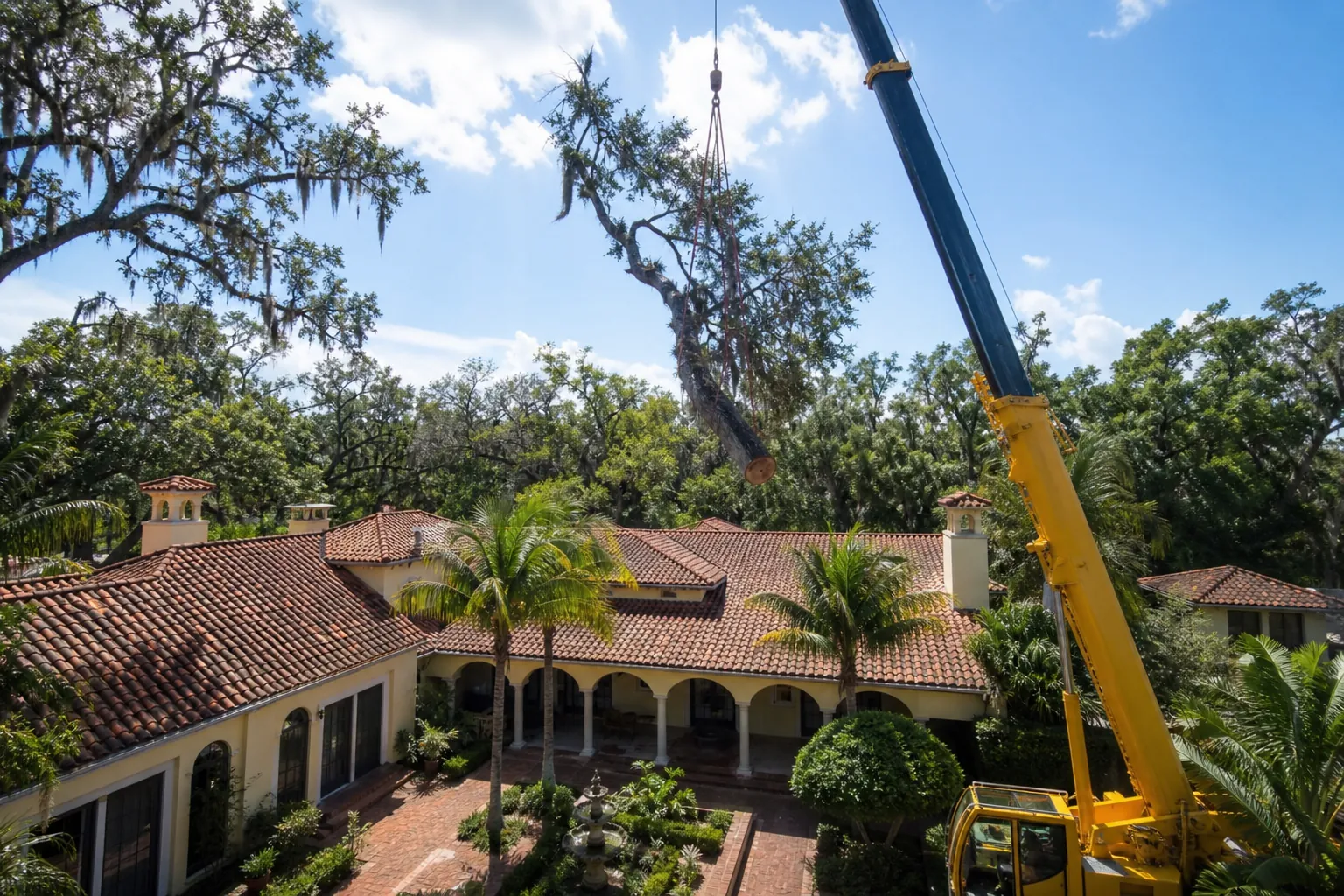
A mature tree growing beside or within a courtyard can become difficult to remove when there is no clear path to the street. Buildings, walls, walkways, pools, landscaping, utilities, and occupied spaces may prevent crews from lowering large limbs directly to the ground. In these settings, crane tree removal over courtyard areas can provide a controlled way to lift tree sections out of a confined space.
Crane-assisted work requires careful planning. The crane is only one part of the operation. Tree condition, rigging points, equipment access, load paths, communication, and property protection all affect how the job should proceed. Florida Foliage evaluates these details before recommending an approach.
Why Courtyard Tree Removal Is Complex
Courtyards are designed for people, not heavy tree equipment. Their narrow entrances and enclosed layouts can limit access for machinery and leave little room for branches or trunk sections to land. Even when a tree looks reachable from the ground, its canopy may extend across roofs, balconies, fences, or shared amenities.
Florida conditions add other concerns. Saturated soil can affect equipment placement, while wind and storms may weaken limbs or root systems. Palms and broad-canopied trees also present different weight distributions and rigging needs. An arborist inspection helps identify visible decay, cavities, cracks, deadwood, leaning, or root-zone disturbance that could influence the removal plan.
Traditional tree removal often involves cutting and lowering pieces within the tree's immediate footprint. A crane may instead lift secured sections vertically or guide them along a planned route to an open processing area. This can reduce the need to move heavy material through corridors, gates, or landscaped spaces.
How A Crane-Assisted Removal Is Planned
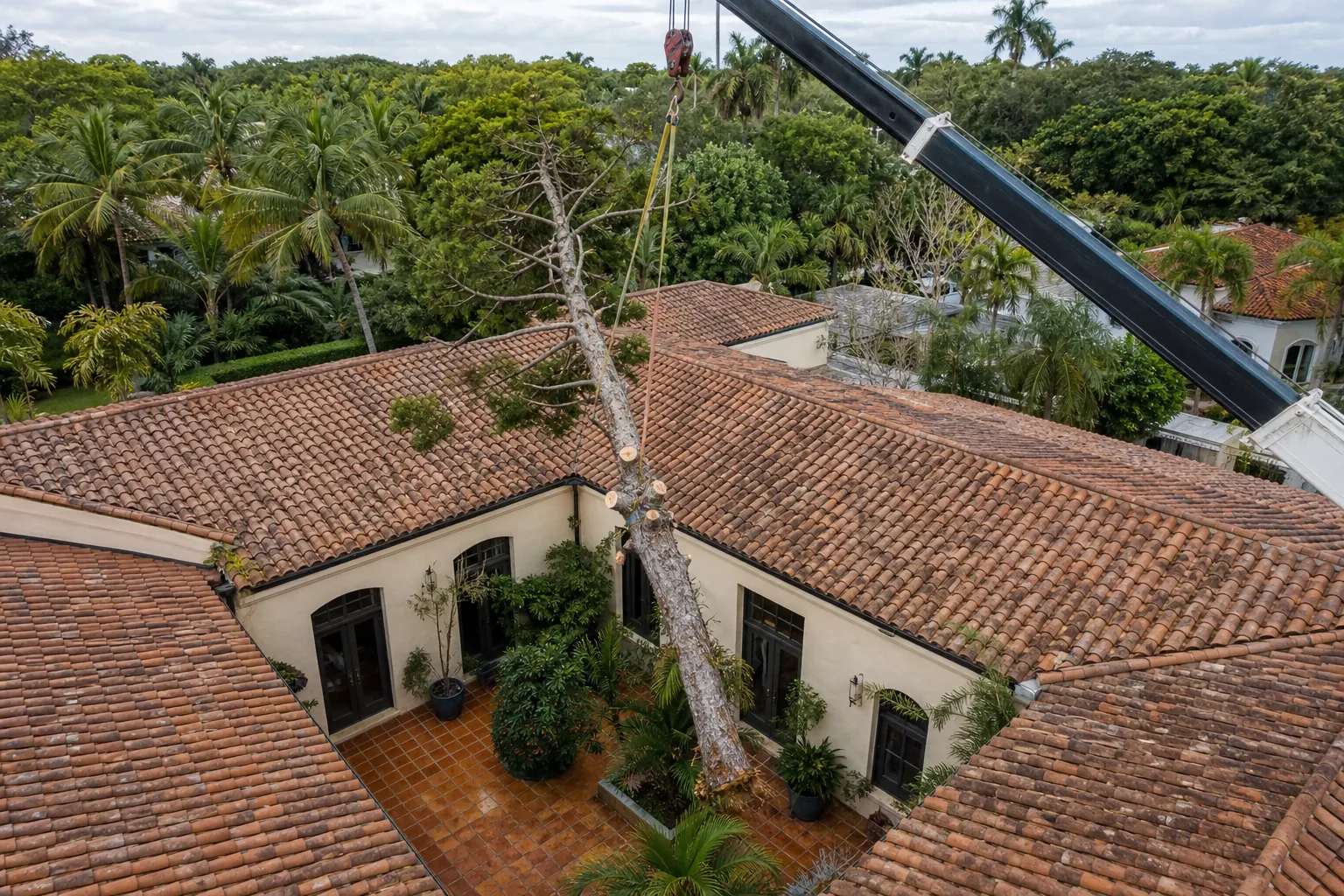
Planning starts with both the tree and the surrounding property. The crew must determine whether suitable crane access and setup space are available. They also consider overhead lines, underground utilities, pavement, drainage features, building clearances, and soil conditions. The crane's lifting position must support the intended reach and load path.
The tree is then assessed for practical cutting and rigging locations. Each section needs to be secured before it is separated. The expected weight and balance of branches or trunk pieces influence their size. The goal is to keep each lift stable and direct it away from vulnerable features.
A typical site review may cover:
- Tree condition: Visible defects, dead limbs, trunk damage, decay, and changes around the roots.
- Crane access: Entry width, setup area, surface conditions, reach, and clearance around the boom.
- Lift route: The path each tree section will follow from the courtyard to the processing zone.
- Property protection: Roofs, glass, walls, paving, pools, irrigation, lighting, and ornamental plantings.
- Work-zone control: Safe boundaries for residents, tenants, employees, vehicles, and pedestrians.
- Debris handling: Where lifted sections can be cut down and prepared for removal from the property.
- Communication: Clear signals among the climber, crane operator, ground crew, and site contact.
If the property is part of a condominium, HOA, or commercial site, scheduling may also need to account for shared access, deliveries, parking, and resident notifications. Florida Foliage provides HOA and condo tree services as well as commercial tree services for these more coordinated environments.
What Happens During The Removal
Before cutting begins, the work area is established and nonessential activity is kept outside it. The crane is positioned according to the site plan, and the crew reviews communication and lift procedures. Rigging is installed on the selected tree section before a cut is completed.
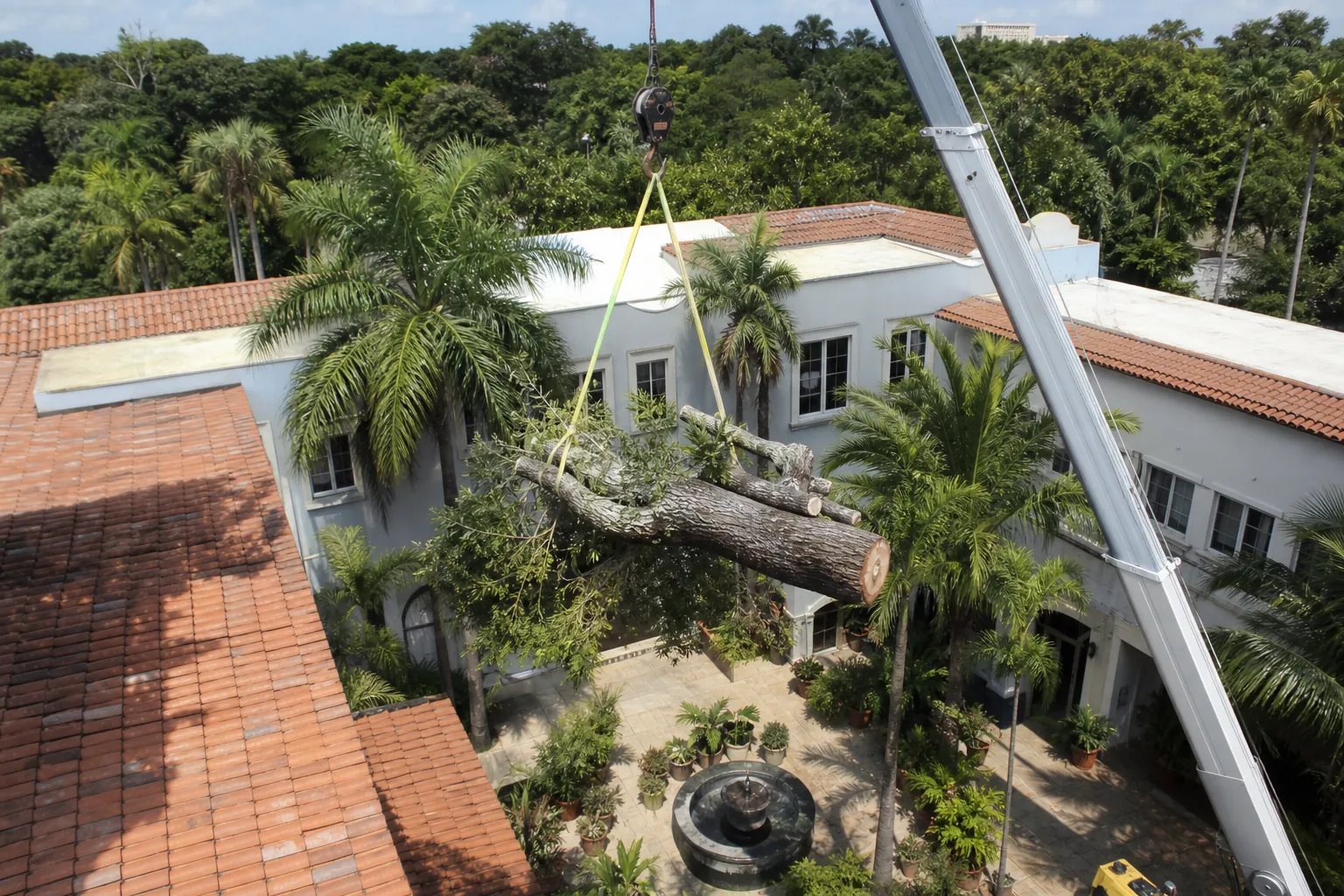
Once separated, the piece is lifted away from the tree and guided along the planned path. It is placed in a designated area where ground crews can process it. This sequence continues from canopy sections to larger wood, with the order adapted to the tree's structure and condition.
Crane removal does not mean the entire tree is lifted at once. Dividing it into manageable sections helps the crew control balance, clearance, and placement. A compromised tree may require smaller or differently positioned lifts because weak wood may not behave like sound wood.
After the tree is removed, stump grinding may be considered where access and site conditions allow. Courtyard stumps deserve a separate evaluation because nearby foundations, utilities, hardscape, and irrigation can restrict grinding depth or equipment access.
How Property Managers And Homeowners Can Prepare
Good preparation can reduce interruptions on the service day. Start by sharing accurate information about access points, locked gates, underground features, utility locations, irrigation, septic components, and any recent construction near the tree. Let the tree service know about roof access limitations or areas that cannot support equipment.
Move portable furniture, planters, decorations, and vehicles from the identified work and staging zones. Keep pets and occupants indoors or away from the site as directed. For multifamily or commercial properties, provide advance notice to residents, staff, vendors, and neighboring occupants when access could be affected.
Local requirements vary across Florida. Property owners and managers should confirm applicable tree removal permissions, documentation, and site rules with their city or county before work begins. An arborist report or tree inspection may help document condition when requested, but local authorities determine what is required.
When Other Tree Care Options May Apply
Removal is not the only response to a courtyard tree concern. When the tree is structurally appropriate to retain, tree trimming, canopy thinning, or crown reduction may address clearance or canopy density. These services should be selected based on tree biology and structure rather than used as interchangeable cutting methods.
Canopy thinning selectively reduces branch density without stripping the interior of healthy growth. Crown reduction decreases height or spread through cuts back to suitable lateral branches. Tree trimming can address dead, damaged, or conflicting limbs. An inspection can help determine whether one of these approaches is practical or whether removal is more appropriate.
Storm-damaged or suddenly unstable trees may call for emergency and hurricane tree removal. These situations require added caution because broken limbs, shifted root plates, and partially failed trunks can move unexpectedly. Avoid approaching or standing beneath a damaged tree, especially when electrical lines may be involved.
Arrange A Courtyard Tree Evaluation
Successful courtyard removal begins with a realistic assessment of the tree, crane access, lifting route, and surrounding structures. Florida Foliage provides crane tree removal, tree removal, tree inspections, and related arborist care for challenging Florida properties.
To discuss a confined courtyard tree and schedule an evaluation, call Florida Foliage at (386) 481-7913. The team can review site access and explain which service may fit the property's conditions.
Call (386) 481-7913 to talk through next steps.