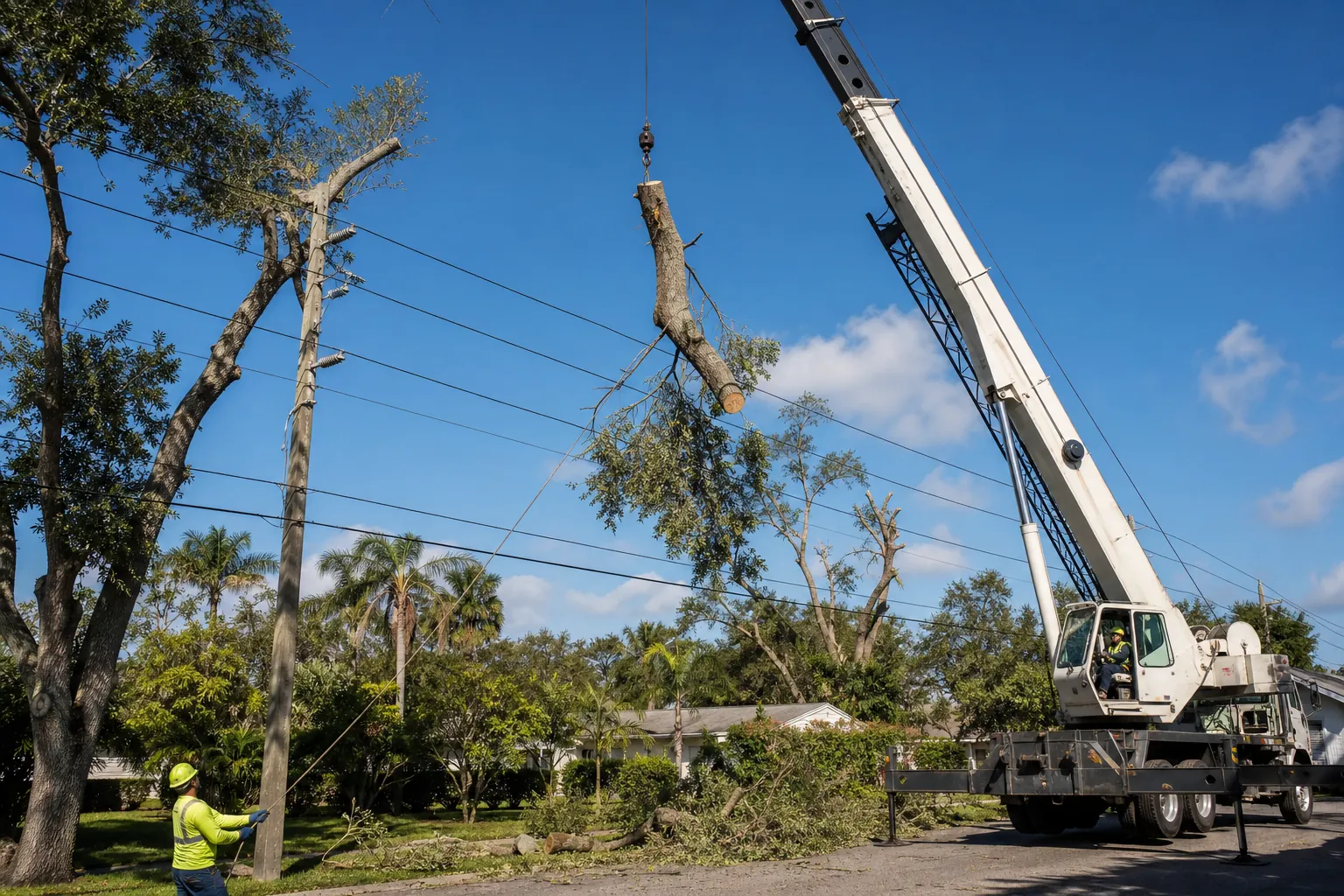
Removing a tree beside overhead electrical lines is not a routine cutting job. Branches may already be touching conductors, the trunk may lean toward the utility corridor, and limited yard access can make conventional lowering methods impractical. In these situations, crane tree removal can provide a controlled way to lift sections away from sensitive areas.
Crane tree removal over power lines requires careful planning among the tree crew, crane operator, property owner, and, when necessary, the electric utility. A crane does not eliminate electrical hazards. Instead, it gives qualified professionals another tool for controlling heavy limbs and trunk sections while maintaining an appropriate work zone.
Why trees near electrical lines require special care
Electricity can travel through conductive materials, including live tree tissue, equipment, ropes, and tools. A worker or homeowner does not need to touch a wire directly to face danger. Electrical arcing may occur when equipment or tree material gets too close to energized conductors.
Tree structure adds another layer of risk. A limb under tension can split unexpectedly, and a decayed trunk may not support a climber or react predictably when cut. Wind, saturated soil, hidden cavities, and storm damage can further change how the tree behaves.
Never attempt to prune or remove a tree that is touching or close to a power line. Keep people and pets away from fallen wires and any tree, fence, vehicle, or object in contact with them. Contact the electric utility or emergency services as appropriate before approaching the area.
When a crane may be the right removal method
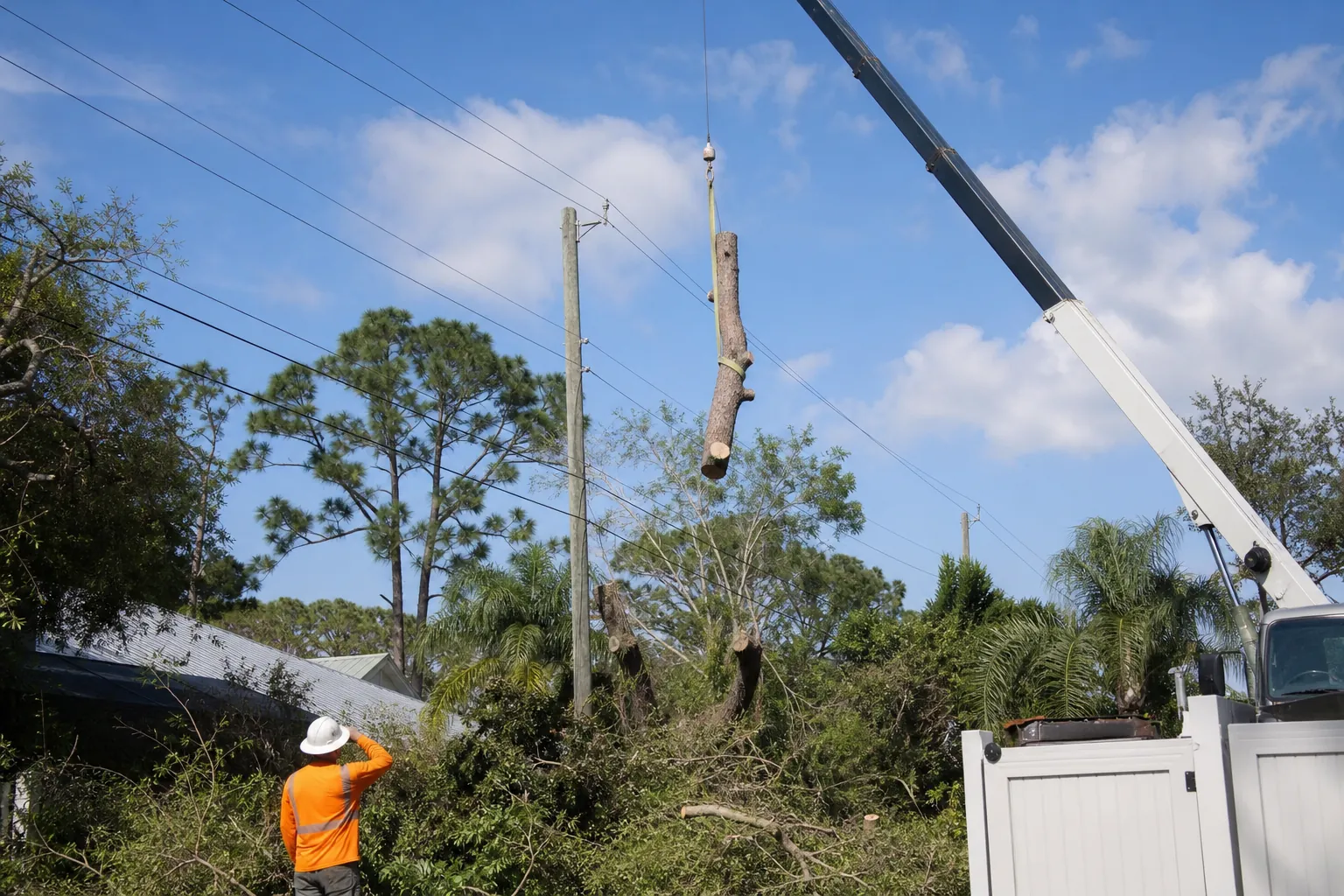
A crane is often considered when there is not enough room to fell a tree safely or lower large pieces through conventional rigging. The crane can support a selected section before it is cut, then move that section to a designated landing area for processing.
Conditions that may support a crane-assisted plan include:
- A large tree leaning toward overhead utility lines
- Heavy limbs extending over conductors, roofs, pools, roads, or neighboring property
- A trunk weakened by decay, cracks, cavities, storm damage, or root failure
- Restricted access that limits the use of standard lowering methods
- A dead or unstable tree that may not be suitable for conventional climbing
- A site where controlled lifting can reduce the movement of cut sections near obstacles
Not every site can accommodate a crane. The setup area must support the equipment, and outriggers need sufficient clearance and stable footing. The crew must also consider underground utilities, septic systems, driveways, soft ground, fences, traffic, and the crane's lifting path. A tree inspection helps determine whether crane tree removal is appropriate or whether another method should be used.
How professionals plan the work
Planning starts with a site assessment. The tree's species, size, lean, defects, root condition, and proximity to structures are reviewed. The crew also identifies utility lines and distinguishes electrical conductors from communication lines, although all overhead lines should be treated cautiously until confirmed.
Qualified professionals establish work zones based on the hazards present. If work could enter an unsafe distance from energized lines, coordination with the utility may be required. The utility determines how its infrastructure will be handled, which may include de-energizing, insulating, or otherwise controlling the electrical hazard. A tree service should not make assumptions about whether a line is active.
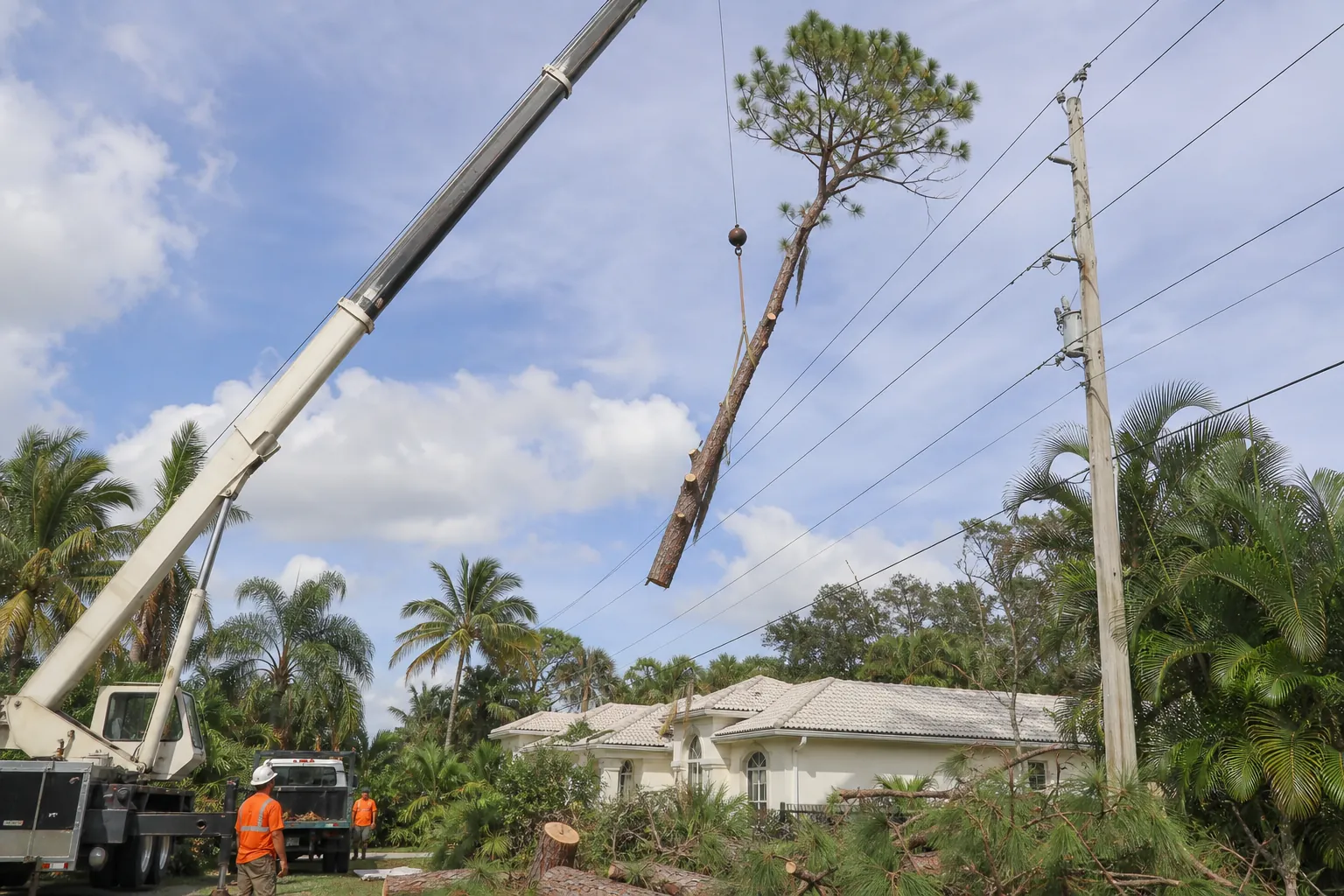
Before lifting begins, the crew plans crane placement, outrigger locations, communication methods, cut sequence, rigging points, load estimates, and the landing zone. Weather is also important. Wind, lightning, rain, and unstable soil can make crane operations unsafe and may require work to pause.
Local rules may affect tree removal, road access, protected trees, or work in rights-of-way. Property owners should confirm current requirements with their city or county and coordinate with the utility when electrical facilities are involved.
What happens during crane-assisted removal
Once the site is secured, the crane is set up on suitable ground and the work area is kept clear. Rigging is attached to a planned tree section so the crane can take controlled tension. A qualified tree worker then makes the cut while maintaining communication with the crane operator and ground crew.
The operator lifts the separated section away from the tree and overhead obstacles, then places it in the landing area. Ground workers remove rigging and process the material before the next lift. The sequence usually proceeds from selected limbs to larger trunk sections, with each piece evaluated individually.
The goal is not to pull a tree away from wires or swing material across the property. Controlled lifting depends on appropriate attachment points, balanced loads, clear communication, and a planned route. Unexpected movement can occur if a section is heavier than anticipated, contains hidden decay, or shifts as fibers separate, which is why experience and preparation matter.
How property owners can prepare safely
Homeowners, property managers, HOA boards, and commercial site managers can help by sharing accurate site information and keeping the work area accessible. Preparation should never involve touching branches near wires or trying to create clearance personally.
- Report any tree or limb contacting a utility line before scheduling site work.
- Move vehicles, furniture, planters, and movable decorations from the proposed access route.
- Identify known septic components, irrigation lines, wells, and underground utilities.
- Arrange access through gates and advise the crew about locked areas or pets.
- Notify neighboring occupants if equipment access or temporary noise may affect them.
- Ask what debris handling, stump grinding, or follow-up tree trimming is included in the planned scope.
- Keep children, visitors, tenants, and pets outside the established work zone.
An arborist report or tree inspection may also be useful when a tree's condition is disputed, multiple trees are involved, or a commercial, HOA, or condo property needs documented observations for planning.
Reducing future conflicts with utility lines
After a hazardous tree is removed, nearby trees should be reviewed for developing conflicts. Tree trimming, canopy thinning, and crown reduction may be appropriate for certain trees when performed according to their structure and condition. These services should not be treated as interchangeable, and aggressive topping can create weak regrowth and long-term maintenance problems.
Long-term planning also includes choosing suitable planting locations and allowing enough space for mature height and canopy spread. On larger properties, coordinated commercial tree services, HOA and condo tree services, or land and lot clearing can address access and vegetation needs without overlooking retained trees. Brush hogging may help manage dense ground vegetation, while stump grinding can address a remaining stump after removal.
Request a professional tree assessment
If a tree is leaning over electrical lines, has storm damage, or appears structurally unstable, keep your distance and seek professional guidance. Florida Foliage provides tree removal, crane tree removal, emergency and hurricane tree removal, tree inspections, and related arborist care across Florida service areas.
For a calm review of the tree, access conditions, and potential next steps, call Florida Foliage at (386) 481-7913. If a line is down or a tree is actively contacting electrical equipment, stay clear and contact the utility or emergency services first.
Call (386) 481-7913 to talk through next steps.