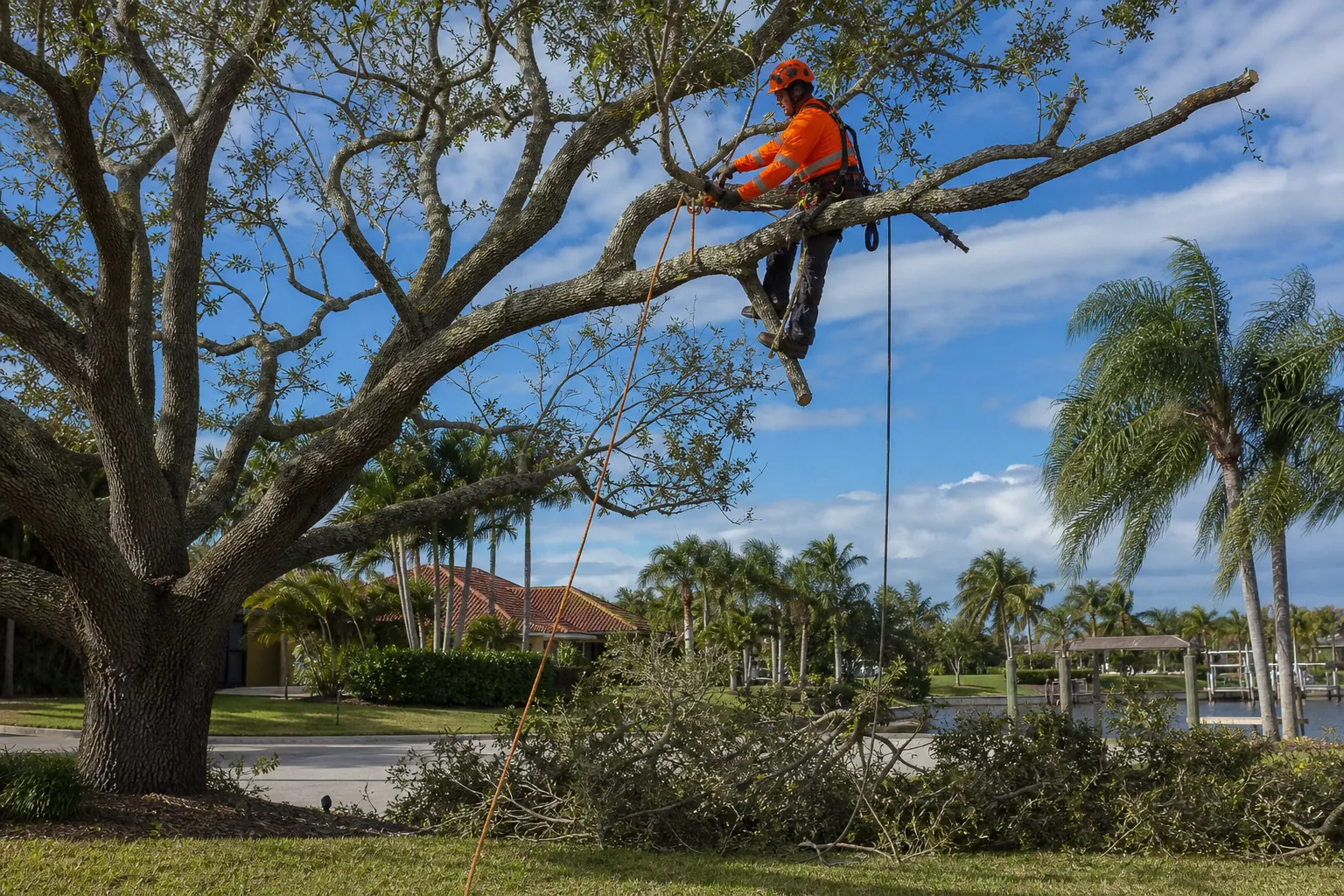
Long, heavy limbs can place considerable leverage on a tree, especially when most of the foliage and smaller branches are concentrated near the tips. In Florida, recurring storms, strong winds, rapid growth, and heavy rain can make that imbalance more noticeable. Crown reduction for branch end weight is a targeted pruning approach used to shorten selected limbs and reduce leverage while maintaining a natural canopy.
This work is different from simply cutting back every branch. A thoughtful reduction plan considers branch structure, tree health, clearance needs, and how each cut may affect future growth. When performed appropriately, it can address specific concerns without removing more live canopy than necessary.
What branch end weight means
Branch end weight describes the load concentrated toward the outer portion of a limb. As a branch grows longer, the distance between its attachment and its leafy tip increases. That length acts like a lever, adding stress where the limb joins the trunk or a larger scaffold branch.
End weight may be more concerning when a limb has an included union, a visible crack, a sharp bend, previous storm damage, or an uneven distribution of smaller branches. Limbs extending over roofs, driveways, walkways, parking areas, or neighboring property also deserve careful evaluation because the consequences of failure may be significant.
Not every long branch needs reduction. Some are well attached and appropriately tapered. An arborist report or tree inspection can help distinguish normal growth from structural conditions that may warrant tree trimming, crown reduction, canopy thinning, or another response.
How crown reduction changes limb leverage
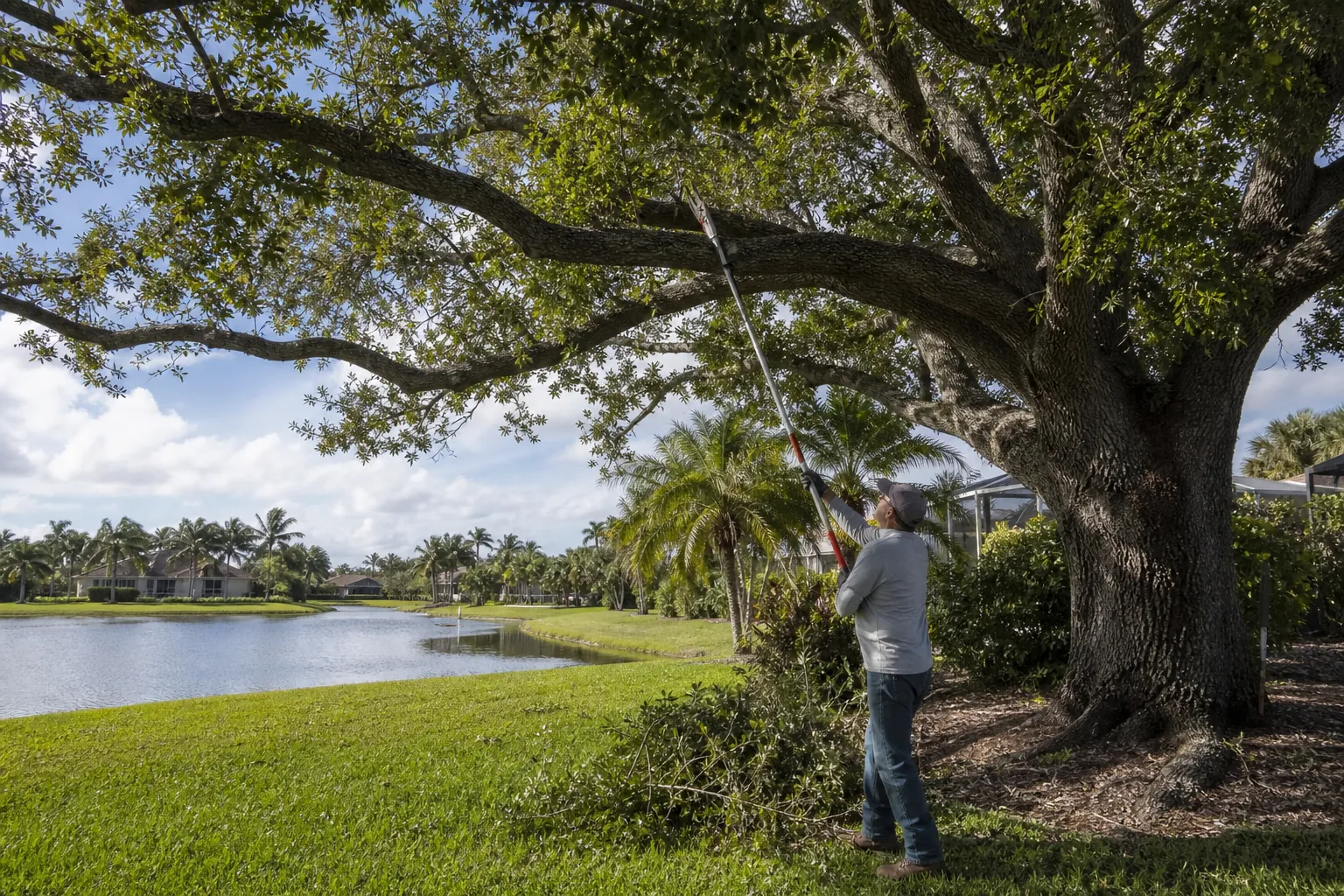
Crown reduction shortens selected branches by pruning them back to suitable lateral branches. The lateral should be positioned to continue the branch's growth pattern and support a natural appearance. By bringing the branch tip closer to its attachment, the work can reduce leverage and lessen the amount of foliage exposed at the far end.
Proper reduction is selective. The goal is not to create a perfectly rounded outline or remove all outer foliage. Cuts are planned around the tree's architecture, with attention to species, age, condition, and the amount of live canopy being removed during one service.
This approach differs from topping. Topping leaves stubs or cuts major limbs without regard for suitable laterals. It can trigger dense sprout growth, expose wood to decay, and create weakly attached shoots. A reduced limb should retain a functional growth path rather than ending abruptly at an arbitrary point.
Signs that an evaluation may be helpful
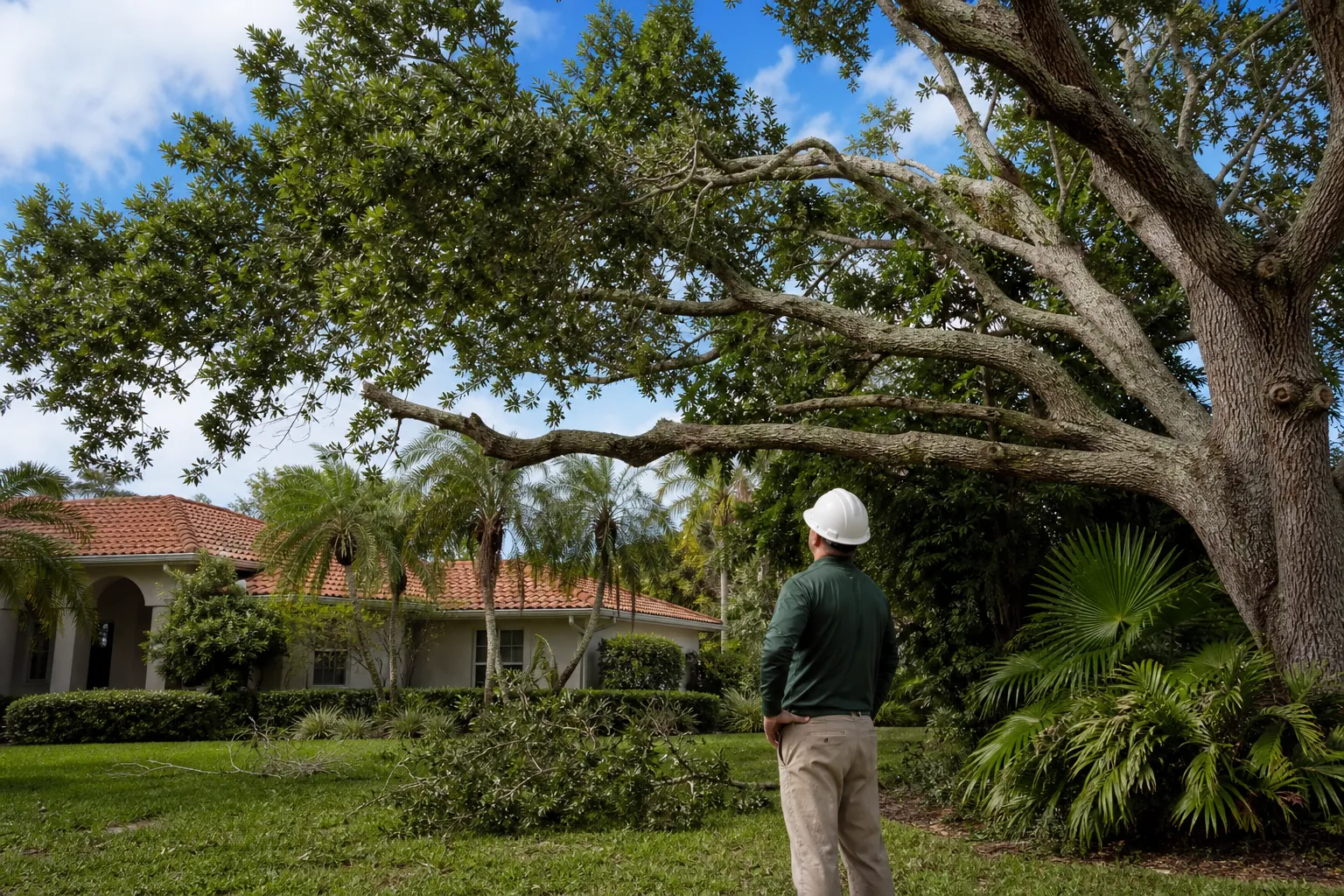
Property owners do not need to diagnose structural problems themselves. However, several observations can indicate that a professional tree inspection is appropriate:
- A long horizontal limb carries dense foliage mainly near its outer end.
- A branch has dropped lower over time and now approaches a roof, road, walkway, fence, or utility area.
- Cracks, cavities, splits, or peeling bark are visible near a major branch attachment.
- One side of the canopy is substantially longer or heavier than the other.
- A limb was partially damaged by wind but remains attached.
- Multiple upright shoots have developed after old heading or topping cuts.
- Branches rub, cross, or place pressure on adjacent limbs.
- A mature tree has changed noticeably after nearby construction, clearing, or storm damage.
Sudden leaning, fresh cracking, hanging limbs, or recently broken branches may require prompt attention. Keep people and vehicles away from the area and contact a qualified tree service. Florida Foliage provides emergency and hurricane tree removal when damaged trees or limbs require urgent assessment and action.
Crown reduction versus canopy thinning
Crown reduction and canopy thinning are related tree trimming methods, but they serve different purposes. Reduction decreases the overall length or spread of selected limbs. Thinning removes selected interior branches to improve spacing and reduce canopy density without substantially changing the tree's size.
Thinning alone may not adequately address branch end weight. Removing inner growth while leaving a long, heavy tip can maintain or even emphasize the lever-like form of a limb. Likewise, reduction is not a substitute for broad thinning when the primary concern is crowded, rubbing, or poorly spaced interior growth.
Some trees benefit from a carefully coordinated combination of both methods. The plan should avoid excessive foliage removal, lion-tailing, and large unnecessary cuts. Lion-tailing occurs when interior branches are stripped away and foliage remains mainly at the ends, which is the opposite of balanced branch management.
What a professional assessment should consider
Before making cuts, a tree care professional should look at the entire tree and its surroundings. Important factors include trunk condition, root-zone changes, branch unions, previous pruning, deadwood, canopy balance, targets below the tree, and potential access for workers and equipment.
The appropriate service depends on what the inspection reveals. Crown reduction may be suitable for shortening viable limbs. Tree trimming or canopy thinning may resolve other canopy issues. If a tree is severely compromised or cannot be managed through pruning, tree removal may be considered. Crane tree removal can help in situations involving limited access, large sections, or nearby structures. Stump grinding can address the remaining stump after removal.
Commercial properties, HOAs, and condos may need coordinated scheduling, documented observations, and a consistent scope across multiple trees. Florida Foliage offers commercial tree services as well as HOA and condo tree services. Arborist reports and tree inspections can support planning and communication when tree condition or proposed work needs to be documented.
Planning tree work responsibly in Florida
Timing and scope matter. Pruning decisions should reflect the tree species, current condition, active defects, weather exposure, and the stress created by removing live tissue. A measured approach is generally preferable to severe cutting intended to solve every concern at once.
Access also affects the work plan. Crews may need to protect lawns, landscaping, buildings, and paved areas while lowering branches. Properties with overgrown areas may require separate land and lot clearing or brush hogging, but these services should not disturb a tree's root zone without careful consideration.
Tree work requirements can vary by location and property type. Before pruning or removal, confirm any applicable rules, approvals, or permit requirements with your Florida city or county. HOA and condo communities should also review their governing procedures before scheduling work.
Choose a targeted approach to heavy limbs
Crown reduction for branch end weight is most effective when it responds to a defined structural concern rather than serving as routine shaping. Selective cuts can shorten overextended limbs, preserve useful canopy, and maintain a more natural form. The right recommendation starts with seeing the tree in person and understanding what is beneath and around it.
If you are concerned about long, heavy branches on a Florida property, contact Florida Foliage for a practical evaluation. Call (386) 481-7913 to discuss tree inspections, crown reduction, tree trimming, or other appropriate tree care.
Call (386) 481-7913 to talk through next steps.