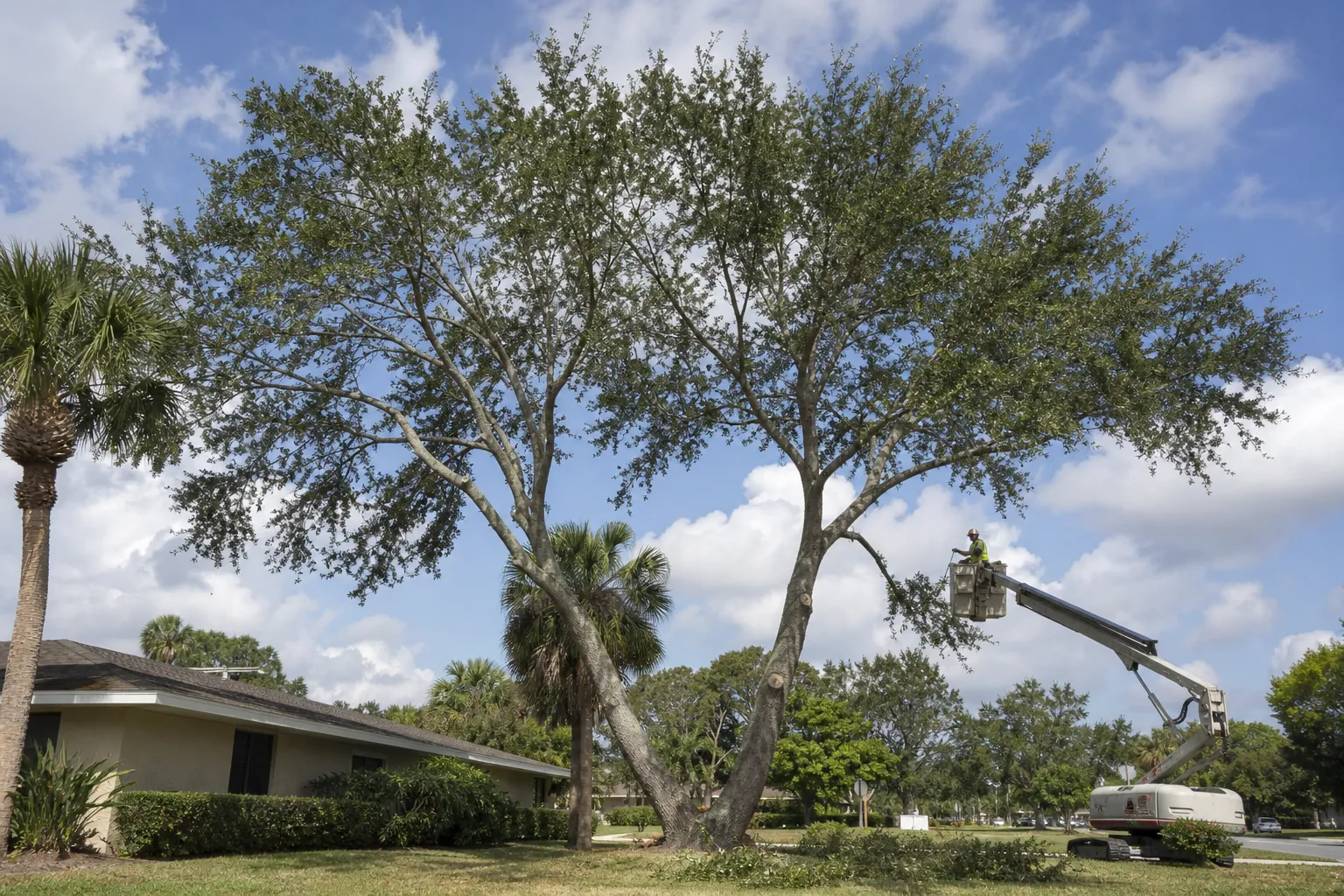
Codominant stems are common in Florida landscapes. Instead of developing one clearly dominant trunk, a tree forms two or more upright stems of similar size. This structure is not automatically hazardous, but it deserves attention because the connection between competing stems can become a weak point as the canopy grows.
Crown reduction for codominant stems is one way an arborist may manage this condition. The goal is usually not to remove a large stem in one visit. Instead, selective pruning reduces leverage and slows the growth of a competing leader while preserving as much healthy canopy as practical.
What codominant stems look like
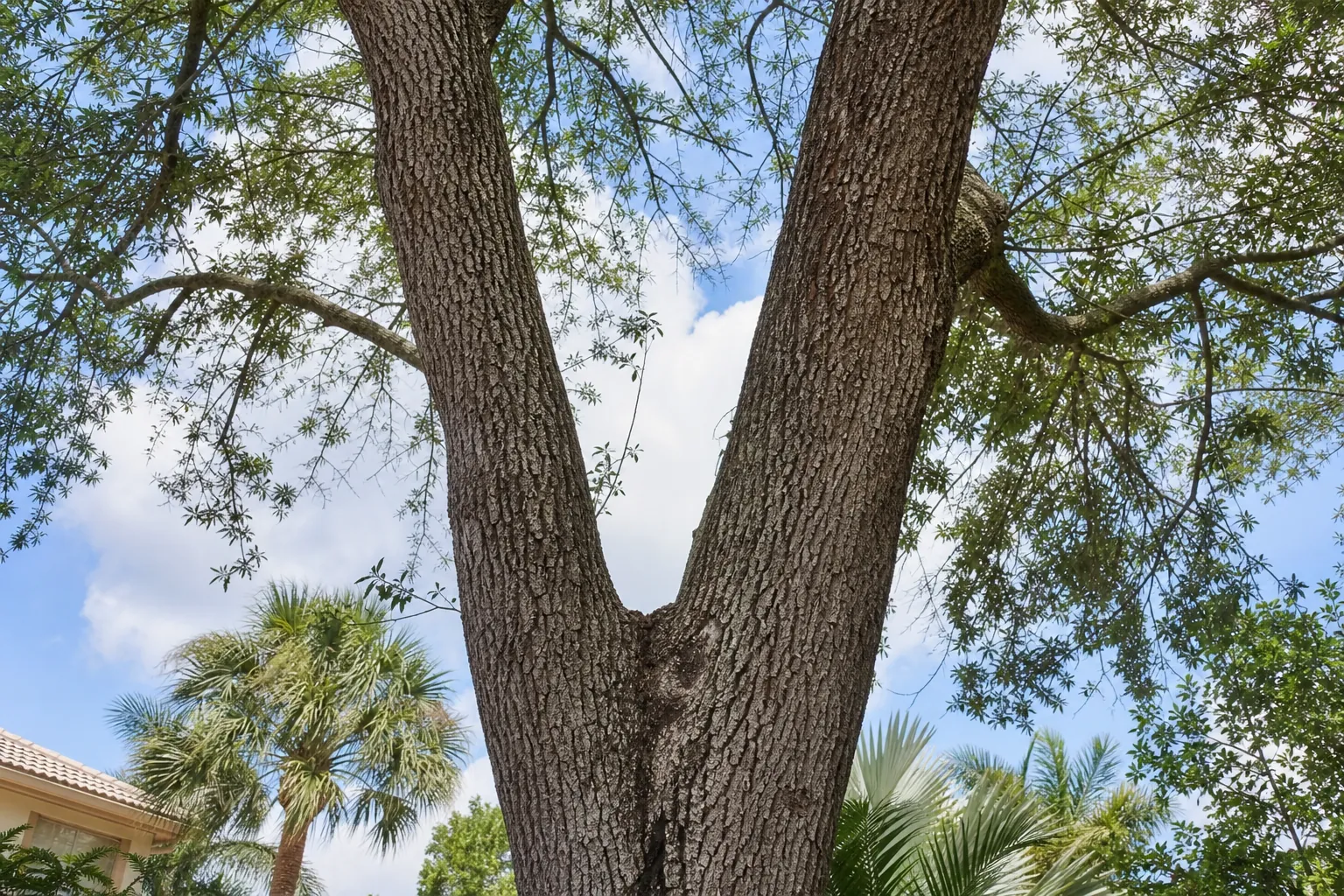
A codominant union often resembles a narrow V where two trunks meet. Some unions form strong attachments, while others contain included bark. Included bark develops when bark becomes pressed between the stems rather than allowing sound wood to connect across the union. This can limit structural support.
Warning signs may include a seam extending below the union, cracking, decay, cavities, abnormal swelling, or movement where the stems meet. Dense foliage, vines, or the height of the union can make these features difficult to see from the ground. Arborist reports and tree inspections can help clarify the structure and identify concerns that may affect pruning decisions.
Tree species, age, health, stem diameter, branch distribution, exposure to wind, and nearby targets all matter. A fork over an open lawn presents a different situation from one over a home, parking area, sidewalk, or frequently used outdoor space.
How crown reduction manages competing leaders
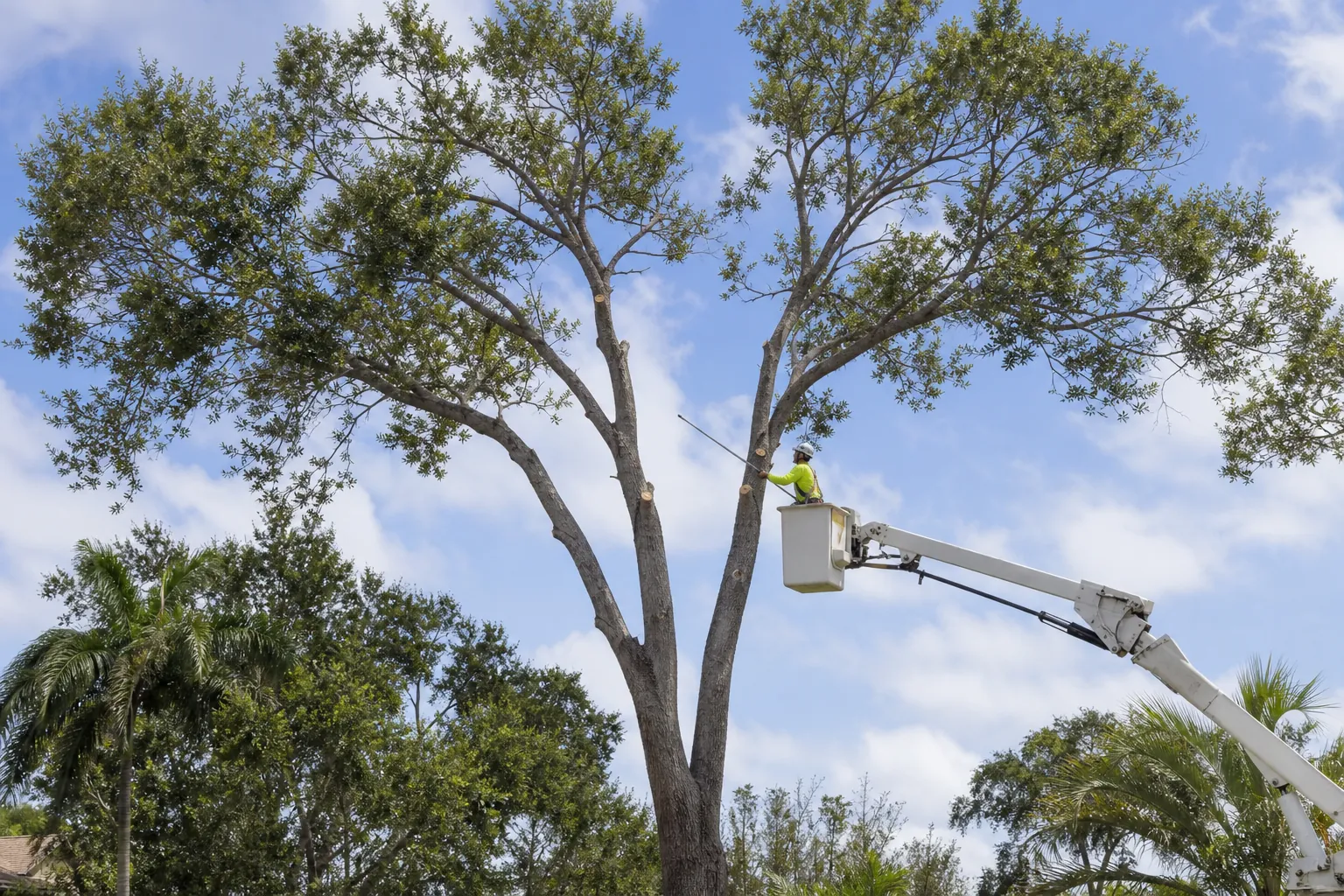
Crown reduction shortens selected branches or stems by pruning them back to suitable lateral branches. When treating a codominant structure, the arborist may reduce one leader while retaining the other as the more dominant part of the crown. This process is sometimes called subordination.
Reducing the length and foliage of a competing stem can decrease its leverage at the union. It can also guide future growth toward a more favorable structure. The work must be selective. Removing too much foliage can stress the tree, expose previously shaded bark, and trigger vigorous sprouting.
Reduction is different from topping. Topping makes indiscriminate cuts without regard for branch structure or appropriate pruning points. Crown reduction uses planned cuts and considers how the remaining canopy will respond. It also differs from canopy thinning, which selectively removes branches throughout the crown to address density without necessarily reducing overall height or spread.
When reduction may be a practical option
Crown reduction may be considered when a tree is healthy enough to respond to pruning and the codominant union can be managed without immediately removing a major portion of the canopy. It may also fit a long-term structural pruning plan for a younger tree, when competing leaders can be addressed before they become very large.
An arborist may evaluate the following factors before recommending work:
- The union: Its shape, attachment, included bark, cracks, decay, and other visible defects.
- Stem size: Large stems generally require more conservative planning than small, developing leaders.
- Tree condition: Leaf density, dieback, wounds, pests, root-zone disturbance, and overall vitality.
- Canopy balance: How shortening one section could change weight distribution, wind exposure, and appearance.
- Nearby targets: Homes, vehicles, utilities, fences, pedestrian areas, and other places where people gather.
- Florida weather exposure: Open-grown trees and trees exposed to strong storm winds may need particular attention.
- Pruning history: Old topping cuts, previous reductions, and poorly placed cuts can affect available options.
- Species response: Different trees vary in decay resistance, growth pattern, and tolerance for foliage removal.
Reduction is not appropriate for every tree. Extensive decay, an active split, severe decline, or an unfavorable location may lead an arborist to discuss other options, including tree removal. Crane tree removal may be used when access, tree size, or nearby structures require controlled lifting. Stump grinding can address the remaining stump after removal.
Why Florida conditions affect the plan
Florida trees grow in a climate that can support long growing seasons, rapid canopy development, and recurring storm exposure. Saturated soils and strong winds can add stress, especially when a broad canopy creates substantial leverage. At the same time, aggressive pruning shortly before severe weather does not automatically make a tree safe and can create additional stress.
Timing and scope should reflect tree health, species, site conditions, and the amount of live foliage being removed. Some trees benefit from staged reduction over multiple pruning cycles. This allows the arborist to guide growth gradually rather than making one severe change.
Property owners should also check for local requirements before pruning or removing protected trees. Rules vary by Florida city and county, so confirm current requirements with the appropriate local agency. If documentation is needed, arborist reports and tree inspections may provide useful information for planning and communication.
What to expect from professional pruning
A practical process begins with a ground-based inspection and discussion of the property owner's concerns. The arborist identifies the codominant stems, evaluates the union, and considers what lies beneath or near the canopy. The resulting plan should identify which leader is being reduced, suitable pruning points, and how much live crown can reasonably be removed.
During tree trimming, crews should protect the branch collar and avoid flush cuts. Properly placed cuts support the tree's natural compartmentalization process. Large, unnecessary wounds should be avoided when smaller reduction cuts can meet the objective.
Afterward, the tree may need periodic review. New shoots, continued extension growth, changes at the union, or storm damage can alter the next step. Crown reduction is often a management strategy rather than a one-time correction. Emergency and hurricane tree removal may still be necessary if a tree fails or develops an urgent condition after severe weather.
Plan around the whole property
Codominant stems should not be evaluated in isolation. Root damage from construction, soil changes, nearby clearing, and repeated equipment traffic can influence stability and health. For larger sites, commercial tree services and HOA and condo tree services can coordinate inspections and pruning across multiple trees. Land and lot clearing or brush hogging should also be planned to avoid unintended damage to trees being retained.
Florida Foliage provides tree trimming, canopy thinning, crown reduction, tree inspections, and related tree care for Florida properties. If you are concerned about competing leaders, a visible crack, or an unbalanced canopy, call (386) 481-7913 to discuss an inspection and an appropriate next step.
Call (386) 481-7913 to talk through next steps.