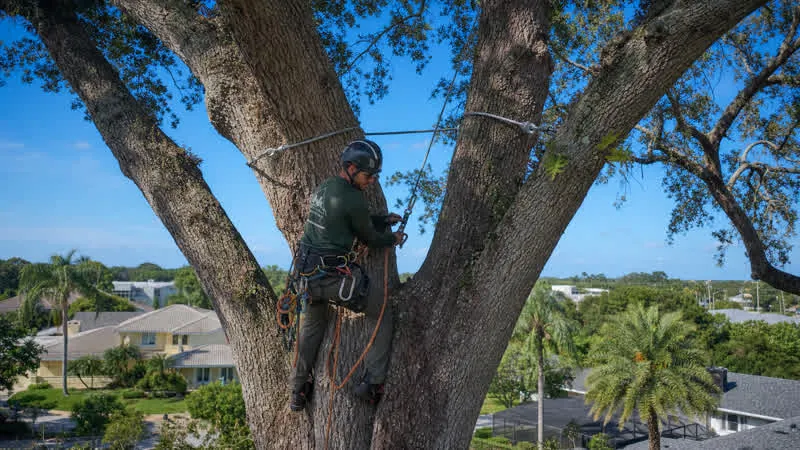
Quick Answer
Tree cabling and bracing in Ormond Beach, FL can reduce the chance of splitting or limb failure when a tree has weak unions or heavy, over-extended branches. It’s often paired with structural pruning to lower wind load. If you’re seeing cracks, rubbing stems, or a past split, schedule an evaluation with Florida Foliage and call (386) 481-7913 for a free estimate.
What cabling and bracing does (and what it doesn’t)
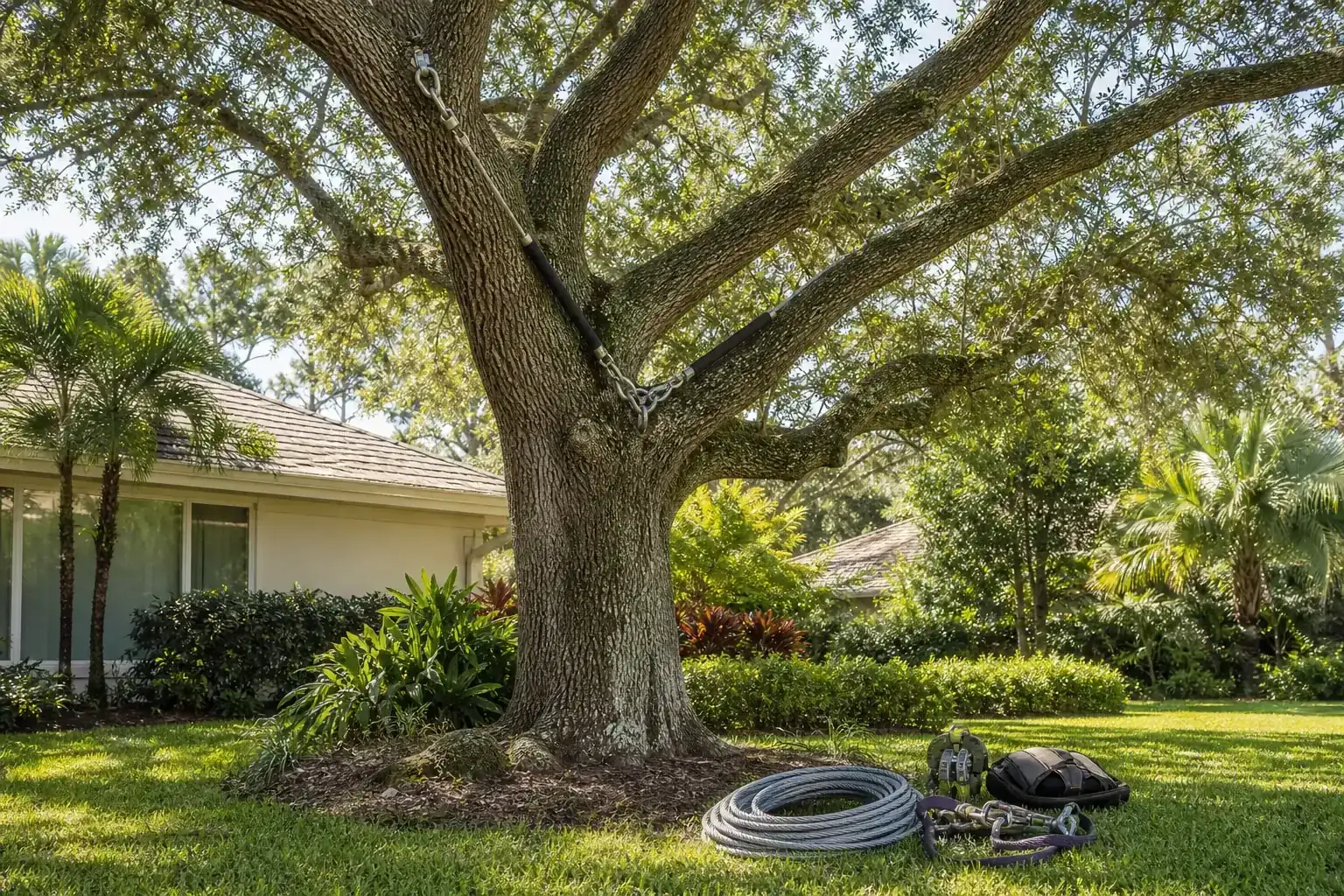
Cabling and bracing are support techniques designed to manage stress on a tree with structural weaknesses. They reduce peak loads during wind events, but they are not a guarantee that nothing will ever break. Systems should be inspected over time as the tree grows.
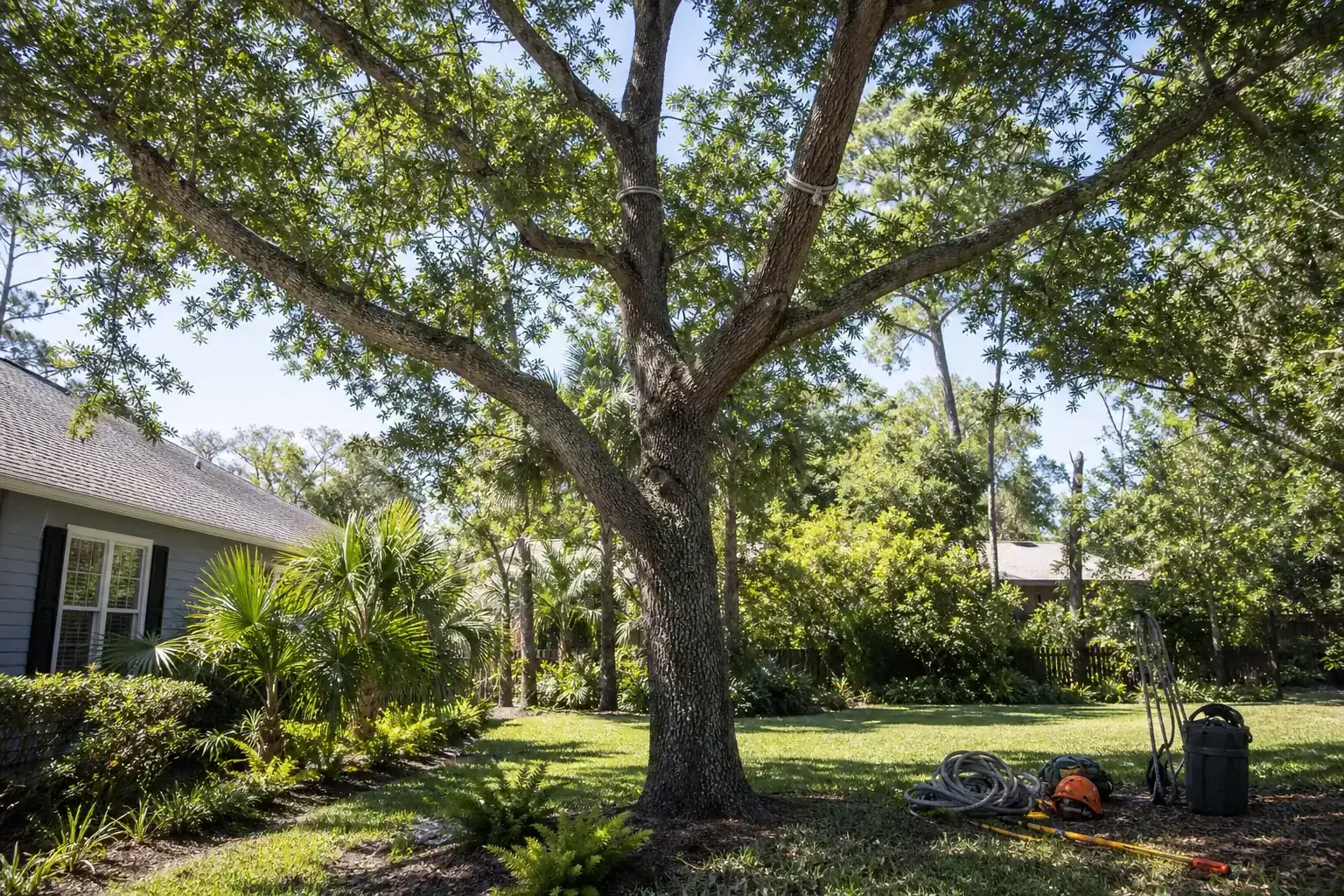
Florida Foliage serves Ormond Beach and surrounding Volusia and Flagler County areas with an ISA Certified Arborist consultant who can evaluate whether cabling is appropriate. Call (386) 481-7913 to schedule an on-site assessment.
When cabling is a good fit for Ormond Beach properties
Support systems are commonly recommended when the tree is otherwise healthy but has a structural issue that could worsen. Wind exposure and saturated soil can amplify stress on weak attachments.
| Problem | How cabling/bracing helps | Common companion service |
|---|---|---|
| Co-dominant stems | Reduces likelihood of splitting at the union | Structural pruning |
| Heavy end-weight limbs | Limits extreme movement in wind | Crown reduction |
| Weak branch attachments | Supports load sharing across limbs | Weight reduction pruning |
| Historic storm damage | Stabilizes defects while monitoring | Risk assessment |
How arborists decide: support vs. pruning vs. removal
A proper recommendation considers the defect, the likelihood of failure, and what the tree could hit. We often start with a certified arborist evaluation and may recommend a tree trimming plan first. If a defect is too severe, tree removal may be recommended for safety.
For help deciding, call (386) 481-7913—we’ll walk you through the options and what they accomplish.
Cost factors and maintenance expectations
| What affects cost | Why it matters |
|---|---|
| Tree size and height | Access and hardware sizing change with load |
| Number of stems/limbs supported | More hardware and labor for multi-point systems |
| Access constraints | Tight yards may require specialized rigging |
| Pruning scope | Support systems usually work best with weight reduction |
| Documentation needs | Some properties require written recommendations |
Hardware is only part of the picture. Trees change over time, and a system that was ideal today may need adjustment later as stems grow and loads shift. Routine inspections help ensure the system continues to function as intended.
Planning for storm season: practical steps homeowners can take
If your goal is storm readiness, cabling/bracing is most effective when combined with proactive pruning. Removing deadwood and reducing end-weight lowers stress so the support system has less to manage.
Florida Foliage is open Mon–Sat 7AM–6PM and offers free estimates. Call (386) 481-7913 to book an evaluation in Ormond Beach.
Service area notes and scheduling
We serve Ormond Beach as well as nearby communities throughout Volusia and Flagler County. If you’re dealing with a storm-damaged limb that needs fast help during our business hours, review our emergency tree removal options.
For local coverage details, visit our Ormond Beach service area.
Cabling and bracing hardware basics (in plain terms)
Support systems typically use a combination of cables (to limit extreme movement) and bracing rods (to reinforce weak unions). Placement is based on the tree’s structure and expected load paths.
Because trees grow, installation must account for future expansion and movement. That is why periodic inspections matter—hardware that was properly tensioned can change as the canopy develops.
Support systems are rarely “set it and forget it.” They are part of an overall plan that usually includes pruning and monitoring.
How to know if your tree is a candidate for support
Trees with healthy foliage but a structural defect—like a split that has stabilized, or a weak union between two major stems—may benefit from cabling and pruning rather than removal.
If you see a tight V-shaped union with bark included between stems, that’s a common reason to ask an arborist about support options.
If there is advanced decay at the base, major root movement, or repeated failures, removal may be safer than support.
Inspection and maintenance schedule you should expect
After installation, plan on periodic checkups, especially after major wind events. The inspection looks for hardware movement, changes in limb growth, and new defects.
If additional pruning is needed to keep the canopy balanced, addressing it early helps the support system work as intended and reduces long-term stress.
Florida Foliage can schedule these checkups during business hours; call (386) 481-7913 to set a plan.
When removal is still the better choice
Cabling is not appropriate when the tree is already failing at the root plate or when trunk decay has removed too much structural wood. In those cases, support may create a false sense of security.
If a tree is leaning more after storms, has significant cracks that are actively widening, or shows major dieback, a risk assessment may point to removal as the safest option.
If removal is recommended, Florida Foliage can coordinate safe rigging and debris cleanup, and you can discuss stump grinding if you want the area ready for replanting.
Propping vs. Cabling: The Difference Between Prop Rods, Bracing Rods, and Flexible Cable Systems
When people hear "tree support," they often picture a single wire holding a branch in place. In practice, arborists have several different hardware options, and the right choice depends on what the tree actually needs. Prop rods, bracing rods, and flexible cable systems each solve a different mechanical problem. Using the wrong one can put more stress on the tree than it relieves, so understanding the differences helps homeowners ask better questions before work begins.
Prop rods are rigid steel rods installed vertically beneath a heavy, horizontal limb. They typically rest on a padded base at ground level and connect to the underside of the branch with a threaded end fitting. Prop rods work well when a single limb has grown nearly parallel to the ground and its weight would otherwise split it away from the trunk over time. They are common on old live oaks in Volusia County, where wide-spreading limbs are part of what makes the tree valuable. The limitation is that prop rods restrict the natural sway of a branch, so placement and load calculations matter.
Bracing rods are threaded steel rods that pass through the wood of co-dominant stems or included bark unions and are secured with washers and nuts on both sides. They hold two stems together from the inside, preventing them from splitting apart under load. This is structural work inside the tree, and it requires drilling, so it is usually reserved for situations where the union is already showing signs of separation. Florida Foliage arborists inspect the wood condition before recommending bracing rods because installing them in decayed wood offers little real benefit.
Flexible cable systems are installed higher in the canopy, anchored between stems or major branches with eye bolts. Unlike prop rods, they allow the tree to move in wind while limiting how far a limb can deflect before the cable catches the load. This dynamic response is actually better for the tree's long-term health because it preserves the natural movement that stimulates trunk taper and root development. If you are unsure which system your tree needs, call (386) 481-7913 to schedule an on-site evaluation before the Atlantic hurricane season puts the decision off any longer.
What Tree Cabling Looks Like After a Hurricane: Inspecting Hardware for Storm Damage
After a named storm moves through Ormond Beach, most homeowners walk the yard looking for fallen branches and fence damage. Existing cable-and-brace systems rarely make that inspection list, but they should. Hardware that absorbed load during a storm may look intact from the ground while carrying hidden damage that makes it unsafe for the next event. A post-storm hardware inspection is not optional maintenance; it is part of what keeps the system doing its job.
The most common issue after a major wind event is eye bolt pull-through. When a gusted limb yanks hard against a cable anchor, the eye bolt can elongate the hole in the wood around it, even if the bolt itself holds. The bolt may still look straight and tight from the ground, but the wood fibers surrounding it have torn, reducing the anchor's effective holding strength. A certified arborist checks for this by looking at the bark around each anchor point for radial cracking, raised ridges, or weeping sap that suggests wood failure beneath the surface.
Cables themselves can suffer kinking, corrosion acceleration from salt air, and strand breakage that is invisible unless someone climbs to the attachment point and inspects the cable up close. In Ormond Beach's coastal climate, galvanized cable that was already several years old before a storm hit may have lost enough zinc coating that saltwater intrusion during the storm pushed it toward the end of its service life. Florida Foliage recommends a full hardware inspection after any storm that produces sustained winds above 45 mph, not just Category 1 and above.
Bracing rods should be checked for bending, which indicates the stems they connect actually moved against each other under load. A bent rod means the union experienced forces beyond what the hardware was designed to absorb quietly, and the wood at the drill points should be probed for new decay pathways. If your property had cable or brace work done more than three years ago and has since been through multiple storm seasons without a hardware check, call Florida Foliage at (386) 481-7913 to get eyes on the system before the next storm season peaks in August and September.
FAQs
What is tree cabling and bracing?
Cabling and bracing are support systems installed to reduce stress on weak unions or heavy limbs. They help manage movement and lower failure likelihood when used appropriately.
When is cabling better than removal?
If the tree is otherwise healthy and the main issue is a weak union or co-dominant stems, support systems plus pruning may be safer and more cost-effective than removal.
How long do tree cables last?
Hardware lifespan depends on design, materials, tree growth, and maintenance. Regular inspections are important because trees grow and loads change over time.
Does cabling stop a tree from moving?
No. Proper systems allow controlled movement. The goal is to reduce peak stress during wind and prevent sudden splitting.
Who should install tree cabling and bracing?
An ISA Certified Arborist should design and oversee installation to ensure correct placement, load considerations, and ongoing monitoring.