Reviewed by Clinton Funk
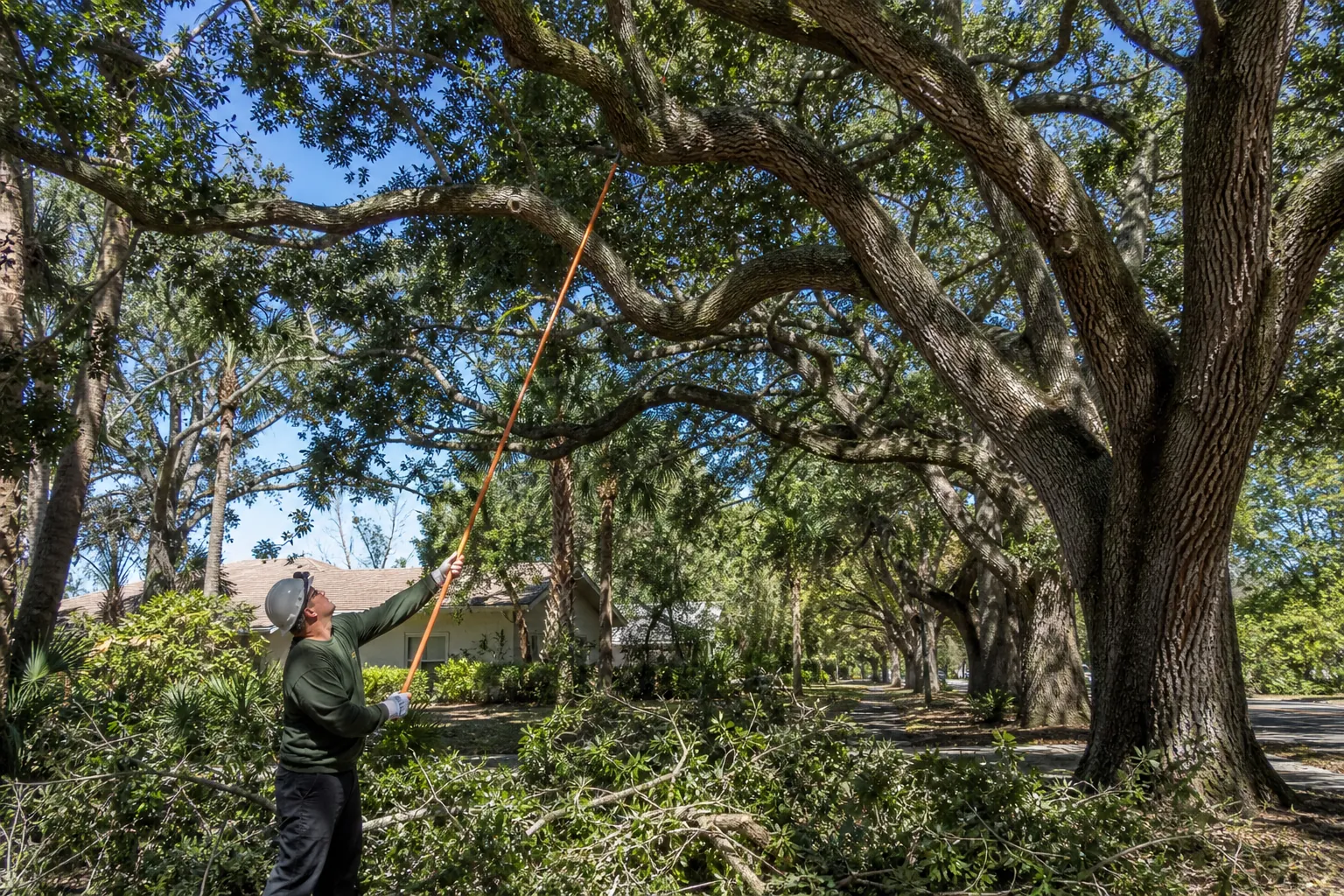
A tree can look crowded without needing extensive pruning. The important question is not how many branches can be removed, but which cuts will improve structure while preserving the foliage the tree needs. In Volusia County, that decision should account for species, existing defects, growing conditions, and exposure to Florida storms.
Canopy thinning is the selective removal of branches within a tree's crown. Done thoughtfully, it can address competing growth and localized crowding. Done indiscriminately, it can leave a tree with large wounds, excessive foliage loss, and a crown that is poorly distributed.
For homeowners researching canopy thinning branch selection in Volusia County, the most useful starting point is a clear objective. Florida Foliage can discuss canopy thinning and tree trimming in the context of the whole tree, rather than treating every dense canopy as a problem.
What Canopy Thinning Should Accomplish
Canopy thinning should have a specific purpose. That might be reducing friction between crossing branches, addressing selected competing limbs, or improving the distribution of smaller branches within a crowded area. A fuller-looking crown is not automatically unhealthy, and open space between every branch is not a meaningful pruning goal.
Healthy foliage supports the tree's energy production. Removing it creates a cost the tree must absorb while also responding to pruning wounds. This is why thoughtful branch selection generally matters more than achieving a particular appearance.
Thinning also differs from other forms of pruning. Crown reduction shortens selected branches using appropriate lateral branches. It may be considered when branch length or clearance is the concern. Thinning removes selected branches without making overall crown size the main target.
- Use canopy thinning to address identified crowding or branch conflicts, not simply to make the entire crown look sparse.
- Consider crown reduction when the objective involves reducing the reach of selected limbs.
- Evaluate dead or broken branches separately from decisions about removing healthy foliage.
- Preserve an appropriate distribution of live branches throughout the crown.
These objectives can overlap during tree trimming, but they should not be confused. A tree needing clearance from a roof may require a different approach from one with rubbing branches inside its crown.
Inspect The Whole Tree Before Selecting Branches
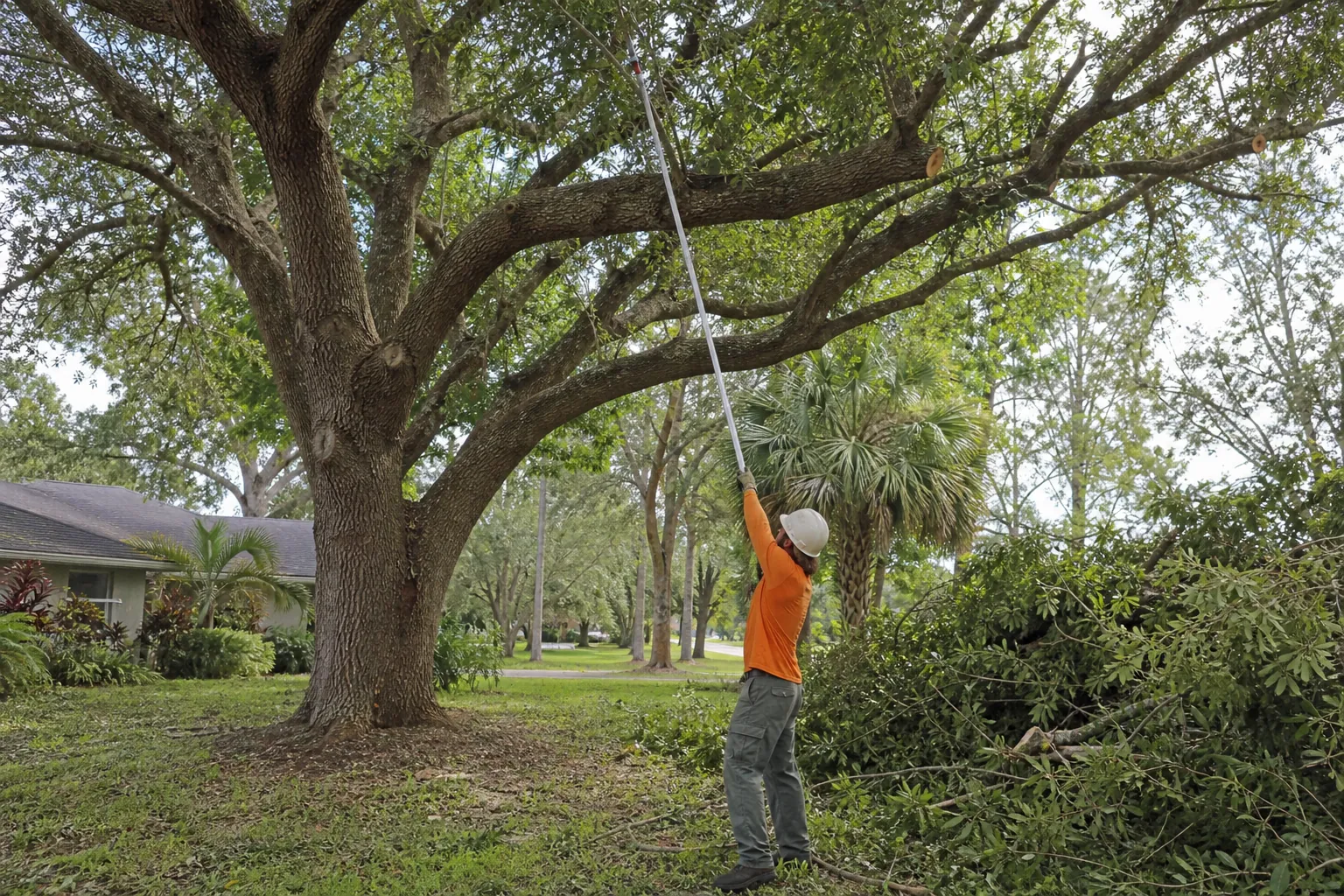
Branch selection begins at ground level, with a review of the trunk, root area, crown, and surroundings. A branch that appears unnecessary from one viewpoint may contribute useful foliage or balance when viewed from another side.
Look for changes that could affect the scope of work. These include fresh cracks, hanging branches, cavities, fungal growth near the base, unusual leaf loss, or soil lifting around roots. None of these observations alone establishes a diagnosis, but each can justify closer inspection.
Site history matters as well. Recent construction, trenching, grade changes, or repeated vehicle traffic near the tree can affect roots. A declining crown may reflect belowground stress rather than a need for more pruning. Removing additional live branches without understanding that stress can be counterproductive.
The inspection should also identify what is beneath or near the tree. Homes, sidewalks, parked vehicles, pools, and neighboring properties influence how branches can be removed safely. Branch selection and the method used to remove those branches are related, but they are separate decisions.
- Observe the tree from several directions before marking potential cuts.
- Note whether crown thinning is widespread or limited to a particular limb.
- Identify recent changes around the root area that may explain reduced vigor.
- Point out previous storm damage and any known history of large branch failures.
Florida Foliage offers arborist reports and tree inspections for situations where a clearer assessment is useful. An inspection can help distinguish a routine pruning objective from a condition that calls for a different response.
Which Branches Deserve Attention First?
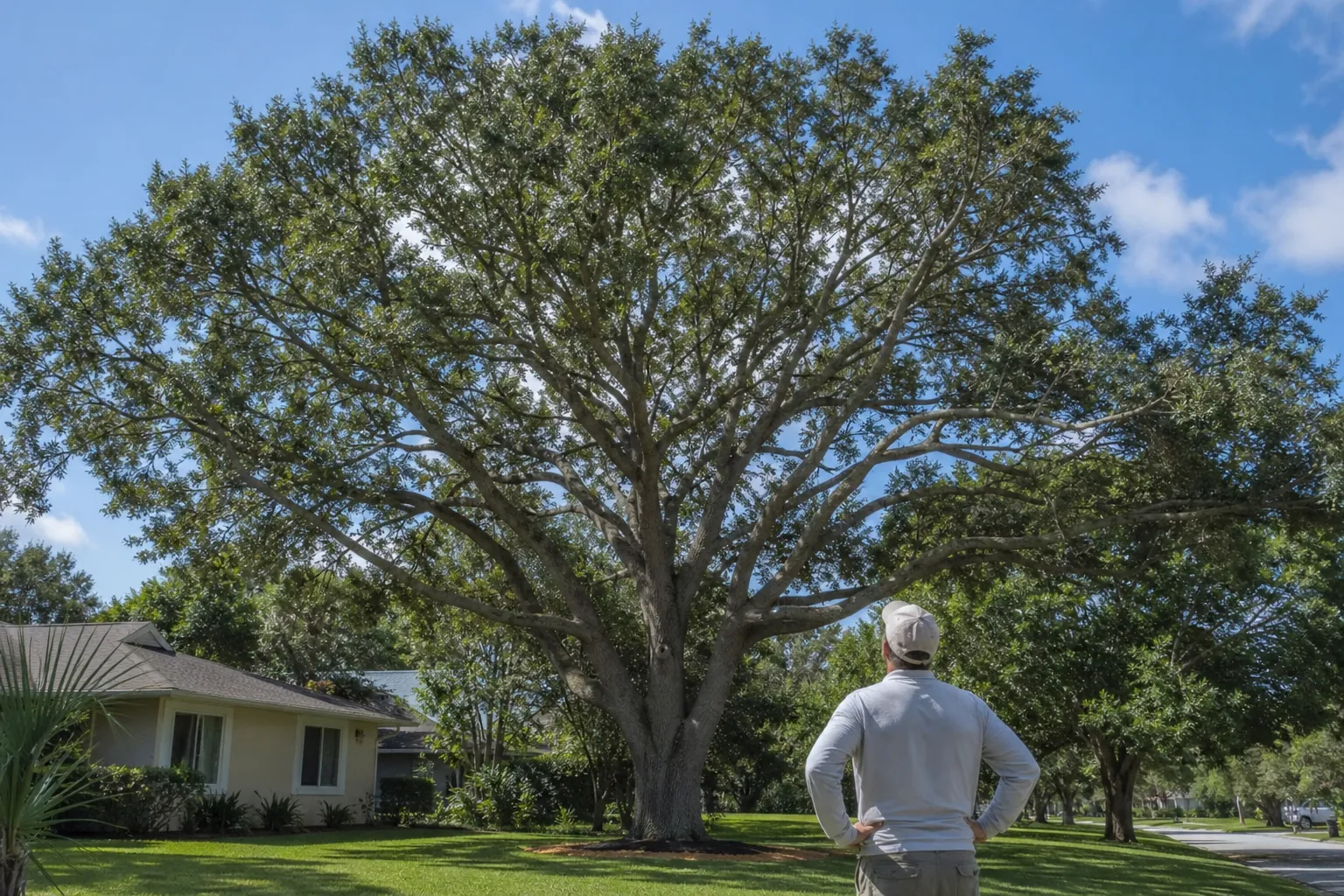
A sound pruning plan usually prioritizes identifiable problems before considering optional thinning. Dead, broken, or hanging branches warrant attention, especially over occupied areas. Their presence does not necessarily mean nearby healthy branches also need removal.
Branches rubbing against one another are another useful starting point. Repeated contact can injure bark. The better choice is not always the smaller branch; attachment quality, growth direction, existing damage, and the role of each branch should guide the decision.
Closely parallel branches may compete for the same space. When selecting between them, consider which one has a more suitable attachment and a useful position in the crown. Removing both can create an unnecessary opening and eliminate more foliage than the objective requires.
Branches growing inward can contribute to crowding, but direction alone is not enough to justify a cut. Some inner growth provides valuable foliage along larger limbs. The question is whether a branch creates a meaningful conflict, not whether it points toward the trunk.
- Prioritize broken or dead branches according to their condition and the areas beneath them.
- Assess rubbing branches individually and retain the better-positioned branch when practical.
- Compare competing branches for attachment, spacing, and future growth rather than size alone.
- Leave healthy branches in place when their removal would not serve a defined objective.
Large competing stems require particular care. A tight union or included bark may raise structural concerns, but removing a major stem from a mature tree can create a substantial wound. An arborist assessment can help determine whether selective pruning, monitoring, or another approach is appropriate.
Which Branches Should Usually Stay?
Useful branch selection includes knowing what not to cut. Well-attached branches with adequate space and healthy foliage generally should remain unless they conflict with a specific pruning objective. A branch does not need to be visually prominent to contribute to the tree.
Interior foliage is especially important. Removing most small branches from the inner crown while leaving leaves concentrated at the ends creates a pattern often called lion-tailing. It can leave long limbs with poorly distributed foliage and expose previously shaded bark.
Smaller branches along major limbs also support future pruning options. If these branches are removed unnecessarily, there may be fewer suitable laterals available when a limb eventually needs reduction. Keeping appropriate inner growth can preserve flexibility.
Low branches deserve individual evaluation. They may conflict with pedestrian or vehicle clearance, but removing them solely for a cleaner appearance can mean substantial foliage loss. On young trees, temporary lower branches can also contribute to trunk development.
- Retain healthy interior growth that does not create a significant conflict.
- Avoid removing all small branches from the length of a major limb.
- Keep suitable lateral branches that may support future crown reduction.
- Evaluate low branches against actual clearance needs instead of an arbitrary visual line.
The best finished crown often still looks natural and reasonably full. Visible gaps throughout the canopy are not proof that the work was effective.
Match The Plan To The Species And Condition
Volusia County landscapes include trees with very different growth habits. A spreading live oak should not be treated like a more upright tree, and a palm does not have the same branching structure as a broadleaf shade tree. A single thinning recipe is not appropriate across species.
Mature trees also differ from young trees. Early structural decisions can often be made with relatively small cuts. On an older tree, correcting the same kind of conflict may require a much larger wound, so retaining and managing a branch may be preferable to removing it outright.
Tree condition changes the balance further. A vigorous tree and a stressed tree may tolerate pruning differently. Sparse foliage, repeated dieback, root damage, or recent storm injury can justify a more conservative approach to removing live branches.
Florida weather adds timing considerations. Heat, drought, saturated soil, and active growth can all affect how a tree responds. Species-specific pest or disease concerns may also influence when pruning should occur. There is no universal calendar date that makes canopy thinning appropriate for every tree.
Describe any recent changes when arranging an inspection. Mention declining foliage, unusual leaf drop, construction activity, or storm damage. Those details help the person assessing the tree decide whether thinning is useful now, should be limited, or should be deferred.
Avoid Over-Thinning And Poor Cut Placement
Excessive thinning is often driven by a vague request to let more light or wind through the tree. Some selective pruning may support a particular objective, but making a crown broadly transparent can remove healthy foliage without addressing structural weaknesses.
Aggressive pruning can also encourage vigorous new shoots in some trees. That response does not necessarily mean the tree benefited. New growth may require future management, and heavy shoot production can follow a substantial loss of foliage.
Cut placement matters as much as branch selection. Removal cuts should respect the branch collar and surrounding trunk tissue. Flush cuts can enlarge the injury, while long stubs can interfere with the tree's normal response to the wound.
Reduction cuts require a suitable lateral branch. Cutting a limb back to an arbitrary point without an appropriate lateral is not the same as properly planned crown reduction. Topping a tree should not be presented as canopy thinning.
- Ask what each proposed group of cuts is intended to accomplish.
- Avoid requests to strip the inner crown or leave foliage only at branch tips.
- Discuss large cuts before work begins, including why they are necessary.
- Do not use a fixed foliage-removal target as a substitute for evaluating the individual tree.
For trees needing substantial correction, work may sometimes be staged. Whether that makes sense depends on tree condition, defects, and exposure beneath the crown. It is not a reason to postpone action on an immediate hazard.
Set Realistic Expectations For Hurricane Preparation
Canopy thinning is not a guarantee against hurricane damage. Wind effects depend on many factors, including tree structure, roots, soil conditions, exposure, and storm intensity. A more open crown does not automatically make a tree safe.
Storm preparation should begin with identifying defects and considering potential consequences. Dead limbs over a driveway, a cracked branch above a roof, or a tree showing possible root movement deserve more attention than general canopy density.
Removing healthy interior foliage simply because hurricane season is approaching can miss the actual concern. A targeted tree inspection can help separate reasonable maintenance from pruning that leaves the tree unnecessarily depleted.
If a tree is severely damaged or presents an unacceptable risk after assessment, tree removal may be considered. Crane tree removal may be appropriate where site access and removal complexity warrant it. Those decisions should follow the tree's condition and site constraints, not a blanket rule about storm season.
Florida Foliage also offers emergency and hurricane tree removal. After a storm, keep people away from hanging limbs and unstable trees. If electrical lines are involved, stay clear and contact the utility or emergency services as appropriate rather than approaching the tree.
Plan The Work Around Your Property
Before scheduling tree trimming, identify the practical outcome you want. Is a particular branch touching the building? Are two limbs rubbing? Has a section of the crown become unusually dense? Specific observations make it easier to develop a focused plan.
For properties with multiple trees, priorities should reflect condition and use of the space. A defect above a frequently used walkway may deserve attention before optional thinning in an unused corner. Avoid assuming that every tree should receive the same treatment during one visit.
Commercial properties and shared residential landscapes need additional coordination. Access routes, parking, resident notifications, and work-area separation should be discussed in advance. Florida Foliage provides commercial tree services and HOA and condo tree services for these settings.
Confirm applicable requirements with your city or Volusia County before substantial pruning or removal. Rules can vary by location, property circumstances, and tree status. An HOA may also have its own approval process, which should be checked separately.
- Identify the branches or areas causing concern before requesting a pruning plan.
- Discuss access, nearby structures, and spaces that must remain available.
- Confirm local requirements and any association approvals before work starts.
- Ask how the proposed work will preserve healthy foliage and avoid unnecessary large cuts.
What To Watch For After Canopy Thinning
After pruning, the tree should retain a balanced distribution of foliage rather than looking hollow inside. Some openings may be visible where problem branches were removed, but a uniformly sparse crown should not be the default result.
Watch for changes over time, including unusual dieback, heavy new shoot growth, or cracks that become more visible. These observations do not automatically indicate a pruning problem, but they are useful reasons to request another inspection.
Keep vehicles and stored materials away from the root area where practical. Avoid responding to a newly visible limb by immediately requesting another round of thinning. Repeated removal without reassessment can compound foliage loss.
There is no single repeat interval that suits every tree. Future tree trimming should depend on growth, condition, clearance needs, and the original objective. Good records of major cuts and observed defects can make later decisions more informed.
Discuss A Tree-Specific Plan With Florida Foliage
The strongest canopy thinning plan explains both what will be removed and what will remain. It addresses meaningful branch conflicts, respects the tree's condition, and avoids treating density alone as a defect.
If you are unsure whether your Volusia County tree needs canopy thinning, crown reduction, or an inspection before pruning, call Florida Foliage at (386) 481-7913. Describe the tree, the nearby structures, and the changes you have noticed so the conversation can begin with your property's actual needs.
Call (386) 481-7913 to talk through next steps.