Reviewed by Clinton Funk
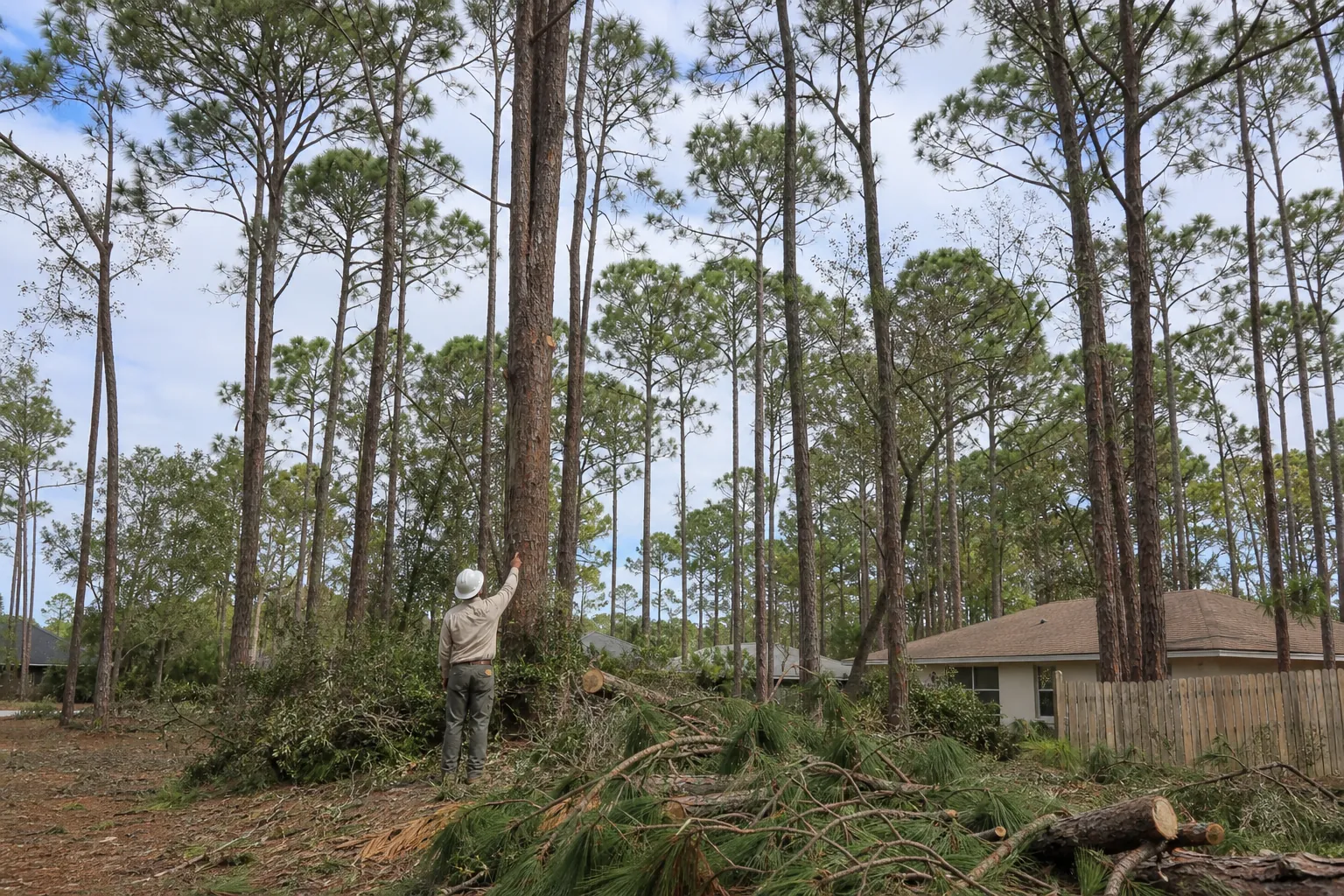
A crowded tree canopy does not automatically need thinning. In Flagler County, the better starting point is to understand each tree's condition, structure, growing space, and role in the landscape. A mature shade tree beside a home may need a different approach from a young tree near a driveway or a group of trees along a shared property boundary.
Good decisions about canopy thinning and tree selection balance shade, tree health, clearance, and the consequences of branch failure. They also account for Florida's heat, seasonal storms, sandy soils, and coastal exposure. Removing more foliage is not always safer, and a tree that looks untidy may still have a sound structure.
This guide explains how to identify trees worth preserving, recognize situations where thinning may help, and distinguish canopy thinning from crown reduction or tree removal. Florida Foliage can help property owners evaluate those choices through arborist reports and tree inspections.
What Canopy Thinning Does And Does Not Do
Canopy thinning selectively removes branches within a tree's crown. When appropriate, the goal is to address crowding and improve branch distribution while retaining the tree's natural form. It should not leave a once-full crown looking hollow or concentrate all remaining foliage at branch tips.
Thinning is different from crown reduction. Reduction decreases the length or spread of selected branches through cuts back to suitable lateral branches. That distinction matters when a tree extends over a roof, crowds another tree, or has branches that reach beyond the available space.
Neither treatment repairs decayed wood or restores a failing root system. A tree with a structural defect may need further evaluation, a different pruning approach, or removal. Simply taking leaves and small branches out of its canopy does not resolve the underlying concern.
Excessive thinning can also be counterproductive. Leaves support the tree's energy production and help shade branches. Removing too much live growth may stress the tree, expose previously shaded bark, and encourage vigorous replacement shoots. The appropriate amount of pruning depends on species, age, health, and prior pruning history.
- Canopy thinning may be appropriate where selected branches cross, rub, or create localized crowding.
- Crown reduction may be more suitable when particular limbs need to be shortened without indiscriminately opening the entire canopy.
- Tree removal may be considered when condition, location, or structural problems make preservation unsuitable.
- A tree inspection helps separate cosmetic concerns from issues that affect health or the potential for failure.
Start Tree Selection With A Clear Property Goal
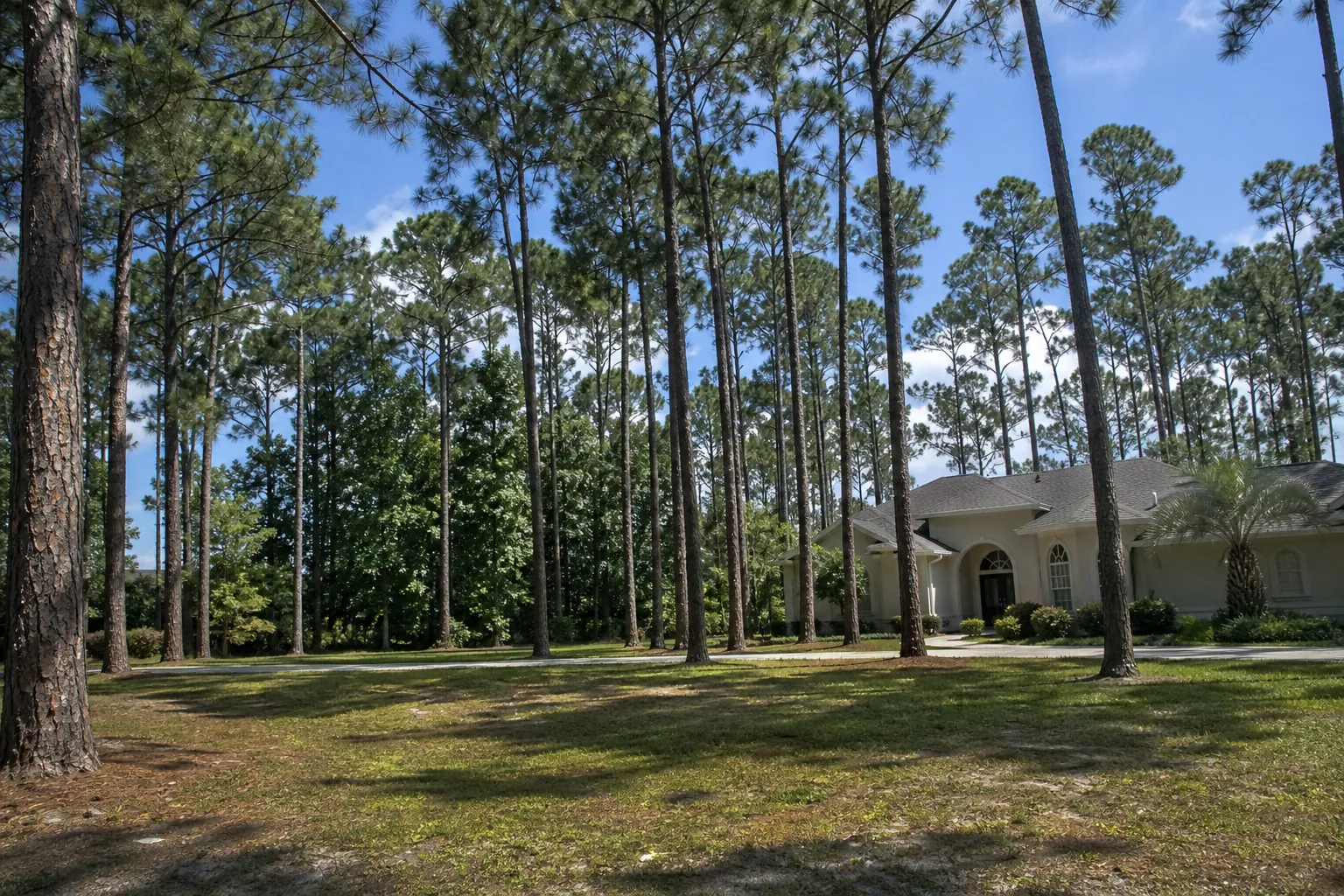
Before deciding which trees to thin, identify what you want the landscape to accomplish. You may want shade over a seating area, more clearance beside a building, or a healthier group of trees competing for limited space. Each goal calls for a different selection process.
Walk the property and note where people spend time, where vehicles park, and which trees are close to buildings. A branch over an unused corner of a large lot has different consequences if it fails than a similar branch over an entrance. This context helps prioritize inspections without assuming that every large tree is a problem.
Also consider what will happen if a tree is removed or heavily pruned. Nearby plants may receive more afternoon sun. A previously sheltered tree may become more exposed to wind. A shaded wall or patio may become noticeably hotter. These tradeoffs should be part of the decision, not an afterthought.
For a wooded lot, selection often means choosing which trees to retain before land and lot clearing begins. Retained trees need adequate protection from machinery, soil disturbance, and damage to their trunks or roots. Leaving a tree standing does not necessarily mean its growing environment has been preserved.
A useful plan identifies the purpose of each proposed action. If the only explanation is that the canopy looks thick, pause and ask what specific improvement the work is intended to achieve.
How To Choose Trees Worth Preserving
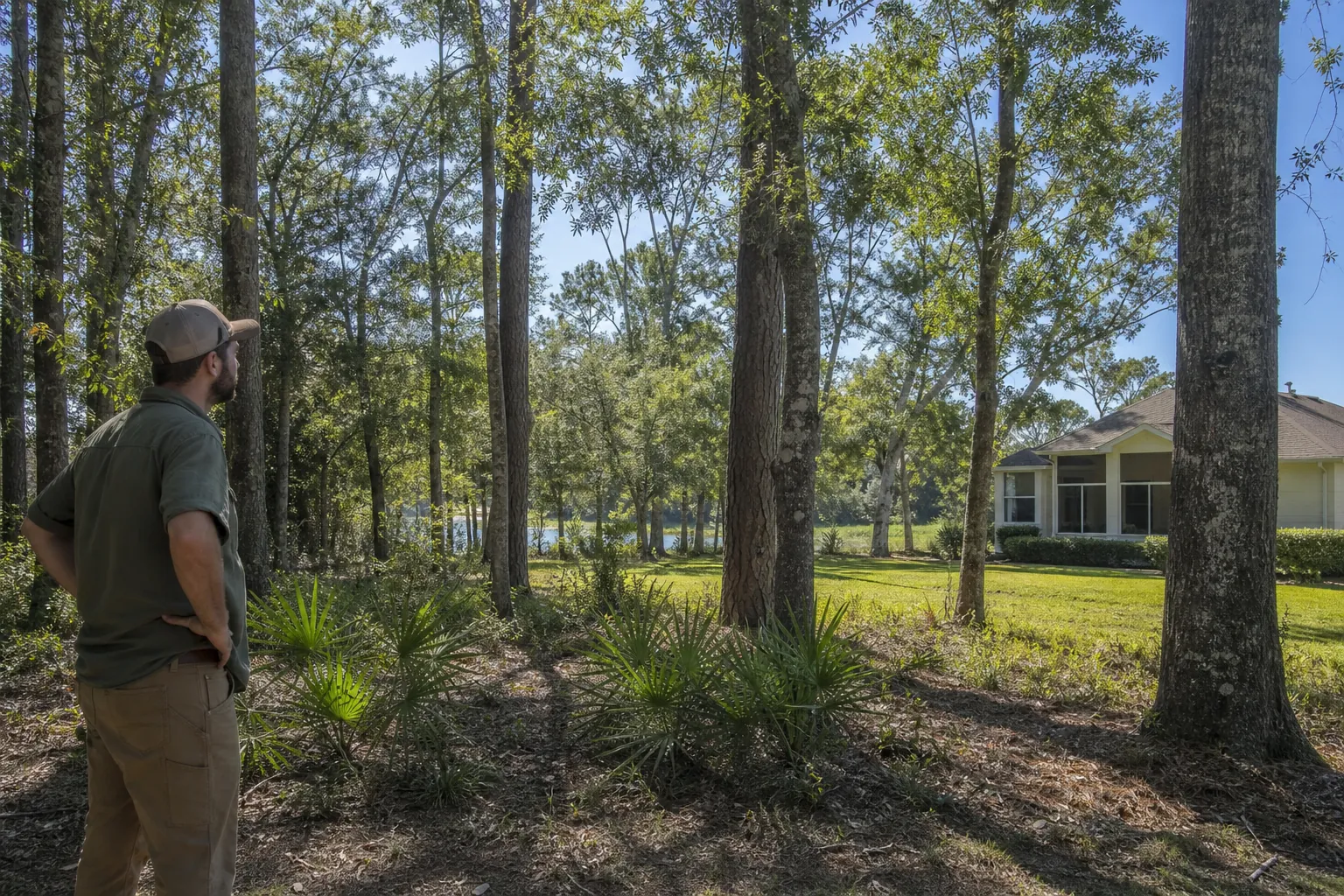
The best candidates for preservation generally combine suitable location, reasonable vigor, and a structure that can be managed without severe pruning. No single feature tells the whole story. A green canopy, for example, does not rule out decay or root damage.
Look at the entire tree rather than only its branches. The trunk base, visible roots, major branch attachments, and surrounding soil all provide useful information. Recent construction, changes in drainage, or repeated vehicle traffic near the tree can affect its condition even when the canopy still appears normal.
Species and mature size matter as well. A tree suited to its available space is often easier to maintain than one that will repeatedly conflict with a building or driveway. Repeated heavy pruning to force a large-growing tree into a small space may create ongoing stress and structural concerns.
- Favor trees with a growing location that can accommodate their mature crown and root system.
- Look for branch structure that can be improved with targeted cuts rather than repeated severe pruning.
- Consider whether the tree provides useful shade, screening, habitat, or a valued landscape feature.
- Review signs of declining vigor, including unusual canopy thinning, dead branch tips, or changes in leaf appearance.
- Ask for an inspection when cavities, cracks, fungal growth, or damaged roots are visible.
A professional evaluation may find that a tree with an irregular appearance is a good preservation candidate. It may also identify concerns in a tree that looks attractive from the street. Selection should reflect condition and context rather than appearance alone.
Account For Flagler County's Growing Conditions
Flagler County properties range from coastal settings to inland neighborhoods and wooded parcels. Salt exposure, drainage, soil conditions, and available rooting space can vary substantially. A tree that performs well on one property may struggle on another nearby site.
On coastal properties, consider exposure to salt spray and wind when selecting trees to retain or plant. Existing trees may also provide shelter for those behind them. Removing several trees at once can change that exposure, so the remaining canopy deserves attention during planning.
In sandy soils, water availability can fluctuate. Some locations drain quickly, while low areas may remain wet after heavy rain. Tree selection should match the actual site rather than rely on a general assumption that all Florida landscapes have the same drainage.
Live oaks, pines, and other broadleaf trees do not respond identically to pruning. A live oak's spreading architecture needs a different evaluation from a pine's branch arrangement. Palms require a separate approach and should not be treated like broadleaf trees with dense branching crowns.
When considering a replacement tree, research its mature dimensions, tolerance for the site's conditions, and likely conflicts with surrounding infrastructure. Choosing an appropriate species and location can reduce the need for corrective pruning later.
Local extension resources can help narrow species options. An on-site tree inspection adds property-specific information that a general planting list cannot provide.
When Selective Thinning May Be Useful
Thinning is most useful when the inspection identifies particular branches to remove and a clear reason for each cut. Examples include branches that rub against one another or interior growth that creates unnecessary crowding. The objective is a better-organized canopy, not maximum visibility through the tree.
Two nearby trees may have overlapping crowns without needing extensive work. If their branches are healthy and their growth is compatible, intervention may be limited. If the overlap produces repeated rubbing, damaged bark, or an unresolved space conflict, selective pruning may be appropriate.
Dead branches deserve attention, especially over occupied areas, but removing deadwood is not the same as thinning healthy foliage. Separating these tasks helps property owners understand the proposed scope and avoids removing live growth simply to make the finished canopy look uniform.
Young trees may benefit more from structural tree trimming than from general thinning. Addressing poorly positioned branches early can help guide future development. Mature trees require more conservative decisions because large cuts can create wounds that the tree must manage over time.
Ask the person evaluating the tree to explain which branches are targeted, why they are being removed, and what the remaining structure will look like. A useful recommendation should connect the work to an identifiable concern.
Pruning Practices To Question Before Work Begins
Not every request to open a canopy leads to good tree care. Topping, indiscriminate cutting, and excessive removal of interior branches can leave trees with avoidable problems. A dramatic visual change is not proof that the work was beneficial.
One practice to avoid is lion-tailing, which removes interior growth while leaving foliage concentrated toward the ends of branches. This changes weight distribution and can leave long, exposed limbs. Appropriate thinning retains a balanced distribution of foliage rather than stripping branches bare.
Large cuts also need careful justification. Removing a major limb to create a view or fit a preferred shape may have lasting consequences. Sometimes a smaller, targeted reduction is more appropriate; sometimes the requested result is incompatible with preserving the tree.
- Ask whether the proposed work preserves the tree's natural architecture and distributed foliage.
- Request a clear distinction between dead branch removal, canopy thinning, and crown reduction.
- Question proposals that rely on topping or removing most interior growth.
- Explain any previous heavy pruning so the evaluation can account for replacement shoots and older wounds.
- Avoid requesting a fixed thinning percentage before the tree's condition has been assessed.
Property owners should not attempt elevated work or pruning near utility lines themselves. Where trees contact or approach electrical infrastructure, coordinate with the utility before arranging work.
Hurricane Planning Requires More Than An Open Canopy
It is tempting to assume that a thinner canopy will make a tree safe during a hurricane. Storm performance depends on many factors, including species, root condition, branch structure, decay, soil saturation, and exposure. Pruning cannot eliminate storm risk.
A useful pre-storm review looks for dead limbs, cracked attachments, signs of instability, and branches that could affect buildings or frequently used areas. It also considers whether earlier pruning has left weakly attached shoots or an unbalanced crown.
Schedule evaluations before a storm is approaching when possible. This allows time to consider options and address priority concerns without making rushed decisions. Some trees may need trimming, while others require a closer inspection or a discussion about removal.
After a storm, stay away from hanging limbs, partly uprooted trees, and damaged trees resting against other structures or trees. Root plates and branches can shift unexpectedly. Downed wires and anything touching them must be treated as dangerous.
Florida Foliage offers emergency and hurricane tree removal. For trees with difficult access or complex removal conditions, crane tree removal may be considered after evaluating the site. The appropriate method depends on the tree, surrounding structures, and available access.
Plan The Work Around Roots, Access, And Shared Spaces
A canopy plan should include what happens at ground level. Equipment access, material handling, and nearby surfaces can influence how work is completed. Identify irrigation components, fences, narrow gates, and other access constraints before the work is scheduled.
Roots often extend beyond the canopy edge. Parking equipment beneath a retained tree or repeatedly driving across its rooting area can compact soil and damage roots. During land and lot clearing, define which trees will remain and discuss how their rooting areas will be protected.
Brush hogging can help manage suitable overgrown areas, but the work should account for small trees intended for retention and exposed roots. Clearing vegetation around a tree is not a substitute for evaluating that tree's condition.
Where removal is selected, discuss whether stump grinding is part of the plan and how the area will be used afterward. Future planting should account for remaining roots, site conditions, and the space required by a new tree.
For shared properties, commercial tree services and HOA and condo tree services benefit from a consistent inventory and documented priorities. Arborist reports can support decisions about which trees to preserve, monitor, prune, or consider for removal.
Confirm applicable requirements with your city or county before tree removal or significant site clearing. For HOA or condo properties, also review the association's approval process. Do not assume that a recommendation replaces any required authorization.
A Practical Checklist For Your Tree Evaluation
You do not need to diagnose a tree before arranging an inspection. Useful preparation consists of describing what has changed, what concerns you, and how the surrounding space is used.
- Take ground-level photographs showing the whole tree, trunk base, and any visible areas of concern.
- Note recent construction, flooding, soil changes, root disturbance, or previous pruning.
- Identify branches near roofs, walkways, parking areas, and places where people gather.
- Explain whether your main goal is shade retention, clearance, improved structure, or selecting trees before clearing.
- Ask which trees need prompt attention and which can be monitored.
- Request a scope that identifies the recommended service and the reason for it.
The best canopy-thinning and tree-selection decisions in Flagler County begin with an evaluation, not a predetermined amount of foliage removal. Some trees need selective pruning. Others are better left largely intact, and some require a different approach altogether.
To discuss canopy thinning, tree trimming, crown reduction, or arborist reports and tree inspections, call Florida Foliage at (386) 481-7913. A property-specific review can help you decide what to preserve and where action is warranted.
Call (386) 481-7913 to talk through next steps.