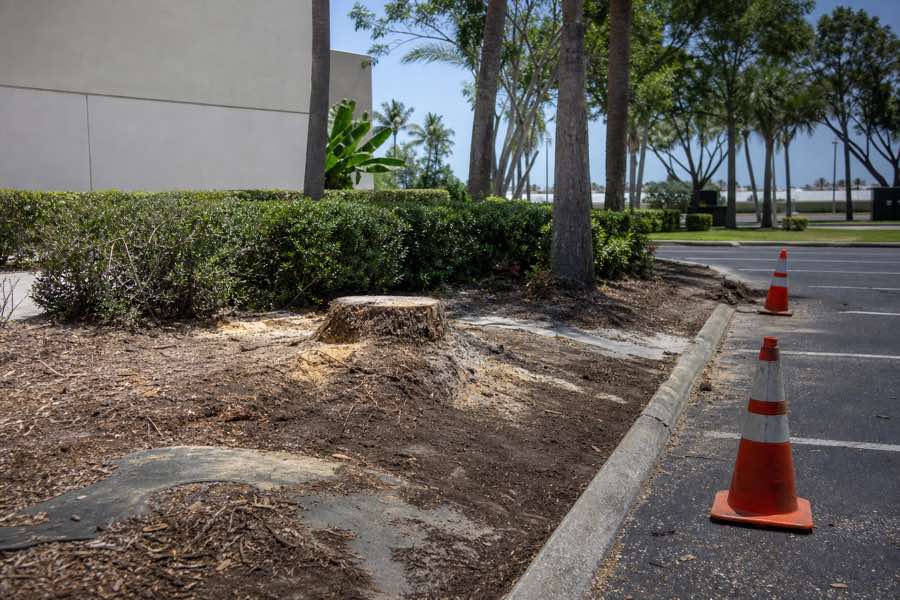
Commercial stump grinding matters before repaving because the former stump area is not ordinary subgrade. In Daytona Beach, sandy soil, storm runoff, buried utilities, and tight paving tolerances can all change the plan. When Florida Foliage handles commercial stump grinding, the scope should define depth, lateral roots, spoil, compaction, and handoff limits before the paving crew starts.
Scope Snapshot
- Set grind depth to match the paving section.
- Address lateral roots before base work starts.
- Locate utilities before any cutting begins.
- Assign chip removal and fill duties in writing.
- Confirm who approves the handoff to paving.
If a contractor treats the stump zone like normal soil, the pavement may bridge over soft material or settle later. That is why commercial stump grinding and repaving need one coordinated scope. Florida Foliage serves Volusia and Flagler counties, with Daytona Beach as the primary market. If you need a commercial stump grinding service, the details matter as much as the cut itself. For broader site work, a stump grinding service can be tailored to the end use of the lot.
Florida Foliage is licensed and insured, and ISA Certified Arborists are on staff. If your project is moving forward, you can request a commercial quote and compare the grinding scope against the paving scope before crews mobilize. If you are planning work in the city, the Daytona Beach service area is where local access, traffic, and drainage details often shape the job.
Coastal Florida adds a few complications. Sand can hide loose pockets after grinding. Heavy rain can soften the fill area between tree work and paving. Utility corridors are common around commercial lots, medians, and drive lanes. Those conditions make commercial stump grinding a coordination task, not a stand-alone cleanup job. Florida Foliage can help define the handoff point so the site is ready for the paving crew.
For tree work on active job sites, OSHA notes that utility and worksite controls matter during tree care and removal operations, which is why a clear work zone matters before equipment starts. See the OSHA inspection guidance for tree care and tree removal operations for that limited point. For stump-related site changes, the City of Daytona Beach’s permit and licensing page can help confirm the local process at its official permitting page.
| Project point | Tree work side | Paving side | Why it matters |
|---|---|---|---|
| Grinding depth | Sets stump removal target | Needs compatible base depth | Avoids a weak spot under the new surface |
| Lateral roots | May need extra grinding | May need more undercut or fill | Helps control settlement near edges |
| Utilities | Locate before work starts | Protects the paving plan | Reduces strike risk and delays |
| Spoil and chips | May be hauled away or reused | Needs clear fill instructions | Keeps organic material out of the base |
| Compaction | Often limited to the stump hole | Must meet paving needs | Improves long-term surface support |
- Confirm final pavement thickness and base depth.
- Mark utilities before equipment reaches the site.
- Define stump depth, root limits, and cleanup.
- Assign spoil removal and replacement fill.
- Coordinate handoff before paving crews mobilize.
What Happens if You Pour Concrete Over a Tree Stump?
Pouring concrete over a tree stump can trap decay, voids, and uneven support under the slab. With commercial stump grinding, the goal is to remove enough wood and roots so the concrete is not bridging a soft pocket. Without that coordination, cracks, heave, or settlement can appear later and affect the paved area.
Concrete needs a stable base that can be compacted in layers. A stump area often contains decaying wood and disturbed soil that behaves differently from surrounding subgrade. In Daytona Beach, moisture and sandy fill can make that difference more noticeable after heavy traffic or rain. A paving contractor should know exactly how far the grinding extended before pouring begins.
Florida Foliage can help define the handoff point so the site is ready for the paving crew. If the stump is large, close to an edge, or near a utility corridor, the project may need more than a standard grind. For stump and root removal concepts, UF/IFAS notes that remaining roots and organic material can continue to decompose and affect stability in the long term.
Can You Build a Patio Over a Tree Stump?
You can build a patio over a stump only if the stump area is properly removed and the base is reworked for the new load. Commercial stump grinding should be tied to the patio layout, because pavers, concrete, and base rock each need a different finish depth and compaction target.
A patio edge near a former stump often needs a larger excavation window than a small ornamental bed would. Root flare, lateral roots, and disturbed soil can extend beyond the visible trunk. If the paving contractor expects a clean rectangular base but the grinder only clears the center, the patio may shift or dip near the edge.
That is where coordination saves time. Florida Foliage can align the tree scope with the paving crew, while the contractor handling the hardscape decides the final base section. If the patio abuts a drive lane or parking area, commercial stump grinding should be documented before fill and compaction begin. Otherwise, the stump zone may be treated as ordinary soil when it is not.
Why Shouldn't You Leave a Tree Stump in the Ground?
You should not leave a stump in the ground under future pavement because it decays, settles, and can create voids. Commercial stump grinding removes the bulk of the wood so the site can be regraded and compacted with less risk. In a paved area, that difference helps prevent future repairs.
Left in place, the stump may also interfere with grading lines and drainage. That matters in Daytona Beach, where stormwater flow and low spots can quickly affect a lot, lane, or sidewalk. The old stump location is not the same as native subgrade. It is a disturbed zone that can behave unpredictably after heavy equipment passes over it.
Commercial stump grinding also helps keep later site work cleaner. If a stump stays under a slab or base course, the paving crew may end up working around hidden organic material. OSHA’s tree care and tree removal guidance reinforces the need to manage hazards and worksite controls during tree operations. That is one more reason coordinated access planning matters on commercial sites.
What Are Common Commercial Stump Grinding Mistakes?
Common commercial stump grinding mistakes include stopping too shallow, ignoring lateral roots, and leaving spoil where paving fill should go. Another frequent issue is failing to match the grind area to the planned pavement footprint. That creates weak spots, especially when the former stump sits under a wheel path or entry apron.
Another mistake is not locating utilities first. Even if the stump itself looks isolated, the work area may sit near irrigation, gas, communication, or electric lines. A grinder and a paving crew need a shared map of where the work stops. A second mistake is assuming all chips can stay under the new surface, when some projects need removal instead.
Florida Foliage can help sort those limits before crews arrive. On a commercial site, commercial stump grinding should define who handles spoil, who compacts the hole, and who signs off on the prepared base. If those points are not clear, the paving contractor may inherit an unstable area and the tree contractor may not know the final depth target.
For local permitting questions tied to site changes, the City of Daytona Beach provides permit and licensing information at its official permitting page. Property-specific permit decisions belong to the governing jurisdiction, so the project team should confirm the right path before work begins.
How Long Does It Take to Grind a 30-Inch Stump?
The time to grind a 30-inch stump depends on access, depth, roots, and cleanup needs. Commercial stump grinding on a commercial lot is rarely just one quick cut, because the crew may need to work around curbs, signs, buried features, or traffic control. The stump diameter alone does not tell the full story.
A 30-inch stump in soft sandy soil may behave differently from one with thick lateral roots or compacted fill around it. If the paving scope requires deeper removal for base replacement, the grinder may need more passes. The handoff also takes time if chips are being removed, the hole is being backfilled, or compaction is being coordinated with a paving crew.
That is why estimates should be built from site conditions, not assumptions. Florida Foliage can review the stump location, access path, and desired finish before work starts. If your schedule depends on moving from tree work to paving in sequence, the better question is how the entire commercial stump grinding and repaving plan fits together.
Will a Tree Grow Back If You Grind a Stump?
Yes, some trees can send up new shoots after stump grinding, but the amount depends on species and root condition. Commercial stump grinding reduces the stump below grade, yet it does not always eliminate all living root tissue. For a repaving project, that biological issue matters less than the risk of regrowth lifting or disturbing nearby edges.
If the stump sits close to a planter, curb, or sidewalk, shoots can make future maintenance harder. In a commercial setting, that can mean more trimming and more interference around the paved area. The site plan should decide whether the goal is just surface clearance or a broader removal scope. A grinder can lower the stump, but the final use of the space determines how much root material should remain.
When the site will be repaved, commercial stump grinding should be described in terms of the end use. Florida Foliage can discuss that with the property team so the tree side and paving side are aligned. If the stump is near active traffic, a fresh shoot is not the main concern. Settlement and surface failure are usually the bigger issue.
What Is the Average Cost of Commercial Stump Grinding?
The average cost of commercial stump grinding varies because access, diameter, depth, root spread, and cleanup scope all affect the job. Commercial stump grinding for a repaving project may require more effort if the crew must remove more material, separate chips, or prepare a cleaner handoff for the paving contractor.
In Daytona Beach, cost also tracks with site access and the condition of the surrounding pavement or soil. A stump beside a loading area may require more planning than one at the edge of a maintenance strip. The best comparison is more than one number. It is what depth is included, whether roots are addressed, and who handles spoil and compaction.
Florida Foliage offers free estimates, which helps property managers compare scopes before they commit. For a commercial project, commercial stump grinding should be quoted alongside the paving sequence so there is no confusion about the finish point. Call (386) 481-7913 to discuss a site in Volusia or Flagler counties, including the Daytona Beach area, or request a commercial quote online.
For example, if a paving contractor wants a clean base but the stump contractor only plans a shallow grind, the quote should reflect that mismatch early. A separate review can also confirm whether the area needs hauling, extra fill, or a larger grind window. Commercial stump grinding is easier to compare when the deliverable is stated in plain terms: depth, footprint, spoil, and handoff.
Florida Foliage works with commercial properties that need clear coordination before paving starts. If your project includes striping, resurfacing, driveway replacement, or concrete work, the stump scope should be locked before the paving schedule is set. That reduces rework and helps both crews move in the right order. If you need to speak with someone, call (386) 481-7913.
How deep should grinding go before a paving project?
Grinding should go deep enough to support the planned pavement section, but the exact depth depends on the finish elevation, root spread, and base design. For commercial stump grinding, the paving contractor and tree contractor should agree on the target so the former stump area is not left as a weak, organic pocket under the new surface.
Who decides which lateral roots must be addressed?
The paving scope usually defines the performance need, while the tree contractor explains what can be removed safely and effectively. For commercial stump grinding, the decision should be shared by the property manager, paving contractor, and arborist or estimator on site. If the root zone affects support or edge stability, it should be addressed in the written scope.
Should utilities be located before stump work begins?
Yes, utilities should be located before stump work begins on a commercial site. That includes underground lines that may not be obvious from the surface. Commercial stump grinding can expose hidden conflicts near curbs, sidewalks, medians, or drive lanes, so the work area should be checked and marked before equipment starts cutting.
Who removes chips and prepares replacement fill?
That should be stated before the job starts, because chip removal and replacement fill are common handoff points. In commercial stump grinding, one party may haul chips away while another installs and compacts fill. If the roles are unclear, the paving crew may receive a base that is too loose or too organic for the next phase.
Can Florida Foliage coordinate scope with a paving contractor?
Yes, Florida Foliage can coordinate the tree-side scope with a paving contractor so the grind depth, spoil plan, and handoff limits are clear. That coordination helps commercial stump grinding fit the repaving schedule instead of interrupting it. Call (386) 481-7913 to discuss the project and compare the site needs with the paving plan.
When a repaving project is planned, the stump area should be treated as a separate scope, not ordinary soil. Florida Foliage can help define that line for commercial stump grinding in Daytona Beach and across Volusia and Flagler counties. If the site needs a clear estimate and a clean handoff, call (386) 481-7913 or start with a free estimate.
Florida Foliage can review the site, compare scopes, and help you keep the paving plan on track. For commercial stump grinding, the next step is a clear estimate, a defined finish depth, and one coordinated schedule. Call (386) 481-7913 or use the free estimate page to begin.