Reviewed by Clinton Funk
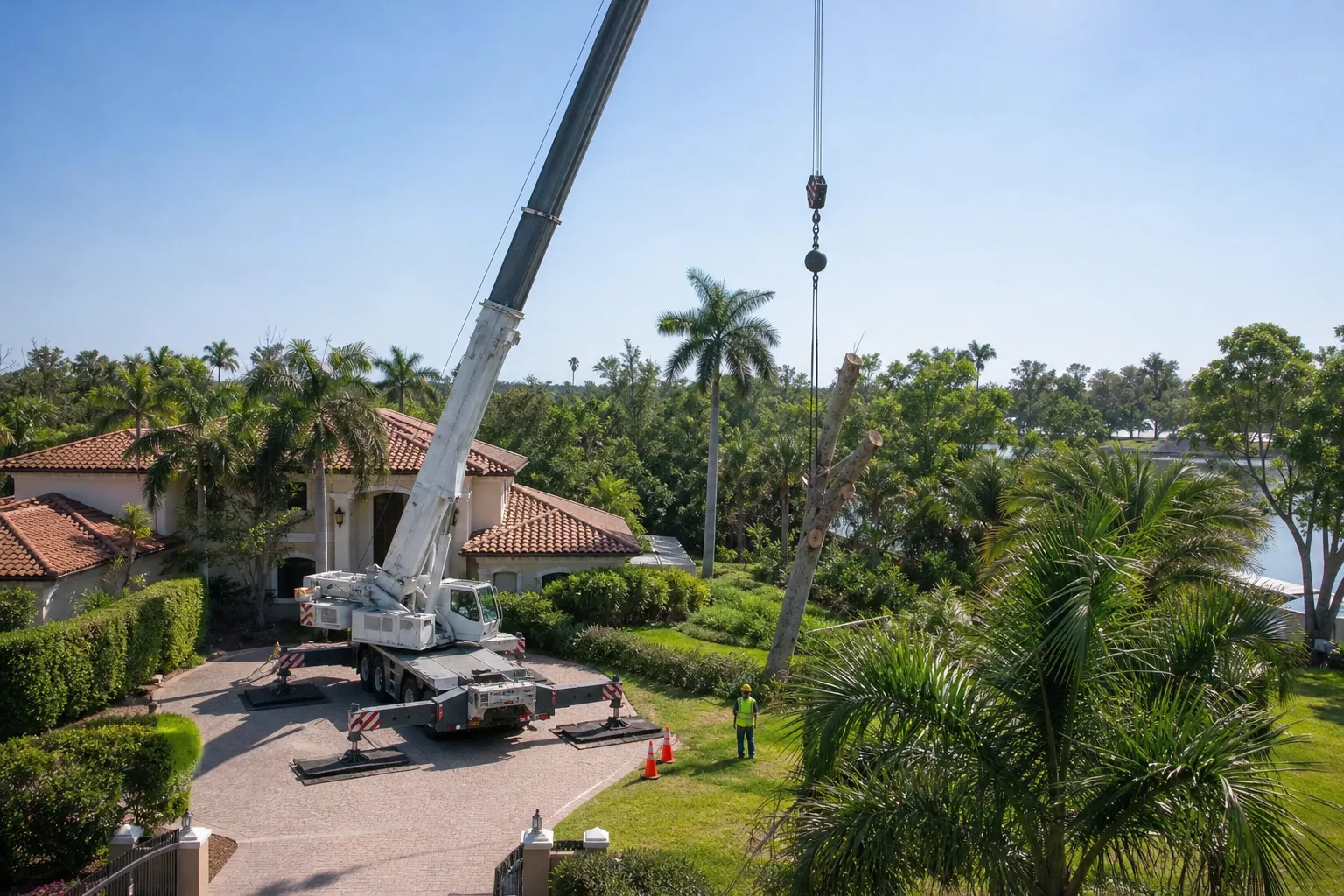
A large tree can stand in a surprisingly small yard, but removing it with a crane requires more than room beside the trunk. The crew needs a suitable location for the crane, space for its stabilizing equipment, a clear lifting route, and a controlled area where tree sections can be lowered and handled.
For Florida homeowners and property managers, planning starts with the entire site rather than a single driveway measurement. Sandy soil, buried utilities, pools, overhead wires, narrow gates, and afternoon storms can all influence whether a proposed setup works.
If you are researching crane tree removal setup space in Florida, the most useful question is not simply how much room a crane needs. It is whether your property provides a workable combination of access, support, reach, and clearance. Florida Foliage can discuss your tree removal needs and the site conditions that deserve attention before work begins.
Why There Is No Universal Setup-Space Measurement
Crane dimensions vary, and the area occupied by the vehicle is only part of the working footprint. Outriggers or other stabilizing components may extend beyond the vehicle. Their position and required support depend on the equipment and the planned lifts.
The tree also influences the setup. A tall tree close to the crane presents a different lifting problem from a tree behind a house. The crew must consider the weight of each section, its distance from the crane, the lifting path, and where it will be placed afterward.
A driveway that appears spacious can still be unsuitable if it cannot support the planned loading or if the crane cannot reach the tree from that position. Conversely, a compact property may have a workable approach from another approved location.
Do not treat a generic width, driveway length, or online equipment specification as approval for your site. A qualified crane operator and tree removal crew must evaluate the actual setup and work within the equipment's operating requirements.
Start With The Route Into The Property
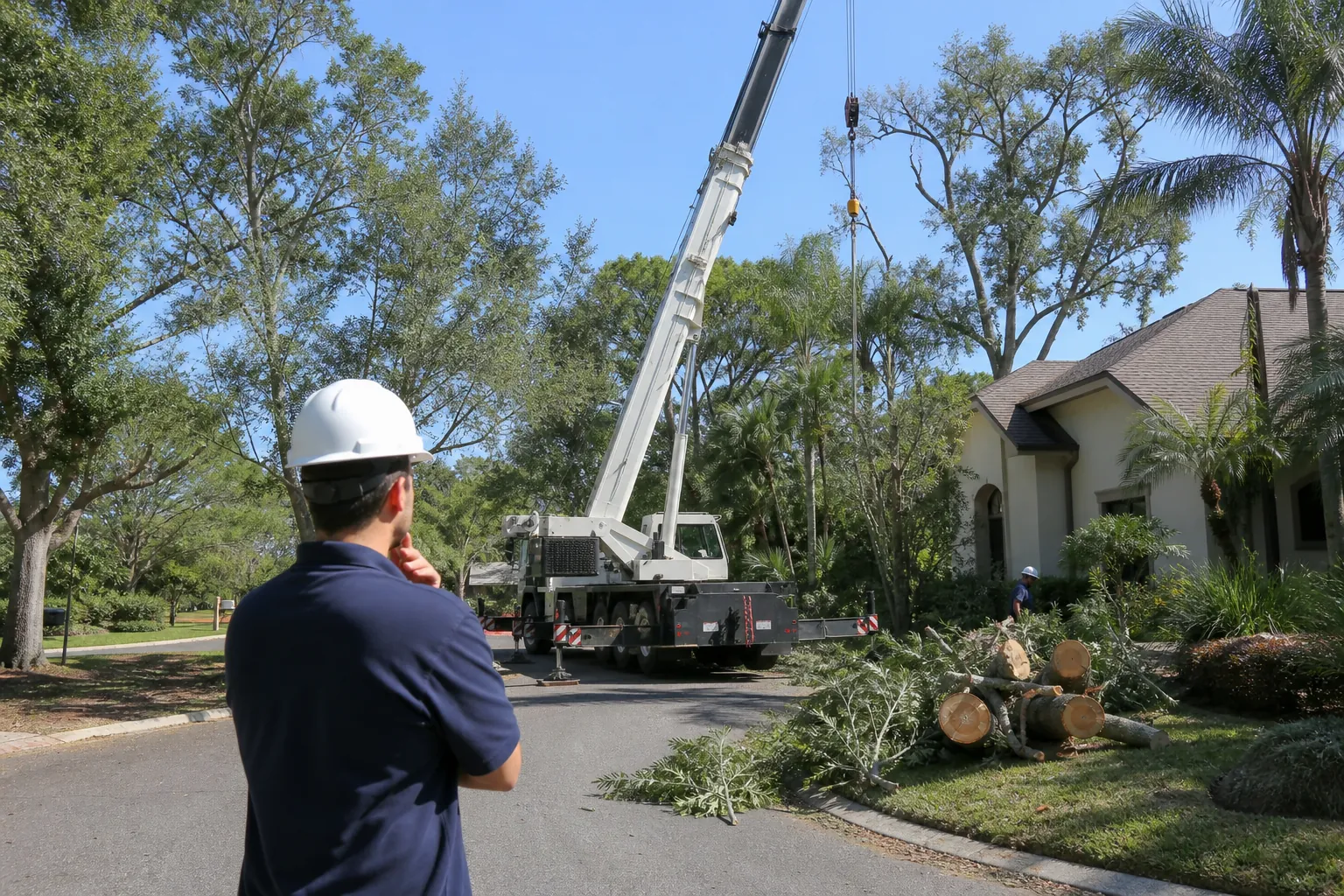
Access begins before the crane reaches its intended parking position. The route from the road must accommodate the vehicle's width, height, turning needs, and weight. Tight corners, driveway slopes, low branches, and gate structures can make entry harder than photographs suggest.
Look at the entire approach, including the point where the vehicle turns off the street. A narrow driveway entrance may be especially restrictive when there are parked cars, drainage ditches, mailboxes, or walls nearby.
- Measure the clear opening between gateposts, walls, or other fixed objects rather than estimating from the gate's advertised size.
- Identify low branches and overhead structures along the approach, but do not remove or alter them without discussing the access plan.
- Tell the crew about sharp turns, steep transitions, narrow bridges, and driveway areas that have settled or cracked.
- Explain whether access crosses a shared driveway or property controlled by an HOA, condominium association, or neighboring owner.
Provide measurements as preliminary information, not proof that access is safe. The crew may need an on-site inspection to assess turning clearance and conditions that are difficult to capture in a photo.
Separate The Crane Footprint From The Full Work Area
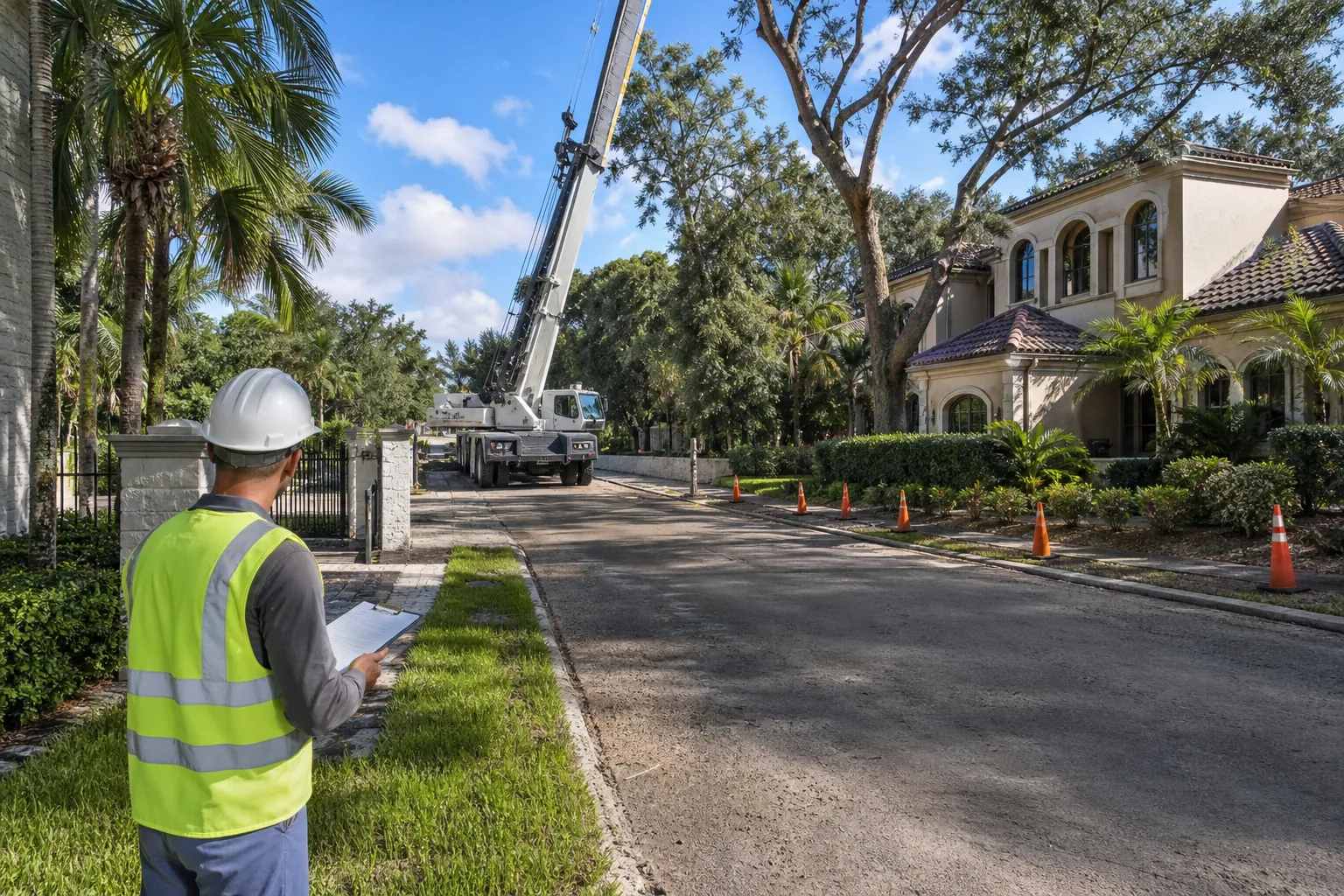
The crane's setup area is not the same as the complete job site. Tree removal also requires space for workers, equipment movement, lowered sections, and debris handling. These areas must be coordinated so that routine movement does not interfere with lifting operations.
The crew needs an exclusion area around active work. Family members, tenants, visitors, pets, and uninvolved workers should remain outside it. A yard that looks open may lose much of its usable space once these boundaries are established.
Ask where the crew expects to lower tree sections. This landing area may be separate from the crane position. Its location affects how sections are moved afterward and whether nearby surfaces or landscaping need protection.
- Identify a possible staging area that does not block the crane approach or required building access.
- Discuss where vehicles normally park and which spaces must remain clear during the work.
- Point out pool equipment, irrigation controls, outdoor kitchens, and other features that are easy to overlook.
- Ask how people will be kept away from both the lifting zone and the debris-handling area.
A coordinated layout usually matters more than simply having a large lawn.
Ground Support Matters As Much As Open Space
Crane setup transfers substantial loads to the ground through the equipment's support points. A surface can look firm while concealing conditions that make it unsuitable. Neither grass nor pavement alone proves that the ground can support the planned operation.
Florida properties may include loose sand, saturated soil, recent fill, buried drainage features, or areas affected by previous excavation. Heavy rain can change site conditions between the inspection and the scheduled removal.
Driveways also require evaluation. Concrete thickness, reinforcement, underlying support, and hidden voids are often unknown to the property owner. Pavers and asphalt have their own limitations. The crew must determine whether the proposed location and support arrangement are appropriate.
Crane mats or other support materials may be part of the plan, but they do not automatically make every surface suitable. Their selection and placement belong to the crane operator and other qualified personnel.
Tell the crew about recent construction, recurring puddles, sinkholes or unexplained depressions, and areas where vehicles have previously become stuck. Do not cover questionable ground with loose material in an attempt to make the site appear ready.
Locate Buried Features Before Choosing A Setup Position
Underground features can limit otherwise attractive setup locations. Septic tanks, drain fields, utility lines, irrigation piping, drainage structures, and underground storage areas deserve attention before heavy equipment enters the property.
Share any reliable property plans or records you have, while recognizing that older drawings may not reflect current conditions. Marking a suspected feature yourself is useful for communication, but it is not a substitute for appropriate locating and verification.
- Tell the crew where the septic tank and drain field are believed to be located, even if those areas are away from the tree.
- Identify recent utility work and any trenches that cross the driveway or lawn.
- Ask who will coordinate any necessary utility locating before the work starts.
- Explain which underground features are privately owned, because they may require separate locating arrangements.
Public utility locating does not necessarily identify every private line or buried structure. Confirm the scope of any locating request and discuss unresolved questions with the crew. An uncertain underground condition may require a different setup location or additional investigation.
Check Overhead Clearance And The Planned Lifting Path
Overhead clearance includes more than the space directly above the crane. The boom, rigging, and lifted tree sections need a suitable path throughout the operation. Roofs, balconies, neighboring trees, utility lines, and other obstacles can affect that path.
Power lines require particular care. Property owners should never estimate that a crane can safely work near a line based on how far away it appears from the ground. The crew must assess applicable clearance requirements and coordinate with the utility when necessary.
Do not assume a covered or insulated-looking wire is safe to approach. Also avoid attempting to move a line, trim branches near it, or guide equipment beneath it yourself.
The tree's crown can create hidden conflicts. Branches may extend over a roof or intertwine with another tree, limiting how a section can be separated and lifted. Tree inspections help the crew understand structure, decay, and other conditions relevant to planning.
Tell the estimator about all visible overhead lines and nearby structures. Include photos from several safe ground-level viewpoints. If the lifting path would cross neighboring property, ask what access or permission issues must be resolved before scheduling.
Understand Why Reach Changes The Setup Decision
A crane's lifting capability depends on its configuration and the distance between the crane and the load, among other factors. The same tree section may be manageable from one setup position but unsuitable from a more distant one.
This is why parking farther away is not always a simple solution to a tight yard. Additional reach can change the allowable load and the way the crew divides the tree into sections. The operator must evaluate the actual lift plan using the equipment's rated capacities.
Moving closer is not automatically better either. A closer location may introduce weak ground, restricted outrigger placement, overhead obstacles, or conflicts with the work area. The final position balances these considerations.
Ask why a particular setup location is being proposed. A clear explanation should connect the equipment position with ground support, tree access, lifting clearance, and landing space. You do not need to calculate crane capacities yourself, but you should understand which parts of your property the plan relies on.
Plan For Florida Weather And Storm-Damaged Trees
Florida weather can affect both scheduling and site suitability. Rain may soften the ground or flood a proposed access route. Lightning, wind, and changing visibility can interrupt work, even when the property was suitable during the initial assessment.
Crews should reassess conditions rather than rely solely on an earlier visit. A setup approved during dry weather may need adjustment after prolonged rain. Keep the company informed if standing water develops or a driveway edge washes out.
Storm-damaged trees add uncertainty. Split trunks, suspended limbs, damaged roots, and trees resting against structures may behave differently from intact trees. Emergency and hurricane tree removal requires attention to those hazards before equipment placement or cutting begins.
- Stay away from hanging branches and trees that have shifted after a storm.
- Report any new cracks, leaning, root movement, or contact with utility lines.
- Do not move fallen sections that could be supporting another unstable part of the tree.
- Allow scheduling flexibility when weather or changing ground conditions make the planned operation unsuitable.
If a tree is contacting electrical equipment, keep clear and notify the utility. Do not approach it to take closer photos.
Coordinate Shared Access And Local Requirements
Some sites cannot accommodate a crane entirely within the owner's property. A potential setup may involve a street, shoulder, shared driveway, or neighboring parcel. These locations bring additional access and coordination questions.
Requirements differ by jurisdiction and by the proposed activity. Confirm with your city or county whether the tree removal or use of a public area requires approval, a permit, or other arrangements. Do not assume that permission to remove the tree also authorizes occupying the roadway.
HOA and condo tree services may require coordination with property management, especially where parking, pedestrian routes, and shared landscaping are involved. Commercial tree services may also need planning around customer traffic, deliveries, and building operations.
Neighbor permission should be addressed before work depends on entering or using neighboring property. Clearly identify the proposed access area and discuss how it will be used.
Ask who is responsible for confirming each requirement. Keeping that responsibility clear helps prevent a crew from arriving to find that the intended setup location is unavailable or that essential access arrangements remain unresolved.
Prepare Useful Information For The Site Visit
A productive site visit starts with an accurate picture of the tree and its surroundings. You do not need technical crane knowledge. You do need to share conditions that may not be obvious during a brief walk-through.
- Provide photos showing the whole tree, the driveway entrance, the likely setup area, and nearby overhead obstacles.
- Explain whether the tree has changed recently, including new leaning, broken limbs, or storm damage.
- Share known locations of septic components, private utilities, drainage structures, and recently disturbed ground.
- List access restrictions, such as gate schedules, parking rules, delivery windows, or locked shared entrances.
- Ask which belongings and vehicles should be moved before the crew arrives.
- Confirm whether stump grinding is included in your requested work and whether its access needs affect the overall plan.
Keep people and pets away from hazardous areas while gathering information. Do not climb the tree or enter an unstable area for a better view.
Before the scheduled work, confirm that the agreed access route remains clear. If anything changes, including parked vehicles, construction activity, or wet ground, let the company know rather than assuming the original plan still applies.
What Happens If The Property Lacks Suitable Space?
A constrained site does not automatically mean the tree cannot be removed. It means the proposed crane approach needs careful review. Another equipment position, a different removal method, or revised access arrangements may be considered by the qualified crew.
However, not every alternative is appropriate for every tree. Decay, structural damage, nearby buildings, and utility conflicts can limit the available choices. The decision should follow a site-specific assessment rather than pressure to make a particular machine fit.
For trees that do not necessarily require removal, tree inspections and arborist reports can help clarify their condition and management options. Tree trimming, canopy thinning, or crown reduction may be considered when appropriate, but these are not automatic substitutes for removing an unsafe tree.
The practical next step is a conversation about your tree, access route, and property constraints. Call Florida Foliage at (386) 481-7913 to discuss crane tree removal in Florida and the information needed to evaluate setup space. A clear plan helps you understand what must be available, what needs confirmation, and how to prepare without making unsafe assumptions.
Call (386) 481-7913 to talk through next steps.