Reviewed by Clinton Funk
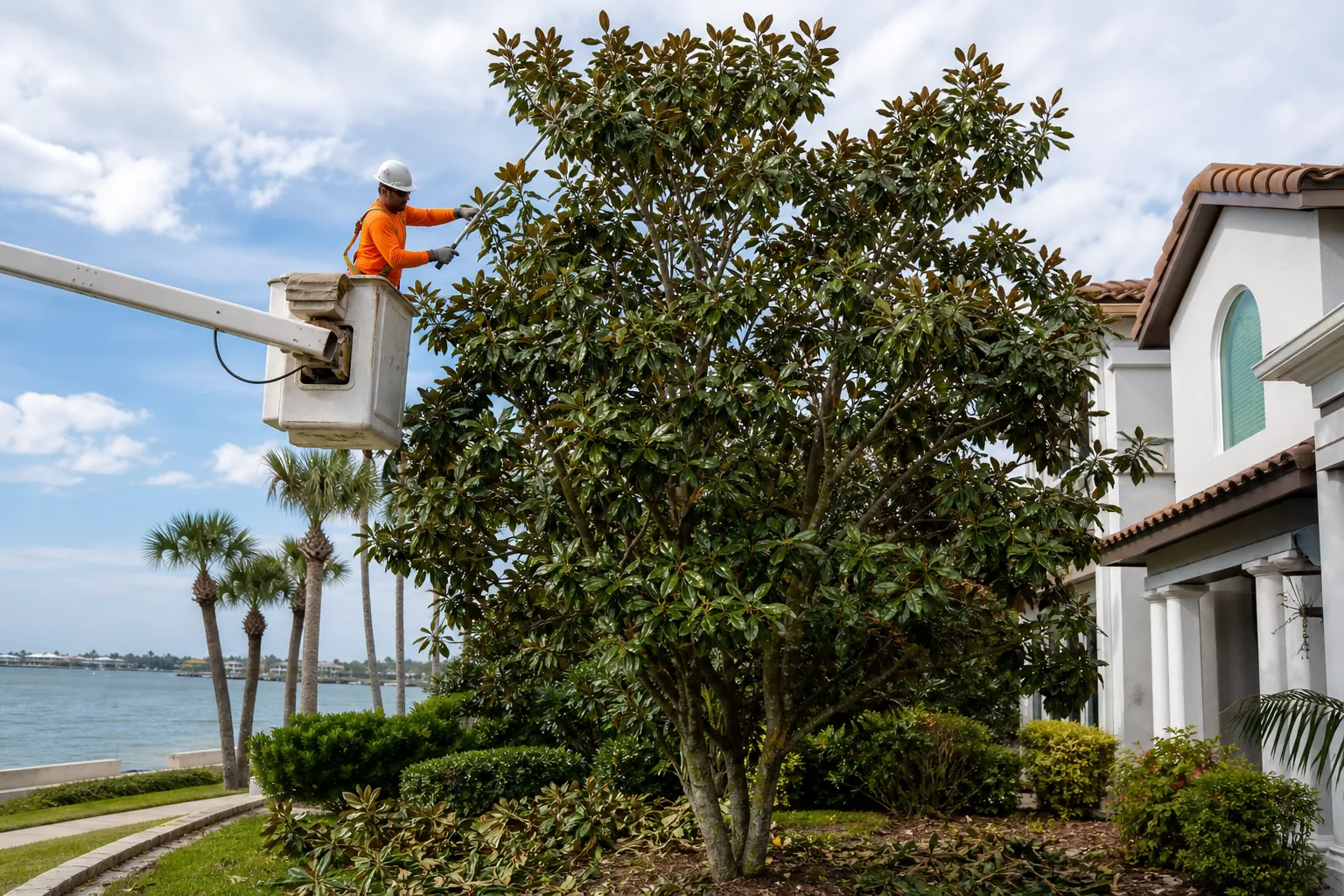
A magnolia can be one of the most recognizable trees on a New Smyrna Beach property. Its broad leaves, substantial limbs, and seasonal flowers give the landscape character. As the tree matures, however, branches may extend over a roof, crowd a driveway, or occupy more space than the site comfortably allows.
Crown reduction can sometimes address those conflicts, but it is not simply a matter of cutting the top lower. Magnolias need thoughtful pruning that respects their structure, condition, and natural growth habit. Removing too much foliage or making poorly placed cuts can create problems that outlast the original clearance issue.
For homeowners researching crown reduction magnolia trees New Smyrna Beach, the most useful starting point is a clear question: What specific problem needs to be solved? Florida Foliage can help evaluate that question through tree inspections and discuss whether crown reduction, another pruning approach, or no immediate work makes sense.
What Crown Reduction Actually Does
Crown reduction selectively shortens branches to decrease the height or spread of particular parts of a tree's crown. The goal is to retain a functional, naturally shaped canopy while addressing a defined concern. It should not leave a mature magnolia looking like a collection of blunt stubs.
A proper reduction cut takes a branch back to a suitable lateral branch that can assume the growing role. That lateral needs to be large enough and well positioned for the remaining structure. When no suitable lateral exists, forcing a reduction may require an undesirable cut or excessive foliage removal.
On a magnolia, the practical objective is often localized clearance rather than a dramatic overall size change. Shortening a few overextended branches may resolve a roof conflict without reducing the entire crown. The amount of work should follow the tree's condition and the available cutting points, not a predetermined height.
- Crown reduction changes the reach of selected branches while retaining suitable laterals.
- Canopy thinning selectively removes branches within the crown rather than primarily shortening its outer dimensions.
- Tree trimming is a broader service category that can include different pruning objectives.
- Topping makes indiscriminate cuts that leave stubs and is not a substitute for careful crown reduction.
These distinctions matter when requesting an estimate. Saying that a tree needs to be made smaller does not establish which cuts are appropriate. A useful plan identifies the branches involved, the reason for each change, and the foliage that should remain.
Why Magnolia Species And Site Conditions Matter
Southern magnolia is common in Florida landscapes, but not every magnolia has the same mature size, form, or growth pattern. A large-growing tree and a smaller cultivar can look similar when young yet require very different amounts of space later. Identification helps set realistic expectations before pruning begins.
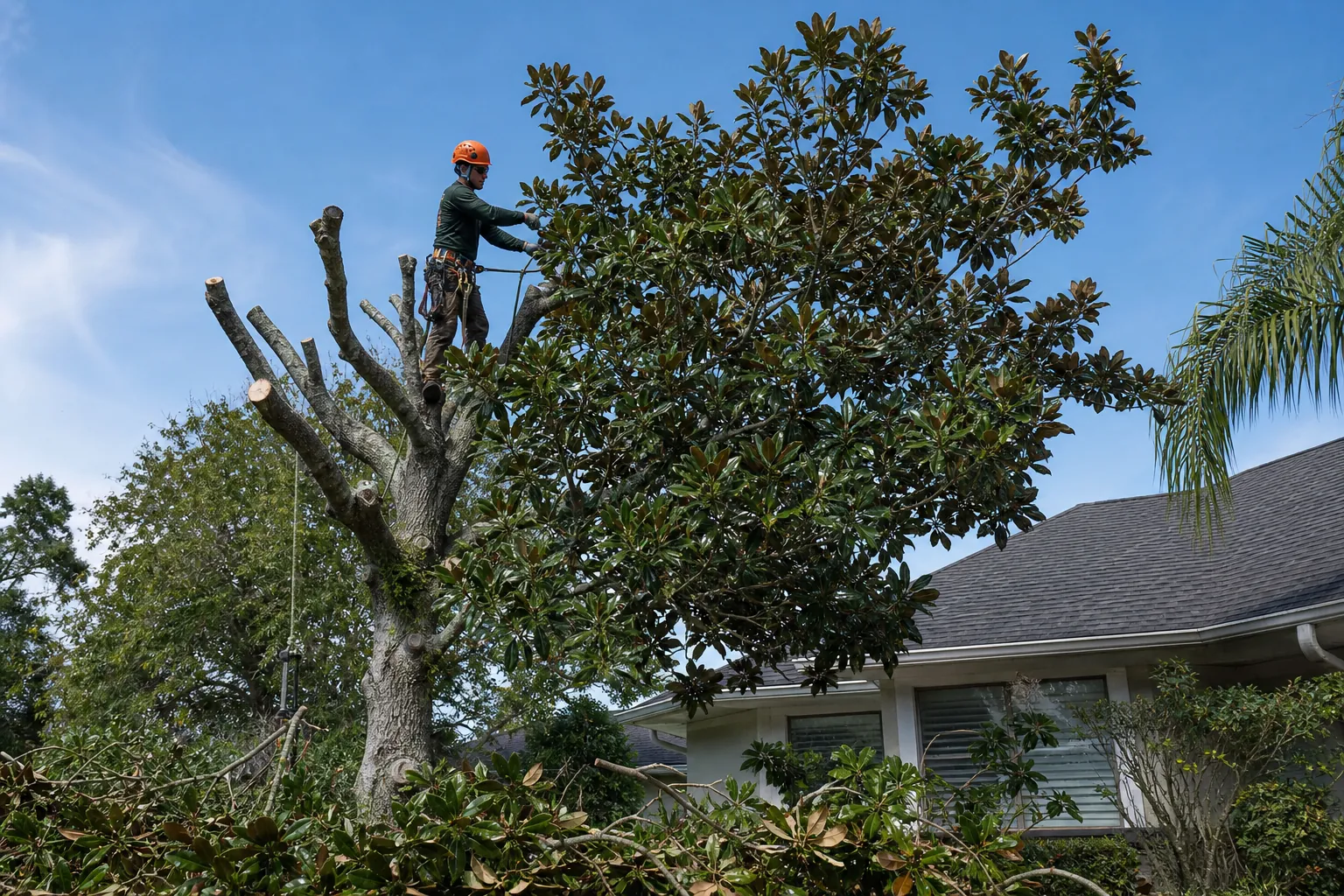
Magnolias generally benefit from conservative pruning. Their dense foliage can make the branch framework difficult to inspect from the ground, and large pruning wounds may remain visible for years. A tree that has already been heavily cut needs a different assessment from one with an intact, balanced crown.
In New Smyrna Beach, exposure also varies from property to property. Coastal wind, salt exposure, drainage, nearby construction, and available root space can influence tree condition. A sheltered magnolia inland may respond differently from a tree on an exposed site near the coast.
The root zone deserves attention even when the concern is overhead. Soil compaction, recent digging, added fill, or damaged roots can affect the tree's capacity to tolerate pruning. Removing foliage does not correct those underlying conditions and may add stress to an already declining tree.
Before deciding on reduction, consider the tree as a whole: its species, vitality, past pruning, root environment, and relationship to nearby structures. Canopy size alone is not enough to determine the right work.
When Crown Reduction May Be Appropriate
A reasonable crown reduction starts with a specific, observable conflict. Branches touching roofing, reaching into a regularly used access area, or extending beyond what their structure can reasonably support may justify closer evaluation. The aim is to solve the problem with the least disruptive practical intervention.
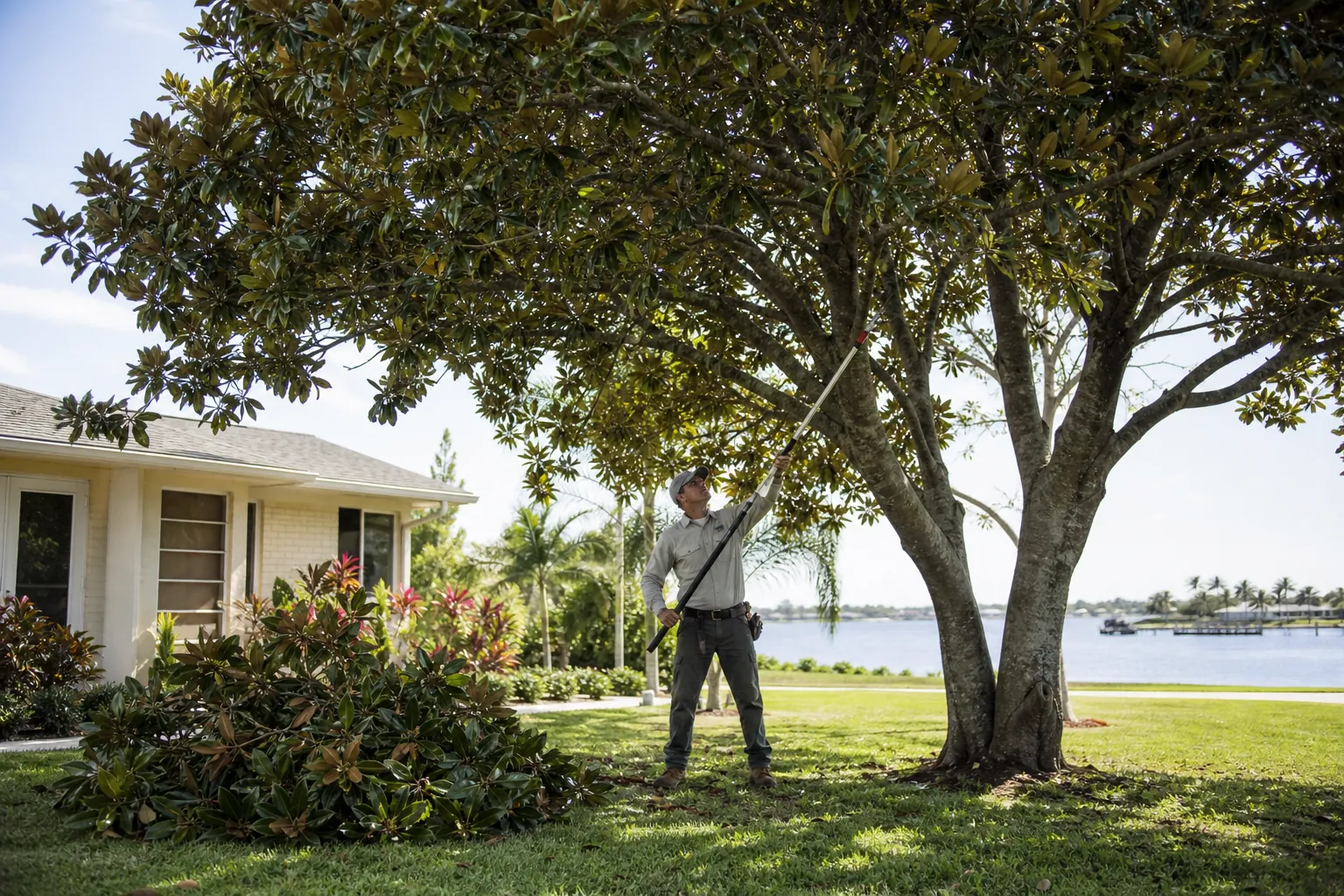
Clearance should be assessed at the branch level. A limb that touches a roof during wind may need selective shortening, while a separate branch that merely casts shade may not need work. Treating both the same can lead to unnecessary canopy loss.
Some mature magnolias also develop long, heavily loaded limbs. Whether shortening such a limb is appropriate depends on its attachments, existing defects, available laterals, and the consequences if it fails. Reduction can change loading, but it cannot make a defective tree free of risk.
- Consider an inspection when branches repeatedly contact the roof, siding, or another structure.
- Ask for evaluation when a major limb appears cracked, unusually extended, or different from its previous position.
- Review clearance needs when normal driveway or pedestrian access is genuinely obstructed.
- Discuss past pruning when clusters of new shoots have developed around old cuts.
- Reassess the plan if the tree appears too large for the site even after modest pruning.
Sometimes the answer is to leave a healthy section of the crown alone. If the concern can be resolved by shortening one branch, a whole-tree reduction may offer little benefit. A narrowly defined scope usually makes the pruning easier to justify and evaluate.
Situations Where Reduction Is Not The Best Answer
Crown reduction does not repair trunk decay, replace missing roots, or eliminate weak branch attachments. It may be one part of managing certain structural concerns, but it should not be presented as a cure for every tree problem.
A magnolia with severe decline, extensive defects, or a poor long-term fit for its location may need a broader discussion. Tree removal can be appropriate when keeping the tree creates unacceptable concerns or requires repeated, damaging cuts. That decision should follow an inspection rather than an assumption based on size.
Repeatedly cutting a large-growing magnolia to fit a very small space can become a cycle. New growth appears, clearance disappears, and increasingly large cuts are requested. Recognizing that mismatch early helps avoid spending years reshaping a tree that cannot sustainably occupy the available space.
Requests to substantially lower a mature tree deserve particular caution. If the desired height would require removing the main framework without suitable lateral branches, the requested result may not be achievable through proper crown reduction. A responsible assessment should explain that limitation clearly.
Likewise, canopy thinning is not automatically the right alternative. Removing interior foliage without a defined objective may leave an unbalanced crown while doing little to resolve outer-branch clearance. The pruning method should match the actual concern.
How Careful Magnolia Reduction Is Planned
The first step is identifying the target area and examining the tree's condition. A visual inspection can reveal dead branches, old pruning wounds, cracks, competing stems, and other features that influence the work. Some concerns may require closer examination or an arborist report before a final decision.
Next, the proposed cuts should be traced to appropriate lateral branches. This process determines what clearance is realistically available without stripping the crown. If suitable cutting points are absent, the scope may need to change.
Good pruning also preserves a sensible distribution of foliage. Removing excessive growth from the interior or leaving foliage concentrated only at branch ends can create an undesirable structure. A magnolia should retain enough healthy canopy to support its ongoing growth.
Cut placement matters as much as the quantity removed. Branch removal cuts should respect the branch collar rather than cutting flush into the trunk. Reduction cuts should not leave unnecessary stubs. Large cuts deserve special consideration because the resulting wounds cannot simply be undone.
- The plan should identify the clearance or structural objective in plain language.
- The selected cuts should retain suitable laterals and a coherent branch framework.
- The scope should account for dead or damaged wood without treating it as permission for excessive live pruning.
- The work should protect nearby structures and avoid unnecessary disturbance around the roots.
- The expected appearance should be discussed before cutting begins.
For some trees, a staged approach is more appropriate than a large one-time reduction. That does not mean every magnolia needs recurring pruning. It means the tree's response and remaining structure may need reassessment before additional work is considered.
Timing Pruning Around Growth And Storm Concerns
There is no single calendar date that makes every magnolia pruning job appropriate. Species, flowering, current growth, stress, and the urgency of the concern all matter. When work is elective, scheduling should consider those factors rather than relying only on convenience.
Magnolias are valued for their flowers, so pruning can affect the display depending on which growth and buds are removed. If flowering is important to you, mention that during the inspection. The pruning plan can then account for both clearance needs and the parts of the crown you most want to preserve.
A tree showing drought stress, unusual leaf loss, or recent root disturbance may need a more cautious approach. Delaying elective live-branch removal can sometimes be preferable to adding stress. Dead, broken, or hazardous branches require a separate judgment based on their condition and surroundings.
Hurricane preparation should focus on identifiable defects and practical clearance, not aggressive stripping of the canopy. No pruning method can guarantee that a tree will withstand a storm. Heavy reduction performed simply to make a tree appear storm-ready can undermine its condition.
After severe weather, keep away from hanging limbs, split branches, and trees entangled with utility lines. Contact the utility for line-related hazards. Florida Foliage provides emergency and hurricane tree removal when storm damage calls for removal rather than routine pruning.
Questions To Ask Before Approving The Work
A good proposal should make the intended result understandable. You do not need to know every pruning term, but you should know which problem the work addresses and what the tree is expected to look like afterward.
Start by asking whether the concern requires crown reduction at all. The answer may be targeted tree trimming, a different scope, or continued observation. If removal is recommended, ask which findings support that recommendation.
- Ask which branches will be shortened and why those branches were selected.
- Ask whether suitable lateral branches exist at the proposed reduction points.
- Ask how much live canopy the plan would remove and whether a smaller scope would work.
- Ask how previous cuts, visible defects, or root disturbance affect the recommendation.
- Ask how crews will manage branches above roofs, fences, driveways, or other sensitive areas.
- Ask whether follow-up observation or a written arborist report would be useful.
Describe your priorities too. Roof clearance, preserving flowers, maintaining shade, and retaining privacy can pull the plan in different directions. Clear priorities help avoid misunderstandings about the finished canopy.
Requirements for tree work can vary by location and property circumstances. Confirm applicable rules with the City of New Smyrna Beach or the relevant county before work begins. If the property is governed by an HOA or condominium association, also check its approval process.
What To Watch For After Magnolia Pruning
After crown reduction, the tree should retain a recognizable, reasonably balanced form. Some changes in light and visibility are expected, but extensive bare framework or numerous blunt stubs warrant questions about whether the work matched the agreed scope.
Observe the tree over time rather than judging its response only on the day of pruning. New shoots near cuts, changes in foliage density, and the return of clearance conflicts can help guide future decisions. Vigorous shoot growth does not by itself prove that a heavily pruned tree is structurally sound.
Keep normal landscape activities from adding avoidable stress. Avoid piling soil or mulch against the trunk, damaging bark with equipment, or compacting the root area with repeated vehicle traffic. If irrigation changes are being considered, account for drainage and existing soil moisture rather than automatically adding more water.
Contact a tree professional if you notice a new crack, a hanging branch, pronounced canopy decline, or a substantial change in lean. Some leaves naturally age and drop, but sudden or widespread changes deserve attention.
Do not assume the magnolia needs reduction on a fixed annual schedule. Future pruning should respond to actual growth, condition, and clearance needs. Keeping notes and occasional photographs can make those changes easier to discuss during the next inspection.
Discuss Your Magnolia With Florida Foliage
The best outcome begins with a realistic assessment, not a promise to make any magnolia fit any space. A suitable crown reduction preserves useful foliage and structure while addressing a clearly defined problem. When that cannot be done responsibly, the alternatives should be explained.
Florida Foliage offers crown reduction, tree trimming, canopy thinning, and arborist reports and tree inspections. For trees that cannot reasonably be retained, tree removal and stump grinding are also available. Commercial tree services and HOA and condo tree services can help address magnolia concerns on shared properties.
If your magnolia is crowding a roof, extending into access areas, or showing a branch problem, call Florida Foliage at (386) 481-7913 to discuss an inspection in New Smyrna Beach. Describe the concern, any recent changes, and your priorities so the conversation starts with what the tree and property actually need.
Call (386) 481-7913 to talk through next steps.