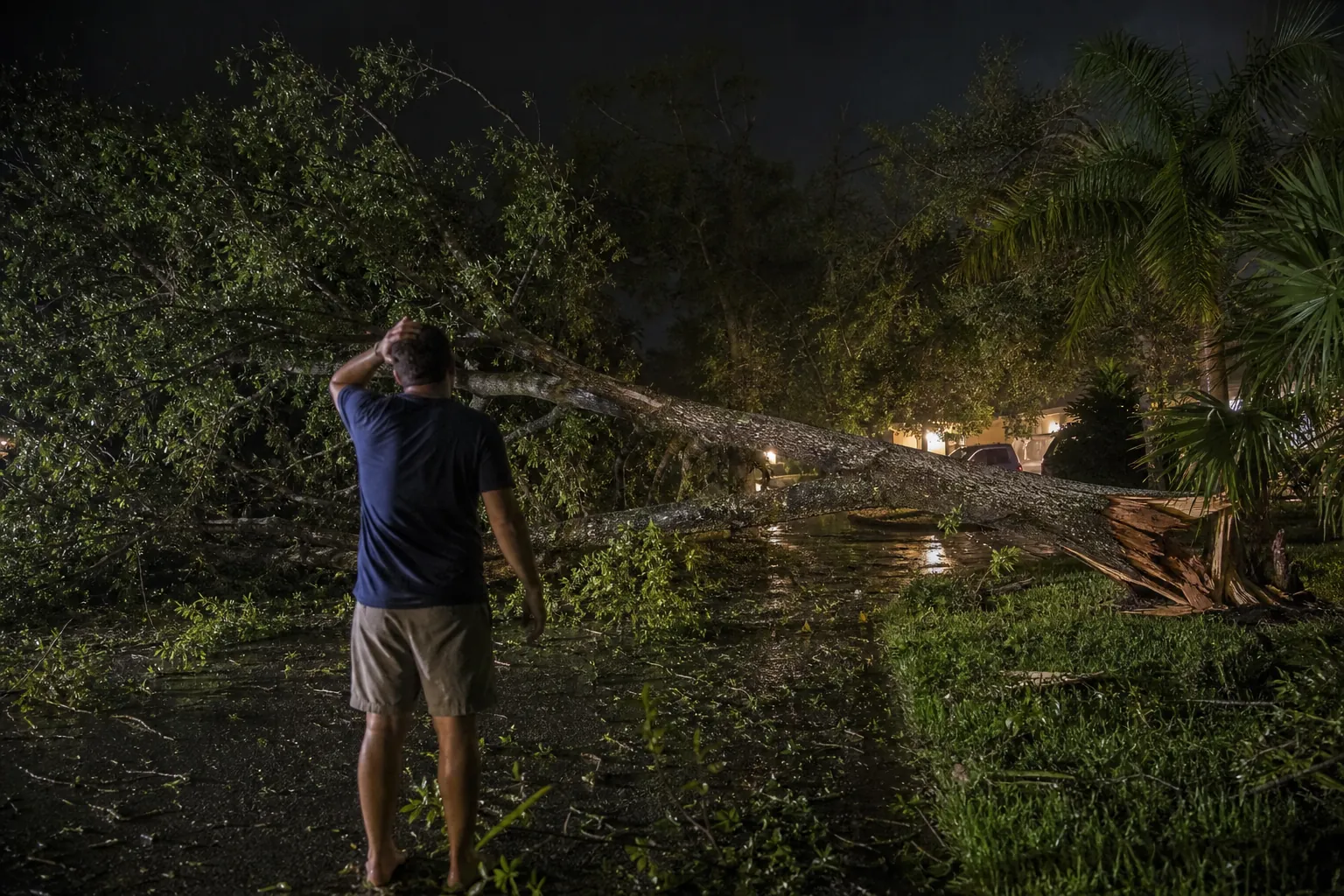
A cracking limb outside your bedroom window or a fallen tree across the driveway can turn an ordinary evening into a stressful situation. Darkness makes it harder to judge what has moved, what remains attached, and whether another part of the tree could fall. The first priority is protecting people, not clearing the damage.
For homeowners and property managers seeking emergency tree removal after hours in Flagler County, a useful response starts with distance, a clear description of the problem, and professional assessment. Florida Foliage provides tree removal, emergency and hurricane tree removal, and arborist reports and tree inspections. Call (386) 481-7913 to describe the situation and ask about the next available response.
This guide explains what to watch for, what to avoid, and how to prepare for help without putting yourself in the path of unstable wood or electrical hazards.
Recognize A Tree Emergency Without Approaching It
A tree emergency is usually defined by the immediate exposure of people, buildings, vehicles, or essential access routes to a hazardous tree or limb. A branch lying flat in an unused corner of the yard is different from a partly detached limb hanging above the front door.
Look only from a safe location. Do not walk underneath the canopy to get a better view, and do not assume a tree is stable because it has stopped moving. Broken wood can remain suspended until wind, shifting weight, or further structural failure releases it.
- A newly leaning tree with lifted soil or exposed roots may have lost anchorage and should be kept clear of people.
- A large broken limb hanging over a walkway, roof, parking space, or entrance can present an immediate hazard.
- A split trunk or major branch union may indicate structural failure, especially if the opening is new or widening.
- A tree resting on a building, vehicle, fence, or another tree can hold unpredictable loads and should not be disturbed.
- A fallen tree blocking the only practical exit requires prompt communication about safe access.
Sounds can also matter. Fresh cracking, popping, or tearing during gusts may indicate movement, but you should not stay nearby to listen. If a tree appears likely to strike an occupied area, move people away from that area using a route that does not pass beneath it.
Old pruning wounds, dead twigs, and sparse foliage can deserve an inspection without necessarily requiring nighttime removal. When you cannot tell whether the condition is urgent, describe what changed and what the tree could strike rather than trying to diagnose it yourself.
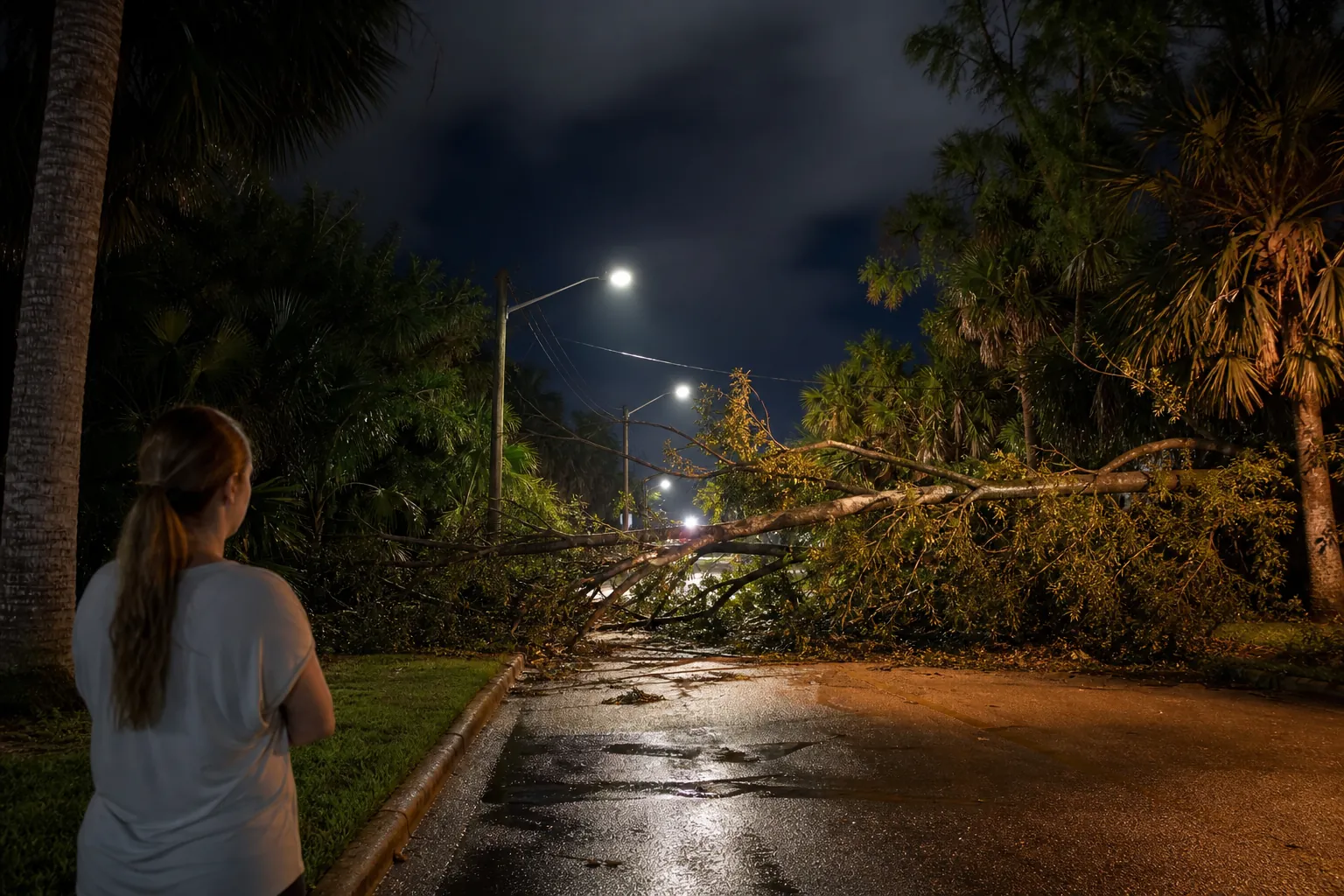
Take These Safety Steps Before Making A Tree-Service Call
Start by accounting for family members, visitors, pets, and anyone working on the property. Keep them away from the affected tree and the surrounding area. There is no single safe distance that fits every tree failure, so avoid estimating a narrow boundary based only on the branches already on the ground.
If the tree has damaged the home or appears capable of causing further damage, do not enter the affected rooms to retrieve belongings. Follow emergency officials' instructions when structural safety is uncertain. For an immediate threat to life, fire, injury, or people trapped inside, contact emergency services first.
- Move to a safe location without crossing beneath damaged limbs or stepping over wires.
- Keep children and pets indoors or in another secure location away from the hazard.
- Stop using a driveway, door, or parking area that sits beneath unstable branches.
- Warn other occupants from a safe position, and do not approach the tree to install caution tape.
- Keep vehicles out of the affected area rather than trying to move them from beneath hanging wood.
A limb lying on the ground may still be connected to the tree or loaded under tension. Cutting it can cause sudden movement. Likewise, a trunk resting across a driveway may roll or shift when someone removes a smaller branch supporting it.
Do not climb, pull branches with a vehicle, or use a ladder to reach storm damage. Homeowner chainsaw work is especially risky after dark because footing, overhead hazards, and hidden loads are difficult to evaluate. Waiting in a safe location is often the most useful action you can take.
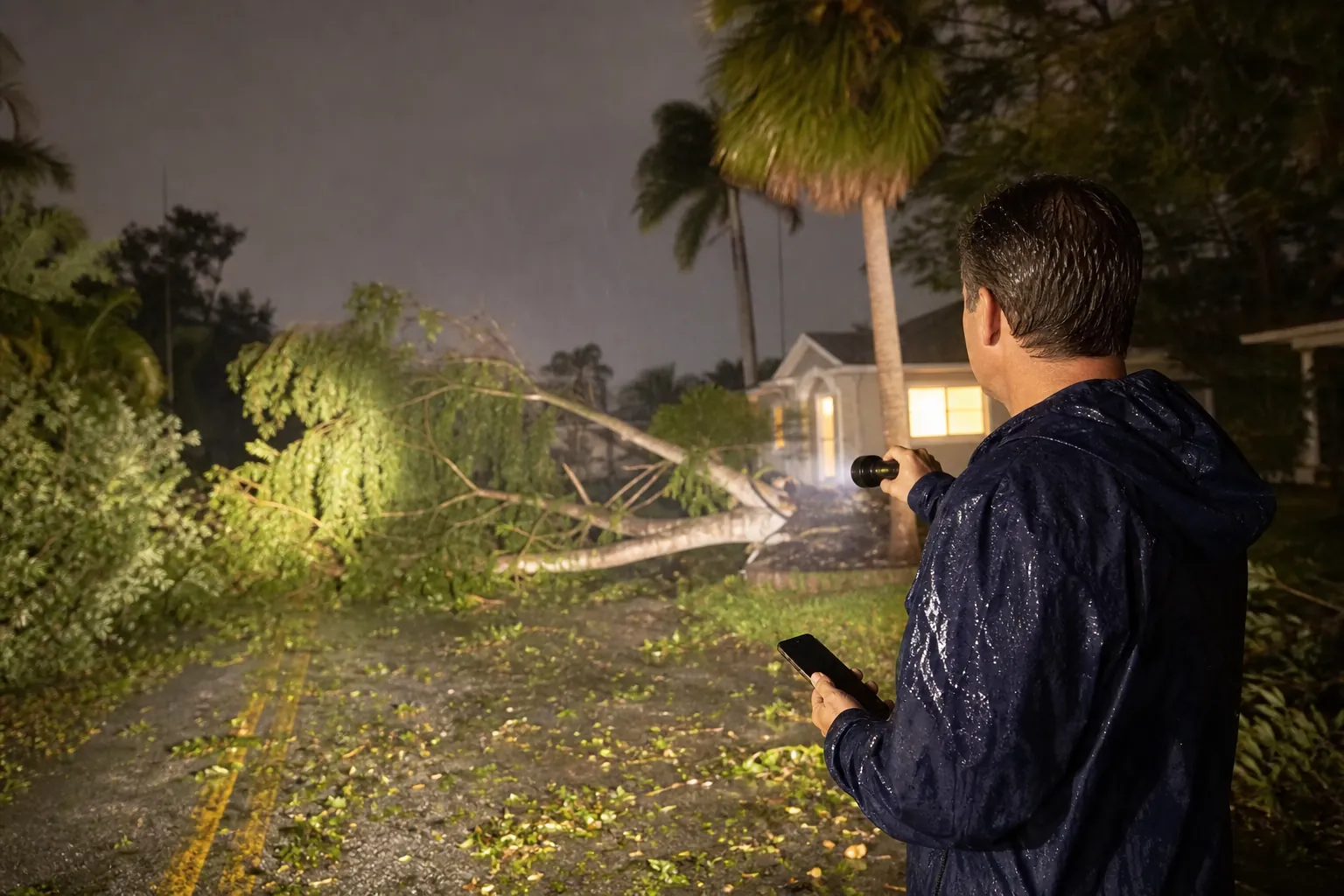
Treat Every Tree And Wire Contact As An Electrical Hazard
When a tree or branch touches a utility line, the situation is not simply a tree-removal problem. A wire may be energized even if it is quiet, dark, or lying on the ground. Electricity can also travel through objects in contact with the line.
Stay away from the tree, wires, nearby fences, standing water, and anything else that could be involved. Do not attempt to identify a cable by its appearance. Report suspected line contact to the utility, and contact emergency services if there is an immediate danger.
Never cut a branch off a wire or try to push a cable aside with a tool. Do not assume a power outage means the line is safe. Tree work involving electrical exposure requires appropriate utility coordination and qualified personnel.
Tell Florida Foliage about any visible or suspected wires when you call. If you cannot see the area clearly, say so. Uncertainty is important information, particularly when a fallen tree is near a service connection to the building.
If you are in a vehicle near a downed line, avoid stepping out into the surrounding area and seek emergency guidance. A tree-service visit cannot replace the utility's assessment of an electrical hazard.
Understand Why After-Hours Work Requires Careful Planning
Nighttime tree work introduces challenges beyond the damage itself. Crews need to evaluate access, lighting, ground conditions, overhead exposure, and where cut sections can be safely controlled. Wet grass, debris, and poor visibility can make an otherwise straightforward approach unsafe.
Flagler County properties vary widely. A coastal yard may have limited space between buildings. A wooded lot may have narrow access and soft ground. An HOA or condo property may have multiple entrances, parked vehicles, and pedestrian routes to protect.
Rain-saturated soil can affect both root stability and equipment placement. Wind can change the movement of suspended limbs. Lightning or severe weather may prevent safe work even when the damage is urgent. An assessment should account for current conditions, not just the size of the tree.
Depending on the hazard, the appropriate plan might involve removal during a safe weather window, an initial assessment followed by daylight work, or coordination with a utility before any cutting begins. Calling after hours does not mean every situation can or should be resolved immediately.
Crane tree removal may be considered when access, tree position, and lifting requirements support it. A crane is not automatically the right choice for a large tree. Equipment placement, ground support, reach, and surrounding obstacles all need evaluation before a removal method is selected.
Give Useful Information When You Call Florida Foliage
A concise description helps establish the nature of the hazard. Begin with the property location in Flagler County and whether people are currently exposed. Then explain what happened, what the tree is touching, and whether the situation is changing.
You do not need to know the species or measure the trunk. Practical details about the surroundings are usually more valuable than a guess about the tree's height.
- Explain whether the tree is standing, leaning, partly uprooted, broken, or already on the ground.
- Identify any contact with a roof, vehicle, neighboring structure, utility line, or other tree.
- State whether a driveway, entrance, shared walkway, or essential access route is blocked.
- Describe access restrictions, including gates, narrow passages, parked cars, or soft ground.
- Mention continuing wind, rain, flooding, or sounds of further cracking from a safe location.
- Say whether you are the owner, tenant, property manager, or an authorized HOA or condo representative.
Photos can help communicate the scene, but only take them from a safe location. Do not walk closer for a clearer image, stand under a hanging branch, or step outside near suspected electrical contact. A distant image showing the tree and surrounding structures may be more informative than a close-up of broken bark.
Ask about current availability, the likely assessment process, and what access information is needed. If conditions change after the call, provide an update. A tree that begins leaning farther or a newly visible wire can change the response priorities.
What A Professional Assessment May Consider
The objective of an assessment is to understand the tree's condition and its interaction with the site. The visible break is only part of the problem. Remaining limbs, trunk sections, and neighboring trees may also be affected by the same storm or impact.
A tree leaning against another tree can transfer weight in ways that are difficult to see from the ground. A limb resting on a roof may be supporting another broken section. Removing the most obvious piece first is not always the safest sequence.
Access planning matters as much as cutting. Crews may need a controlled work area that extends beyond the fallen wood. Occupants may be asked to stay clear of certain doors, move uninvolved vehicles when safe, or keep pets secured throughout the work.
Tree removal may be appropriate when the tree has failed or presents an unacceptable risk that cannot reasonably be addressed through pruning. In other situations, tree trimming or crown reduction may be considered after the remaining structure is assessed. These options are not interchangeable, and reducing a canopy does not repair failed roots or a split trunk.
Arborist reports and tree inspections can help document concerns and guide follow-up decisions. If you need a written report for a property record, insurer, or association, explain that need before work is arranged. Confirm the intended scope rather than assuming every visit includes formal documentation.
Document Damage Without Delaying Safety Decisions
Once everyone is safe, record what you can from a protected location. Note when you first observed the damage, which areas are affected, and whether the condition changed. Keep photographs, messages, and any instructions you receive together for later reference.
If insurance may be involved, contact your insurer to ask about documentation and claim procedures. Coverage depends on the policy and circumstances. Do not assume that a tree-service assessment determines coverage or that every part of the removal will be treated the same way.
- Photograph visible damage only when doing so does not expose you to falling wood or electrical hazards.
- Keep records of communications with the tree service, utility, property manager, and insurer.
- Ask your insurer what records it needs, while following emergency guidance about immediate safety.
- Describe observed facts rather than assigning blame or guessing why the tree failed.
If the tree crosses a property line, notify the neighboring owner or responsible manager when practical. Do not enter another property or authorize work on someone else's tree without addressing permission and responsibility.
Tree-removal requirements can vary by municipality, county jurisdiction, property designation, and other circumstances. Confirm applicable requirements with your city or Flagler County, including how emergency situations are handled. An HOA or condo association may also have an approval process that should be checked with its authorized representative.
Plan Follow-Up Care After The Immediate Hazard Is Addressed
Emergency removal addresses the immediate tree problem, but it may not resolve every concern on the property. Once conditions are safe, review remaining trees, access areas, and any unfinished work with the service provider.
Stump grinding is a separate consideration after tree removal. Discuss the stump's location, nearby utilities or irrigation, and your plans for the area before scheduling it. Removing the above-ground tree does not mean the stump has been addressed.
Nearby trees may benefit from tree inspections, especially if they experienced the same wind exposure or have newly broken branches. Tree trimming can address appropriate pruning needs. Canopy thinning and crown reduction should be selected for specific tree conditions, not used as a blanket response to every storm.
A heavily reduced canopy is not a substitute for sound structure. Avoid requesting indiscriminate cutting simply because a tree is tall or close to the house. Ask what the proposed pruning is intended to accomplish and whether removal is a more appropriate option for a severely compromised tree.
For commercial properties, HOA communities, and condo sites, follow-up planning should include shared access and responsibility for remaining trees. Florida Foliage offers commercial tree services and HOA and condo tree services, along with inspections that can inform future maintenance decisions.
Prepare Before The Next Nighttime Tree Emergency
Preparation cannot prevent every storm-related failure, but it can make your response more organized. Keep your property address, gate instructions, utility contact information, and association or management contacts accessible to everyone who may need them.
Arrange tree inspections when you notice a new lean, soil lifting, trunk cracks, substantial dead branches, or changes following construction or severe weather. Early evaluation gives you time to discuss tree trimming, crown reduction, or tree removal before a problem becomes an after-hours event.
Know which entrances and indoor areas are closest to large trees. Consider an alternate safe route through the property, but reassess it during an actual event because fallen limbs or wires may make your usual route unsafe.
If a tree emergency occurs after hours in Flagler County, keep people clear, report electrical or life-threatening hazards to the appropriate emergency responders, and avoid attempting removal yourself. Call Florida Foliage at (386) 481-7913 to explain what you can safely observe, discuss current availability, and determine the next practical step.
Call (386) 481-7913 to talk through next steps.