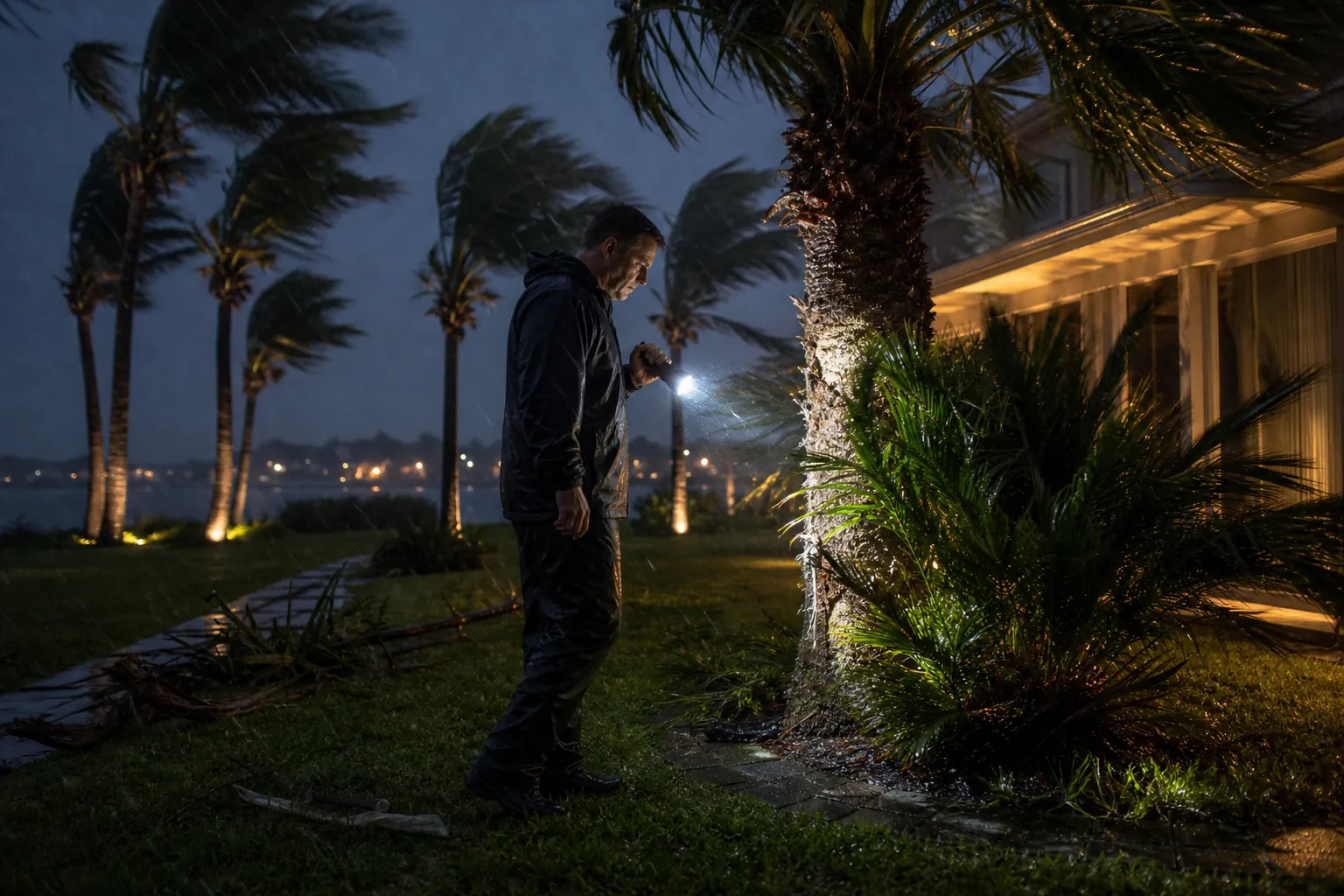
After a hurricane, make your first yard check from indoors. Do not enter a debris field at night with a flashlight as if it were a work light. Note only what you can see from a place you already consider clear, and keep household members away from visible tree hazards. Storm-damaged tree work has falling-limb and unstable-tree hazards, according to OSHA’s storm tree-work safety guidance. Use the plan below to organize observations and decide on a calm next step.
By Tim Francis. Florida Foliage is headquartered in Daytona Beach. Clinton Funk is the owner and has decades of hands-on tree care experience. This article is editorial content and does not claim that he reviewed it.
What Should You Do First After Dark?
Start by making the check an indoor decision, not a night yard task. Keep household members together, choose a clear route inside, and record what can be seen from there. The tree removal service overview and tree trimming service overview offer general information about these kinds of services, not a promise of local availability.
Darkness can make it hard to tell what is on the ground and what is still attached. You do not need to resolve every question tonight. A useful plan is to separate what you can plainly observe from what would require close inspection or tree work. Keep the first task small: tell people where not to go, write down the visible issue, and leave the area undisturbed.
- Ask everyone in the household to stay inside or use a route that does not pass the yard area of concern.
- Do not enter a debris field with a flashlight as though it were a work light; use a light only from a place you already consider clear.
- Do not approach a tree or branch to get a better view, and do not attempt tree work in the dark.
- Write down the time and the location of anything you can see without going closer.
This is a household organizing plan, not a way to assess a tree. OSHA identifies falling limbs and unstable trees as hazards in storm-damaged tree work. Keep nonessential people outside work and drop areas, as OSHA advises in its guidance for tree trimming after a hurricane. If you cannot tell whether a place is clear, leave it out of the route.
How Can You Check the Yard Without Going Outside?
Use a brief indoor check and stop when you have enough information to keep people away from the area. For background on Florida Foliage, see the company background page; to share a general question, use the contact page. These links explain the company and a way to get in touch, but do not indicate a Pensacola office or local crew.
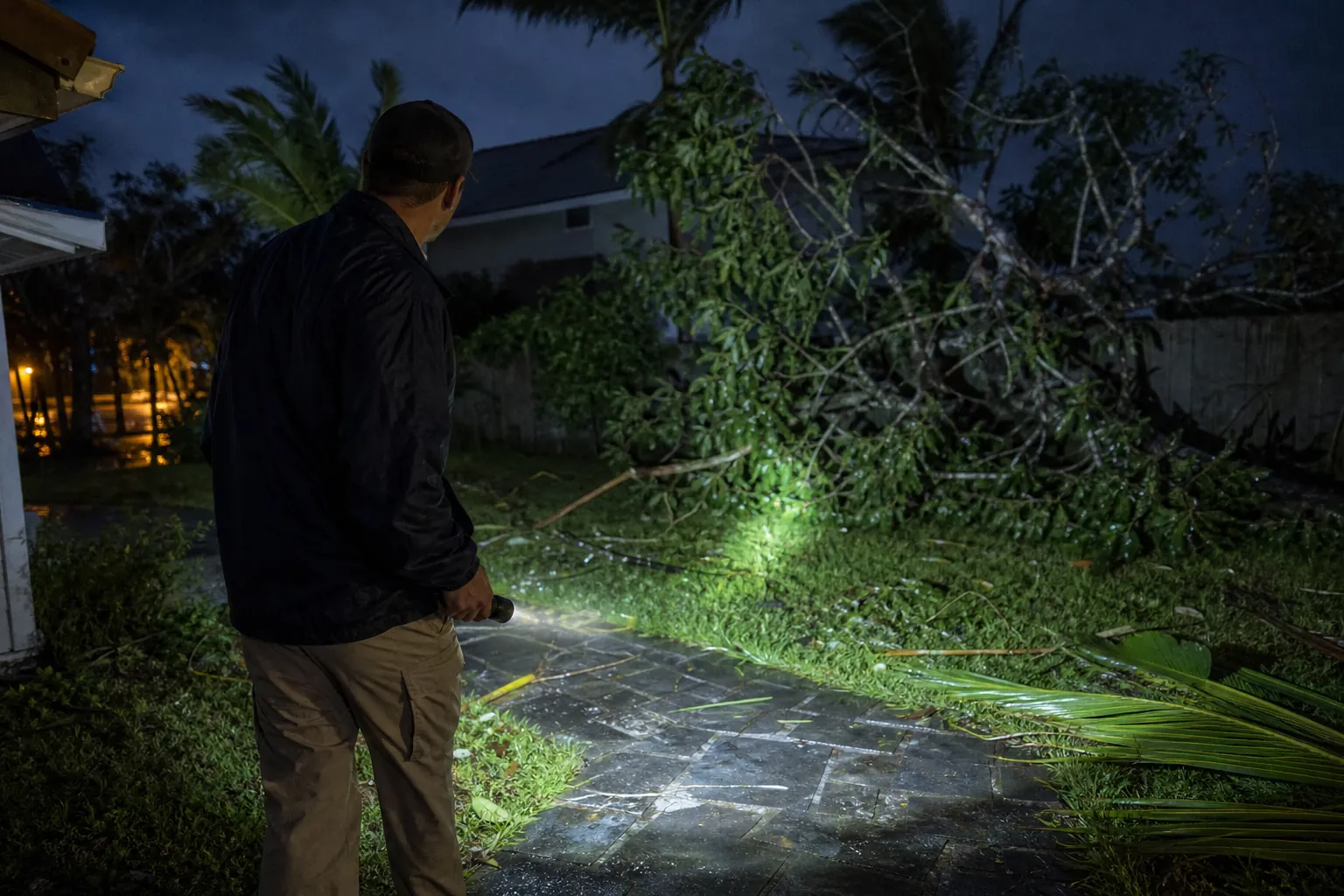
Look through a window only if you can do so without opening a door or stepping into the yard. A window view may show a limb on the ground, material caught in a tree, or a clear route that has become blocked. Write down what is visible in plain terms. Avoid guessing about a tree’s condition or what caused a change.
Keep notes focused on location and appearance. “A large limb is across the back path” is a visible observation. “The tree is about to fall” is a conclusion you cannot confirm from that view. This distinction helps you communicate clearly later without turning a quick look into a diagnosis.
- Note the side of the home or yard where you see the issue, using words everyone in the household understands.
- Describe what is visibly present, such as a branch on the ground or material resting against a fence.
- Mark a route or room to avoid on a household note, rather than asking someone to go outside to place a marker.
- Keep children and visitors informed with a simple direction, such as staying inside and using another route.
A phone photo can help you remember what you saw, but do not use a photo as proof that a tree is safe. A picture shows only one view at one time. It cannot replace a tree-work discussion or make a dark yard suitable for closer inspection. If the view is unclear, record that you could not see enough and leave the question for later.
What Tree and Electrical Hazards Should You Treat With Caution?
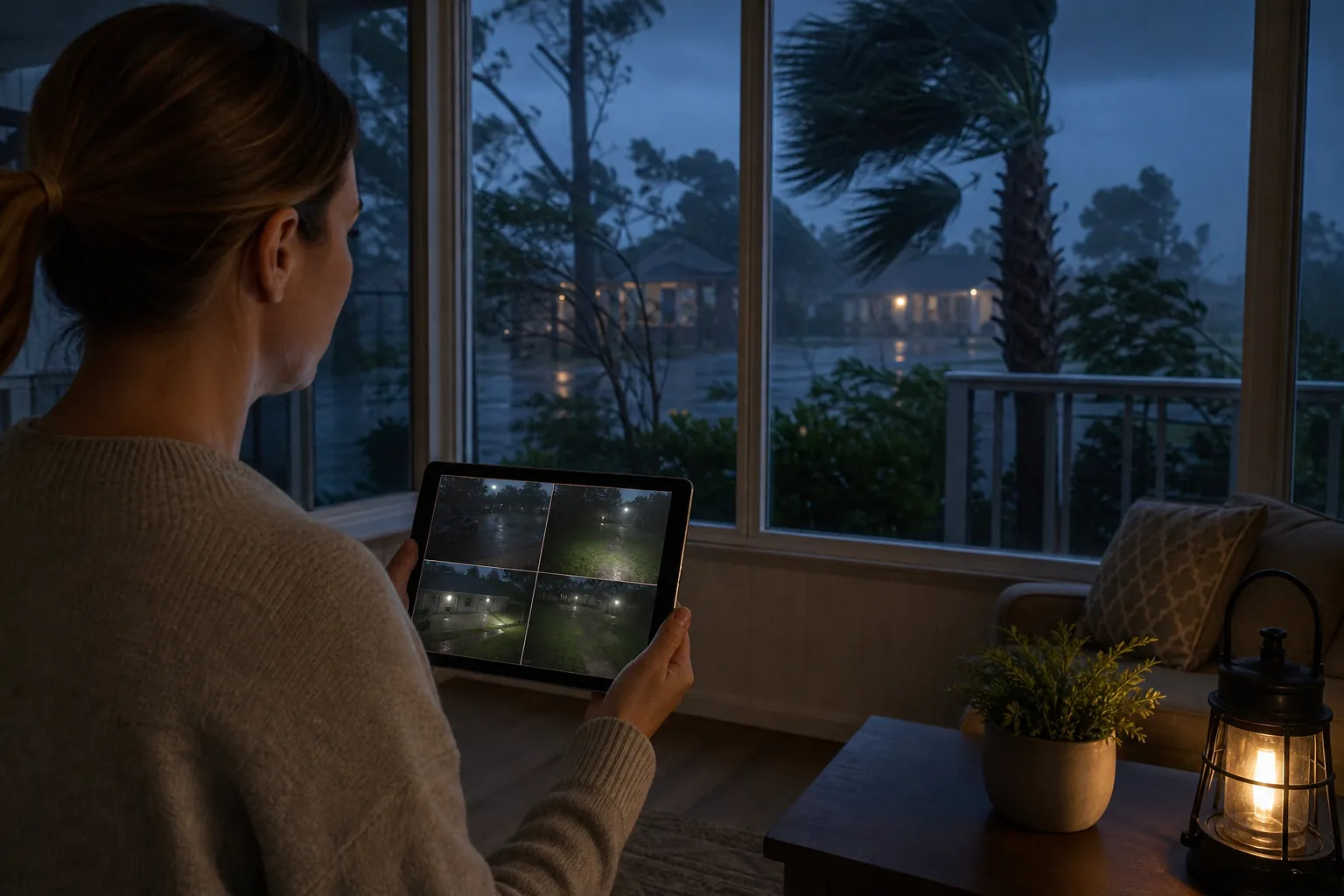
Keep people away from a tree or branch that appears damaged, hanging, or unstable, rather than trying to test it. OSHA describes falling limbs and unstable trees as hazards in storm-damaged tree work, and also warns that downed electrical conductors can energize trees and fences. Review the tree trimming information and use the contact page only as general information and a neutral way to reach Florida Foliage.
Do not touch a downed conductor, tree, or fence that may be in contact with one. OSHA’s hurricane tree-work guidance says downed electrical conductors can energize trees and fences and advises avoiding both direct and indirect contact. Read OSHA’s guidance on tree-work hazards. If you see a conductor down, keep away from the area and do not use a tree or fence as a route around it.
Tree material can also be under tension, and rolling or sliding limbs are hazards, according to OSHA’s storm tree-work guidance. You do not need to identify tension or predict how material might move. The useful household action is to keep people away and avoid touching or moving it.
Use this short sequence to pass on what you know without turning the check into an inspection:
- Write down the location and what you can plainly see from indoors.
- Note any visible downed conductor or material that appears to be in contact with a tree or fence, without approaching it.
- Tell everyone in the household which route or yard area to avoid.
- Leave tree work and close assessment for a later discussion with an appropriate professional.
These steps help keep the household plan simple. They do not establish that an unseen part of the yard or tree is clear. If you are unsure what lies between your viewing point and an exit, choose a different route that you already know is clear.
How Should You Keep People Away From Debris?
Choose an indoor place for household updates and give everyone the same simple directions about routes to avoid. OSHA advises keeping nonessential people away from debris machinery and outside tree-work and drop areas. For general company context, read about Florida Foliage, and see the tree removal service information for background, not a statement about work in Pensacola.
After a storm, outdoor areas may contain more than branches. OSHA notes that debris can hide meters and fire hydrants. Do not move debris or step into a pile to check what is underneath. If you notice a leaking chemical container, stay clear; OSHA says specialist evaluation is needed. These points are in the agency’s hurricane debris collection guidance.
Keep household plans separate from cleanup activity. If machinery is present, keep nonessential people away from it, as OSHA advises in its debris collection guidance. Do not assume that a familiar yard feature is visible beneath debris. A meter or hydrant may be obscured, so leave the area as it is rather than searching through material.
- Choose one person to share the household directions so people do not receive conflicting instructions.
- Ask children and visitors to stay inside and use a route that avoids the area you noted.
- Do not gather around a tree-work area or debris machinery; OSHA advises keeping nonessential people out of those areas.
- If you see a leaking chemical container, stay clear and do not handle it; OSHA says specialist evaluation is needed.
- Do not treat a debris pile as a place to search for a meter, hydrant, or other hidden feature.
Keep the directions short and repeat them if household members change rooms or return home. A note on an indoor table can help: name the area to avoid, the route to use instead, and who has the latest update. The note is a communication aid, not a sign that the rest of the yard has been checked.
What Should You Record for a Later Tree Discussion?
Make a brief record of visible details while you remain in a place you consider clear. Keep observations separate from guesses, and do not go outside to improve a view. The tree trimming overview and tree removal overview explain service categories in general; neither link says that Florida Foliage has a Pensacola office or crew.
A useful record is plain and limited. Note the location, what is visible, and whether the view was from a window or another place indoors. If something blocks your view, say so. This helps another person understand the limits of your observation instead of mistaking a partial view for a complete account.
You can also save a photo taken from indoors, if doing so does not require approaching the area. Label it with the time and viewing location. Treat it only as a record of what appeared in that frame. Do not use photos as proof that a tree, branch, fence, or route is safe.
- Write “branch on the driveway near the front” rather than assigning a cause or predicting what will happen.
- Record whether you saw a downed conductor from indoors, and do not approach to confirm its location.
- Note which paths you have told household members to avoid.
- Include what you could not see, such as the far side of a tree or an area hidden by debris.
Keep the note in one place so you do not need to repeat a nighttime check. A later conversation can begin with the visible facts and the limits of your view. The note is not a tree diagnosis and does not establish that a yard is clear for work or ordinary use.
How Can You Choose a Calm Next Step?
Once people know which area to avoid, pause and decide what information you need next. Florida Foliage is headquartered in Daytona Beach, not Pensacola. You can read the company background or use the contact page to share a general question; neither is a promise of local availability or a response time.
If you choose to contact Florida Foliage, describe what you observed and where you observed it. You can call (386) 481-7913 or use the contact page. This is a neutral contact step, not a guarantee of a particular service, visit, or outcome. Avoid sending someone into the yard to gather details that you cannot see from indoors.
Keep the focus on what is known. A branch on the ground is an observation. Whether a tree is stable, whether more material could fall, or what work is appropriate requires assessment beyond that observation. Do not try to settle those questions through a photo or a close look in the dark.
- Share the location, visible condition, and limits of your view in plain language.
- Say whether you noticed a downed conductor or leaking chemical container from a place you already considered clear.
- Keep household members away from the area while the next step is being considered.
- Do not assume that a contact form or phone call means a local crew is available in Pensacola.
A calm night plan is modest: stay out of the debris field, communicate a route to avoid, record what is visible, and leave tree assessment and work for a later discussion. When daylight comes, do not treat a brighter view or a photograph as proof of safety. Keep your notes factual and let the next conversation start from what you actually saw.
Frequently Asked Questions
Should I walk into the yard with a flashlight after a hurricane?
Should I walk into the yard with a flashlight after a hurricane? No. Treat the first check as an indoor observation, not a reason to enter a debris field. OSHA identifies falling limbs and unstable trees as hazards in storm-damaged tree work. A flashlight does not make a yard suitable for close inspection. Note what you can see from a place you already consider clear, and keep others away.
Can a photo show that a tree is safe?
Can a photo show that a tree is safe? No. A photo can record one view at one time, but it is not proof that a tree is safe. Use it only as a note about what appeared visible from your viewing place. Do not go closer to take a better picture, and do not use an image to replace a later tree-work discussion.
What should I do if a conductor is down near a tree?
What should I do if a conductor is down near a tree? Keep away and do not touch the conductor, tree, or fence. OSHA says downed electrical conductors can energize trees and fences, and advises avoiding direct and indirect contact. Do not approach to check where the conductor leads or to get a clearer view. Share only what you can observe from a place you already consider clear.
What if I see a leaking container among storm debris?
What if I see a leaking container among storm debris? Stay clear and do not handle the container. OSHA’s hurricane debris collection guidance says to stay clear of leaking chemical containers and that specialist evaluation is needed. Keep household members away from the area, and do not search through nearby debris. If you cannot tell what is in a container, do not move closer to identify it.
Does contacting Florida Foliage mean a Pensacola crew is available?
Does contacting Florida Foliage mean a Pensacola crew is available? No. Florida Foliage is headquartered in Daytona Beach, and a contact step does not promise local availability, a visit, or a response time. For general information, use the contact page or call (386) 481-7913 . Share only the visible observations you can report without going closer.
For a broader overview of hurricane tree cleanup in Pensacola, see the Pensacola hurricane tree cleanup guide.
Call (386) 481-7913 to talk through next steps.