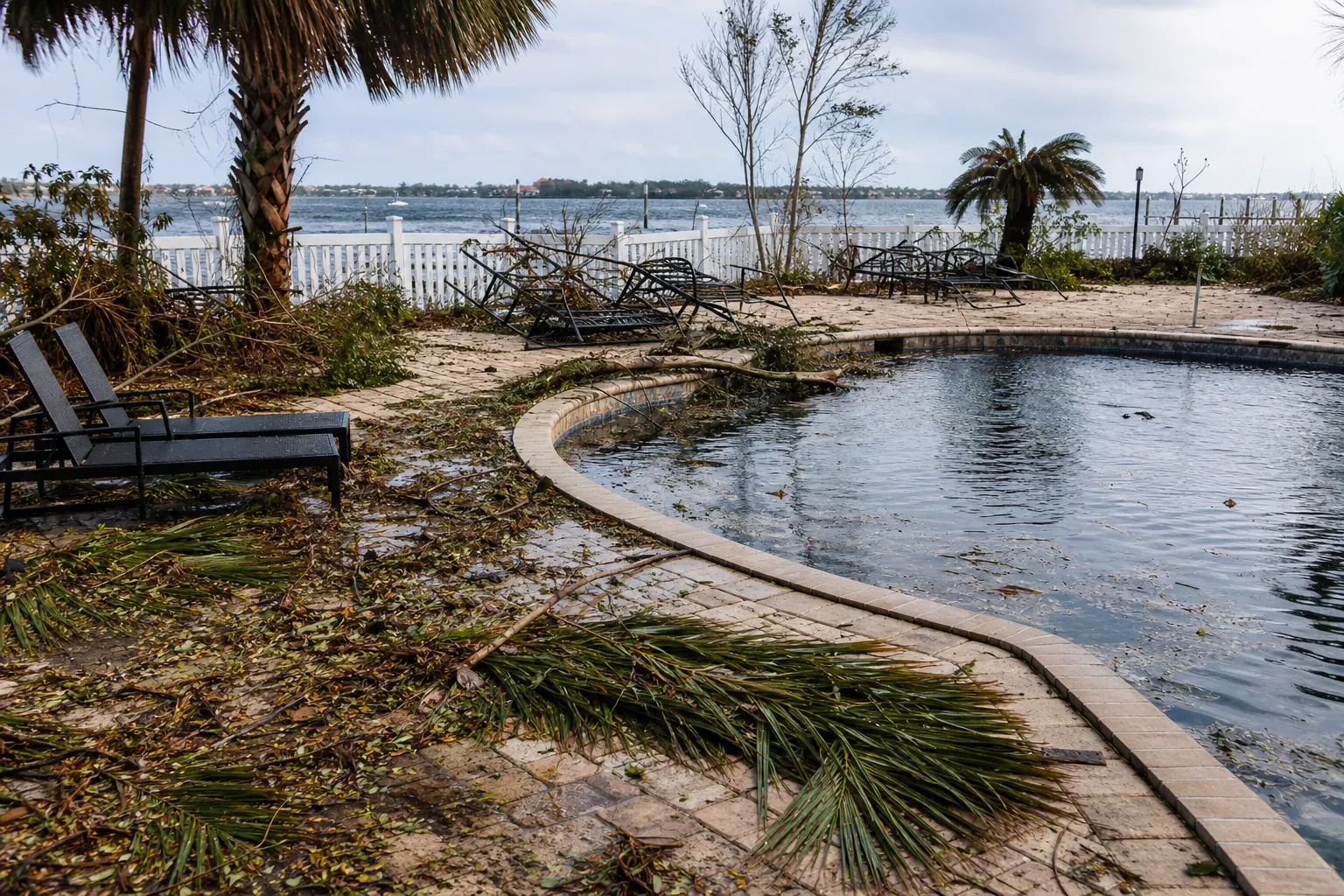
After a hurricane, keep household members away from a pool area covered by storm limbs or debris, and use another route if one is available. Do not treat a photograph or a quick look as proof that a tree is safe. Note visible conditions from a place you can comfortably observe, and leave questions about damaged trees or debris movement for a tree-work discussion. The aim is to keep people clear of the affected area while you organize the next household steps.
What Should You Do First After Storm Debris Reaches the Pool?
Start by telling everyone in the household that the pool area is not in use while limbs or debris cover it. Pick a different path for everyday movement, if one is practical. The contact page offers a neutral way to ask a question, and the about page explains who Florida Foliage is. Neither page says that service is available in Pensacola.
Keep the first response simple and focused on people, not on making the yard look tidy. A blocked deck, covered furniture, or debris on a screen is enough reason to pause ordinary pool use. You do not need to decide what happened to a tree before you can set a household boundary around the affected space.
- Tell household members and visitors which part of the yard is off limits for now.
- Choose an alternate route that does not pass through the debris-covered pool area.
- Make a brief written note of what you can see, without treating that note as a tree assessment.
Keep the message calm and consistent. For example, say that the pool area is temporarily out of use because debris is present, and that the household will revisit the plan after a tree-work conversation. Avoid suggesting that the area is safe simply because a limb appears still or because the pool itself is visible. A still scene is only what you can observe at that moment.
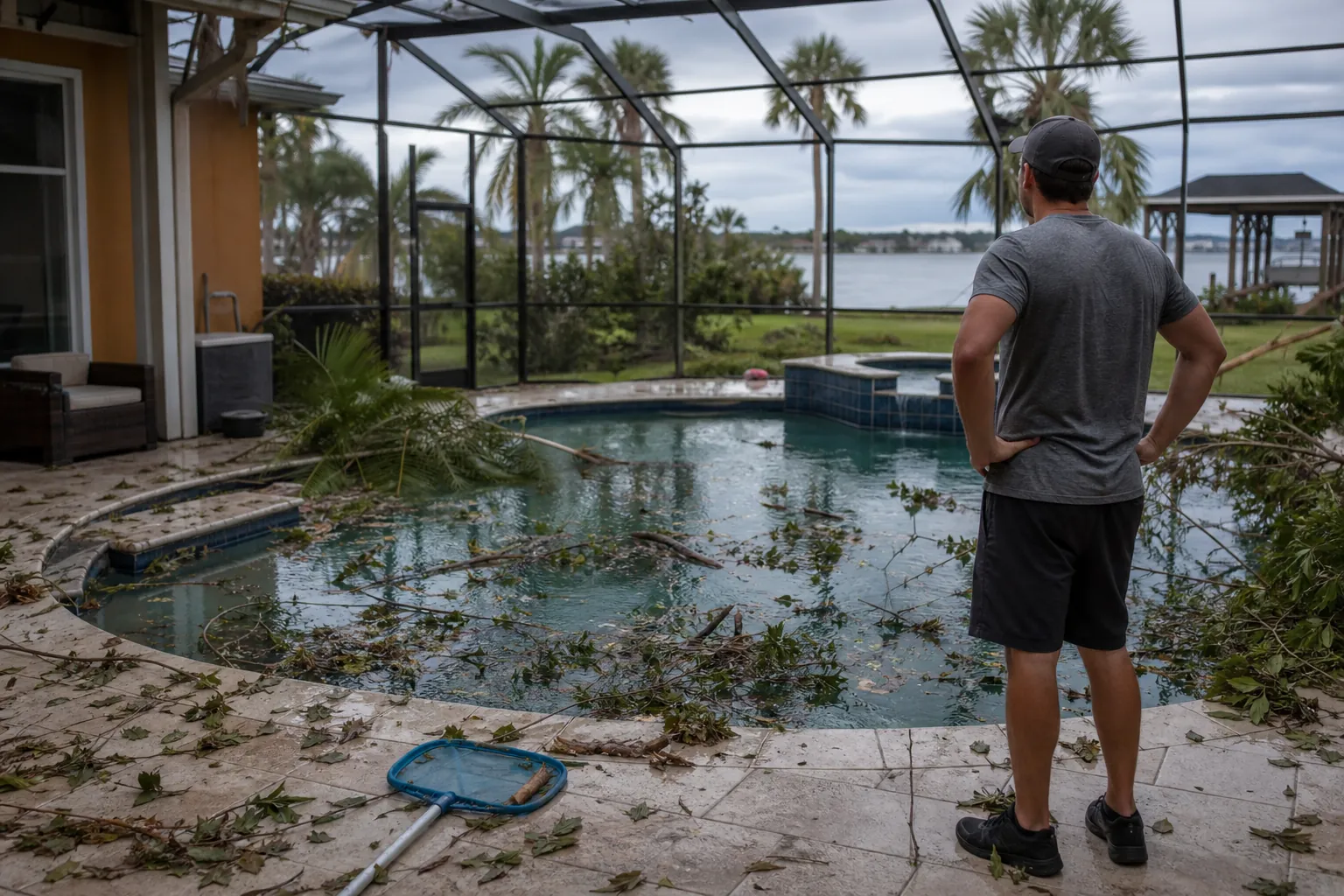
How Can You Plan Alternate Pool Access?
Plan a route that keeps people away from the affected deck, screens, furniture, and limbs rather than trying to pass through or around debris. A useful first step is to state where the alternate route begins and ends. The tree trimming page and tree removal page provide context about those topics, but do not establish Pensacola service availability.
Think through normal household routines before explaining the change. Consider how people get to the yard, where they leave towels or pool items, and whether visitors might follow their usual route without asking. These are ordinary organizing questions, not a technical assessment of the tree or debris.
- Tell everyone which entrance or path to use instead of the pool-side route.
- Put a simple reminder where household members will see it before heading toward the pool.
- Ask visitors to check with a household member before going into the yard.
If there is no convenient alternate route, make the household plan clear that the pool area is not part of the current routine. Do not feel that you must create access through the affected space to keep normal plans. A postponed swim or a changed path is a straightforward way to avoid treating a debris-covered area as an ordinary walkway.
Keep the plan easy to repeat. A short message such as “Use the side path; the pool area is closed for now” is more useful than a long explanation that leaves room for different interpretations. Revisit the household message when visible conditions change or after you have had a tree-work discussion. Do not use a photo as confirmation that the space has become safe.
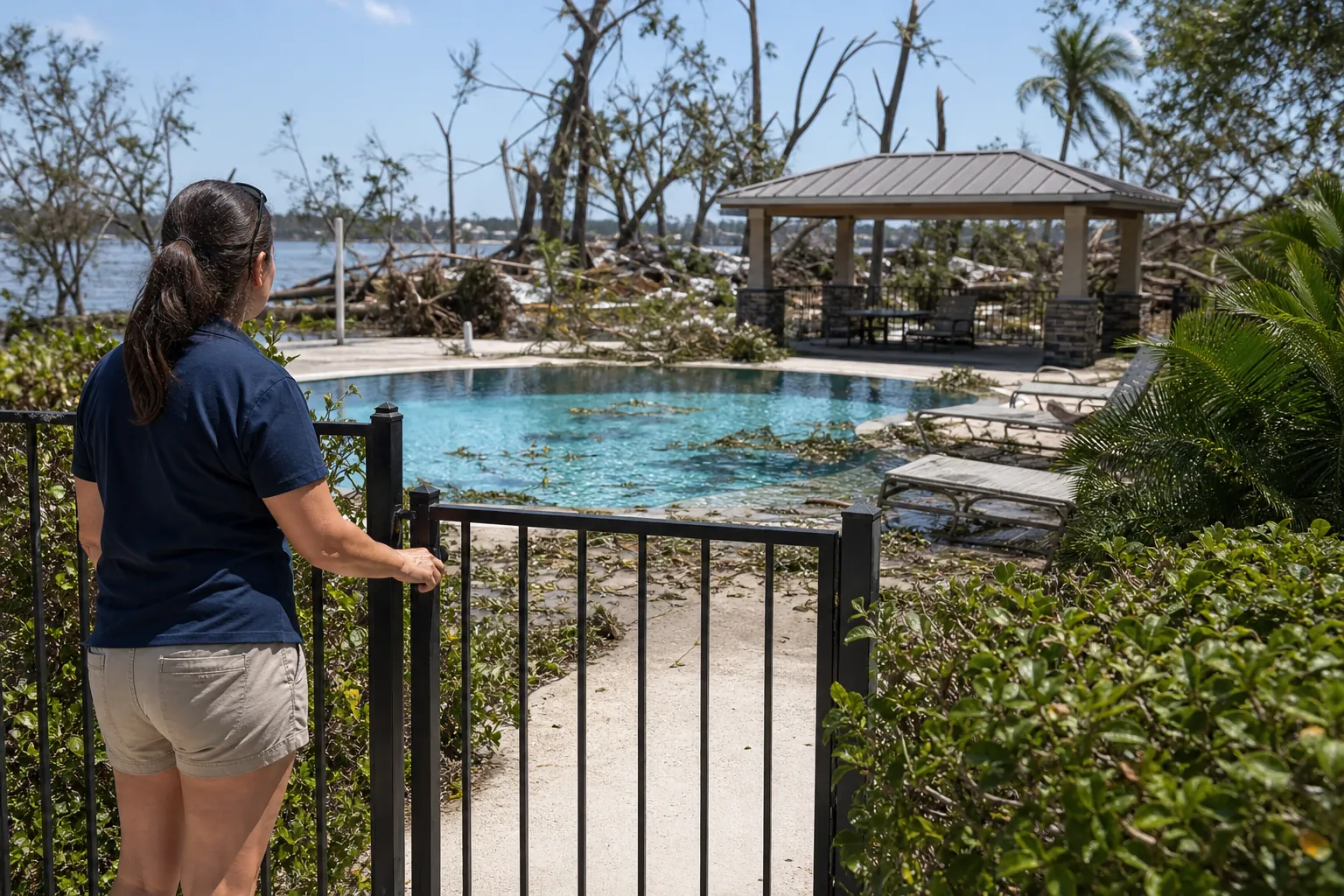
What Can You Observe Without Diagnosing a Tree?
Describe what is visible rather than deciding what it means. You might note that a limb rests across a screen, that debris covers part of the deck, or that a tree appears damaged. For general context, see the Florida Foliage about page and the contact page; neither turns a household observation into a diagnosis or says that crews are based in Pensacola.
Use plain, specific words in a note for yourself. Record where the debris appears in relation to the pool area, what household access it affects, and whether you noticed something that merits a question. Avoid labels such as “stable,” “safe,” or “ready to clear” when you do not have a basis to make that judgment.
- Write down visible details, such as “debris is on the deck” or “a limb is across the screen.”
- Separate what you saw from what you think may have caused it.
- Keep photographs as personal records only, not as proof that a tree or area is safe.
There is a useful difference between seeing a limb and knowing whether a tree is stable. OSHA describes storm-damaged tree work as involving falling-limb and unstable-tree hazards in its storm tree-work guidance. That is a reason to avoid turning a household visual check into a conclusion about the tree. Keep your notes factual and leave the assessment question for a suitable tree-work conversation.
It can also help to record what you do not know. For instance, you may be unsure whether debris is attached to a tree or resting on a screen. Stating that uncertainty is more useful than guessing. The point of noting visible details is to communicate clearly, not to decide on a work method or judge whether the pool area can reopen.
Why Is Storm Debris Around a Pool a Reason to Keep People Clear?
Storm debris can involve hazards that are not clear from a quick look. OSHA notes that damaged tree work can involve falling limbs and unstable trees, and that tree material under tension or limbs that roll or slide can pose hazards; see its tree-work safety guidance. The tree removal page and tree trimming page offer service-topic context, not a local availability statement.
Electrical conductors add another concern. OSHA states that downed conductors can energize trees and fences and advises avoiding direct or indirect contact. If a conductor is down near the pool area, do not touch it, a tree, or a fence that may be connected to it. Read the linked OSHA guidance for that specific safety point.
- Keep household members away from an area where storm debris is present.
- Do not make contact with a downed conductor, tree, or fence that may be energized, as OSHA advises in its tree-work guidance.
- Do not approach a leaking chemical container; OSHA says specialist evaluation is needed in its debris collection guidance.
OSHA also says nonessential people should stay outside work and drop areas, and that nonessential people should be kept away from debris machinery. Those points apply to work activity, not just to how a pool deck looks. Keep people out of an active work area rather than gathering to watch or trying to direct activity from nearby. The relevant details are in OSHA’s tree-work guidance and debris collection guidance.
How Can You Keep Household Communication Simple?
Use one shared message about the affected space, the alternate route, and who should answer questions. The about page introduces Florida Foliage, while the contact page gives a neutral channel for a question. These links are background information and do not imply a Pensacola office, crew, response time, or local availability.
Household plans are easier to follow when they use everyday language. Avoid giving different instructions to different people, or relying on someone to notice a change in the yard without being told. A written reminder can be useful for family members and visitors who are not part of the initial conversation.
- Choose one short description of the affected area, such as “the pool deck with storm debris.”
- Agree on the alternate route and repeat it in the same words to everyone.
- Choose a household member to answer questions and update the message when the plan changes.
- Keep the pool-area reminder in place until the household has a clear reason to change its routine.
Keep the note factual and avoid promising a reopening time. You can say that the household is keeping clear of the area while it considers what to do next. This gives people useful direction without asking them to judge a tree from a distance or assume that a change in appearance means the area is ready for use.
If someone asks whether the tree is safe, it is fine to say that you have not determined that. A visible observation is not the same as a professional assessment. Keep the question separate from the access plan: the family can follow the alternate route while you decide whether to seek a tree-work discussion.
What Should You Ask During a Tree-Work Discussion?
Describe the pool-area issue and ask what information would be useful for a discussion about the tree or debris. Do not propose a work method based on a photograph or guess at a diagnosis. The tree trimming information and tree removal information explain the site’s service topics, but they do not say that those services are available in Pensacola.
Keep your description grounded in what you can observe: where the debris is, what part of the pool area it covers, and how it affects household access. If you have a question about what you noticed, state it as a question rather than presenting it as a conclusion. That leaves room for a conversation without treating a homeowner’s observation as a diagnosis.
- Explain that the concern is storm debris near a pool deck, screen, furniture, or access route.
- Share only the visible details you can describe clearly, and say when you are unsure.
- Ask what the next appropriate discussion step is, without assuming a local crew or a particular outcome.
Florida Foliage is headquartered in Daytona Beach and has no Pensacola office. A website page or phone conversation should not be read as confirmation of local availability. The company is owned by Clinton Funk, who has decades of hands-on tree care experience. Tim Francis is the author and has editorial responsibility for this article. No personal review of this draft by Clinton Funk is represented here.
When Is It Useful to Contact Florida Foliage?
Contact can be a neutral first step if you want to ask whether a tree-work conversation is appropriate for the visible situation. Florida Foliage is based in Daytona Beach, not Pensacola, so contact does not promise local availability or a particular response. Use the contact page or the about page to learn more about the company before deciding what to ask.
You can also call (386) 481-7913. Keep the call focused on a simple description of what you see and the question you want to ask. There is no need to call a visible condition safe or unsafe; explain that you are looking for guidance about whether a tree-work discussion makes sense.
- State that the location is Pensacola and describe the pool-area debris in plain terms.
- Ask whether the company can discuss the situation, without assuming that local service is available.
- Continue using the household alternate-access plan while you consider what you learn.
If contact is not the right next step, you can keep the household plan in place and use your own judgment about whom to approach. A phone call or web page does not replace an assessment of a damaged tree. Keep the main priorities simple: people stay away from the affected pool area, observations remain distinct from conclusions, and no one treats a picture as proof of safety.
How Can You Keep the Plan Useful Over Time?
Keep the household plan focused on current observations and the route people should use, then update it if circumstances change. The contact page is a place to ask a general question, and the tree removal page describes a service topic. Neither makes a claim about Pensacola availability or tells you whether a particular tree is safe.
Try to separate three things in your notes: what you saw, what the household is doing, and what question remains. For example, you might record that debris covers part of the screen, that everyone is using another route, and that you have not determined whether the tree needs attention. This simple format reduces guesswork when you explain the situation later.
- Update the household reminder if the route or affected area changes.
- Keep descriptions factual, and leave uncertain details marked as uncertain.
- Do not change the pool-area plan just because a photograph or brief glance looks different.
For additional safety context, OSHA notes that storm-damaged tree work can involve unstable trees, falling limbs, tensioned material, and limbs that roll or slide. The guidance is about hazards associated with tree work; it is not a way to diagnose your yard from a description. Keep nonessential people outside work and drop areas as OSHA advises in its tree-work guidance.
A calm, repeatable plan is useful even while you have unanswered questions. Household members can follow the alternate route without reaching a conclusion about the tree. When you are ready to ask about tree work, explain what you can see, what access it affects, and what you do not know. That is enough to begin a clear conversation.
Frequently Asked Questions
These short answers reinforce the household steps above. The tree trimming page and contact page provide general context, but neither confirms service availability in Pensacola.
Should we use the pool if limbs cover the deck?
Keep household members away from the debris-covered pool area and use another route if one is practical. Do not treat a quick look or photograph as proof that the area or tree is safe. If the debris raises a tree-work question, describe what you can observe without trying to diagnose it.
Can I tell whether a storm-damaged tree is safe from a photo?
No. A photo shows only a view at one time and does not establish that a tree is safe. OSHA identifies falling limbs and unstable trees as hazards in storm-damaged tree work. Keep your notes limited to visible details, and leave questions about the tree for an appropriate tree-work discussion.
What if a downed electrical conductor is near the pool?
Do not touch the conductor, a tree, or a fence that may be connected to it. OSHA warns that downed conductors can energize trees and fences and advises avoiding direct and indirect contact. Keep household members away from the affected area and refer to OSHA’s tree-work safety guidance.
What should I tell household members and visitors?
Give everyone the same short message: the pool area has storm debris, it is not part of the current route, and they should use the alternate path. A written reminder can help visitors who do not know about the change. Keep the message about access and visible conditions, not a conclusion that the tree is safe.
Does calling Florida Foliage mean service is available in Pensacola?
No. Florida Foliage is headquartered in Daytona Beach and does not have a Pensacola office. You may call (386) 481-7913 or use the contact page to ask a neutral question, but contact does not confirm local availability or a particular response.
For a broader overview of hurricane tree cleanup in Pensacola, see the Pensacola hurricane tree cleanup guide.
Call (386) 481-7913 to talk through next steps.