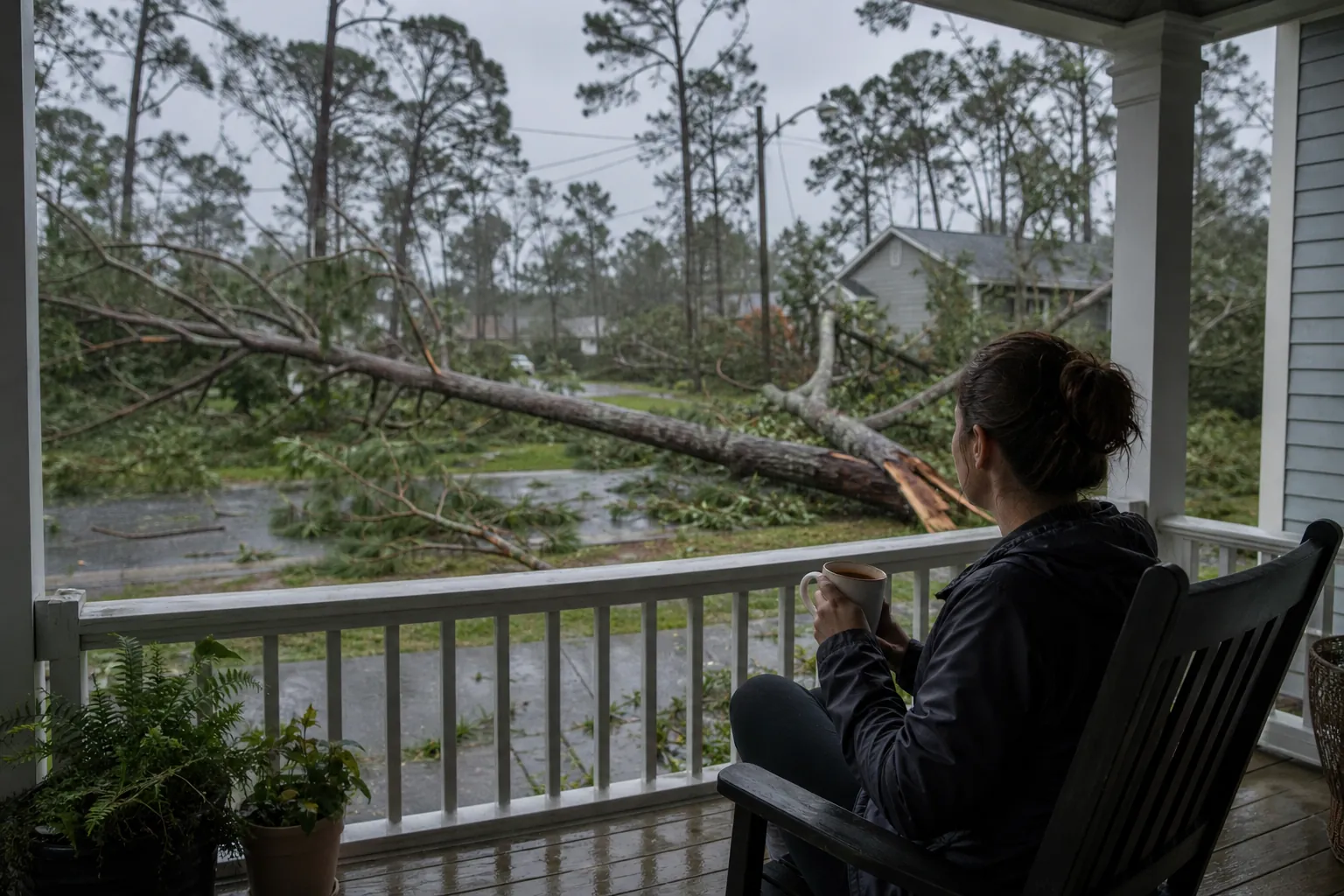
After a hurricane, observe tree changes only from a place where you can stay clear of hanging limbs and tree debris activity. Storm-damaged trees can present falling-limb and unstable-tree hazards, so do not walk beneath a hanging limb to get a closer look (OSHA information on storm-damaged tree hazards). Make a brief record of what you can see, where you saw it, and when you noticed it. Keep observations separate from conclusions, and do not use a photo as proof that a tree is safe.
What Does Safe Porch Observation Mean?
Start with the limits of observation, not a goal of getting a perfect view. The Florida Foliage company background and its tree trimming service information can provide general context, but neither changes what you can safely observe from where you are.
A porch, doorway, or window may give you a view without requiring you to approach the tree. Choose only a place where you can stay out of the area where tree debris is being handled. Storm-damaged trees can have falling limbs, and unstable trees are a hazard (OSHA information on falling limbs and unstable trees). If your usual viewing spot does not feel suitable, skip the observation. A record can wait; a closer view is not worth pursuing.
- Look from a spot you can remain in without walking under a hanging limb.
- Do not enter an area where tree debris is being handled or where people are working.
- Ask other household members to leave the observation to one person rather than gathering near the tree.
- Stop if your view would require you to move closer or around the tree to see more.
These are practical boundaries for collecting notes, not a way to decide whether a tree is sound. Keep the words in your record plain and limited to what is visible. If you cannot tell what you are looking at from your chosen spot, write that down rather than trying to resolve it yourself.
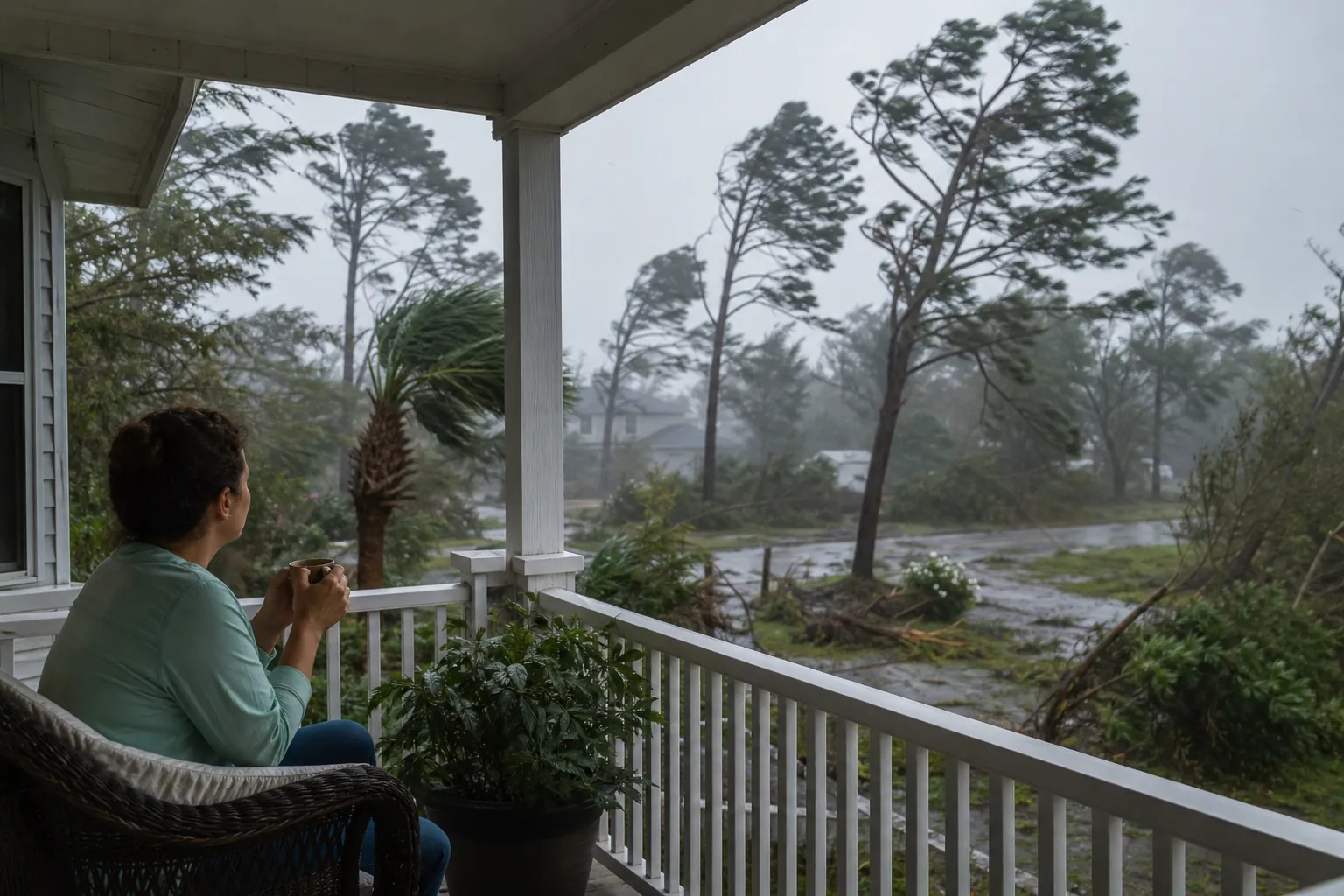
How Can You Prepare to Make Notes?
A little household organizing can make observations easier to find later. The contact page is a neutral route for general company questions, while the company information page offers background about Florida Foliage. Neither link is a promise of local service or a substitute for your own observations.
Choose one place for notes, such as a notebook or a folder on a household device. Use a simple format that does not encourage you to investigate. Before you begin, decide what you will record and what you will leave unknown. For example, a note can say that a branch is hanging over a visible part of the yard. It need not guess why it is hanging or what may happen next.
- Write the date and approximate time that you made the observation.
- Note the viewing place in everyday terms, such as “front doorway” or “kitchen window.”
- Describe the part of the tree or yard you can see without assigning a cause.
- Keep your record in one place so household members do not have to search through messages.
If you share the notes with someone, explain that they describe only what you saw from that place at that time. Trees and surrounding conditions may change, and a written record is not a current assessment. Do not revisit an observation simply to make the description more complete.
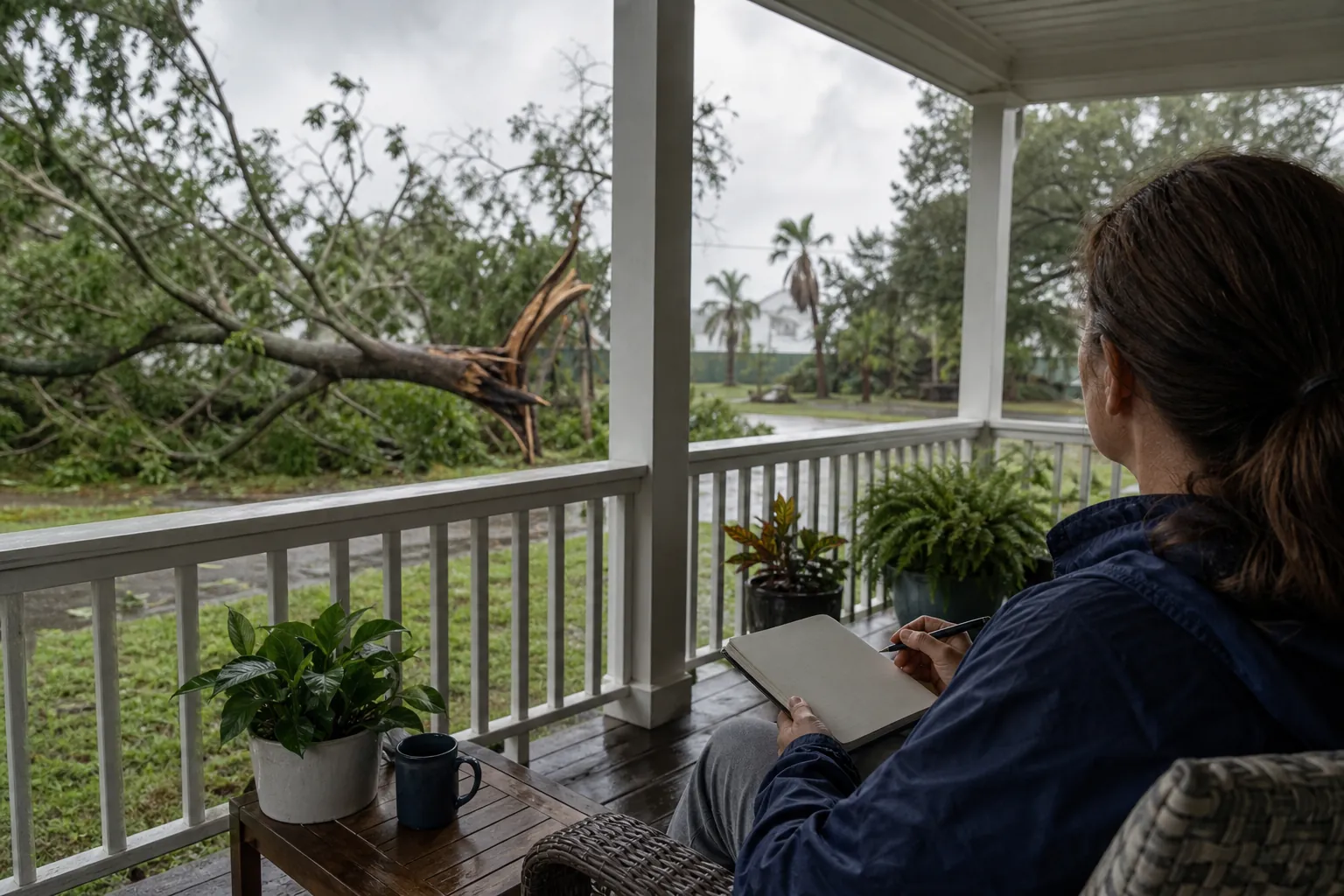
What Details Are Useful to Record?
Useful notes are specific about visible details and modest about what they mean. The tree removal service overview and tree trimming service overview describe different service categories; they are not a basis for deciding which category a particular tree may need.
Describe what is in view in simple terms. You can identify a location by relating it to a fixed feature you already know, such as the driveway or a corner of the house. Avoid moving around to establish a better angle. If a feature is hidden, say it is hidden. A clear note about what you cannot see is more useful than a guess presented as fact.
- Record visible changes, such as a limb that was not hanging in that position in an earlier observation.
- Describe where debris is visible without approaching it to sort or move anything.
- Note whether a view is blocked by a structure, foliage, or other material.
- Use neutral words such as “visible,” “not visible,” and “unclear from this spot.”
- Keep separate observations on separate lines instead of joining them into a theory.
Avoid writing that a tree is safe, unsafe, healthy, or likely to fail based only on what you see. Those are conclusions, not simple descriptions. If you do not know whether a feature is new, record that uncertainty. Do not fill the gap by going out to look beneath a limb or by asking someone else to approach it for a better view.
Should You Go Closer to Check a Hanging Limb?
No. Do not walk beneath a hanging limb to get a closer look. Storm-damaged tree work can involve falling-limb and unstable-tree hazards (OSHA information on storm-damaged tree hazards). Use only a view you already have from a place you can remain, and leave uncertain details uncertain.
For general context, you can read the tree trimming service description and the company contact information. These pages do not tell you to approach a tree or establish that a service is offered in your area.
- Do not step underneath a hanging limb to see where it connects.
- Do not move debris to reveal a part of the tree that is out of view.
- Write “not visible from my observation spot” when the view is incomplete.
- Let the observation end when it would require you to move closer.
What If You See a Downed Electrical Conductor?
Do not touch a downed electrical conductor, a tree, or a fence that may be in contact with one. A downed conductor can energize trees and fences, and direct and indirect contact should be avoided (OSHA information on electrical conductors near trees and fences). Do not approach to check what is touching what.
The company background page and contact page are for general company information, not urgent hazard guidance. Keep your own observation brief and make no attempt to investigate the conductor or nearby materials.
- Keep your notes to what is visible from your current place.
- Do not touch the conductor, tree, or fence, directly or indirectly.
- Do not ask another household member to approach and confirm what you saw.
Are Photos Proof That a Tree Is Safe?
No. A photo records a view, not a diagnosis, and it cannot establish that a tree is safe. Storm-damaged trees can have falling-limb and unstable-tree hazards, which are not resolved by taking a picture (OSHA information on storm-damaged tree hazards).
The tree removal service information and tree trimming service information are general descriptions, not photo-based assessments. If you choose to keep an image, take it only from a place you already occupy without moving closer. Treat it as an optional note, not as proof or a reason to revisit the area.
- Keep any image with its date and a short note about where you were standing.
- Do not take another picture if a clearer view would require approaching the tree.
- Do not use an image to label a tree safe or to settle what may have caused a change.
How Do You Separate Observation from Diagnosis?
An observation states what you can see; a diagnosis explains what it means. The Florida Foliage background page and tree removal service page offer company context, but your notes should not present a view from a porch as an expert conclusion.
Use descriptions that another person can understand without having to accept a guess. “A limb is visible above the side yard” describes a view. “The tree is failing” assigns a cause and outcome that you cannot establish from that sentence. When the right description is unclear, say so. It is fine for an observation log to contain unanswered questions.
- Write “I can see a split-looking area” rather than deciding what caused the appearance.
- Write “I cannot see the base from this window” rather than moving to find it.
- Record “the view is different from my earlier note” without predicting what will happen next.
- Keep other people’s guesses separate from your own direct observations.
This distinction also helps when you speak with someone later. You can share the date, place, and visible details without presenting your notes as a professional assessment. If you are unsure what a word means, choose a simpler description instead of using a technical label. The purpose is a clear record, not a decision about the tree.
How Can You Keep the Household Record Clear?
A short, consistent log is easier to read than a long stream of messages. The contact page offers a general route to the company, and the about page provides its background. Keep either page separate from your own dated observations.
Use a new entry each time you notice something, and do not erase an earlier description just because a later view looks different. A record can show what you noticed at different times without explaining why things changed. Keep access simple for the household, but avoid asking anyone to go outside or inspect the tree to complete missing information.
- Write the date and time, then name the place from which you observed.
- Describe only the details visible from that place, using ordinary words.
- Mark anything hidden or uncertain instead of filling in a likely explanation.
- Keep optional images with the matching note, and do not treat them as proof of safety.
- Stop the entry when further detail would require approaching the tree or debris.
For example: “Late afternoon, back doorway. A limb is visible over the lawn. The point where it joins the tree is not visible from here.” This kind of note is limited, but it tells a reader what you saw and what you could not see. It does not make a prediction or suggest a remedy.
What Should You Do Around Debris or Leaking Containers?
Keep away from debris machinery and leaking chemical containers. Nonessential people should stay away from debris machinery, and leaking chemical containers need specialist evaluation (OSHA information on debris collection and leaking containers).
The tree removal service overview and company contact page provide general company information only. Do not use them as a reason to approach machinery, containers, or debris. Leave the area alone and keep your observation to what is already visible from your current place.
- Do not go closer to debris machinery to identify what it is handling.
- Do not touch or approach a leaking chemical container.
- Do not move debris to look for a feature that is hidden.
- Make a brief note from your current location, or skip the note if you cannot observe without approaching.
How Can You Make a Neutral Follow-Up?
If you want general company information, you can use the Florida Foliage contact page or call (386) 481-7913. The company background page explains who Florida Foliage is. A contact step is simply a way to ask a question; it is not a promise about location, timing, or service.
When you reach out, keep your question focused on the information you need. You can say that you are in Pensacola, describe what you observed from a protected spot, and ask whether the company can provide relevant general information. Do not treat a call or message as a substitute for staying away from hazards. Florida Foliage is headquartered in Daytona Beach, and this article does not represent a Pensacola office or local crew.
The article is by Tim Francis, who is responsible for its content and editorial presentation. Florida Foliage owner Clinton Funk has decades of hands-on tree care experience. No personal review of this article by Clinton is represented.
Frequently Asked Questions
For more background, see the Florida Foliage company information and the contact page. The answers below focus on keeping household observations limited to what you can see without approaching a tree or debris.
Can I walk beneath a hanging limb to see it better?
No. Do not walk beneath a hanging limb for a closer view. Storm-damaged trees can present falling-limb and unstable-tree hazards (OSHA information on storm-damaged tree hazards). Use only a view you already have from a place you can remain, and note anything you cannot see.
What should I write if part of the tree is hidden?
Write that the part is not visible from your observation spot. Add the date, time, and place, then stop there. You do not need to move around the tree or clear anything to complete a note. A clear statement of what you cannot see is better than a guess about the hidden part.
Can a photo show that a tree is safe?
No. A photo captures one view and does not establish that a tree is safe. Keep an image only as an optional record of what you saw at a particular time and place. Do not approach for a better angle, and do not treat a photo as a diagnosis or as a reason to revisit the area.
What if a downed conductor is near a tree or fence?
Do not touch or approach the conductor, tree, or fence. A downed electrical conductor can energize a tree or fence, and direct and indirect contact should be avoided (OSHA information on electrical conductors near trees and fences). Do not investigate which objects may be touching.
How can I ask Florida Foliage a general question?
Use the contact page or call (386) 481-7913. You can share your location and a brief description of what you observed from a protected place, then ask what general information is available. Contacting the company does not promise service, timing, or a particular outcome.
For a broader overview of hurricane tree cleanup in Pensacola, see the Pensacola hurricane tree cleanup guide.
Call (386) 481-7913 to talk through next steps.