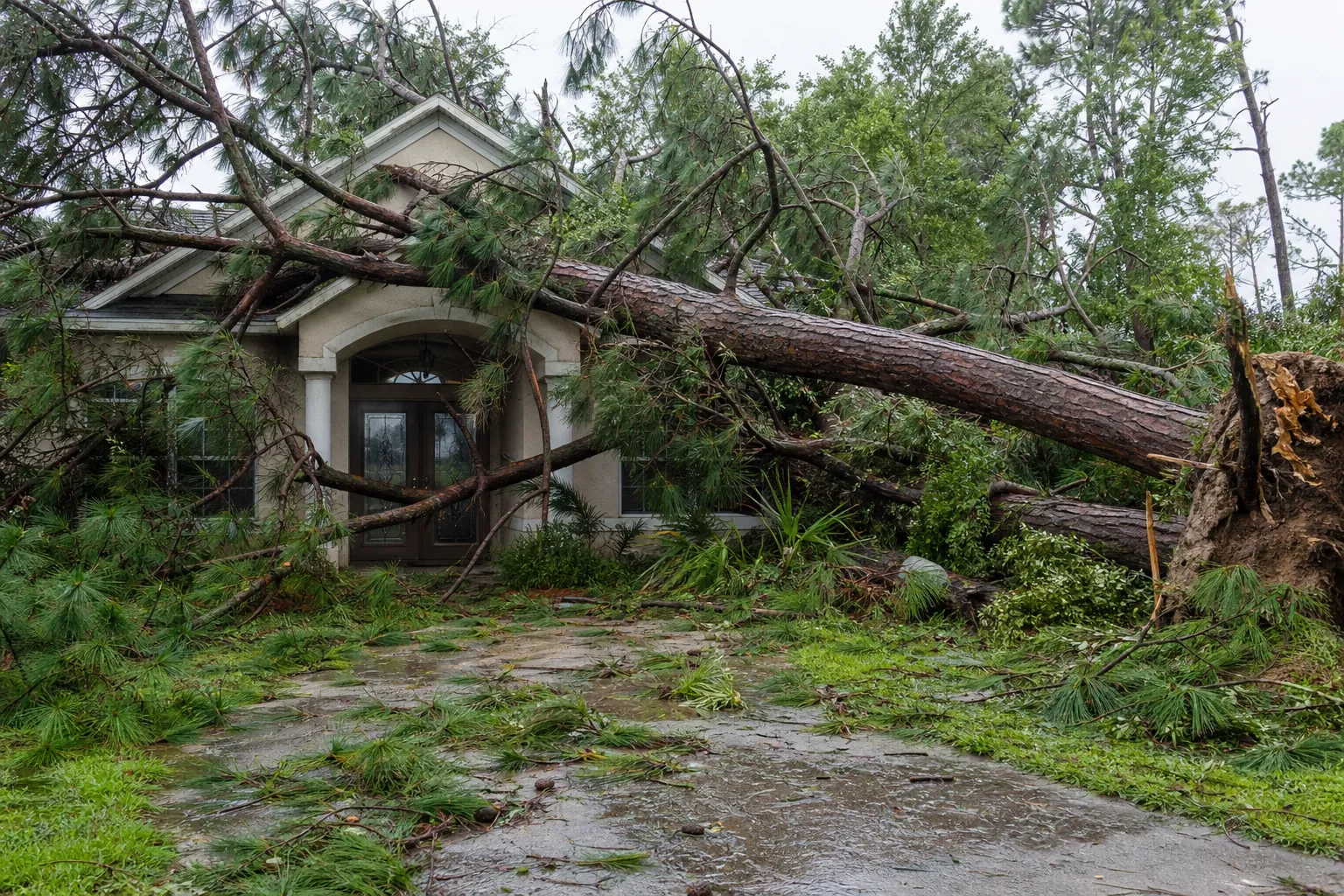
If a hurricane leaves a tree blocking your front door in Pensacola, focus on telling others what is happening, not planning cleanup. Tell emergency services if anyone is hurt, if people are inside, and if another exit seems accessible. Do not assume an opening is safe. Storm-damaged trees can have falling limbs and be unstable, as OSHA explains. This guide adds practical reporting and household organization steps to our emergency tree removal in Pensacola resource.
By Tim Francis, responsible for this article’s content and editorial presentation. Florida Foliage is headquartered in Daytona Beach. This article does not establish service availability in Pensacola or a local response schedule.
What Should You Do When a Tree Blocks Your Front Door?
Start by describing the blocked exit and who is affected. Do not decide how the tree should be moved. Our tree removal service overview explains this type of service. The contact page offers a separate way to ask general business questions. Neither replaces contacting emergency services about an immediate emergency.
A blocked front door is something you can observe. Whether the trunk is stable, a limb can move, or another route is safe are separate questions. Do not use a quick look to answer any of them.
If another exit seems accessible, tell the emergency dispatcher and ask what to do in your situation. Say if you can see that exit from where you are. Do not call a route clear just because its door opens if you have not checked it.
OSHA identifies tensioned tree material and rolling or sliding limbs as hazards during work on storm-damaged trees. This is why the article does not give homeowners instructions for moving or clearing a tree. Read OSHA’s storm tree hazard guidance.
- Say which door is blocked and whether it is the household’s usual exit.
- Say who is inside and whether anyone has an immediate medical concern.
- Describe another exit as visible, inaccessible, or not yet observed. Do not call it safe.
- Keep household notes separate from instructions from emergency services.
What Details Should You Share on an Emergency Call?
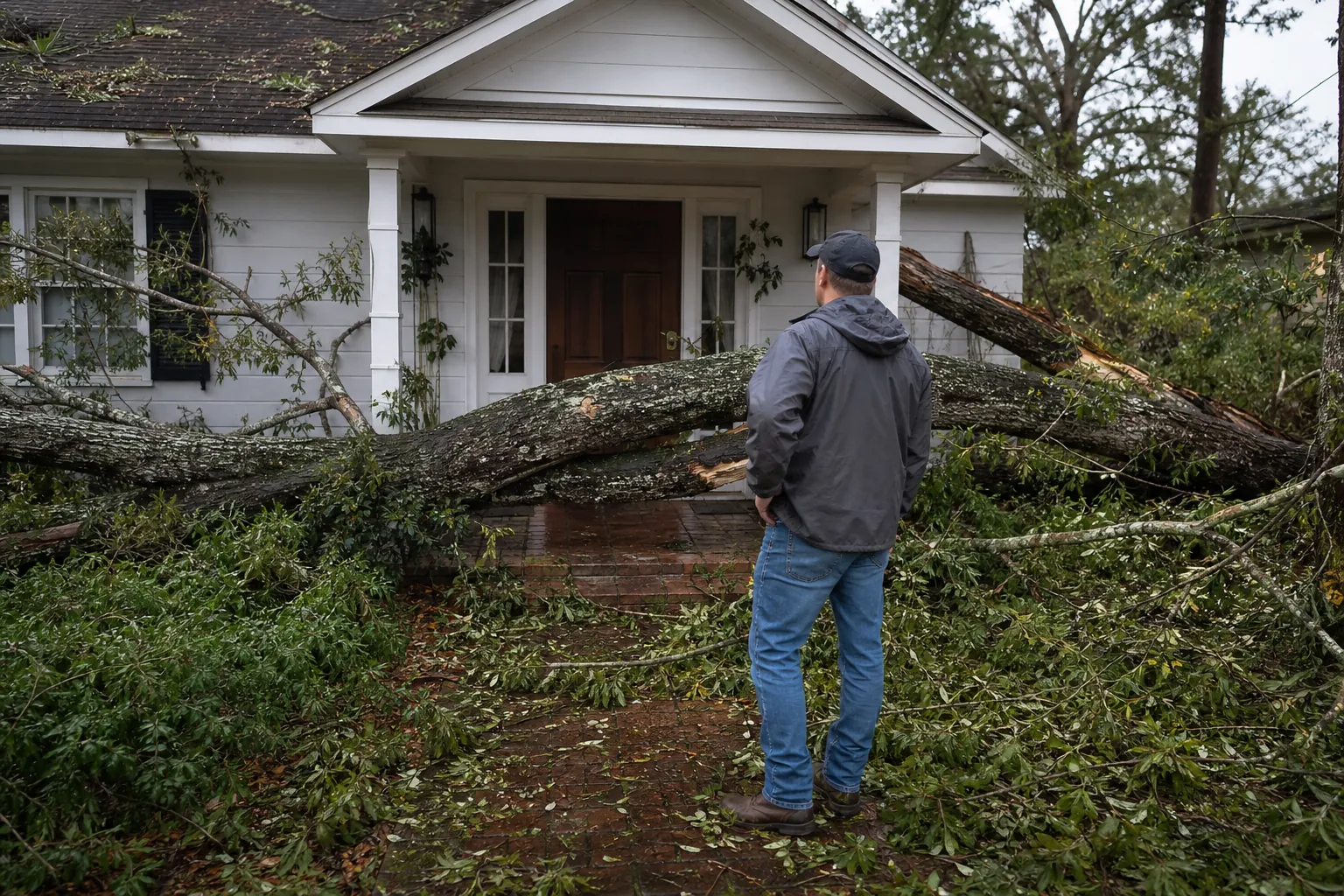
Give your location. Explain that a hurricane-damaged tree blocks the front door, and describe who is affected. Share what you can see instead of guessing about the tree’s stability. The removal service information and company background offer business context. Neither tells emergency services what they need to know about your situation.
You do not need tree-care terms to make a useful report. “A large branch covers the front steps” is clearer than an uncertain tree name or a guess about how much wood is involved. If you cannot see the lower part of the door, say so.
Keep what you see separate from what someone else reports. For example, “I can see branches against the door” and “a neighbor reports a wire near the tree” show two different sources of information. This helps keep the conversation accurate without asking you to investigate.
Downed electrical conductors can energize trees and fences. Avoid direct and indirect contact with them, as described in OSHA’s electrical hazard guidance. Report a visible wire as a wire. Do not call it harmless based on how it looks.
- Give the address and say which entrance the tree affects.
- Say whether people are inside and describe any immediate medical concern.
- Describe visible tree material, wires, and door access without making a diagnosis.
- Tell the dispatcher what you do not know, including whether another exit is accessible.
- Listen to the questions. Repeat any instruction you do not understand.
This order is an editorial way to organize a stressful conversation. It is not an emergency protocol. Let the dispatcher guide the call. If you lose your place, return to the basic facts: location, people, blocked door, and what you can see now.
How Can You Describe the Tree Without Diagnosing It?
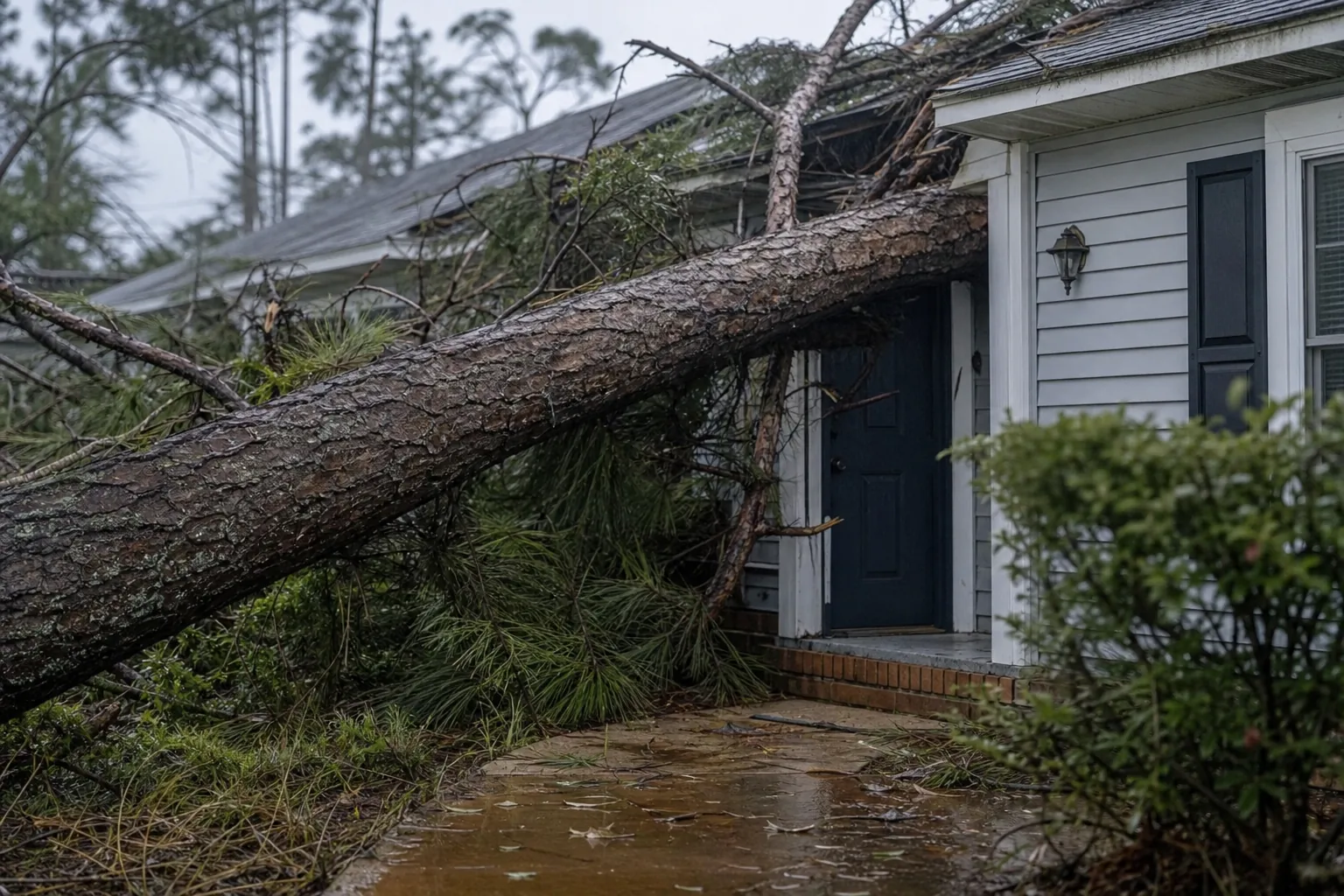
Describe where the tree is, what it touches, and what access it blocks. Use everyday words. Do not guess that a tree is stable because its trunk is still or because of a photograph. Our tree trimming service overview and tree removal overview explain different service types. But a homeowner’s description should not decide which service a damaged tree needs.
Useful descriptions answer simple questions. Is the visible material across the steps, against the door, or beside the entry? Does the door look covered from where you are? Can you see the whole tree, or only branches through a window?
Words such as “only,” “minor,” and “secure” can suggest more than you know. “Only one branch is visible” describes the limits of your view. “Only one branch is damaged” suggests you know the whole tree. Choose the first kind of statement.
A photograph can record what you saw when you took it. It cannot show that a tree is safe. According to OSHA’s hurricane tree-work guidance, storm-damaged tree work has falling-limb and unstable-tree hazards. Sharing an image should not replace telling others about people’s current access needs.
- Use location words such as “front steps,” “door frame,” and “walkway” instead of technical tree terms.
- Say if your view is limited by a window, darkness, or the tree’s position.
- Identify a neighbor’s description as secondhand, not as something you saw yourself.
- Keep older notes separate from newer observations so the order is clear.
An incomplete but accurate report is more useful than a detailed guess. It is fine to say, “I cannot tell from here.” That keeps the uncertainty clear instead of hiding it with reassuring words.
Keep Official Storm Guidance Separate From Household Notes
Use trusted sources for safety instructions. Use a simple household note for names, messages, and unanswered questions. The Florida Foliage background page identifies the business. The business contact options support general inquiries. Neither is a substitute for official hurricane safety guidance.
The National Weather Service advises walking carefully around the outside of a home to check for loose power lines, gas leaks, and structural damage. This guidance is not a reason to approach a blocked doorway or fallen tree to complete these notes. Read the National Weather Service’s after-hurricane guidance.
The same source says to stay out of a building if you smell gas, if floodwaters remain around it, or if authorities have not declared it safe. See the National Weather Service’s building safety advice. A familiar doorway or a view through a window does not answer these questions.
Never use a portable generator inside your home or garage. The National Weather Service includes this warning in its after-hurricane guidance. Keep this warning separate from questions about the tree. That way, an urgent household concern does not get lost in a cleanup discussion.
- Record which source gave an instruction. Do not mix it with household preferences.
- Write down questions you cannot answer instead of making assumptions.
- When practical, use one shared message for household updates so everyone gets the same information.
- Note if an update concerns the blocked door, the building, or another household issue.
These suggestions help with organization. They are not a checklist that says a property is ready for entry or a tree is ready for work.
Organize Cleanup Questions Without Planning the Work
Keep the household’s access needs separate from decisions about tree work. The removal service description gives general information. The trimming service description explains another type of service. Neither page determines the right work for a hurricane-damaged tree or confirms service availability in Pensacola.
Your notes can explain what the household needs to share. For example, the front entrance is blocked, an occupant has belongings inside, or the usual arrival instructions no longer describe the doorway. These are practical details, not a plan for handling the tree.
OSHA says to keep people who are not needed outside work and drop areas. See OSHA’s tree-work area guidance. Household updates can repeat this warning. Do not invent a distance or tell someone where a work area should begin.
Do not turn your notes into instructions for moving limbs or making a path through the tree. Tensioned material and limbs that roll or slide are known hazards in OSHA’s storm cleanup guidance. This article does not explain work methods.
- State the access concern in one sentence before adding background details.
- Record whom the household has contacted and which questions remain open.
- Keep messages about personal belongings separate from messages about tree work.
- Describe any change as a new observation, not proof that the tree is now safe.
A short update is often easier for relatives to follow than a long string of guesses. For example: “The front door remains blocked. We have reported the situation. We do not yet have an answer about the other entrance.”
Common Questions About a Hurricane-Blocked Door
These answers explain what you can report and what you cannot judge by appearance alone. For business details, read about Florida Foliage. For a general question that is not about an immediate emergency, use the contact page. Give the location before discussing a service request.
Should I use another door if the front door is blocked?
Tell emergency services if another door seems accessible. Ask what to do in your situation. Do not assume an open door means the route is safe. Report what you can see, including anything you cannot see. This article does not assess another exit or the space beyond it.
Can a photo show that the tree is safe?
No. A photo shows a view, not whether something is safe. Describe what it shows and what is outside the frame. OSHA’s storm tree guidance identifies falling limbs and unstable trees as hazards. Do not use an image to decide that tree material is safe to approach or move.
What if a wire is touching the fallen tree?
Avoid direct and indirect contact. Downed electrical conductors can energize trees and fences, according to OSHA’s hurricane tree-work guidance. Tell emergency services what you can see. Do not guess whether the wire carries electricity. Describe where it is visible, and say if you cannot see its full path.
Does this article mean Florida Foliage has a Pensacola office?
No. Florida Foliage is headquartered in Daytona Beach. This homeowner article does not establish a Pensacola office, local crews, response times, or service availability. Clinton Funk is the owner and has decades of hands-on tree care experience. Tim Francis is responsible for this article’s content and editorial presentation; no personal draft review by Clinton is represented.
What should I say in a general business inquiry?
Give the location and explain that a hurricane-damaged tree blocks the front door. Separate what you have seen from questions you cannot answer. Ask if the business can address your inquiry before assuming service is available. Say how you prefer to be contacted. For an immediate emergency, contact emergency services rather than relying on a business message for urgent direction.
Choose the Right Next Conversation
Use the Florida Foliage contact page for a general business inquiry. Read the company information if you want background before reaching out. You can also call (386) 481-7913. Give your location and ask if the business can address your inquiry. This article does not promise availability or a response.
For more on this topic, return to our guide to emergency tree removal in Pensacola. Keep the household’s immediate situation separate from a later business conversation.
- Clearly report the blocked door and the people affected.
- Mark unknown conditions as unknown.
- Keep official instructions separate from household planning notes.
- Ask about business availability instead of assuming it from an article about a location.
Call (386) 481-7913 to talk through next steps.