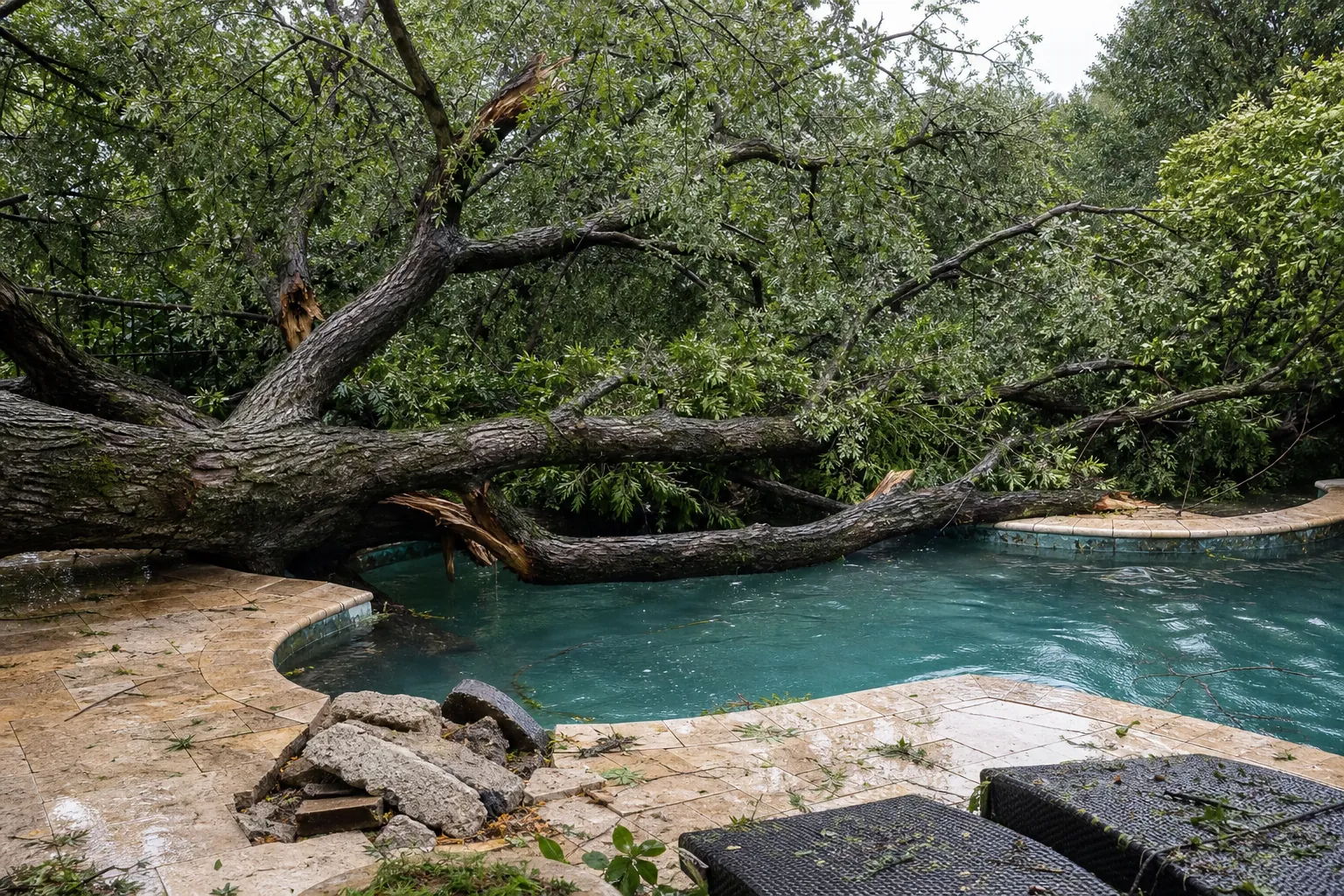
If a hurricane leaves a tree in your Pensacola pool, keep everyone out of the pool area. Do not try to retrieve branches or equipment. Storm-damaged trees can have falling limbs and unstable sections. Downed lines can also electrically charge water. OSHA storm-tree hazards and Ready.gov hurricane guidance explain these risks. Start with those precautions. Then use our guide to emergency tree removal in Pensacola for related context, not a promise of service.
By Tim Francis, responsible for this article’s content and editorial presentation. This guide covers storm safety and household organization. It does not assess your tree, pool, or electrical equipment.
What Should You Do When a Hurricane Tree Falls Into Your Pool?
Keep household activity out of the pool area. Do not start moving storm-damaged wood. OSHA lists falling limbs, unstable trees, and rolling or sliding limbs as hazards. Read OSHA’s tree-work guidance. For context, explore tree removal service information and ways to contact Florida Foliage. Neither confirms Pensacola availability.
A tree in a pool can make a familiar backyard feel unfamiliar. Your first household task is not to sort out every branch. Instead, give everyone the same clear message: leave the pool area alone while you gather information.
Use plain language. A short message is easier to remember than a long talk about what might have happened. Tell family members that nobody is using the pool or handling the fallen tree.
- Tell household members not to gather in the pool area while the situation is unresolved. OSHA says people who are not needed should stay outside work and drop areas. OSHA work-area guidance.
- Choose one person to keep household notes. This can help avoid conflicting descriptions.
- Write down your questions instead of turning guesses into conclusions.
Your first description can be brief. “A tree is partly in the pool after the hurricane” gives useful context. It does not suggest that you know how stable the tree is or what work it needs.
Why Are Water, Wires, and Fallen Wood a Concern?
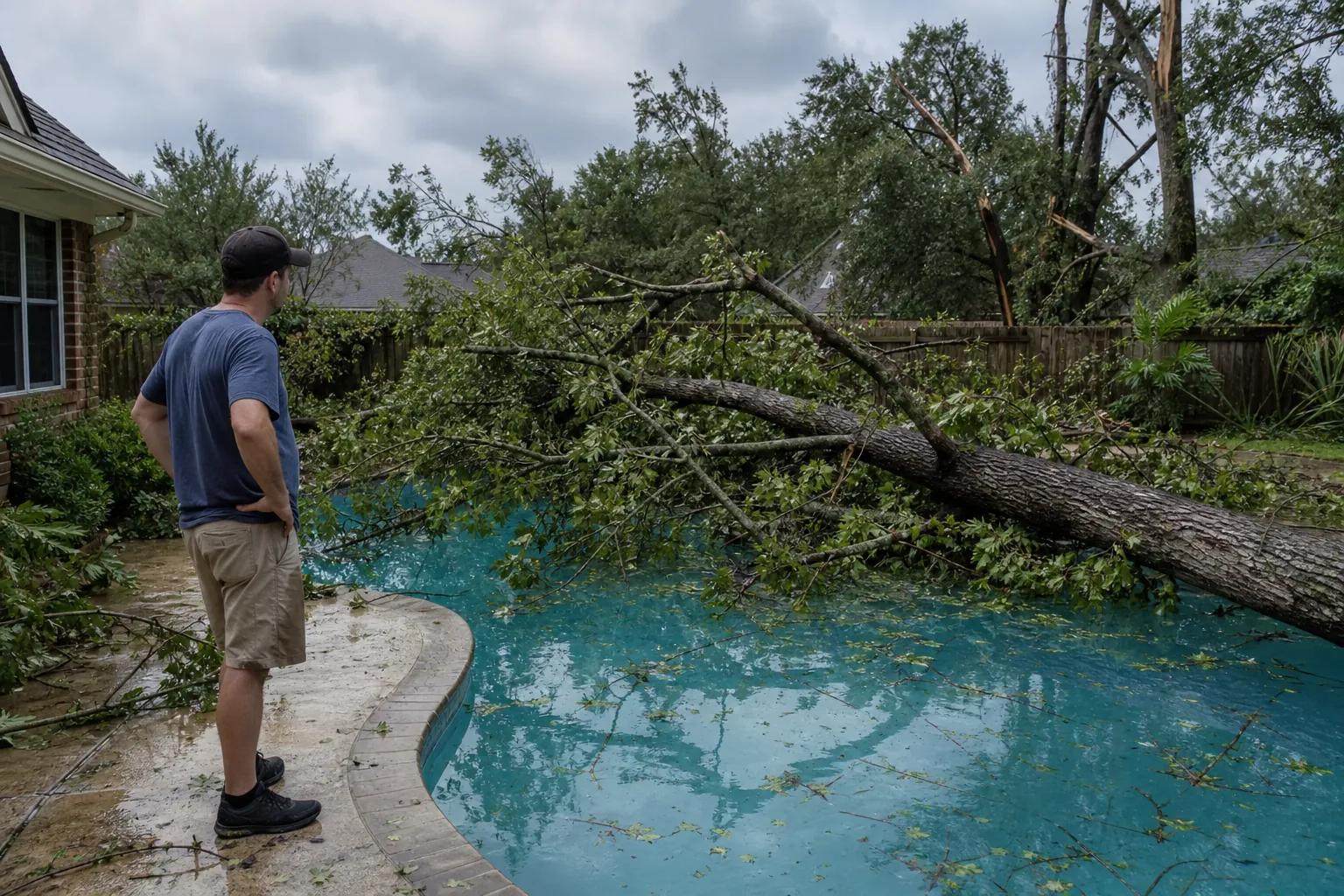
Water and fallen wood can be part of electrical hazards after a hurricane. Ready.gov says underground or downed power lines can electrically charge water. OSHA says downed conductors can energize trees and fences. Ready.gov; OSHA. Browse removal service context and company background for information, not a site assessment.
Do not touch electrical equipment if it is wet or if you are standing in water. This instruction comes from Ready.gov’s hurricane guidance. Pool equipment is still electrical equipment, even if it is familiar.
OSHA also says to avoid direct and indirect contact with downed electrical conductors. These conductors can energize trees and fences. OSHA electrical hazard guidance. Do not use a branch, fence, or other object to investigate a suspected wire.
- Include any wire you have already noticed in your written description. Do not try to identify its type.
- Do not touch wet electrical equipment or handle it while standing in water. Ready.gov electrical precautions.
- Use “I cannot tell” when describing possible electrical involvement.
Your notes do not need to say whether a wire is energized. They should say what you observed and what remains unknown. Do not ask another household member to check a guess by touching equipment, wood, or a fence.
Can You Tell Whether the Tree Is Safe From Its Appearance?
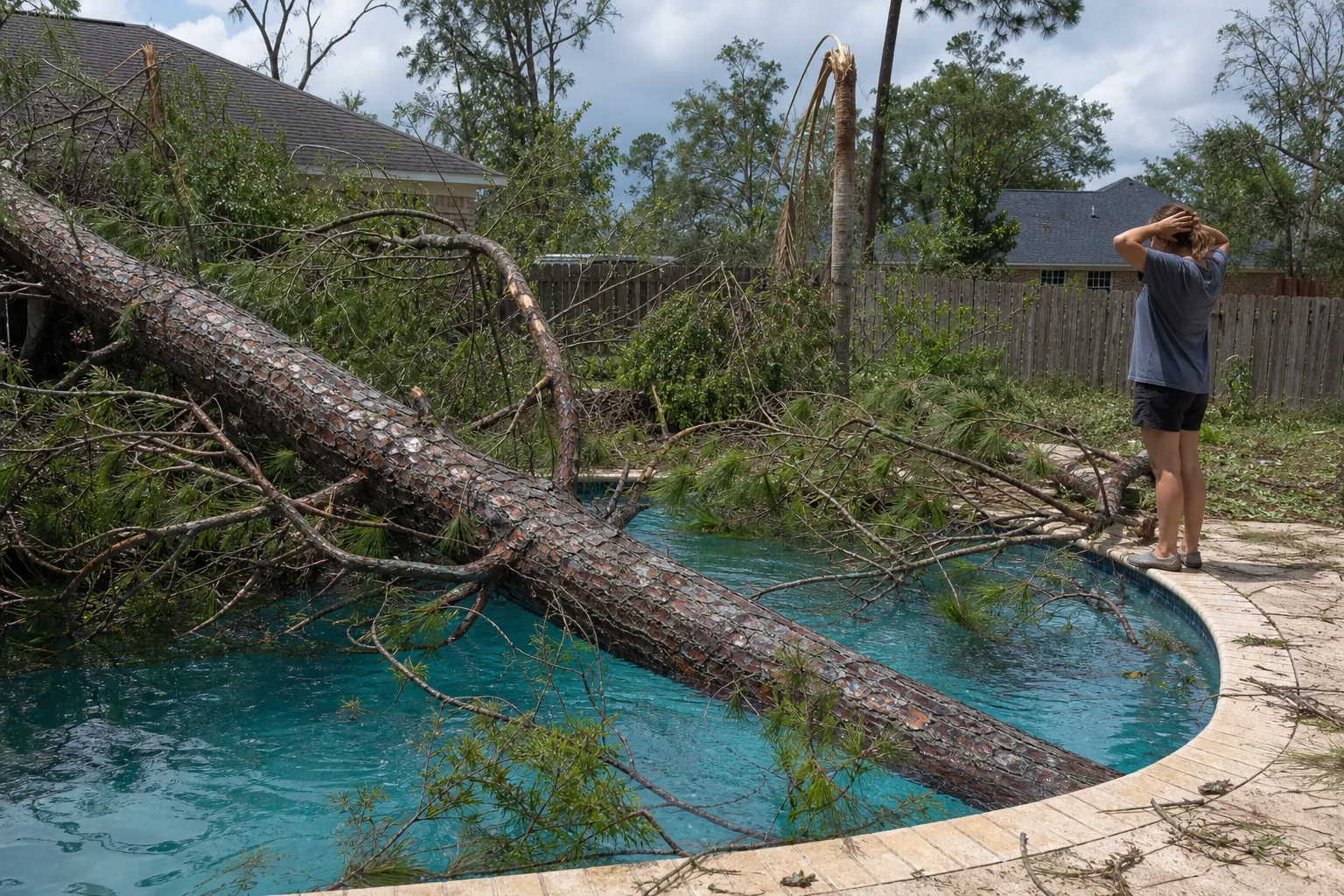
No. A description is not a diagnosis. A photo should not be treated as proof that a tree is safe. OSHA lists unstable trees and tensioned tree material as storm-work hazards. OSHA hazard guidance. Use removal information and trimming information for service context, not conclusions.
There is a useful difference between “a large branch is in the water” and “the branch is secure.” The first describes something visible. The second makes a claim about its condition. Keep household notes on the descriptive side of that line.
The same is true of the remaining tree. You may have noticed a broken-looking section or a change in its position. Those observations do not establish the condition of the whole tree. This article cannot turn an account of storm damage into a tree assessment.
- Use phrases such as “appears to be,” “partly visible,” and “I cannot tell” when they match what you know.
- Separate what you saw from what someone else told you.
- Do not call a tree safe because it looks still in a photo. OSHA lists unstable trees and falling limbs as storm-work hazards. OSHA storm-tree guidance.
If you already have pictures, label them with simple details, such as when they were taken. Use them to explain your question, not to certify a condition. You do not need to take more pictures to create a useful first message.
Organize a Clear Household Record
A short record can make later conversations easier to follow. Use the contact page to learn how to send a question. Read Florida Foliage’s company information to learn whom you are contacting. These pages offer background. They do not establish a Pensacola office or local service availability.
Keep your notes in one place, such as a paper notebook or shared document. Make the record simple enough for someone else in your household to understand. A few clear entries are more useful than a stream of repeated messages.
The numbered list below is an editorial tool to help you stay organized. It is not a technical inspection checklist. Fill in only what you already know. Leave uncertain items open instead of trying to complete every field.
- Record that the property is in Pensacola, FL. State that a hurricane left a tree or tree section in the pool.
- Describe what you can see in ordinary words. Do not decide what removal or trimming work is needed.
- Note whether you have already seen wires, wet electrical equipment, or other storm debris. Say when you are unsure.
- List the questions you want answered. These may include whether the company serves your location and handles this kind of inquiry.
- Save the date and main points of each conversation. This can help your next message pick up where the last one ended.
- Give each entry a plain heading, such as “What we saw” or “Questions to ask.”
- Keep guesses out of the observation list, or clearly mark them as open questions.
Your record can stay incomplete. Its purpose is to organize communication, not replace an assessment or decide how the tree should be handled.
Keep Cleanup Plans Separate From Tree Work
Keep ordinary household planning separate from instructions for moving storm-damaged trees. The tree removal overview and tree trimming overview explain service categories only. OSHA lists tensioned tree material and rolling or sliding limbs as hazards during storm-tree work. OSHA storm-tree hazards.
It may be tempting to call a branch “just debris” because it is no longer upright. That wording does not remove the hazards OSHA describes. Focus your plan on questions and household communication. Do not make plans to pull, shift, or take apart the wood.
Ready.gov says floodwater can contain debris, chemicals, waste, and wildlife. Ready.gov floodwater guidance. This does not tell you what is in your pool. If you do not know whether floodwater entered it, record that uncertainty. Do not declare the water clean or contaminated.
- Do not add tree-handling tasks to a household cleanup list. OSHA lists unstable trees, tensioned material, and moving limbs as hazards. OSHA tree-work guidance.
- Keep ordinary administrative tasks on a separate list, such as organizing messages and writing down questions.
- For debris cleanup, Ready.gov says to wear protective clothing and appropriate masks. This is not a reason to handle the fallen tree yourself. Ready.gov cleanup guidance.
This article does not explain how to handle wood or restore a pool. A useful next conversation starts with the situation as it is, not with a method chosen by the homeowner.
Contact Florida Foliage Without Assuming Local Availability
Use Florida Foliage’s contact options to ask whether the company can address your inquiry. Read the company background page for context. Florida Foliage is headquartered in Daytona Beach. This article does not establish a Pensacola office, local crews, response times, or availability for your property.
You can call (386) 481-7913. Start with your location and the basic situation. Then ask whether Florida Foliage serves that location and handles questions about hurricane trees in pools. This is a neutral contact step, not a promise that service can be arranged.
You might say: “I am in Pensacola, and a hurricane left a tree partly in my pool. I would like to know whether your company serves this location and handles this type of situation.” This leaves room for a clear answer without assuming what happens next.
- Ask about location and service scope before building a household plan around a particular company.
- Share your brief observations and identify anything you cannot determine.
- Write down the answer so other household members receive the same information.
For more information, return to the guide to emergency tree removal in Pensacola. Use it to shape further questions. Keep your property’s condition and service availability unresolved until you have specific information.
Frequently Asked Questions
These answers show the difference between observations, storm precautions, and service questions. The tree removal service page offers general context. The contact page gives you a way to ask about your location. Neither page proves that a tree is safe or that Pensacola service is available.
- Use the linked authoritative guidance for the safety statements below.
- Keep questions about your property separate from general website information.
Should anyone enter the pool to retrieve a branch?
No. Keep household members out of the pool area. Do not send someone in to retrieve wood. Ready.gov says underground or downed power lines can electrically charge water. OSHA also lists unstable trees and falling limbs as storm-work hazards. A branch may look easy to reach, but that does not resolve these concerns. Ready.gov; OSHA.
What if a wire is touching the tree or fence?
Avoid direct and indirect contact. OSHA says downed electrical conductors can energize trees and fences. Do not use another object to check the contact. In your written account, say that you saw a wire and describe what you noticed. Do not try to identify its type or whether it is energized. OSHA electrical hazard guidance.
Can existing pictures show that the tree is safe?
No. Pictures can help describe what you saw, but they do not prove the tree is safe. OSHA lists unstable trees, tensioned tree material, and rolling or sliding limbs as hazards. Describe images in factual terms. Leave conclusions about the tree’s condition unresolved. This article does not assess the tree shown in any image. OSHA tree-work hazards.
Does stormwater mean the pool contains harmful material?
There is not enough information here to tell what your pool contains. Ready.gov says floodwater can contain debris, chemicals, waste, and wildlife. That general guidance does not tell you what is in a particular pool. Record whether you know that floodwater entered the pool. If you are unsure, say so. Do not use the water’s appearance to draw a conclusion about its contents. Ready.gov floodwater guidance.
Does Florida Foliage have a Pensacola office?
Florida Foliage is headquartered in Daytona Beach. This article does not identify a Pensacola office or establish local availability. Call (386) 481-7913 to ask whether the company serves your location and handles your type of inquiry. Give a short description and ask for information. Do not assume there will be a visit, a response time, or a particular outcome.
Call (386) 481-7913 to talk through next steps.