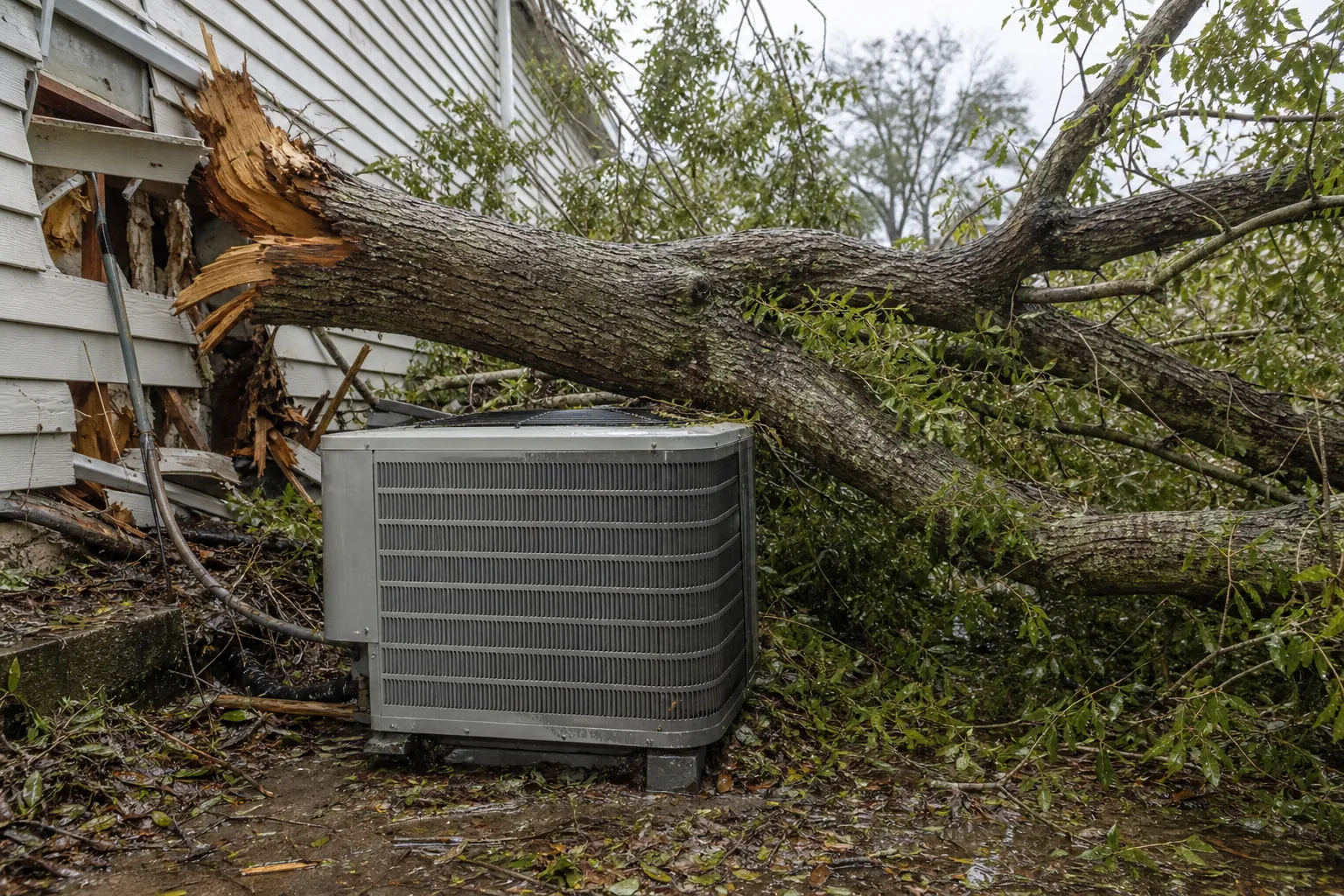
If a hurricane leaves a tree or limb on your outdoor AC unit in Pensacola, do not touch wet electrical equipment. Do not touch tree material that could contact an electrical conductor. Ready.gov warns against touching wet electrical equipment. OSHA warns that conductors can energize trees. Read the wet-equipment guidance and electrical-contact guidance. This guide supports our emergency tree removal in Pensacola resource. It offers practical ways to organize visible observations and your next contact step.
What Should You Do When a Limb Lands on an AC Unit?
Leave wet equipment untouched. Avoid direct or indirect contact with tree material near electrical conductors. Ready.gov and OSHA explain these hazards. For service context, read our tree removal overview. Use our contact page to ask questions. Do not assume local availability.
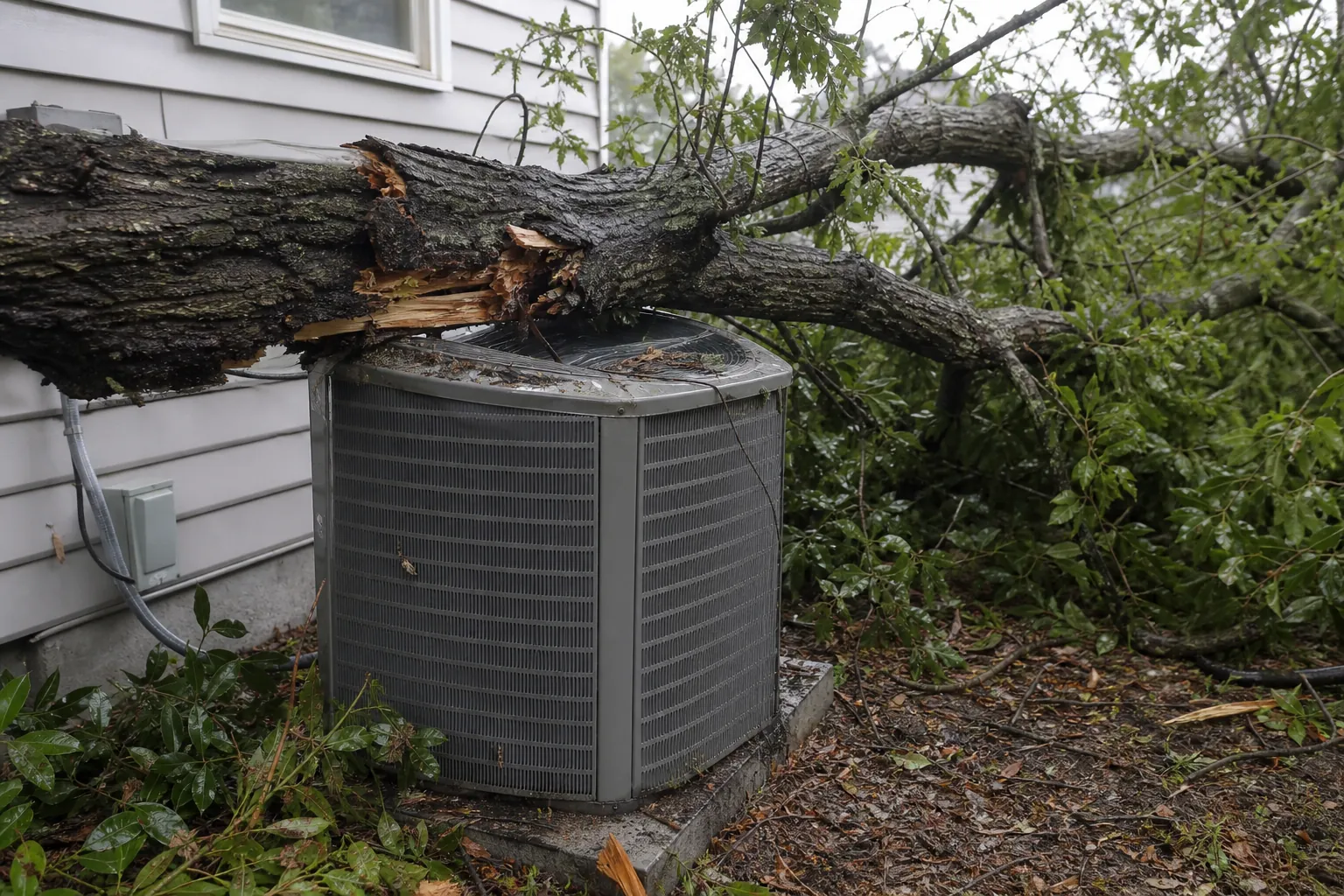
A limb on an AC cabinet gives you two subjects for your notes: the visible tree material and the visible equipment. Keep those subjects separate to make your description clearer. This does not establish the condition of either one.
Ready.gov says not to touch electrical equipment when it is wet or when you are standing in water. Ready.gov hurricane guidance. This instruction still applies if you only want to look beneath a branch or read a label.
- Use plain words, such as “a limb is resting on the outdoor unit.” Do not name damage you cannot confirm.
- Write whether your description comes from a current view, an earlier view, or someone else's report.
- Keep tree observations and AC observations in separate parts of the same note.
You do not need a complete account before asking a question. A short, honest description is more useful than a detailed guess about what happened or what work might follow.
Why Is Wet Equipment Different From Ordinary Yard Debris?
Do not touch wet electrical equipment during storm cleanup. Water can also become electrically charged by underground or downed power lines. Ready.gov explains both points. Our removal service information offers context about the tree. Our company background explains who Florida Foliage is.
The outdoor unit may look like just another object under a fallen branch. But that does not change Ready.gov's instruction about wet electrical equipment. A neat cabinet, a familiar location, or a clear view does not tell you whether the equipment is safe to touch.
Floodwater can contain debris, chemicals, waste, and wildlife. Ready.gov floodwater guidance. For an initial message, you can simply say, “water is visible around the unit.” You do not have to identify what the water contains.
- Include visible water in your written description. Do not assign it a depth or explain its cause.
- Write “wetness is unknown” if your current view does not show the equipment clearly.
- Keep questions about equipment condition separate from questions about tree debris.
This separation can also help keep a conversation focused. “What information do you need about the limb?” and “Who should address the equipment question?” are clearer than asking whether everything is fine. Neither question requires you to make a diagnosis.
What Can You Observe Without Making a Diagnosis?
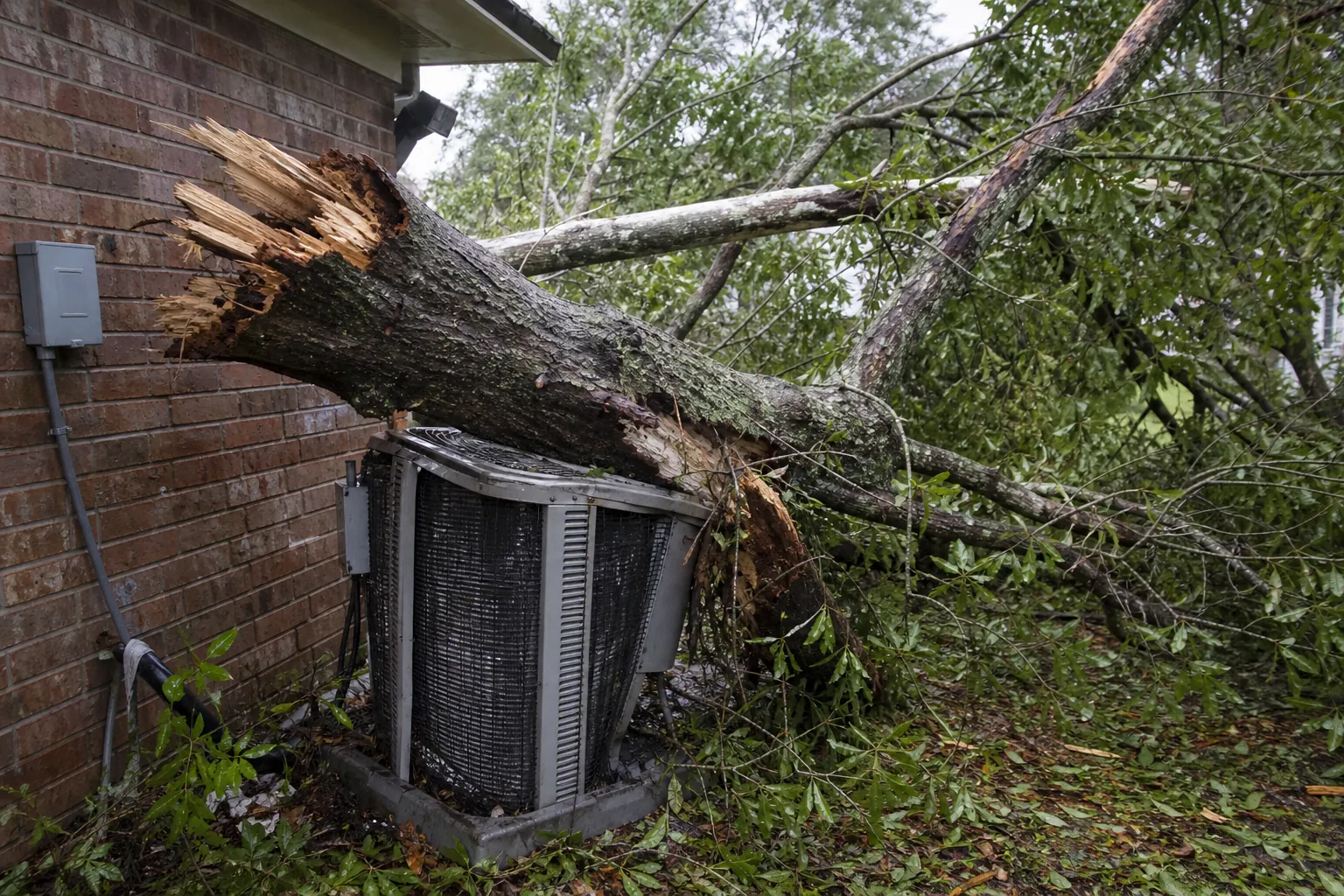
You can describe what is already visible without deciding whether a tree or AC unit is safe. Note the limb's visible position, the objects it touches, and what you cannot see. Our tree trimming overview gives general service context. Our inquiry page lets you share those limits.
Observation and diagnosis are different. “The cabinet looks dented” describes what you see. “The unit will still work” is a conclusion that a yard view cannot support. The same applies to tree material: a visible break is an observation, not a full account of the tree's condition.
Use information you already have. Do not turn note-taking into a physical inspection. This article does not explain how to test equipment, move branches, or examine hidden contact points.
- Describe a visible bend, dent, branch, or break in plain language.
- Write “I cannot see that part” when a limb or another object blocks your view.
- Separate your own observations from statements shared by someone else.
- Do not present a photograph as proof that a tree is safe.
If you already have a photograph, label it with its date and what it shows. A picture may help explain your message, but it does not turn an appearance into a diagnosis. Keep written notes about what is unknown beside the image, not hidden in a later conversation.
Which Tree Hazards Matter After a Hurricane?
OSHA identifies falling limbs, unstable trees, tensioned tree material, and rolling or sliding limbs as hazards in storm-damaged tree work. Read OSHA's tree-work guidance. Our tree removal service page and tree trimming service page explain service categories. They do not give instructions for handling those hazards yourself.
A branch resting on an outdoor unit is only the part of the situation you can see. OSHA's list is a reason not to treat the scene like an ordinary household cleanup task. This guide does not explain how to release, separate, lift, or cut storm-damaged tree material.
Downed electrical conductors can energize trees and fences. OSHA says to avoid direct and indirect contact. OSHA electrical-contact guidance. Do not assume contact is harmless when you are unsure whether a conductor is present.
- Include a visible conductor or fence in your description if it is part of the scene you can already see.
- Write “connection is unclear” if you cannot tell whether objects are touching.
- Keep observations about the standing tree separate from observations about fallen material.
You do not need to name every hazard in your message. Accurate limits are useful: “I can see the limb on the unit, but I cannot see the whole tree” tells the reader what you know and what remains unknown.
How Can You Organize a Clear Household Note?
A short household note can collect observations you already have, unanswered questions, and the contact details you plan to use. It helps you organize information. It is not a safety assessment. Our contact form gives you a place to ask questions. Florida Foliage's background page helps identify the company you are contacting.
Choose one shared note instead of several scattered messages. Give it a clear heading, such as “Outdoor AC unit and fallen limb.” Add the date of each observation so older information is not mistaken for the current scene.
- Start with the property location in Pensacola and a plain description of the outdoor unit.
- Add what is visibly resting on or beside the unit. Do not guess about hidden damage.
- List unknowns, including parts of the scene you cannot see from your current view.
- Write the questions you want to ask about the tree-related service scope.
- Add a contact name and your preferred way to receive a reply.
- Keep any existing images with the note. Label them as visual records, not safety findings.
- Update an earlier statement instead of leaving two conflicting descriptions unexplained.
- Use short sentences so another household member can understand the note quickly.
This format can also reduce repetition. If someone asks what happened, you can share the same short account instead of rebuilding the story from memory. Leave unanswered questions open until you have an answer.
What Should Stay Separate From Debris Cleanup?
Keep your household organizing plan separate from physical debris work and equipment questions. OSHA says people who are not needed should stay outside work and drop areas. Read OSHA's work-area guidance. Our removal overview explains the tree-service category. Our contact options support a neutral question about scope.
Putting notes in order is not the same as clearing the yard. Do not let a household checklist become a set of tree-handling instructions. This article does not provide steps for cutting, lifting, pruning, or testing equipment.
Ready.gov recommends protective clothing and suitable masks when cleaning debris. Ready.gov debris-cleanup guidance. That guidance does not replace Ready.gov's separate instruction against touching wet electrical equipment. Ready.gov wet-equipment guidance.
- Use your checklist for messages, notes, and unanswered questions, not physical tree work.
- Label tree-related questions and AC-related questions separately so neither gets lost.
- Keep a record of what was discussed, including any question that still needs an answer.
A tidy plan should not suggest that anyone has assessed the scene. Marking “message sent” means only that you sent a message. Marking “photo attached” means only that you shared a visual record. Neither entry establishes the condition of the tree or the outdoor unit.
How Should You Contact Florida Foliage About the Tree?
Send a plain description and ask whether Florida Foliage can address your inquiry. Do not assume this article confirms Pensacola availability. Use the Florida Foliage contact page for questions and the company information page for background. Florida Foliage is headquartered in Daytona Beach, not at a Pensacola office.
You can call (386) 481-7913. You could begin: “I am in Pensacola, and a hurricane left a limb on my outdoor AC unit. Can you tell me whether you can address this inquiry and what information you need?”
That message gives the location and concern without predicting service arrangements. You can also say that the equipment appears wet, if that is something you have already observed. There is no need to give a technical explanation.
- Ask about the tree-related scope before assuming the outdoor equipment is part of the same service.
- Say when a detail is unknown instead of filling in the story with a guess.
- Include your preferred contact method so it is easy to find.
What Should Your Next-Step Summary Include?
Your summary should say what you can see, what remains unknown, and what you want to ask next. The tree removal information page can help frame a tree-related inquiry. The contact page gives you a direct place to send it. Neither provides details about your specific scene.
Keep the summary short enough to read aloud. For example: “A fallen limb is resting on the outdoor AC unit. Water is visible nearby. I cannot see the full contact area. I want to ask about the tree-related service scope.” This is a description, not a safety finding.
- Start with what you can see, not a prediction about damage.
- Include only observations you can identify as your own or clearly attribute to someone else.
- End with a question the recipient can answer without guessing what you mean.
For broader context, return to our guide to emergency tree removal in Pensacola. Keep its role separate from an assessment of a specific property. A useful homeowner plan organizes information and leaves unknown conditions unknown. You do not need to touch wet equipment, move the limb, or prove that the tree is safe.
Frequently Asked Questions
These answers separate safety facts supported by sources from household organizing suggestions. They do not diagnose your tree or AC unit. For general context, visit our tree removal service overview. For a question about your situation, use our contact page. Do not assume Pensacola service arrangements are available.
Can I touch the AC unit if I only want to check it?
Do not touch electrical equipment if it is wet or if you are standing in water. Ready.gov hurricane guidance. A quick check does not change that instruction. For your household note, record what is already visible. Leave the equipment's condition as an unanswered question instead of trying to check it by hand.
Does a photograph show that the tree is safe?
No. Treat a photograph as a record of what is visible, not proof that a tree is safe. Describe what the image shows and what it leaves out. OSHA identifies falling-limb and unstable-tree hazards in storm-damaged tree work. OSHA tree-work guidance. The image does not resolve those concerns.
What if water is visible around the outdoor unit?
Include that observation in your message. Do not try to explain what the water contains. Ready.gov says floodwater can contain debris, chemicals, waste, and wildlife. It also says underground or downed power lines can electrically charge water. Ready.gov hurricane guidance. A visible patch of water is an observation, not a diagnosis of its condition.
Should I move a limb to make my description clearer?
Do not include moving tree material in your note-taking plan. OSHA identifies tensioned material and rolling or sliding limbs as hazards in storm-damaged tree work. OSHA tree-work guidance. Write that your view is blocked instead. An incomplete but accurate description is useful. You do not need a clear view of every contact point.
How do I ask Florida Foliage about my Pensacola situation?
Call (386) 481-7913 or use the contact page. Say that you are in Pensacola, describe the visible limb and outdoor unit, and ask whether Florida Foliage can address the inquiry. The company is headquartered in Daytona Beach. This article does not establish a Pensacola office, local availability, or a response time.
Author: Tim Francis. Content and editorial responsibility: Tim Francis.
Call (386) 481-7913 to talk through next steps.