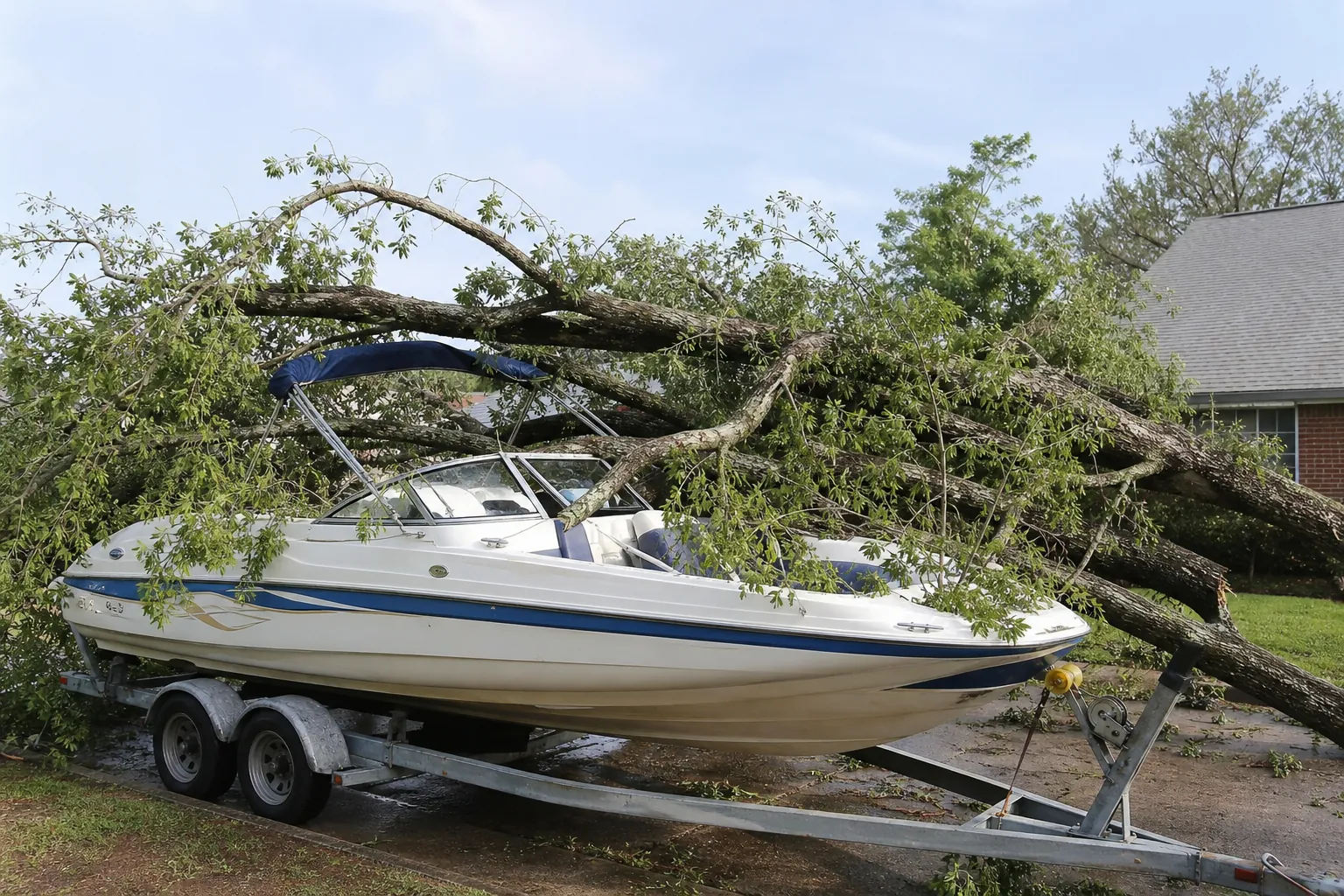
If a hurricane leaves a tree on your boat or trailer in Pensacola, leave the tree and load alone rather than trying to move them. OSHA identifies tensioned tree material and rolling or sliding limbs as storm cleanup hazards. Read OSHA’s tree work guidance. Start with a simple written account of what you already know. This guide supports our page on emergency tree removal in Pensacola and explains how to organize a clear contact request.
Written by Tim Francis, who is responsible for this article’s content and editorial presentation.
What Should You Do First When a Tree Lands on a Boat?
Leave the tree and boat load alone while you organize what you already know. OSHA identifies unstable trees, falling limbs, and tensioned material as hazards. See OSHA’s storm tree guidance. Our tree removal overview provides service context, while the contact page offers a place to ask questions without assuming Pensacola availability.
A boat or trailer can make the scene hard to describe. You may see part of a limb over a cover, a trunk across the trailer, or debris that blocks your view of the hull. Those are observations. They do not tell you how the tree material will behave or what condition the boat is in.
For your notes, divide the situation into three parts: the tree, the boat, and the trailer. This keeps a single phrase such as “tree damage” from standing in for several different things. Use only details you already have. An incomplete account is more useful than a confident guess.
- Write whether the visible material is a limb, a trunk, or something you cannot identify.
- Describe whether it appears over the boat, across the trailer, or beside them.
- Label hidden portions as “not visible” rather than filling in missing details.
- Keep nonessential people outside tree work and drop areas, as directed in OSHA’s storm tree guidance.
Your first note does not need technical terms. “A large piece of tree is across the covered boat” is clear enough to start a conversation. It does not diagnose the tree, describe a removal method, or suggest that the load is stable.
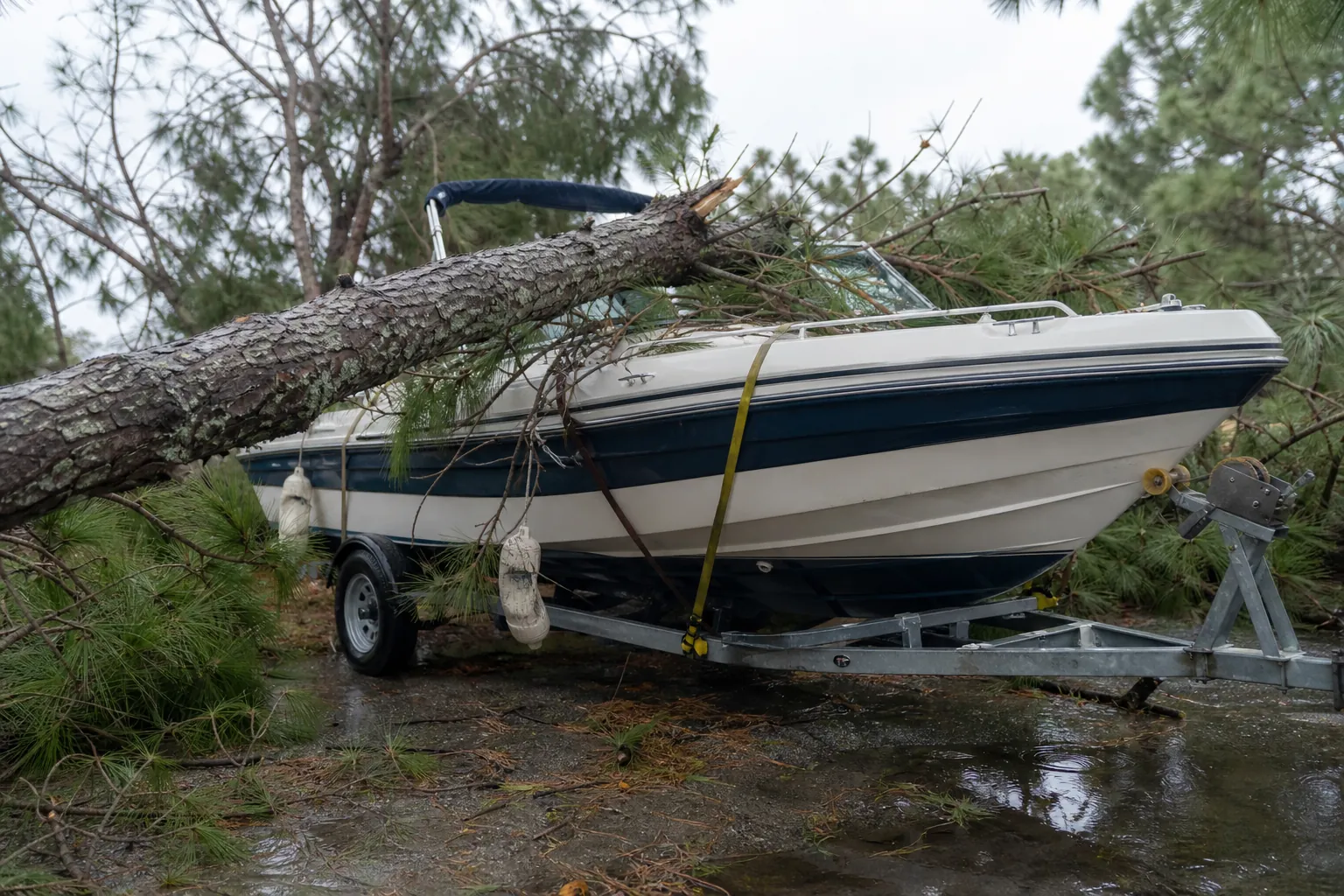
Why Should the Tree and Trailer Be Left Alone?
The reason is uncertainty about movement, not a diagnosis you can make from appearances. OSHA lists tensioned tree material and rolling or sliding limbs among tree work hazards. Read the hazard list. The removal service overview and tree trimming information explain service categories, not a homeowner work plan.
A homeowner may naturally want to free the trailer, uncover the boat, or shift a piece that seems small. This article does not provide instructions for any of those tasks. A visible resting position is simply what you can see at that moment. It is not a finding that the tree material can be moved safely.
Keep action ideas separate from your description. “The trailer is partly covered by branches” belongs in the observation column. “We can roll it out” is a proposed action, not an observation. That distinction helps keep a conversation focused on facts instead of turning guesses into a plan.
- Leave the tree and load alone because tensioned material and rolling or sliding limbs are recognized hazards in OSHA’s tree work guidance.
- Record whether the boat was on its trailer before the storm, if you already know.
- Note whether a cover hides part of the boat, without trying to inspect beneath it for this checklist.
- Describe a visible change as a change, not as proof of what caused it.
A useful message can say, “The trailer looks different from before the storm, but I do not know why.” That wording preserves the observation and the uncertainty. There is no need to name a mechanical problem or reach a conclusion about the tree.
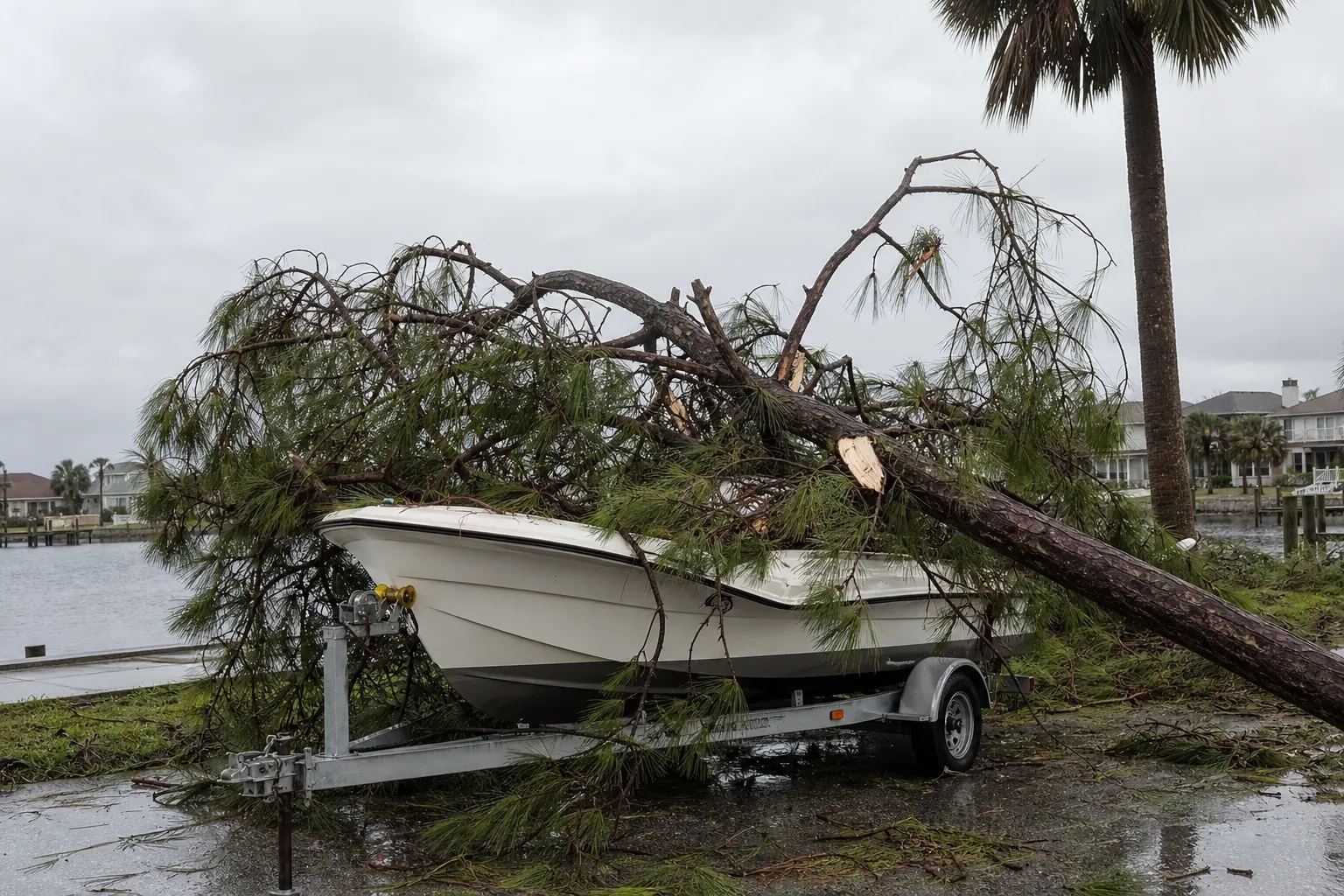
Which Other Storm Hazards Matter Around the Scene?
Electrical conductors, debris machinery, and leaking containers belong in this discussion alongside tree hazards. OSHA addresses each in its storm cleanup guidance. See electrical hazards and debris collection hazards. For company context, use Florida Foliage’s background and the contact information, without treating either as a local response promise.
Not every concern near a boat is a tree concern. Your notes may mention a fence, nearby equipment, containers, or objects hidden by debris. Keep these descriptions separate so they do not get lost in a long account of the boat. You do not need to identify an unknown item to report that it is visible.
- Avoid direct and indirect contact with downed electrical conductors, which can energize trees and fences, according to OSHA’s electrical hazard guidance.
- Keep nonessential people away from debris machinery, as stated in OSHA’s debris collection guidance.
- Stay clear of leaking chemical containers; OSHA says specialist evaluation is needed. Read the container guidance.
- Do not assume debris is only loose plant material; OSHA notes that debris can hide meters and fire hydrants. Read the debris guidance.
Use plain labels such as “wire visible,” “container visible,” or “equipment nearby” when that is all you know. These labels are not an evaluation of the object or its condition. They simply keep relevant information in the account without making technical judgments.
How Can You Record What You See Without Diagnosing It?
Describe shape, location, and what is hidden, then state what you do not know. Do not use photographs as proof that a tree is safe. The tree trimming overview supplies general service context, and the company background page explains Florida Foliage without turning your observations into a technical assessment.
The best notes are plain and specific. “Branches are over the rear of the covered boat” says more than “the boat is ruined.” “The trailer wheel is not visible” says more than “the trailer cannot move.” The first wording in each pair describes the view. The second adds a conclusion you may not be able to support.
If you already have images, keep them with your notes as a visual record. A photo may show where a branch appeared when the image was taken. It should not be treated as a complete view of the scene or as proof of tree safety. This checklist does not call for new inspection pictures.
- Use “appears” when a cover, leaves, or debris makes the view incomplete.
- Record when an existing image was taken if that information is available.
- Keep earlier boat or trailer pictures separate from storm images so their context is clear.
- Write “unknown” for tree condition, hidden damage, and other points you cannot establish.
A short observation sheet is easier to read than a long narrative. Give each visible feature its own line, then put questions below it. This format helps the next conversation stay grounded in what is actually known rather than in a chain of assumptions.
How Should You Organize a Clear Contact Request?
Prepare a short summary, a few known details, and a direct question about whether your inquiry can be considered. The Florida Foliage contact page is the relevant next step, while the tree removal service page explains the service category. Neither page establishes Pensacola availability or a response time.
You can organize the message at home using information already on hand. There is no need to solve the tree problem before writing. A concise inquiry should make the location and situation clear, then give the recipient room to explain whether the company is an appropriate contact.
- Start with “Pensacola, Florida,” and identify whether the tree is on a boat, a trailer, or both.
- Add a brief account of the visible tree material using ordinary words.
- State which parts of the boat or trailer are hidden from view.
- Separate known facts from questions, including anything you cannot identify.
- Ask whether Florida Foliage can consider an inquiry for that location and situation.
This order puts the most useful information first. It also avoids a long opening story that can bury the location or the basic problem. You can add background later if the person receiving the message requests it.
- Choose one household contact name to keep the discussion organized.
- Include the return phone number you want used for the conversation.
- Keep a copy of the message so you do not have to recreate it.
- List unanswered questions separately rather than presenting them as facts.
A contact request starts a conversation. It is not confirmation that work is available, scheduled, or suitable for the situation.
What Can Your Household Organize Without Planning Tree Work?
Your household can organize notes, messages, and existing records without developing a tree work plan. Use the contact page for communication and the Florida Foliage company overview for background. These are information resources, not instructions to move tree material or confirmation that the boat and trailer are safe.
A shared note can prevent several people from repeating the same questions. Keep it simple: one current description, one list of unknowns, and one place for replies. You can also keep boat and trailer names or identifying details handy if those details are already in your household records.
Separate communication tasks from physical cleanup. Updating a message or finding an existing document is an organizing task. Deciding how to move a limb or free a trailer is not part of this household checklist. The distinction gives people a useful role without turning the note into a work plan.
- Ask one person to maintain the current written summary.
- Put existing images in a clearly named folder with their original dates when available.
- Keep questions about the boat separate from questions about the tree.
- Mark information as outdated if a newer account replaces it.
Use calm, neutral language when sharing the summary. “We have not established the condition of the boat” is clearer than a string of guesses about damage. “We have sent an inquiry” is more accurate than telling others that a visit is expected.
You do not need a complicated spreadsheet. A single page or shared message is enough if it makes the known facts, unanswered questions, and contact history easy to find.
How Can You Contact Florida Foliage Without Assuming Local Service?
Contact Florida Foliage to ask whether the company can consider your specific inquiry, not to assume a Pensacola visit. The contact page provides a neutral starting point, and the company background explains who owns the business. Florida Foliage’s headquarters is in Daytona Beach; this article does not establish Panhandle availability.
You can call (386) 481-7913 and describe the situation plainly. Ask whether the company can consider a Pensacola inquiry involving a hurricane-damaged tree on a boat or trailer. Leave room for the answer rather than making plans based on the fact that a phone number is listed.
- State the location at the start of the conversation.
- Use the same factual summary you prepared in your notes.
- Ask which information, if any, would be useful for further discussion.
- Record the actual reply without adding an expected visit or response time.
For broader context, return to the guide to emergency tree removal in Pensacola. The central point remains simple: leave the tree and load alone, keep observations separate from diagnosis, and use a clear inquiry to learn whether a next conversation is appropriate.
Frequently Asked Questions
Can I tow the trailer out from under the tree?
Leave the tree and load alone rather than trying to tow the trailer free. OSHA identifies tensioned tree material and rolling or sliding limbs as hazards. Read OSHA’s tree work guidance. Describe the trailer’s visible position in your notes, but do not treat that description as a finding that movement would be safe.
Does a small branch mean the situation is safe?
No. Calling a branch small is a description, not a safety finding. OSHA lists falling limbs, unstable trees, and tensioned material among storm tree work hazards. See OSHA’s hazard guidance. Record what you already know about its location and leave uncertainty explicit rather than deciding how it can be moved.
Can existing photos establish that the tree is safe?
No. Use existing photos to help describe what was visible, not to establish tree safety or diagnose hidden conditions. Keep their dates and context with your written notes. If the cover, branches, or debris blocks a view, say so. An image can support a description without settling questions about the tree, boat, or trailer.
What should I mention if a wire is visible?
State that a wire is visible and avoid guessing about its condition. OSHA says downed electrical conductors can energize trees and fences and warns against direct and indirect contact. Read OSHA’s electrical hazard guidance. Keep that observation distinct from your description of the boat so it is not buried in other details.
Does Florida Foliage have a Pensacola office?
Florida Foliage’s headquarters is in Daytona Beach. This article does not identify a Pensacola office or establish local service availability. Call (386) 481-7913 to ask whether the company can consider your location and situation. A phone inquiry is a neutral contact step, not a promise of a visit, schedule, or response time.
Call (386) 481-7913 to talk through next steps.