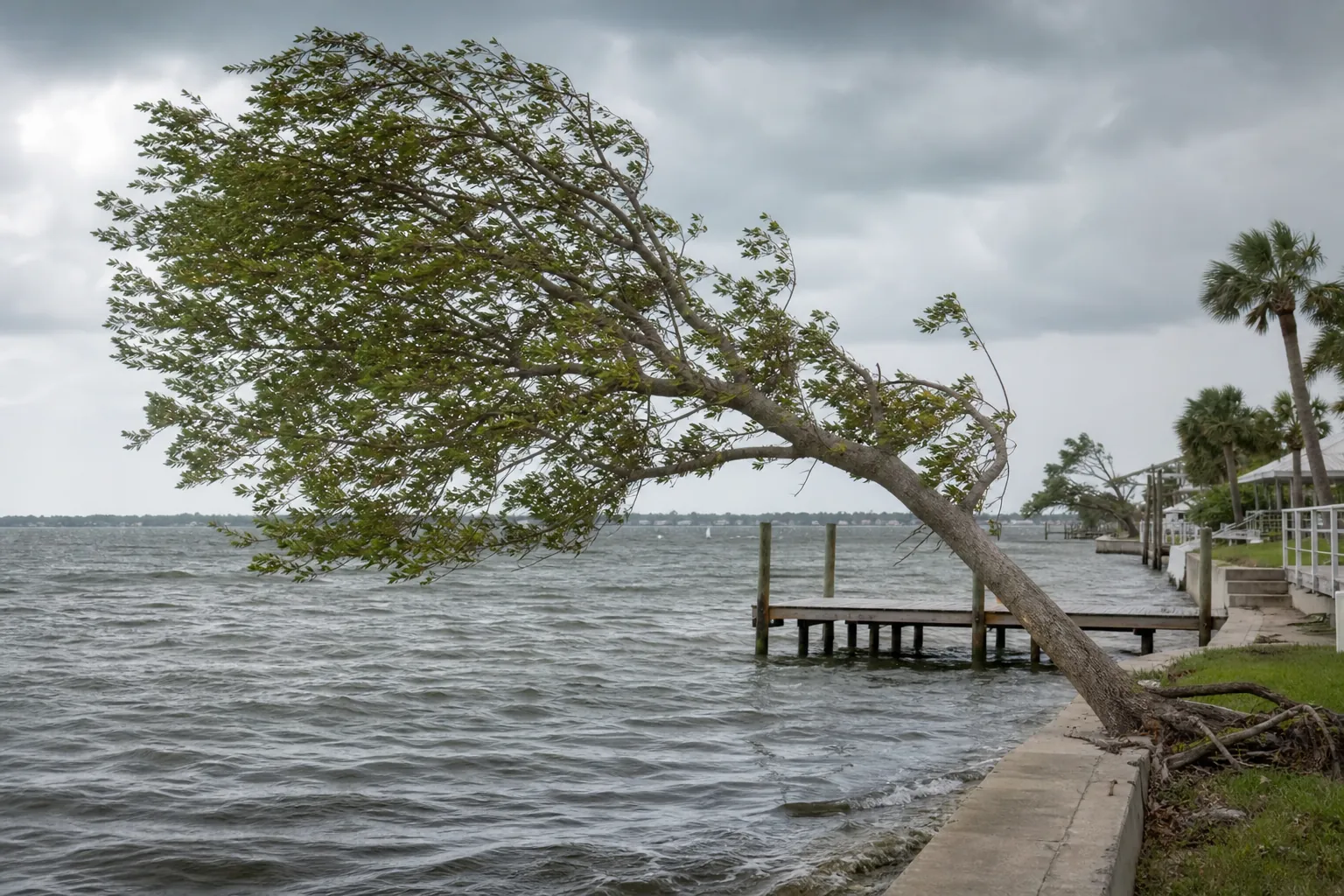
If a hurricane leaves a tree on your dock or seawall in Pensacola, stay off the dock. Do not approach damaged wood. Storm-damaged trees pose hazards from falling limbs and unstable trees, according to OSHA’s storm tree guidance. Start with what you have already seen, not a closer inspection. This guide supports our emergency tree removal in Pensacola pillar. It explains how to organize your observations without treating them as a diagnosis or a reason to enter the area.
What Should You Do When a Tree Lands on Your Dock?
Stay off the dock and describe only what you can already see. Storm-damaged tree work involves falling limbs and unstable trees, as OSHA explains. Our tree removal overview gives service context. The contact page offers a neutral way to ask questions. It does not imply that service is available in Pensacola.
First, separate what happened from what is still unknown. “A tree is lying across the dock” is an observation. “The dock can still hold someone” is a conclusion. A view from shore cannot prove it. Keep these two kinds of statements apart in your notes and conversations.
You do not need to settle every detail before writing a short description. Start with the location and the tree’s general position. Note any part of the dock or seawall that is hidden from your current view. Use “not visible” when that is the honest answer.
- Write down whether the tree seems to cross the dock, rest beside the seawall, or extend over the water.
- Say which parts of the scene are hidden. Do not fill gaps with guesses.
- Share the same short description with household members so the account stays consistent.
Keep your note plain and limited. It does not need technical terms, a species name, or a judgment about the next tree service task. Its purpose is to explain the situation without turning an observation into an inspection.
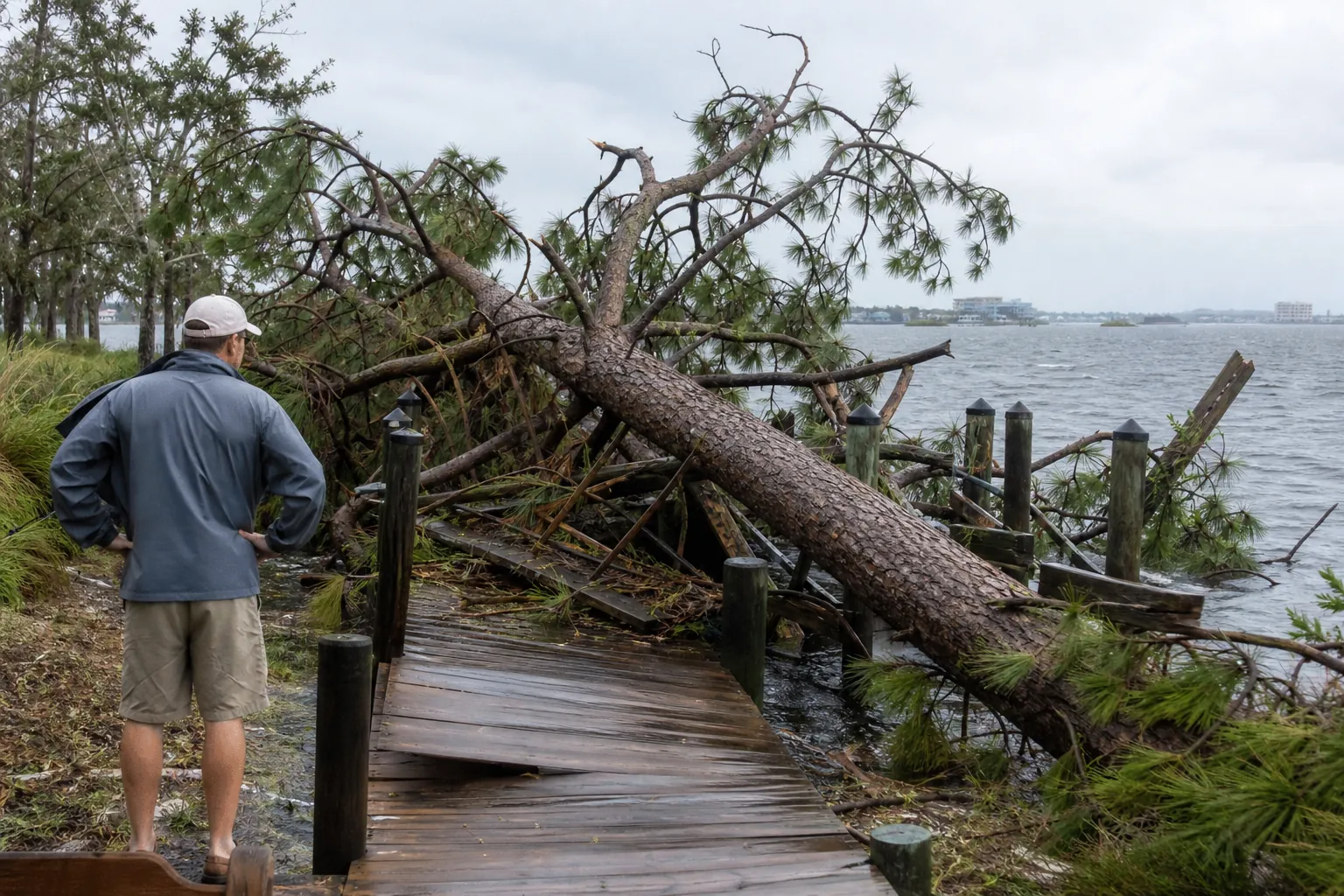
Why Do Water and Damaged Wood Require Caution?
A casual view cannot resolve the hazards from water and storm-damaged wood. Floodwater can contain debris, chemicals, waste, and wildlife, according to Ready.gov. Use our tree removal information for general context. Use the company background to learn about Florida Foliage, not to judge this scene.
Underground or downed power lines can electrically charge water. Do not touch electrical equipment if it is wet or if you are standing in water. Ready.gov’s hurricane guidance gives both points. Do not call water harmless just because you cannot see a wire in your current view.
Downed electrical conductors can energize trees and fences. Avoid direct and indirect contact. OSHA identifies these electrical hazards. These facts are reasons not to check by touching. They are not instructions for testing a tree, fence, or dock fixture.
- Write “water visible beneath the dock” instead of saying the water is safe.
- Note a wire or electrical item only if you can already see it. Do not decide whether it is safe.
- Do not touch wet electrical equipment or equipment while standing in water, as Ready.gov advises.
Keep your written account limited. A photo or confident description cannot rule out a hidden hazard. The goal is to share known details, not to say the area is safe.
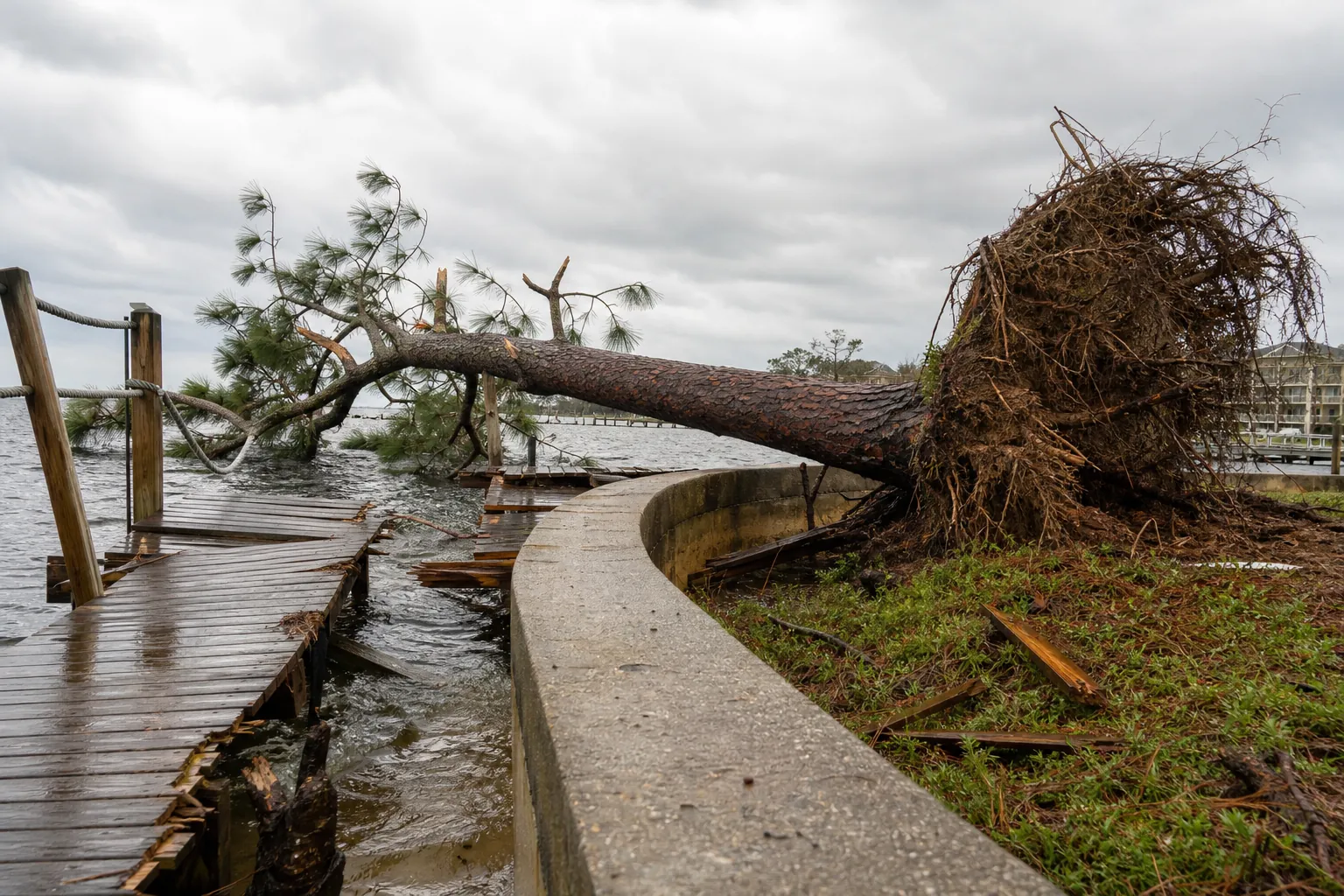
What Can You Observe Without Diagnosing the Tree?
You can describe the tree’s position, where it makes contact, and what it blocks from view. You do not need to decide whether the tree or dock is stable. The tree trimming overview explains a general service category. Our tree removal page offers separate context. Neither page turns household observations into a site diagnosis or confirms local availability.
Choose words that help another reader picture the scene. “The trunk crosses the walkway” is clearer than “the tree is badly compromised.” “The leafy end extends over the water” describes the scene without giving it a technical meaning. “I cannot see the base” marks a real limit in what you know.
Also describe the tree and the surface beneath it separately. Wood resting on a dock does not tell you the dock’s condition. A branch near a seawall does not tell you how either item should be handled. Leave those questions open instead of combining them into one conclusion.
- Describe the visible trunk and branches in everyday words. Do not rate their condition.
- Note what foliage, water, or your viewing angle hides.
- Separate an observation from an interpretation with phrases such as “appears to” and “not known.”
If you already have photos, label them with the date and viewpoint. Do not present them as proof that the tree is safe. A photo is a limited record to go with your description. It is not permission to walk onto the dock or touch the wood.
Build a Clear Household Record
A simple record can keep facts, questions, and contact details together. Our message form offers a way to share a short account. The Florida Foliage background page explains who the company is. This step does not confirm a service area, appointment, or response time.
Use one note instead of several scattered messages. A notebook page or shared document is enough. Put the location at the top. Then add a short description and a separate list of unknowns. This format makes it easier to update the record without rewriting the story each time.
- Write the property location. Note that the tree is on or beside a dock or seawall.
- Add a brief description based only on what you have already seen.
- List unanswered questions, including any parts of the tree or structure you cannot see.
- Attach existing images with clear labels. Do not use them to say the scene is safe.
- Save your contact message and any reply together so the conversation is easy to follow.
- Choose one household member to keep the record and avoid conflicting versions.
- Add dates to updates so an older observation is not mistaken for a current one.
- Remove guesses from the main description. Put real questions in their own section.
This is a way to organize information, not a technical assessment. A short, accurate account is more useful than a long story that mixes visible details with guesses about the tree, water, or dock.
Keep People Separate From Tree Work
Household planning should not become hands-on tree work. The removal service overview and trimming service information explain different service categories, not tasks to try yourself. Storm-damaged tree work can involve tensioned material and limbs that roll or slide, according to OSHA.
A dock or seawall does not remove those tree hazards. OSHA’s storm-damaged tree guidance also lists falling limbs and unstable trees as hazards. Stay off the dock. Do not use it as a closer viewing point for damaged wood.
Keep people who are not needed outside work and drop areas, as OSHA directs. This article does not define those areas for your property or give measurements. It also does not explain how to move, release, shorten, or separate any part of the tree.
- Tell household members that the written description is not an invitation to inspect the tree.
- Keep people who are not needed outside work and drop areas, in line with OSHA’s guidance.
- Do not try to answer questions about tensioned material or moving limbs through contact. Leave them open, given the hazards listed by OSHA.
A household plan can still help without giving anyone a cleanup role. Focus on communication, existing records, and unanswered questions. Do not let an informal conversation become a plan to handle storm-damaged wood.
Separate General Cleanup From the Dock Problem
A general cleanup checklist is not a plan for handling a tree on a dock. Our trimming service description provides background. The contact page lets you ask about the situation. Neither gives a method for working near water, unstable trees, or damaged wood.
When cleaning debris, wear protective clothing and suitable masks, according to Ready.gov. This advice is not a reason to enter the affected dock area. OSHA says storm-damaged tree work has falling-limb and unstable-tree hazards.
For household records, make separate headings for general storm notes and the tree-on-dock issue. This keeps a routine list of belongings or messages from becoming instructions for handling the tree. You can organize information without deciding how physical cleanup should happen.
- Keep dock and seawall questions together. Do not mix them into an ordinary household task list.
- Use a separate list for calls, saved messages, and existing images.
- When cleaning debris, follow Ready.gov’s advice to wear protective clothing and suitable masks.
Do not use clothing or masks as a reason to say a task is safe. The supplied guidance names precautions and hazards, but it does not assess your property. This article also gives no tree-handling method and no judgment about the dock or seawall.
Make a Neutral Contact Request
Use the Florida Foliage contact page to ask a clear question. See our company information for background. Florida Foliage is headquartered in Daytona Beach. This Pensacola article does not establish a Pensacola office, local crews, local availability, or a response time.
You can call (386) 481-7913 or send a message. Start with the location. Explain that a hurricane left a tree on a dock or beside a seawall. Ask whether Florida Foliage can discuss your request. Do not assume that sending information means a visit has been arranged.
A useful message might read: “The property is in Pensacola. A tree appears to be resting across the dock after the hurricane. Part of the tree is not visible from our current view. Can you tell me whether you can discuss this location and what information you would need?”
- Include your preferred way to be reached and keep the description short.
- Ask about the location directly. Do not assume this article confirms service there.
- Save the reply with your household record. Note any questions that remain unanswered.
For more context, return to the guide to emergency tree removal in Pensacola. Tim Francis wrote this article and is responsible for its content and editorial presentation. Clinton Funk owns Florida Foliage and has decades of hands-on tree care experience. This background does not mean he personally reviewed this draft.
Frequently Asked Questions
These answers keep observations, safety guidance, and contact steps separate. The tree removal service page offers general context. The contact page gives you a way to ask about your location. Neither establishes the condition of a particular tree or dock. Neither confirms service availability in Pensacola.
Should I walk onto the dock for a better look?
No. Stay off the dock and away from storm-damaged wood. OSHA lists falling limbs and unstable trees as hazards. Use what you have already seen and mark hidden details as unknown. You do not need a closer view to write a basic description. This article cannot establish the dock’s condition.
Does calm-looking water mean the area is safe?
No. Appearance does not resolve the hazards in the supplied guidance. Floodwater can contain debris, chemicals, waste, and wildlife. Underground or downed power lines can electrically charge water, according to Ready.gov. Describe the water only as an observation. Do not say the dock or tree is safe based on how the water looks.
Can existing photos prove that the tree is stable?
No. Treat existing photos as a limited record, not proof that a tree is safe. Label the date, viewpoint, and anything hidden from view. Storm-damaged trees involve falling-limb and unstable-tree hazards, according to OSHA. A photo can go with your written account, but it is not a diagnosis or a reason to approach.
What should I include in a message about the tree?
Include the Pensacola location, a short description of the tree’s visible position, and a separate list of unknowns. Say whether a dock or seawall is involved. Add existing images only as supporting records, not proof of safety. Ask whether Florida Foliage can discuss the location. Give your preferred contact method, but do not assume a visit is arranged.
Does this article mean Florida Foliage has a Pensacola office?
No. Florida Foliage is headquartered in Daytona Beach. This article does not establish a Pensacola office, crews, response times, or local availability. Call (386) 481-7913 or use the contact page to ask about your location. Clinton Funk owns the company. Tim Francis is responsible for this article’s content and editorial presentation.
Call (386) 481-7913 to talk through next steps.