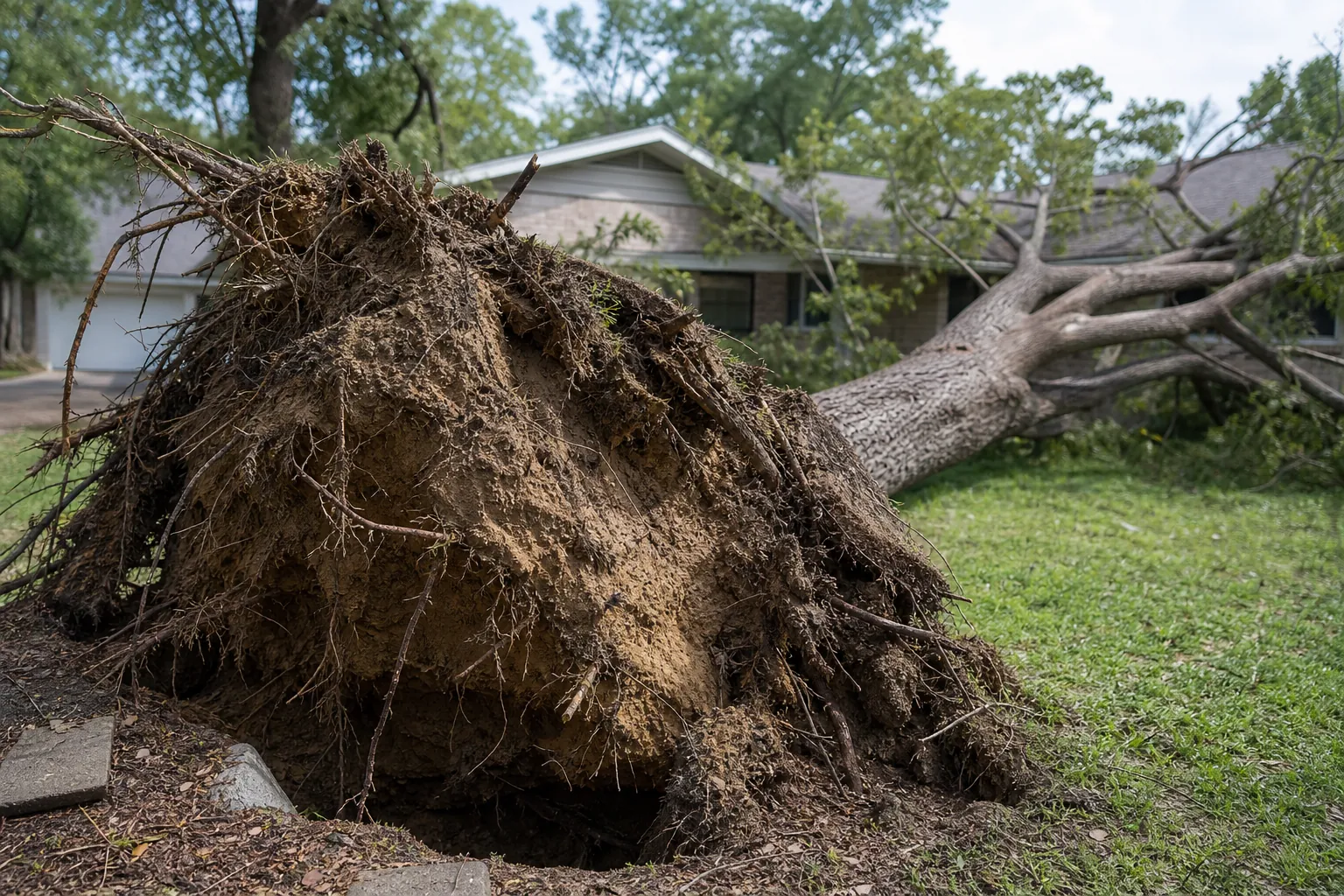
Reviewer and contributor: Clinton Funk, Owner, Florida Foliage. Clinton has decades of hands-on tree care experience.
Tim Francis is responsible for the research and editorial quality of this article. AI tools assisted with drafting and the editorial images. This general information does not assess a particular tree.
Hurricane Tree Base Damage in Pensacola, FL calls for clear notes and a careful household plan.
If a tree base looks different after a hurricane in Pensacola, keep clear and do not approach the base to investigate. Storm-damaged trees and falling limbs can be unstable, says OSHA’s storm tree-work guidance. Describe only what you can already see. Do not guess what happened underground or whether the tree can stay. This guide helps you sort observations from questions and write a neutral inquiry. It does not assess roots or recommend tree work.
What Comes First For Hurricane Tree Base Damage?
A changed tree base shows a visible difference. It does not explain why it changed or what should happen next. tree removal service overview and tree trimming service overview describe two service types. A homeowner’s note cannot show which service, if any, fits the tree.
After a hurricane, technical terms can sound useful. You may hear “root plate damage” and think it names what you see. For a first message, plain words work better. Describe the look instead of naming a condition no one has confirmed.
For example, “The ground beside the base looks raised compared with before the storm” is an observation. “The roots have failed” is a diagnosis. This guide does not explain root mechanics or soil conditions. It cannot tell you whether a tree should stay.
A comparison has limits. If you do not remember how the base looked before the storm, say so. Do not fill that gap with a guess. You can describe the change and say when you first noticed it, if you know.
- Use ordinary descriptions such as “the base looks different” rather than an unconfirmed technical label.
- Separate what you remember from what you can currently see.
- Write “I do not know” when the timing or cause of a change is unclear.
- Keep questions about the tree’s condition separate from your observations.
Why Should You Keep Clear of the Base?
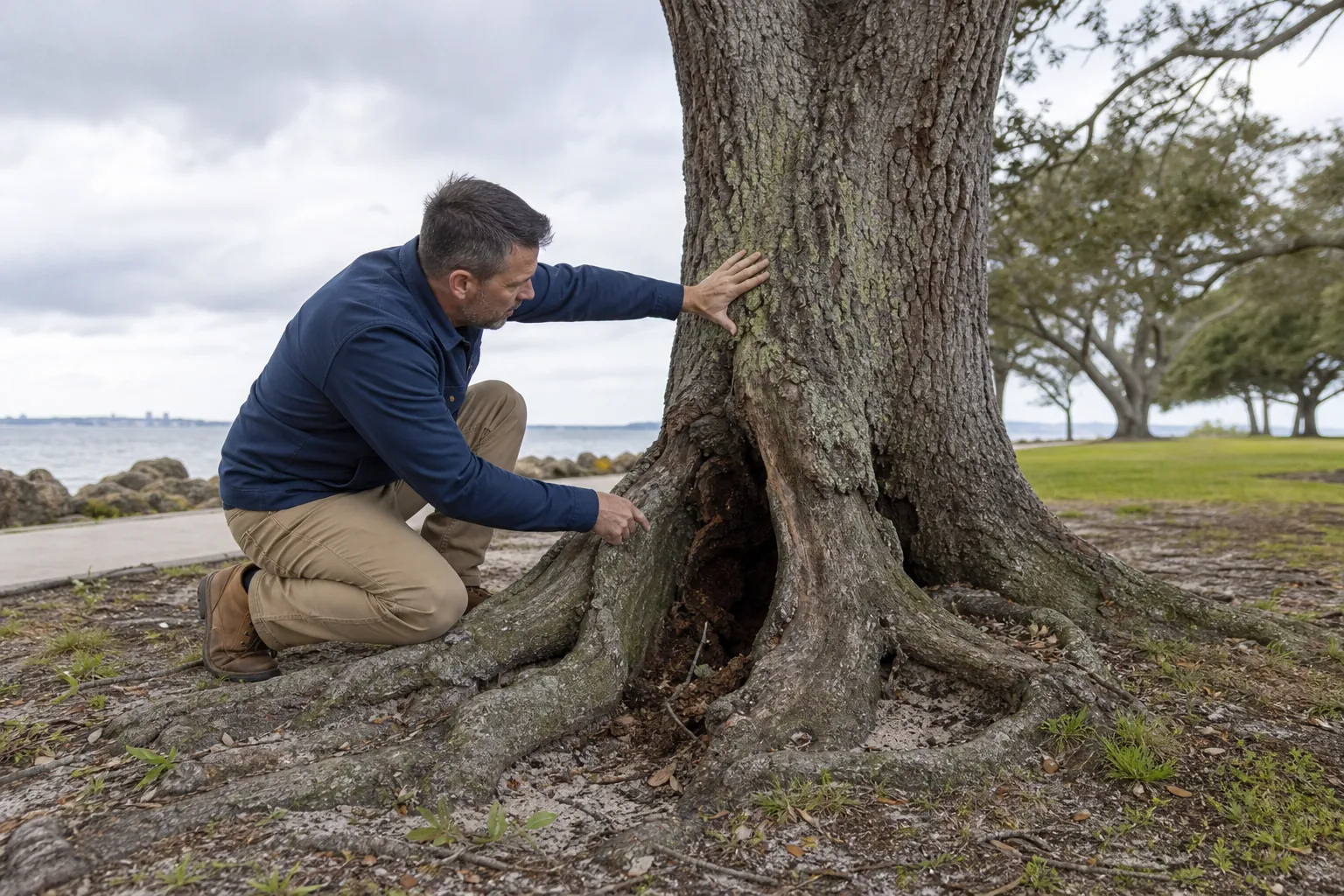
Keep clear because storm-damaged tree work can involve unstable trees and falling limbs. OSHA identifies these hazards lists both hazards. Read the removal service description for removal service details and Florida Foliage’s company background for company background. These pages give business and service context.
The difference is between noticing and investigating. You can report what you already noticed. You do not need to approach the base for a better description. Do not touch the tree, look beneath it, or take measurements. More detail is not worth getting closer.
Do not treat a quiet moment as a safety check. A still image or no visible movement cannot show the tree’s condition. Keep your note to what the tree looks like. Do not say the tree is safe.
Keep family messages simple. Share one written note instead of asking several people to look. If work is underway, OSHA says people who do not need to be there should stay outside work and drop areas. See OSHA’s tree-work guidance
- Keep clear of the changed base in light of the unstable-tree and falling-limb hazards described by OSHA.
- Describe what you already noticed rather than making a closer inspection part of your household checklist.
- Use one shared note so family members do not each need to produce a separate account.
- Keep nonessential people outside active work and drop areas, as directed by OSHA.
Which Other Storm Hazards Matter Here?
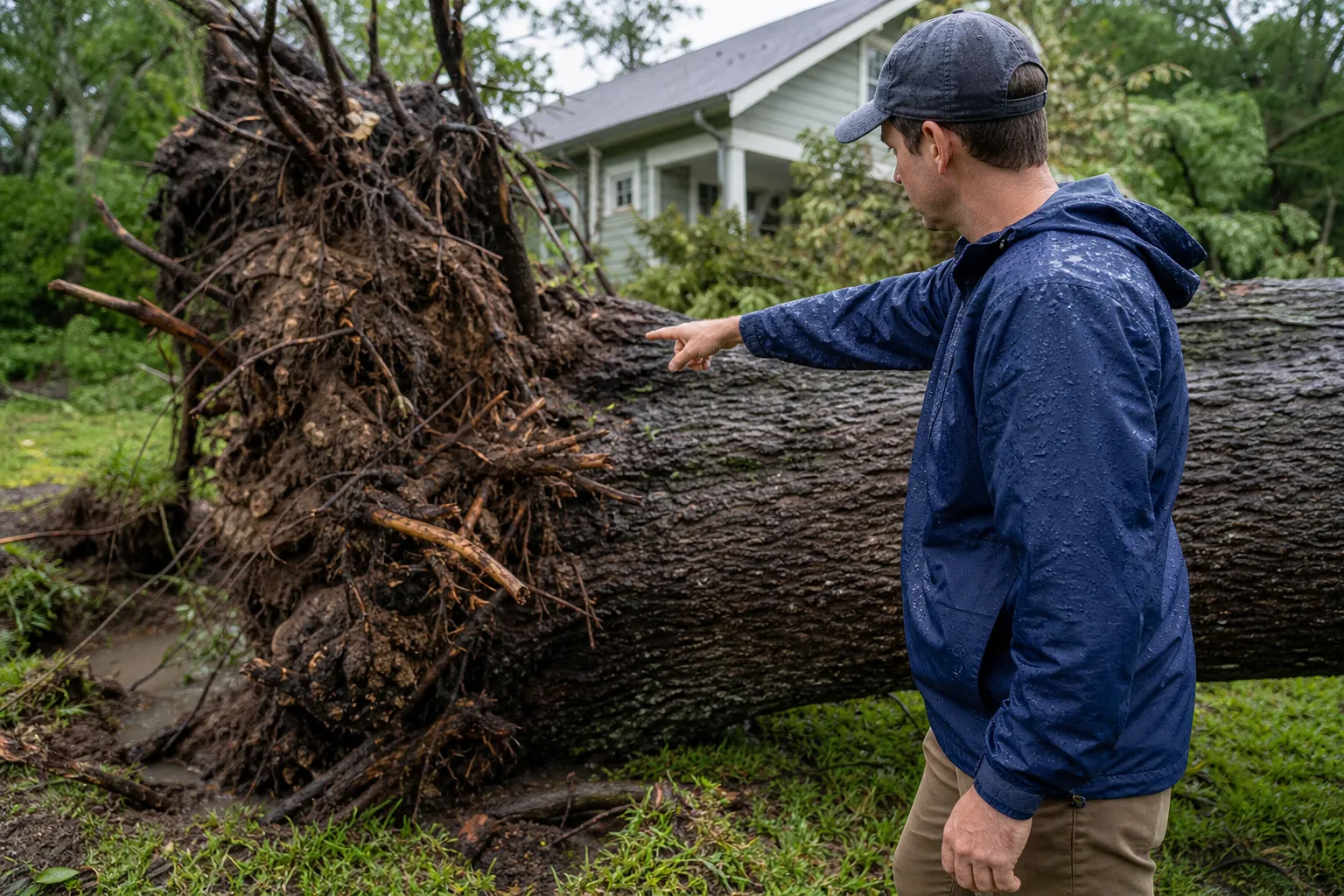
The tree base is not the only storm hazard. OSHA also lists electrical contact, tensioned tree material, and limbs that roll or slide. Read Read the source guidance for the source. the trimming service overview describes trimming service, and the contact page explains how to contact the company. Use these pages for context.
Downed electrical conductors can energize trees and fences. OSHA says to avoid direct and indirect contact. See OSHA’s storm tree-work guidance. Do not call a tree or fence electrically safe based on how it looks. If you already noticed a conductor, report that fact. Do not try to determine its status.
Tensioned tree material and limbs that can roll or slide are hazards listed by OSHA. This guide gives no handling instructions. “There are branches near the tree” is enough for an initial note. Do not add a plan for moving them or explain the forces involved.
Keep other debris concerns separate. OSHA says debris can hide meters and fire hydrants. It also says to keep people away from debris machinery. Stay clear of leaking hazardous chemical containers. OSHA says hazardous-material response personnel should assess them. See See OSHA’s debris collection guidance.
- Avoid direct and indirect contact involving downed conductors, trees, or fences, following OSHA’s electrical hazard guidance.
- Do not make moving tree material part of this observation task; OSHA identifies tensioned material and trees that may roll or slide during felling as hazards in its tree-work guidance.
- Keep nonessential people away from debris machinery, as stated in OSHA’s collection guidance.
- Stay clear of leaking hazardous chemical containers and leave their assessment to hazardous-material response personnel, as directed by OSHA.
How Can You Describe the Change Without Diagnosing It?
Name the visible feature, identify the tree in ordinary words, and say what you do not know. The inquiry form and contact information has contact details. Read the company information page for company background. Ask a neutral question. These steps do not select a service or assess the tree.
Treat your note as a short record, not an argument for one outcome. “The tree beside the front walk seems to lean more than I remember” says what caught your attention. “The tree must be removed” jumps from what you see to a decision this guide cannot make.
Choose a simple name for each tree if several are involved. “Front walk tree” and “back garden tree” may be easier to follow. Use names your household already knows. You do not need to name the species unless you already know it.
Keep the storm reference clear without claiming cause. You can say you first noticed the change after the hurricane. That does not show how the storm affected the tree. If you do not know whether the feature was there before, say so.
If you already have images, use them to show which tree you mean. They are context, not proof of safety. Do not delay a message to get a new image. A plain note can explain your concern without settling what the change means.
- Identify the tree using a familiar location description.
- Describe a visible difference without naming an underground condition.
- State whether you remember seeing the same feature before the hurricane.
- Label existing images as context rather than evidence of safety.
- End with an open question instead of a requested technical conclusion.
Build One Clear Household Record
One shared household note can keep the inquiry clear. Use Florida Foliage’s contact options to contact the company. Read the removal service page to understand the removal service. Your note should describe the concern without choosing what work the tree needs.
This is a simple way to organize details, not a technical checklist. It does not determine the tree’s condition. One shared account can help prevent scattered messages, conflicting details, and guesses from getting mixed with what people saw.
- Give the note a clear heading, such as “Tree base appearance after the hurricane”.
- Identify the tree using the same familiar description throughout the note.
- Write down what you already noticed in plain language.
- Add what you remember about its earlier appearance, or state that you do not remember.
- Separate any existing images from your written observations and label them as context.
- List the questions you want to ask, including whether service is available for your location.
- Save a copy of the message so the household can refer to the same account.
Keep different details in separate sentences. A sentence about the base should not also state a cause, predict an outcome, and request a type of work. Short sentences help readers separate what you noticed from what you want to ask.
If household members remember different details, keep both accounts. Do not choose a technical explanation. One person may recall uneven ground before the storm, while another first noticed it afterward. Keep that difference in the note.
- Use one consistent name for the tree across messages.
- Keep older recollections separate from notes about current visible changes.
- Remove technical terms that you cannot support with an established assessment.
- Keep the record short enough that the main concern is easy to find.
Make a Neutral Florida Foliage Inquiry
Read Florida Foliage’s business background for company background. Use the contact page to send a question. Florida Foliage is based in Daytona Beach. Call (386) 481-7913 to ask about current service options for your Pensacola property.
You can call (386) 481-7913. Say that you are in Pensacola. Then describe the change you noticed and ask whether the company can discuss it.
A useful message might read: “I am in Pensacola, Florida. After the hurricane, I noticed that the base of the tree beside our front walk looks different from what I remember. I have not confirmed the cause. Does Florida Foliage offer services for this location, and what details would help with an initial discussion?”
That wording leaves the tree’s condition open and avoids assuming what comes next. Service pages describe different kinds of work. Reading them cannot show which type fits this tree. You do not need to choose trimming or removal before asking about your location.
- State that the property is in Pensacola before describing the concern.
- Ask about service availability rather than assuming it from a website page.
- Share the short observation record without presenting it as a diagnosis.
- Ask what information would be useful for a discussion without expecting a particular response or outcome.
Keep the Next Decision Separate From the First Observation
The tree trimming information page and tree removal information page offer context about two services. They cannot tell you what should happen to a storm-shifted tree. Keep your first note accurate. State what you noticed, what you remember, and what you do not know.
A complete first message does not need to answer every question. Name the tree, explain what caught your attention, and ask whether the business can discuss the concern for your location. That is enough to begin an inquiry. Do not say you know what happened to the roots or whether the tree should stay.
Keep the difference clear as you organize your note. An observation records what you noticed. An assessment explains what it means. This guide helps with the first task. It gives no instructions for inspecting, handling, or working on the tree.
- Leave the tree’s condition unresolved in your initial account.
- Keep service questions separate from conclusions about the tree.
- Use existing information rather than treating a more detailed inspection as necessary.
- Check that your final message clearly distinguishes observations, recollections, and questions.
Author: Tim Francis is responsible for this article’s content and editorial presentation. Florida Foliage owner Clinton Funk has decades of hands-on tree care experience.
Does a changed tree base prove root plate damage?
No. A changed look is an observation, not a confirmed diagnosis. Describe what looks different and whether you remember seeing it before. This guide cannot interpret root conditions or predict what will happen to the tree. If you use “root plate damage,” present it as a question, not a confirmed finding.
Should I approach the base to get a better description?
Keep clear rather than approaching for more detail. OSHA identifies unstable-tree and falling-limb hazards in storm-damaged tree work. Read OSHA’s guidance. Your first message can use what you already noticed. It does not need measurements, a close look, or a technical explanation.
Can an existing photograph show that the tree is safe?
No. An existing image may show which tree you mean or what looks different. It cannot prove the tree is safe. Mark the image as context and say what you do not know. You do not need a new photo before sending an initial inquiry.
What if I notice a downed conductor near the tree?
OSHA says downed electrical conductors can energize trees and fences. It tells people to avoid direct and indirect contact. See the authoritative guidance. Do not try to decide whether a tree or fence is safe. If you already noticed a conductor, report that fact without drawing a conclusion.
Does Florida Foliage have a Pensacola office?
Call the contact page or (386) 481-7913 to ask whether Florida Foliage has an office or current service option in Pensacola. State where the property is and describe what you already noticed.
Call (386) 481-7913 to talk through next steps.