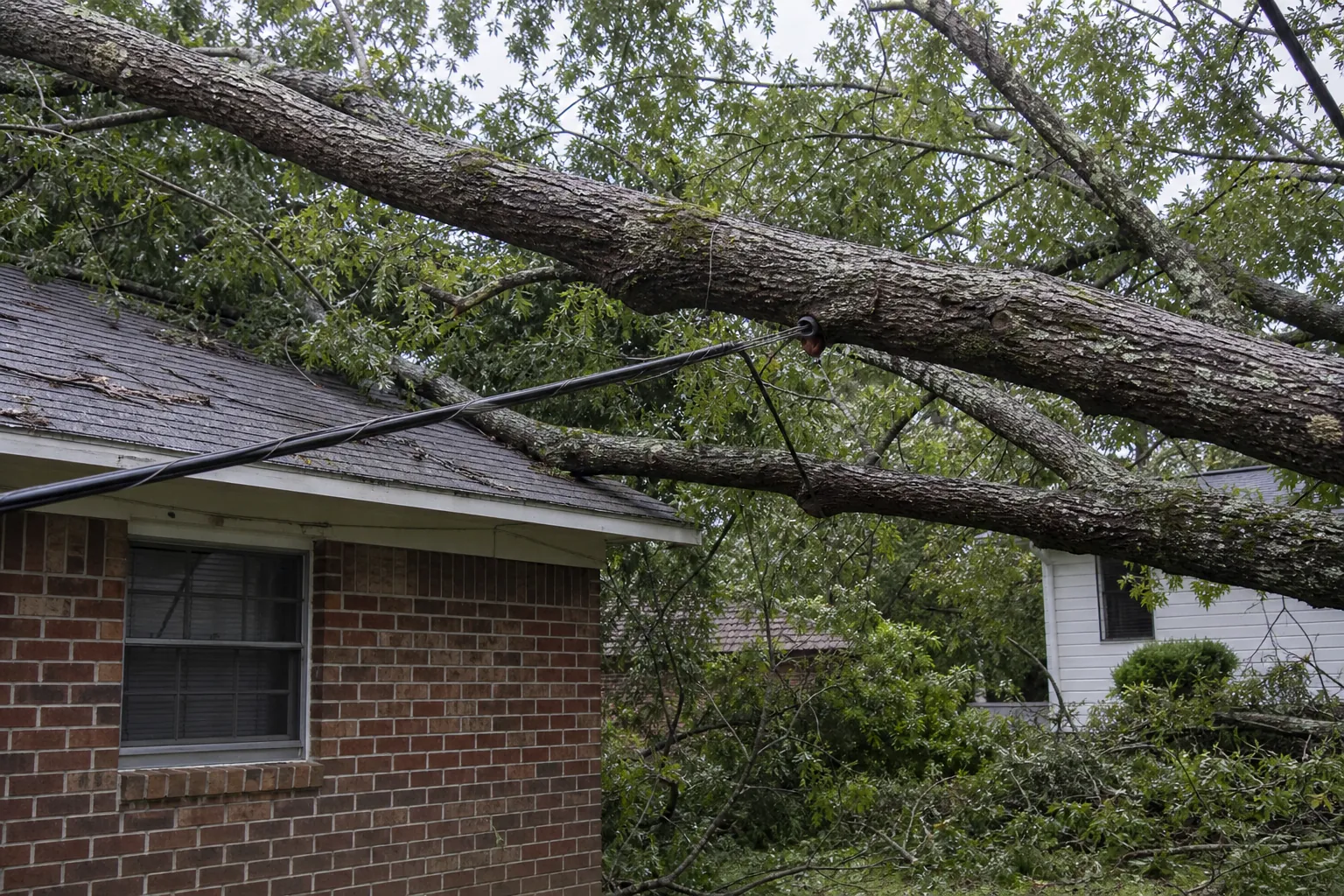
If a hurricane leaves a tree touching what looks like a service wire in Pensacola, treat the tree and nearby fences as possibly energized. Do not touch them. Contact the utility. OSHA says downed electrical conductors can energize trees and fences. Direct and indirect contact can be dangerous. Read OSHA’s electrical hazard guidance. This guide adds practical steps for reporting and household notes to our emergency tree removal in Pensacola resource. It does not tell you how to handle the tree or wire.
What Should You Do About a Tree Touching a Wire?
Contact the utility. Describe the apparent tree-and-wire contact. Do not try to resolve it yourself. OSHA says downed conductors can energize trees and fences. Avoid direct and indirect contact. OSHA explains this hazard. Our tree removal service overview and company contact information offer separate context for later questions.
Focus your first conversation on the electrical concern. You do not need to name the wire type or explain how the tree came to rest against it. Plain words such as “a branch appears to touch a wire running toward the house” are clearer than an uncertain technical label.
Use the utility’s contact information from an existing bill or its official website. Describe the location as you understand it. Keep this conversation separate from any later question about tree services. That way, your notes show who received each piece of information.
- Tell the utility that a hurricane-damaged tree appears to touch a wire.
- Give the address and describe the visible location in plain words.
- Write down the date of the conversation and any directions from the utility.
- Do not say the wire is harmless if you are not sure.
This article cannot tell you the electrical condition of a tree, fence, or wire. It can help you report the concern without treating a homeowner’s description as a diagnosis.
What Can You Describe Without Diagnosing the Tree?
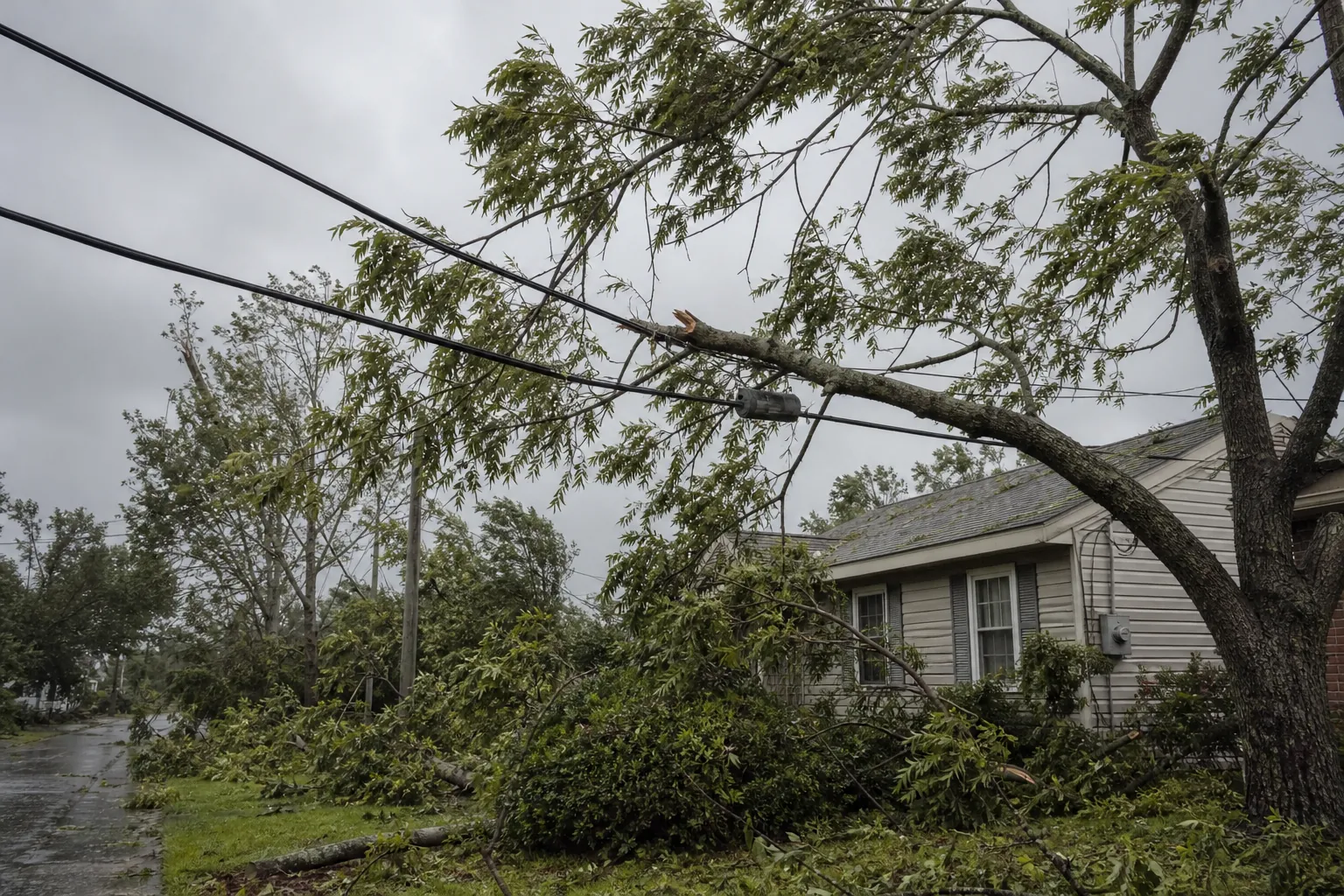
You can describe what you have already seen: where the tree is, any broken branches you can see, and the apparent wire contact. These are observations, not a diagnosis of stability or electrical condition. The tree trimming service overview explains a separate service category. Florida Foliage’s company background identifies the business behind this article.
A useful note separates what you saw from what you think it means. “A large branch is hanging over the driveway” describes something you can see. “The tree will fall tonight” predicts an outcome your note cannot prove. The same applies to a wire that looks stretched or is partly hidden by leaves.
Storm-damaged tree work can involve falling limbs and unstable trees. So, keep your description factual. Do not treat the tree’s appearance as a safety finding. OSHA identifies these storm-damaged tree hazards.
- Write “appears to touch” if you are not sure contact is clear from what you have seen.
- Describe locations using familiar features, such as the driveway or front window.
- Mark details you are not sure about as unknown. Do not fill in gaps.
- Keep any existing photos as visual context, never as proof that a tree is safe.
Your description does not need to be polished. A brief, honest account is more useful than a long one full of guesses. Leave technical interpretations out of your household notes.
How Can You Make the Utility Message Clear?
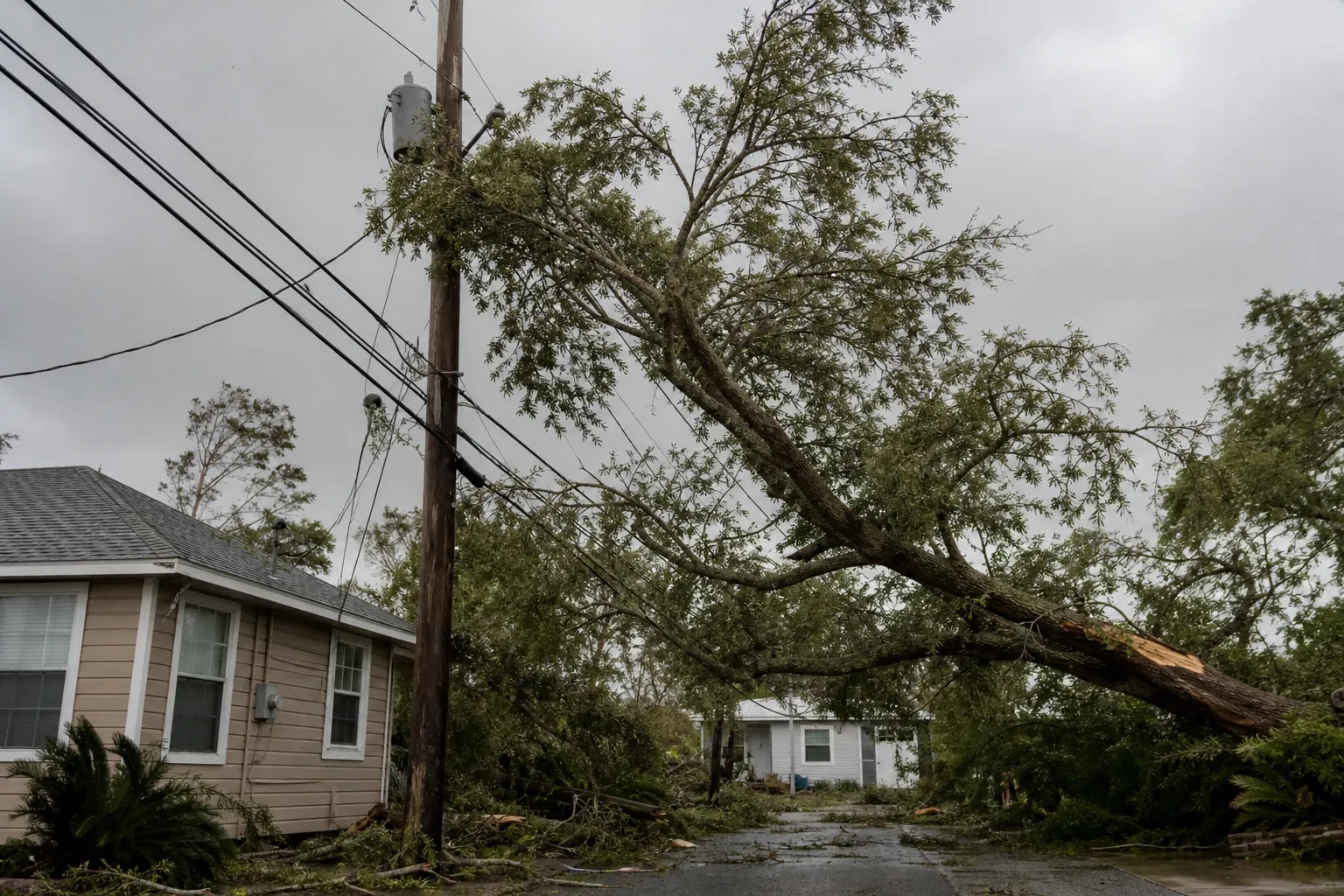
A clear message to the utility gives the address, describes the apparent tree-and-wire contact, and says what is unknown. Keep it short so you can read it back with ease. The Florida Foliage inquiry page is for a separate conversation with the company. The tree removal information page offers background, but does not replace contacting the utility.
You can prepare a simple script before you call: “After the hurricane, a tree at this address appears to be touching a wire near the house. I do not know the wire type or electrical condition.” Add a location detail if you already have one. You do not need to gather more details just to make the message sound complete.
Keep the utility’s words separate from your own summary. If you do not understand a direction, ask the person to repeat or explain it. Do not replace an unfamiliar phrase with your own technical guess.
- Start your note with the address and the apparent tree-and-wire contact.
- Add a short description of where the tree and wire seem to meet.
- List unknown details, including the wire type if you cannot identify it.
- Record the utility conversation apart from other household messages.
- Save any follow-up question in the same note so you do not lose it.
This numbered list helps you organize communication. It is not a set of steps for going near, inspecting, or working on the damaged tree. This matters when several people share messages about the same event.
Organize the Household Without Organizing Tree Work
A shared household note can help avoid mixed messages about what you reported and what is still unknown. Keep it about communication, not a cleanup task. The company information page gives background on Florida Foliage. The contact page for general questions is a separate place for a later inquiry.
Choose a simple format everyone already uses, such as a paper note or shared message thread. Label it with the address and storm date. Put confirmed conversations in one part and unanswered questions in another. This is basic household organization, not a technical response plan.
OSHA says people who are not needed should stay outside work and drop areas during tree work. Do not let a household cleanup invitation become an invitation to enter an area where damaged-tree work is taking place. See OSHA’s guidance on work and drop areas.
- Choose one shared place for contact notes instead of several competing message threads.
- Ask household members to mark secondhand information as secondhand.
- Keep offers to help with normal household tasks separate from tree-work discussions.
- Note who plans to make a follow-up call so the same question is not asked again without need.
A helpful household update might say, “The utility has been contacted, and we still do not know the electrical condition.” This shares progress without suggesting that the call changed the condition of the tree or wire.
Keep Storm Cleanup Separate From the Wire Concern
General storm cleanup advice does not show that a tree touching a wire is ready for household work. Keep these as separate subjects in your planning notes. The overview of tree removal services and overview of tree trimming services help explain service questions. They do not offer a cleanup method.
Ready.gov says not to touch electrical equipment if it is wet or if you are standing in water. Read Ready.gov’s hurricane guidance. It also says that underground or downed power lines can electrically charge water. See Ready.gov’s warning about electrically charged water.
Floodwater can contain debris, chemicals, waste, and wildlife. Note a water-related concern on its own, rather than ignoring it while you discuss the tree. Ready.gov describes these floodwater hazards.
- List water-related observations apart from the apparent tree-and-wire contact.
- Keep general cleanup plans out of the message about the electrical concern.
- Do not describe protective clothing as a fix for an unknown electrical condition.
- Use each source’s advice for its stated purpose. Do not treat it as a tree-work checklist.
For debris cleanup, Ready.gov advises wearing protective clothing and suitable masks. This is general cleanup advice. It does not say that a wire-related situation is suitable for homeowner work. Read Ready.gov’s debris cleanup advice.
Understand What Tree Service Pages Can Explain
Service pages can explain what to ask a tree care business. They cannot diagnose this tree or wire. Read the tree removal service description and tree trimming service description for background only. Neither page shows that the company is available in your area or tells you the condition of your property.
“Removal” and “trimming” are names for service categories. You do not need to choose between them based on how a storm-damaged tree looks. You can ask what information the business needs for a further conversation without choosing tree work in advance.
OSHA also identifies tensioned tree material and rolling or sliding limbs as hazards during storm-damaged tree work. That is one reason this article does not give cutting, clearing, or handling instructions. OSHA lists these tree-work hazards.
- Describe the concern before asking about a service category.
- Say that a wire appears to be involved. Do not leave that detail out of your inquiry.
- Ask what information would help with an initial conversation with the business.
- Keep service-page descriptions separate from conclusions about your tree.
A service inquiry is a chance to share information. It does not show that the electrical concern is resolved, that anyone has evaluated the tree, or that a company has arranged work in Pensacola.
Keep Follow-Up Questions Focused and Factual
Follow-up questions work best when they ask about a missing fact or clarify an earlier message. Keep utility questions separate from company questions. The page for contacting Florida Foliage supports a neutral business inquiry. The Florida Foliage background page helps you learn who you are contacting before that conversation.
Review your existing note before you call again. Look for a question that still needs an answer instead of rewriting the whole event. For example, you may need someone to explain a direction you recorded. Or you may want to correct the location you gave earlier.
If someone shares an update, record who told you and what they said. A household member saying “I heard it was handled” is not the same as a direct conversation that explains what was addressed. Keep the difference clear in your notes. Do not turn it into a technical conclusion.
- Write one clear question at a time so it can be answered directly.
- Correct wrong details openly instead of keeping both versions in the note.
- Keep your first observation with later updates so the order stays clear.
- Mark a question as unanswered until you get a direct response.
A short record is enough. You do not need to make a formal report. Just avoid mixing up an observation, a message, and a confirmed conversation. None of these records proves that the tree is safe.
A Neutral Next Step With Florida Foliage
For a separate tree-service inquiry, use the Florida Foliage contact page and read about the company and its owner. Say that the property is in Pensacola and a wire appears to be involved. Ask whether the company can discuss your inquiry. Do not assume there is local availability, a scheduled visit, or a response time.
Florida Foliage is headquartered in Daytona Beach. This article does not say there is a Pensacola office or that crews are available in the Panhandle. You can call (386) 481-7913 to make a neutral inquiry. Contacting the company is separate from contacting the utility about the electrical concern.
- Give the property location at the start of the company conversation.
- Mention the apparent wire contact before discussing tree service categories.
- Ask whether the business can discuss the situation instead of assuming it will visit.
- Keep any company response in a separate part of your household note.
For more context, return to the guide to emergency tree removal in Pensacola. Keep the main point in view: visible damage is an observation, not a diagnosis. A service inquiry is not a finding about electrical condition.
Frequently Asked Questions
These answers separate safety facts from sources from suggestions for household communication. The tree removal overview for service questions gives general context. The Florida Foliage contact page for inquiries offers a neutral next step. Neither resource tells you whether a specific tree, wire, fence, or work area is safe.
Can a tree or fence become energized after a hurricane?
Yes. OSHA says downed electrical conductors can energize trees and fences. It warns against direct and indirect contact. Read OSHA’s guidance. If a tree seems to touch a service wire, contact the utility and describe the concern. The tree’s or fence’s appearance cannot tell you its electrical condition.
What if I cannot tell which kind of wire is involved?
Say that you do not know the wire type. Describe the apparent contact and location using details you already have. You do not need a technical label to make a clear report to the utility. Mark uncertain details as uncertain. Do not turn a guess about the wire into a conclusion about safety.
Can photographs prove that the tree is safe?
No. Do not use photos as proof that a tree is safe. Existing images may give visual context, but what you can see does not diagnose electrical condition or stability. OSHA identifies falling-limb and unstable-tree hazards in storm-damaged tree work. See OSHA’s description of those hazards.
Does protective cleanup clothing resolve the wire concern?
No. Ready.gov’s advice to wear protective clothing and suitable masks is about debris cleanup. It does not show that a tree touching a wire is suitable for household work. Read the cleanup guidance. Keep general cleanup plans separate from the electrical concern. Describe the apparent wire contact when you speak with the utility.
Does this article mean Florida Foliage has a Pensacola office?
No. Florida Foliage is headquartered in Daytona Beach. This article does not show that there is a Pensacola office, local crews, or a response time. Call (386) 481-7913 for a neutral inquiry and give the property location. Ask whether the company can discuss your question. Do not assume local availability or a scheduled visit.
Author: Tim Francis is responsible for this article’s content and editorial presentation. Clinton Funk owns Florida Foliage and has decades of hands-on tree care experience. This attribution does not say that he personally reviewed this draft. The linked OSHA and Ready.gov pages provide the safety facts used here.
Call (386) 481-7913 to talk through next steps.