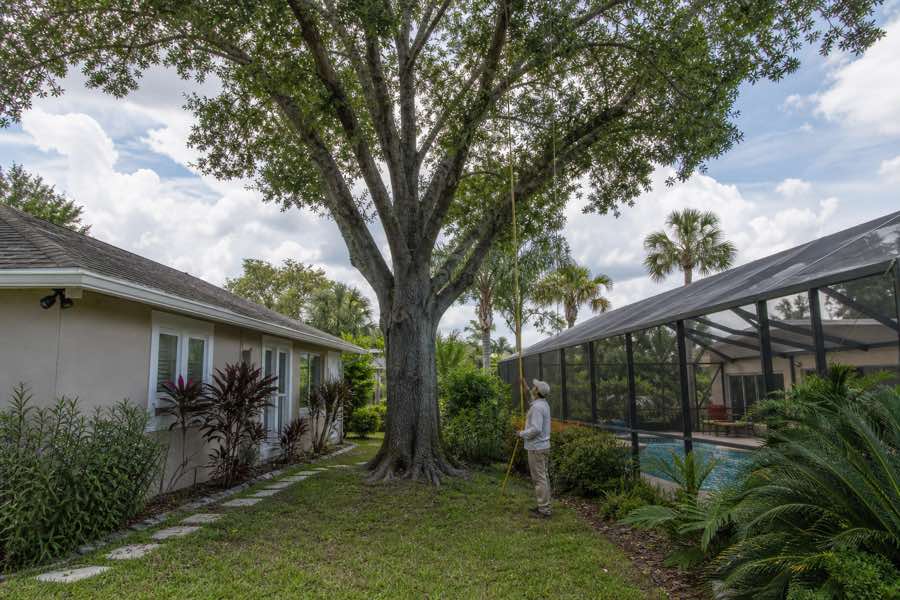
Large tree removal on a small lot takes more planning than force. In Ormond Beach, tight setbacks, pools, fences, sandy soil, and overhead utilities can turn a routine job into a controlled project. The right quote should explain access, staging, landing zones, and what is excluded before work begins. Florida Foliage serves Volusia and Flagler counties, with Daytona Beach as the primary market, and offers a free estimate for large tree removal service planning.
A small-lot removal should be scoped before it is scheduled. Ask where equipment will travel, where brush will land, how debris will exit, what must be protected, and who is responsible for permits. A clear written scope reduces surprises on constrained properties.
In coastal neighborhoods, the questions are practical. Can a truck reach the yard without crossing a pool deck? Will the tree come down in sections or need a crane? Are there fences, irrigation heads, septic components, or utility drops in the path? An Ormond Beach tree service should explain those details in plain terms, not in guesses.
How Close Is Too Close for a Large Tree Near a House?
For large tree removal, “too close” means the house, pool, fence, or utility layout leaves no safe room for controlled work or debris landing. Distance alone is not enough. A professional looks at canopy spread, lean, drop zone, access, and whether sections can be lowered without striking structures.
On a small lot, a tree may be only a few feet from a wall yet still removable in a controlled way if there is workable access and enough landing space. The reverse can also be true: a tree farther away may be harder if the side yard is blocked, sandy, or fenced in. Florida Foliage can inspect the site and help compare practical options before the scope is set.
Do not let a photo decide the job plan. A contractor should confirm if nearby branches overhang the roof, if roots have shifted hardscape, and if the property gives enough room for a bucket truck, climber, or crane setup. For a related scope discussion, you can also compare tree cutting scopes with the larger picture in mind.
OSHA’s tree care guidance makes clear that tree work requires job-specific hazard review, and that is especially true when houses and utilities are close. For broad crane safety principles, see OSHA cranes and derricks.
How Do Professionals Remove Large Trees?
Professional large tree removal usually starts with a site plan, not a saw. Crews decide how the tree will be reduced, where pieces will land, where material will be staged, and how the debris will leave the lot. On tight sites, the method changes with access, not with guesswork.
A qualified crew may use climbing, a bucket truck, rigging, or a crane depending on what the property allows. The important point for homeowners is the sequence of decisions. The company should explain what will happen to limbs, trunk sections, brush, and stump material, plus what areas will be protected.
On a constrained lot, the best scope often separates removal from cleanup. Brush may need to be lowered into a specific corner, hauled by hand, or loaded from the driveway rather than the backyard. That is why the estimate should describe staging, landing, and debris flow, more than the tree itself.
Florida Foliage keeps the conversation grounded in the actual site. If a tree has to be sectioned, or if access suggests a crane tree removal plan, the quote should say so. The point is to choose the method that fits the lot, not the method that sounds simplest on paper.
Qualified arborists matter in that planning. The Tree Care Industry Association’s educational material on hiring an arborist notes that trained tree professionals can help assess risk and scope. See why hire an arborist for the limited point that expert evaluation supports safer tree decisions.
What Questions Should You Ask a Large Tree Removal Company?
Ask whether the large tree removal quote includes access, staging, landing zones, and cleanup boundaries. The best answer is specific. You want to know how the crew will reach the tree, what surface protection is needed, what parts of the yard will be used, and what remains outside the scope.
Good questions force clarity before work starts. Ask who verifies overhead lines, who handles permit checks, whether the pool enclosure needs removal or protection, and what happens if hidden issues appear during the job. A company that answers cleanly is easier to compare than one that gives only a low number.
- Ask where equipment will enter and exit.
- Ask what areas must stay clear.
- Ask how brush and wood will leave.
- Ask what happens near fences and pools.
- Ask which exclusions appear in writing.
Those questions matter because the quote should describe the actual work, not an assumption. If the tree is near a service drop or utility corridor, the contractor should explain who determines clearance limits. The same is true for permits. The city or county decides permit authority, not the salesperson.
Florida Foliage can provide a free estimate and help you compare scope in a way that makes sense for Daytona Beach and nearby coastal properties. Call (386) 481-7913 if you want the site reviewed before you commit to a plan.
How Many Large Tree Removal Quotes Should You Get?
For large tree removal on a small lot, two or three detailed quotes are usually enough if each contractor has inspected the site. More quotes do not help if they are based on different assumptions. Compare scope, exclusions, access needs, cleanup, and who is responsible for protection and permits.
The value of multiple quotes is clarity, not volume. One contractor may plan to protect a pool deck, another may expect to work from the street, and a third may assume a crane. Those are different jobs. A fair comparison starts when every bidder is pricing the same site conditions and the same finish level.
Look for consistency in wording. If one estimate says debris will be hand-carried through a gate and another says the yard will be accessed from the driveway, ask why. If one includes stump handling and another leaves it out, that is not an equal comparison. The better quote makes exclusions easy to spot.
Florida Foliage serves Volusia and Flagler counties, and the local market often includes narrow driveways, seawall-adjacent yards, and limited side access. That makes written scope more useful than a quick verbal promise. If you are comparing options, ask each company to spell out the same constraints.
| Quote Element | Why It Matters on a Small Lot | What to Look For |
|---|---|---|
| Access path | Equipment may not fit every route | Gate width, driveway use, side-yard limits |
| Landing zone | Brush and sections need a safe place | Named yard area, driveway, or street plan |
| Protection | Fences, pavers, and pool enclosures are vulnerable | Tarps, boards, mats, or exclusion language |
| Cleanup scope | Debris must leave without extra damage | Haul-off method and finish standard |
| Exclusions | Hidden assumptions create disputes | Written items not included |
What Factors Affect Large Tree Removal Cost?
The cost of large tree removal changes with access, height, canopy spread, location, and the time needed to protect nearby structures. On a small lot, the biggest driver is often how complicated the site is, not simply how tall the tree stands. More constraints usually mean more planning.
If a crew can work from open ground, the job is more straightforward. If they must protect a pool enclosure, move through a narrow gate, or stage brush in a tight corner, labor and setup become more involved. Sandy soils common in coastal Florida can also affect how equipment is placed and moved.
Debris flow matters too. A tree that sheds large limbs over landscaping may need controlled lowering, while a tree near a fence may require extra rigging to keep material from swinging into a boundary. Cleanup standards can also change the labor needed, especially if the lot gives little room for stacking wood.
Ask for written exclusions. A quote should say whether stump grinding, haul-away, fence repairs, irrigation repairs, or property grounds restoration are included. If those items are not included, the estimate should state that plainly. Florida Foliage is licensed and insured, and its ISA Certified Arborists are on staff, but property-specific decisions still depend on the site review.
The right scope also depends on hidden conditions. Decay, lean, root issues, and overhead utility conflicts can change the plan after inspection. That is why a free estimate should be treated as a decision tool, not a promise about an exact method from a distant view.
How Does Crane Access Affect a Large Tree Removal Quote?
Large tree removal may cost less or more with a crane depending on whether the machine can actually reach the tree and work safely. If access is good and the landing zone is clear, a crane can reduce time. If access is tight, the quote may include setup, traffic control, and more planning.
Crane access is a site question, not a guess from a photo. The crew must check drive width, ground support, overhead wires, curb space, and a safe location for the boom and pickup area. If the machine cannot stage properly, the quote should not pretend it can. The site drives the method.
On a small Ormond Beach lot, a crane may be blocked by fences, pools, parked cars, trees in the neighboring yard, or narrow utility corridors. Even when it is possible, the crew may still need a clear landing zone for sections and debris. That is why the estimate should explain how the crane, if used, changes the workflow.
For properties with tight borders, a company should specify who is responsible for protecting the lawn, confirming street use, and checking overhead conflicts. This is where a local large tree removal service should be candid. Florida Foliage can discuss those constraints during a free estimate, and you can call (386) 481-7913 to start that conversation.
Can a Crane Pull a Tree Out of the Ground?
No, a crane does not magically pull a tree out of the ground during large tree removal. The tree must still be severed and handled by a qualified crew. A crane can lift sections or assist with removal, but stump work, root conditions, and final site restoration are separate issues.
This distinction matters because homeowners sometimes expect one machine to solve every part of the job. It does not. A removal quote may cover taking the trunk and canopy down, while stump grinding, root cleanup, or surface repair are handled separately. The written scope should say exactly what is being removed and what is left behind.
Sandy coastal soil can also affect what happens after the tree is down. The opening left by the stump may need different restoration than a tree removed from dense inland soil. That is another reason to ask about exclusions and finish work before the crew starts. Small-lot work is best when each part of the job is named.
Florida Foliage can review a property, explain the likely staging needs, and help you decide if a crane is worth considering. For an Ormond Beach property, the most useful answer comes from an inspection, not from a guess. If you are ready to talk through the scope, call (386) 481-7913.
Does a small lot always require a crane?
No. Some small-lot removals can be done by sectioning the tree, using a bucket truck, or lowering pieces with rigging if the access and landing area work. A crane is one option, not the default. The property layout, not the lot size alone, should decide the method.
Should the quote identify landing and staging areas?
Yes. The quote should say where limbs, trunk sections, and brush will be placed while the job is underway. It should also identify where crews will stage equipment and whether the driveway, side yard, or street will be used. That helps prevent misunderstandings on tight residential lots.
How are fences and pool enclosures addressed?
They should be addressed in writing. The estimate should say whether the company will protect, remove, or work around fences and pool enclosures, and it should note any excluded repairs. If a barrier limits access, that fact can change the method, cleanup path, and final scope.
Who confirms utility and permit restrictions?
The governing utility provider and the local permit authority confirm those restrictions, not the homeowner or the sales rep. A tree company can help identify likely conflicts and ask the right questions, but property-specific permit decisions belong to the jurisdiction. Insurance questions also depend on the policy and insurer.
Can Florida Foliage inspect an Ormond Beach site?
Yes. Florida Foliage serves Volusia and Flagler counties, with Daytona Beach as the primary market, and can inspect an Ormond Beach property for a free estimate. The site review can help clarify access, staging, landing zones, and written exclusions so the proposal matches the lot conditions.
When you compare large tree removal proposals, the best quote is the one that explains the lot. Florida Foliage can review the access, staging, landing zones, and exclusions before work is scheduled, so the plan fits the property instead of forcing the property to fit the plan. For a free estimate, call (386) 481-7913 or visit request a free estimate.