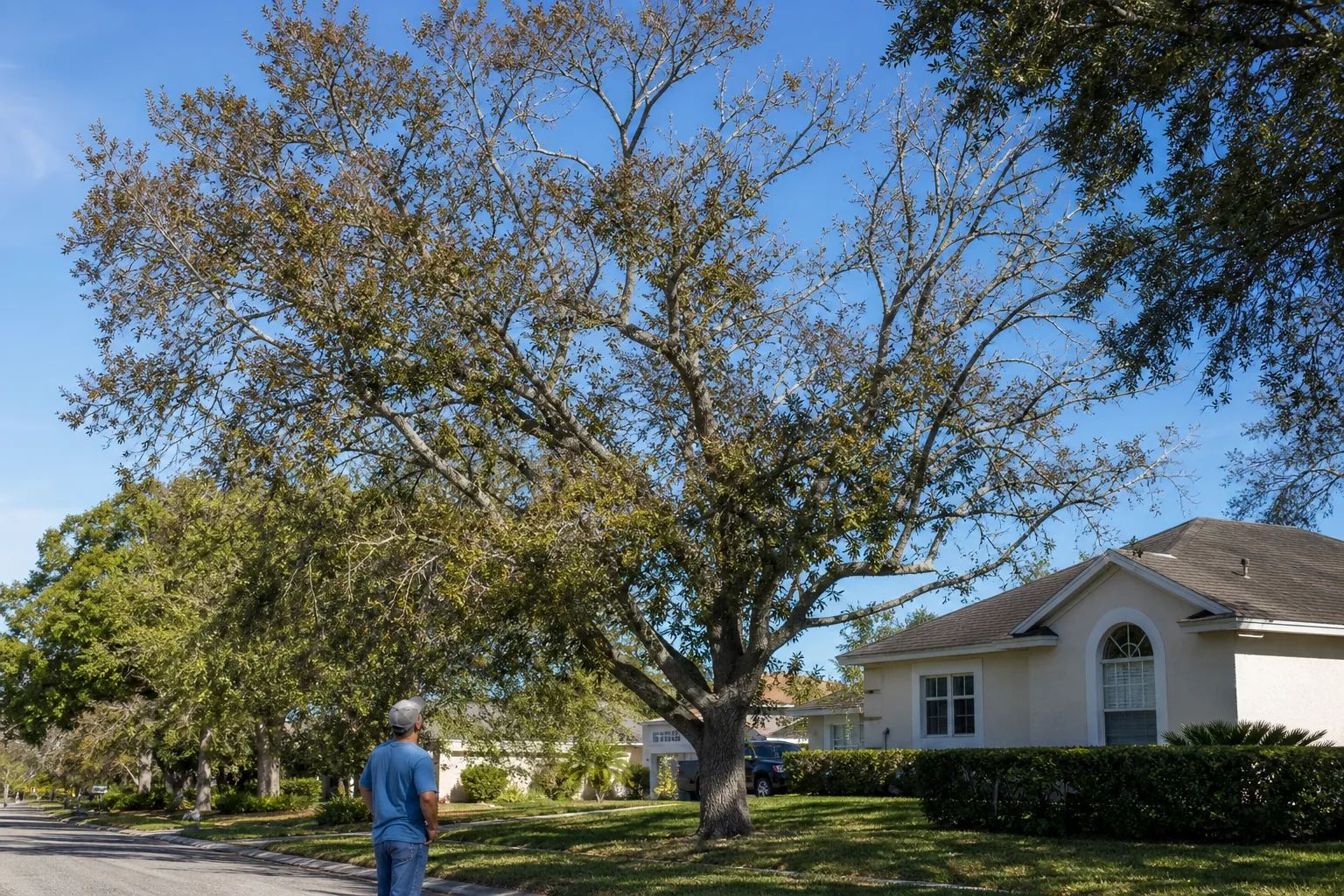
A laurel oak that once shaded your entire driveway may begin showing more sky through its crown. Leaves may look smaller, branches may lose foliage, or mushrooms may appear near the trunk. These changes deserve attention, but no single symptom automatically means the tree must be removed.
For homeowners researching laurel oak decline signs in DeLand, the most useful starting point is a careful comparison: what has changed, how quickly did it happen, and what has happened around the roots? Florida weather, construction activity, drainage problems, and existing decay can produce similar-looking symptoms.
Florida Foliage provides tree inspections and arborist reports to help property owners understand tree condition and consider appropriate next steps. This guide explains what you can observe safely from the ground, which warning signs need prompt attention, and why a site assessment matters before choosing tree trimming or tree removal.
Know What Normal Laurel Oak Changes Look Like
Laurel oaks are common shade trees in Florida landscapes. Their narrow leaves and dense crowns can make them attractive around homes, parking areas, and shared community spaces. As trees mature, however, their condition depends on more than whether they still produce green leaves.
Leaf replacement can create temporary thinning and leaf litter without indicating serious decline. Timing varies with weather and individual trees. A tree that sheds older leaves and then develops a healthy new flush is different from one whose upper branches remain bare through subsequent growth.
Identification also matters. Laurel oak and water oak can be confused, and common names are not always applied consistently. Leaf shape alone may not settle the question. A tree inspection can consider foliage, branching, bark, and other features rather than relying on a single photograph.
Before deciding that a tree is declining, look at its history. Has the crown always been somewhat open? Did a nearby tree recently disappear, exposing it to more sun and wind? Was the lawn excavated or the irrigation schedule changed? Context helps separate a seasonal change from a developing problem.
Look For Persistent Changes In The Crown
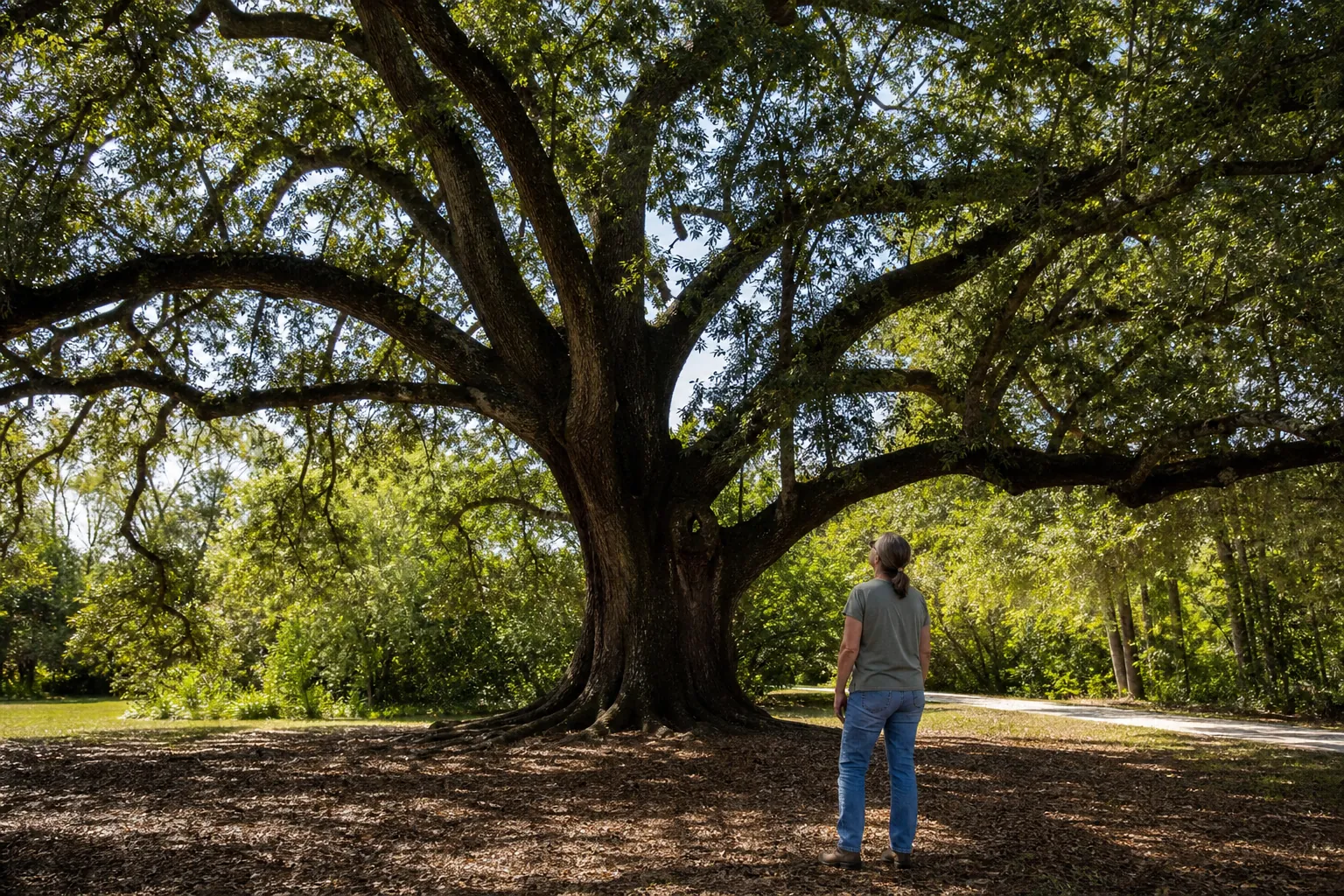
The crown often provides the first visible clues that a laurel oak is under stress. Look from several positions on the property, staying clear of traffic and avoiding any area beneath visibly damaged branches. One viewing angle can hide dead limbs or make a normal gap appear unusually large.
Persistent thinning deserves closer evaluation, especially when it occurs with branch dieback or reduced leaf growth. A crown can remain partly green even when the tree has substantial structural problems, so foliage should never be the only measure of condition.
- Watch for upper branches that remain bare while nearby branches produce new leaves.
- Note whether leaf coverage has become noticeably thinner across several parts of the crown.
- Look for unusually small or pale leaves that persist beyond a brief seasonal transition.
- Record repeated twig or branch loss, particularly when branches fall during otherwise calm weather.
- Notice dense clusters of new shoots along the trunk or larger limbs, especially after damage or heavy pruning.
New shoots can indicate a response to stress, but they do not identify the cause by themselves. Likewise, pale foliage can reflect root trouble, moisture conditions, or other issues. Avoid assuming that fertilizer or additional watering will solve the problem without understanding the site.
Take photographs from the same ground-level locations over time. Include the entire crown and closer views of affected areas. A short record of when symptoms began can be more useful than many photographs taken on one day.
Check The Trunk And Major Branch Unions
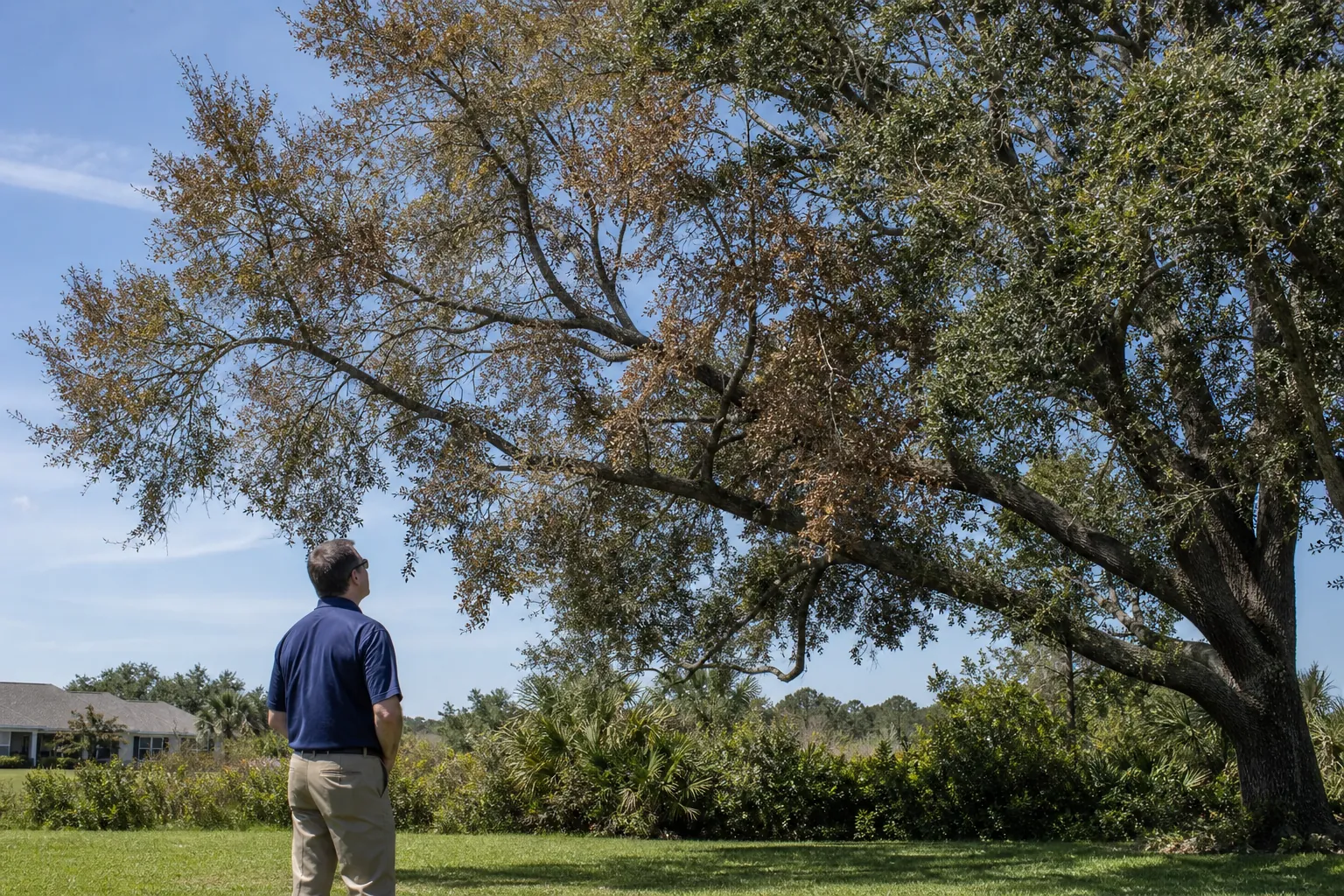
Trunk and branch defects can matter more urgently than gradual leaf thinning. Splits, hanging limbs, and fresh changes in alignment may indicate a structural concern that requires prompt professional assessment.
Look for cracks where large branches join the trunk, particularly if a crack appears fresh or has widened. Bark squeezed between closely joined stems can weaken a union, but its significance depends on the tree's structure and condition. A ground-level observation cannot establish how much load that union can safely carry.
Cavities, missing bark, and old pruning wounds also deserve attention. Some trees retain useful wood around a damaged area, while others have extensive hidden decay. The size of the visible opening does not reliably reveal the amount of internal deterioration.
- Keep people away from a branch that is broken but still attached.
- Arrange prompt evaluation if you notice a fresh trunk split or a major limb pulling away from its attachment.
- Photograph cavities from a safe distance rather than placing your hand or a tool inside them.
- Do not climb the tree to inspect damage or pull on a cracked branch to test its strength.
Dark staining, loose bark, or insects around an injury can help guide an inspection, but they are not a diagnosis. Avoid scraping bark or drilling into the trunk yourself. These actions can injure living tissue and still fail to answer the important structural questions.
Pay Attention To Roots, Soil, And Drainage
A laurel oak's roots extend beyond the trunk and can occupy soil well outside the visible canopy. Damage in that area may not become apparent immediately. Decline that appears months after construction can still be related to excavation, soil compaction, or changes in grade.
DeLand properties vary in elevation, soil conditions, and drainage. Some sites drain quickly, while others hold water after heavy rain. Both prolonged saturation and extended dry conditions can stress roots, depending on the tree and site.
Check the base without digging. The trunk should generally widen as it approaches the ground. Soil or mulch piled against the bark can conceal that transition and keep the lower trunk persistently damp. A buried trunk base warrants evaluation rather than aggressive excavation by the homeowner.
- Note any recent trenching for utilities, irrigation, drainage, or driveway work near the tree.
- Identify areas where vehicles or equipment repeatedly travel over the root zone.
- Watch for standing water that lasts longer than it previously did after rain.
- Look for newly exposed roots, disturbed soil, or a lifted soil plate near the trunk.
- Keep mulch away from direct contact with the trunk and avoid adding fill soil around the base.
Mushrooms near the base or on woody roots may indicate fungal activity. Some fungi decompose harmless organic material, while others are associated with decay in the tree. Location, appearance, and the surrounding symptoms matter. Photograph them before mowing or removing them so the inspector has a useful reference.
Recognize When The Situation Is Urgent
Gradual crown thinning usually allows time to arrange an inspection. A sudden lean, lifting soil, a fresh split, or a suspended broken limb calls for a more immediate response. These signs are especially concerning when the tree could strike a home, occupied patio, driveway, or walkway.
If you see a potentially unstable tree, keep people and pets out of the possible fall area. Do not park beneath it, walk underneath to take photographs, or attempt to move a hanging branch with a rope. Observe from a protected location when possible.
Branches touching or falling onto power lines require extra caution. Stay away from the tree, the wires, and nearby objects that could be energized. Contact the utility or emergency services as appropriate instead of treating the situation as ordinary yard cleanup.
After a hurricane or strong storm, visible foliage can disguise damage. A tree may remain upright despite root movement or a newly opened branch union. Florida Foliage offers emergency and hurricane tree removal when conditions and an assessment support that approach. An inspection helps distinguish urgent hazards from damage that can be addressed through planned work.
Understand Why Laurel Oaks May Decline
Decline is often the result of several pressures acting together. A tree with existing internal decay may tolerate ordinary weather until root damage, drought, or a storm reduces its ability to cope. Treating only the most visible symptom may overlook the underlying issue.
Maturity is part of the picture, but age alone should not decide a tree's future. Size, past injuries, root conditions, and nearby targets all affect the assessment. A large laurel oak with green leaves can still have serious defects, while a thinning crown does not automatically mean failure is imminent.
Heavy pruning can also contribute to problems. Removing too much foliage reduces the tree's capacity to support itself and can trigger vigorous shoots. Large cuts create wounds that may become entry points for decay. Repeated topping changes structure without reliably making a tree safer.
Changes around the tree are easy to overlook. A new driveway, parking pad, drainage project, or soil addition may affect roots even if no large root was visibly cut. Give the inspector a timeline of property work, storm damage, and past pruning to help connect symptoms with possible causes.
What A Tree Inspection Can Clarify
A professional inspection brings together the tree's biological condition, visible structural defects, and the consequences of a possible failure. The question is not simply whether the tree looks unhealthy. It is also which parts are affected and what lies within their reach.
An inspection may examine crown density, deadwood, branch attachments, trunk wounds, root-zone conditions, and nearby buildings or activity areas. Depending on the findings, further evaluation may be recommended. Not every internal defect can be confirmed through a basic visual inspection.
- Ask which observations support the assessment and which conditions remain uncertain.
- Ask whether the concern involves the whole tree, a specific branch, or the root system.
- Discuss whether monitoring, targeted trimming, or removal is the appropriate next step.
- Request a practical explanation of how nearby structures and regular foot traffic affect priorities.
- Ask what changes should trigger another inspection rather than waiting for a scheduled review.
Arborist reports can document observations and recommendations when written information is useful for property planning. For shared sites, commercial tree services and HOA and condo tree services can help organize work around occupied areas, access routes, and multiple trees.
No inspection can promise that a tree will never fail. Its purpose is to make decisions better informed and identify reasonable actions based on the conditions observed.
Choose Pruning Or Removal Based On The Findings
Tree trimming may be appropriate when the main concern is dead or damaged branches and the remaining structure is suitable to retain. The work should have a clear objective, such as removing a broken limb or addressing specific branch conflicts, rather than simply making the crown smaller.
Canopy thinning is not a default solution for a declining laurel oak. Removing healthy foliage from an already sparse crown can add stress. Crown reduction may be appropriate in selected situations, but it requires suitable branch choices and does not repair decayed roots or a compromised trunk.
Tree removal may be recommended when structural concerns, declining condition, and nearby targets make retention unsuitable. Removal planning should account for buildings, fences, access, and the condition of the tree itself. Crane tree removal may be considered where site conditions and the removal plan make it appropriate.
If a tree is removed, stump grinding can address the remaining stump. Discuss nearby utilities, irrigation, and the intended use of the area before work begins. Grinding does not remove every root or automatically prepare a site for immediate replanting.
Before scheduling removal, confirm any applicable requirements with your city or county. Rules can vary with property location and circumstances, so avoid relying on a neighbor's past experience as proof that the same process applies to your tree.
Help The Tree Without Adding Stress
While waiting for an inspection, focus on avoiding additional damage. Keep vehicles and stored materials off the root zone where practical. Do not cut exposed roots to make mowing easier, attach equipment to the trunk, or add soil to hide uneven ground.
Review irrigation rather than automatically increasing it. A tree in saturated soil needs a different response from one experiencing dry conditions. Keep a record of watering schedules, rainfall patterns, and where water collects so those details can inform recommendations.
Avoid applying products simply because leaves are yellow or branches are thinning. Unnecessary treatments may fail to address the cause. Likewise, removing more foliage to make a stressed tree look tidy can reduce its resources when it needs them most.
For future property work, discuss tree protection before excavation or equipment arrives. Planning access and material storage early is easier than trying to reverse root injury afterward.
Make A Practical Plan For Your DeLand Property
Start with three questions: what changed, when did it change, and what could the tree reach if a branch or the whole tree failed? Those answers help prioritize action without jumping to conclusions from one patch of thin foliage.
For gradual symptoms, gather photographs and a short site history, then arrange a tree inspection. For fresh splits, lifting roots, or hanging limbs, restrict access and seek prompt assistance. Do not wait for leaf color to confirm a structural problem.
To discuss a declining laurel oak in DeLand, call Florida Foliage at (386) 481-7913. Tree inspections and arborist reports can help clarify whether monitoring, tree trimming, or tree removal is the sensible next step for your property.
Call (386) 481-7913 to talk through next steps.