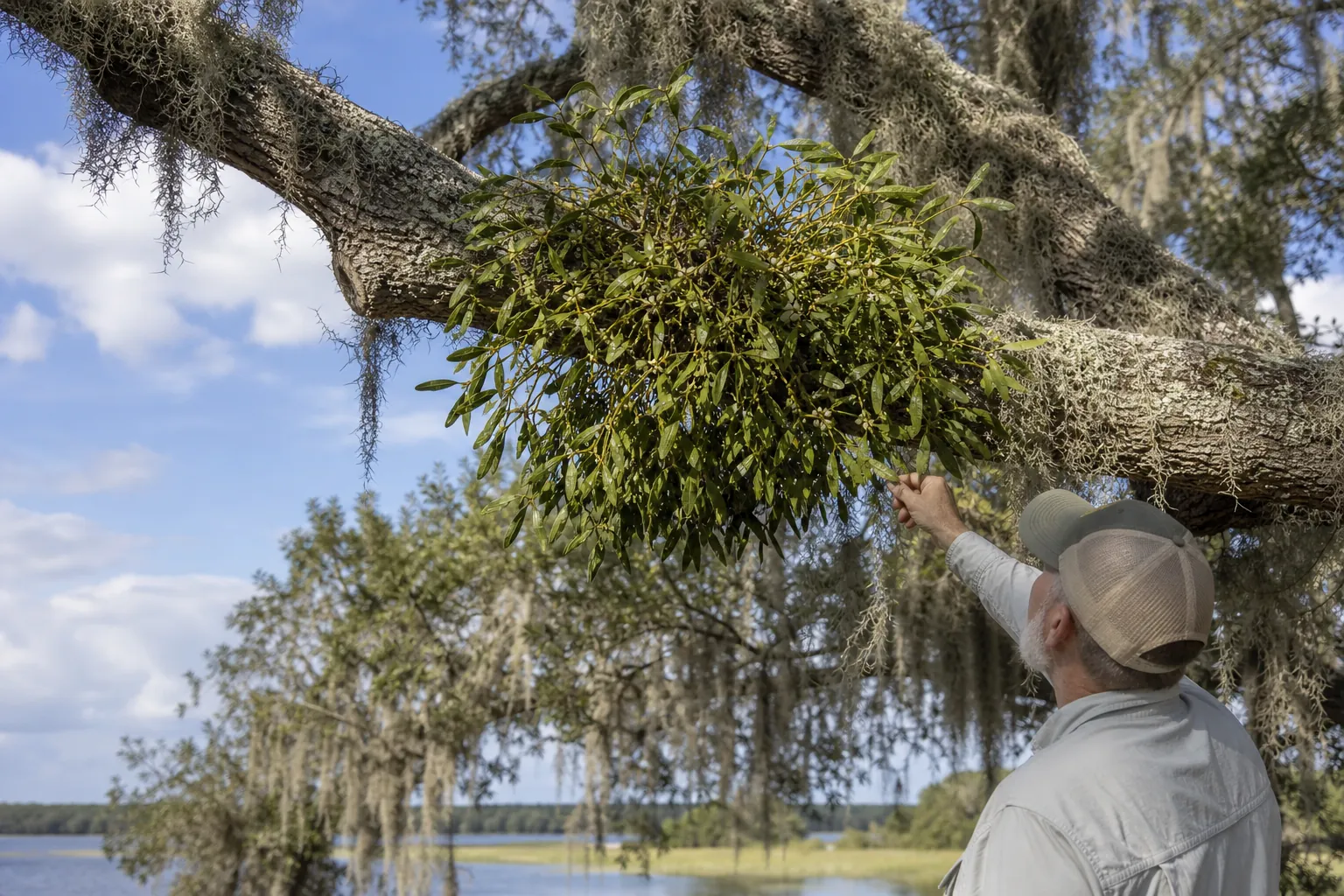
A dense green clump high in an oak may look like ordinary foliage until you notice that it grows differently from the surrounding branches. In Volusia County, that clump could be mistletoe. It is a familiar part of Florida’s landscape, but homeowners often wonder whether it means their tree is sick or needs to come down.
The answer depends on the amount of mistletoe, the condition of the oak, and where the affected branches are located. A few clumps do not automatically make an otherwise healthy tree dangerous. Heavy infestations, especially on trees already struggling with drought, root damage, or branch decline, deserve closer attention.
This guide explains how to recognize mistletoe in oak trees in Volusia County, what it can do to a host tree, and how to approach tree care without unnecessary cutting. Florida Foliage offers tree inspections and arborist reports to help property owners understand their options.
What Mistletoe Is And How It Uses An Oak
Mistletoe is a flowering plant that grows on another plant rather than rooting in the soil. The leafy mistletoe found on Florida hardwoods is a hemiparasite. Its green leaves make some of its own food through photosynthesis, while specialized structures connect with the host branch and obtain water and minerals.
That connection is why mistletoe is more than a plant resting in the canopy. The visible stems are only part of the infestation. Tissue associated with its attachment can remain within the branch, so removing the green growth alone does not necessarily eliminate it.
Birds help spread mistletoe by moving its sticky seeds between branches and trees. A seed that lands on a suitable branch can establish a new plant. This means an oak can develop new clumps even after earlier ones have been addressed.
Mistletoe also has ecological value. Its berries provide food for some birds, and its growth can offer wildlife cover. Tree care therefore does not have to begin with the assumption that every clump must disappear. The practical goal is to protect tree health and manage risk while avoiding excessive damage to the oak.
How To Recognize Mistletoe In A Florida Oak
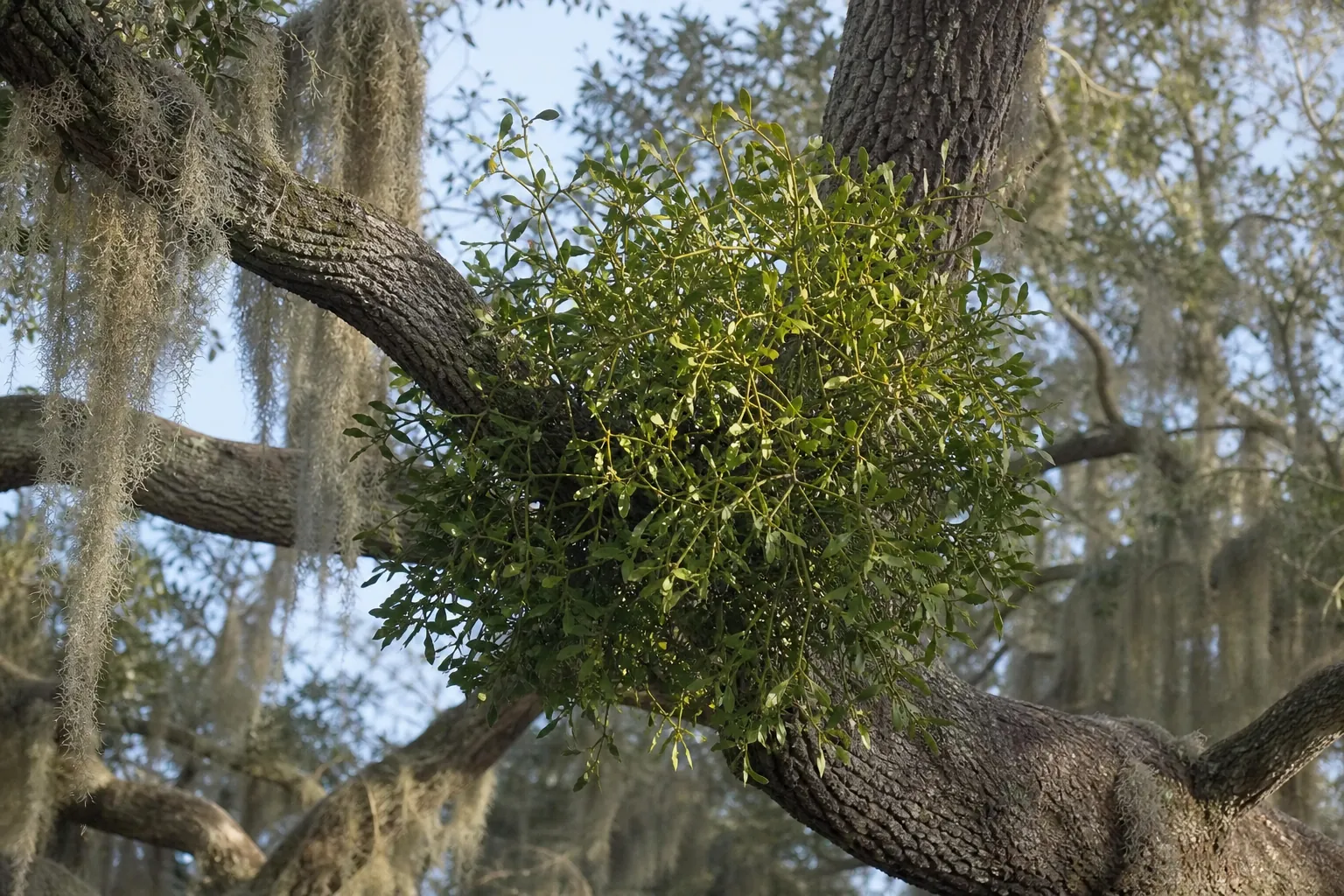
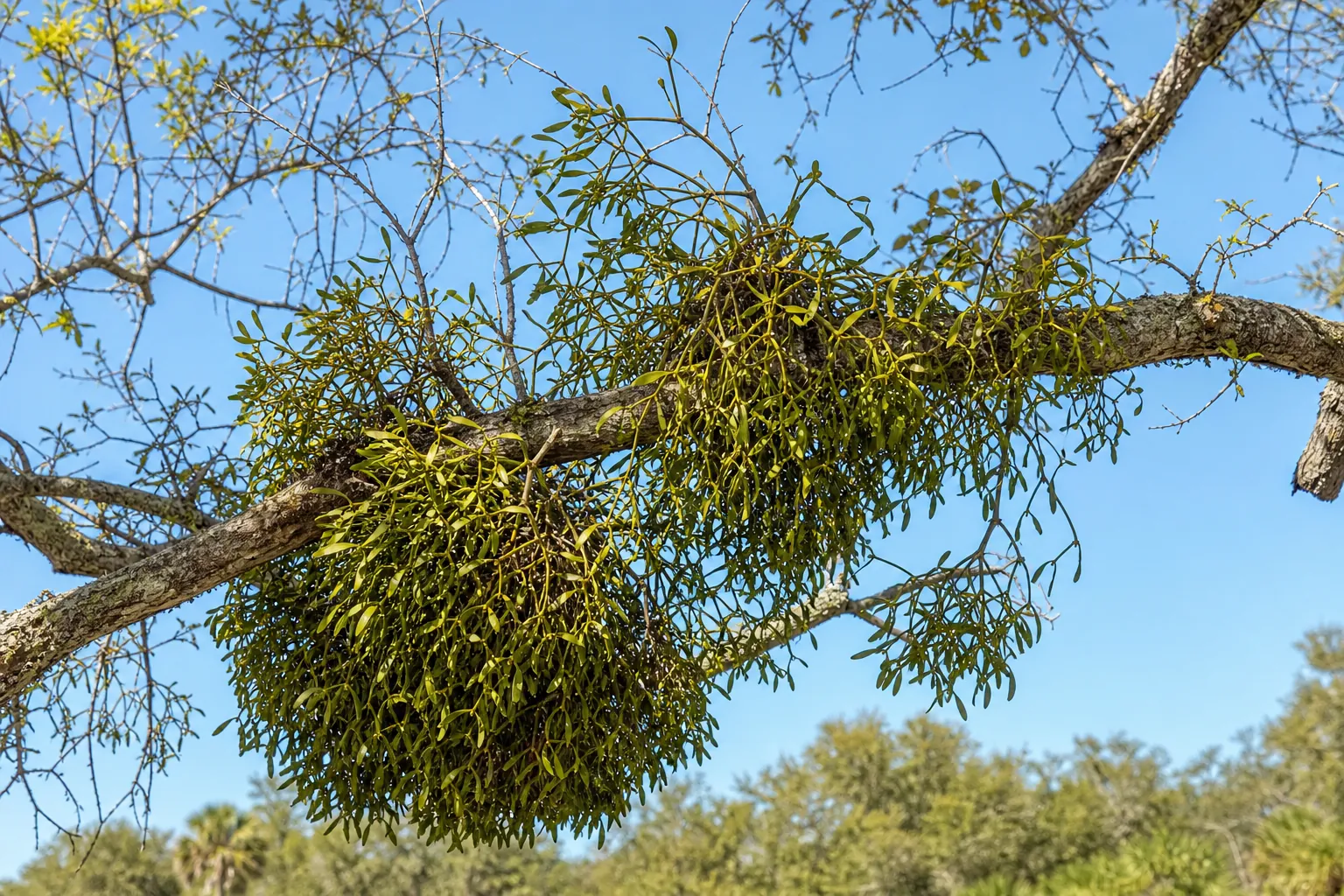
From the ground, mistletoe often appears as a compact, rounded cluster of green leaves growing from a branch. Its texture and branching pattern may differ noticeably from the oak’s foliage. Depending on the season and the plant’s maturity, small pale berries may also be present.
It can be easier to spot when the host canopy is less dense. Some oaks lose their leaves seasonally, while live oaks shed and replace leaves during their annual growth cycle. These periods can reveal clumps that were previously hidden. Leaf drop alone, however, is not proof of mistletoe damage.
Use binoculars or a zoomed photograph instead of climbing the tree. Try to identify the actual attachment point, not just the leafy outline. Several clumps on one branch may look like a single patch from below, and oak foliage can obscure the connection.
- Look for green clusters with leaves and stems that differ from the surrounding oak growth.
- Notice whether each cluster appears to emerge directly from a woody branch.
- Photograph the whole tree as well as the suspected clumps to show their distribution.
- Have uncertain growth identified before deciding that pruning is necessary.
Spanish moss, lichens, and other growth on Florida trees can cause confusion. Spanish moss hangs in gray strands and does not draw water and minerals from the oak in the same way mistletoe does. A tree inspection can distinguish these organisms and put their significance in context.
Does Mistletoe Mean An Oak Is Dying?
Not necessarily. The effect of mistletoe depends on how much is present and how well the oak can support its canopy. An established tree with a small amount of mistletoe may continue growing for years without obvious decline. The presence of mistletoe alone is not a sound reason to recommend tree removal.
Concern increases when many branches are affected or when the host is already under stress. Because mistletoe draws water and minerals from the branch, it can add to the burden during dry conditions. A weakened branch may show reduced growth or dieback, although those symptoms can also have other causes.
Volusia County oaks face conditions beyond mistletoe. Compacted soil, construction activity, altered drainage, damaged roots, and repeated poor pruning can reduce vitality. Storm damage may leave defects that are unrelated to the parasite but more important to immediate safety.
A useful inspection considers the whole tree, including the trunk, major branch unions, canopy, and accessible root area. It should also consider what could be struck if a branch failed. An oak over a driveway presents different consequences from one growing well away from regularly occupied areas.
Avoid diagnosing the tree from a photograph of one clump. Yellowing leaves, thinning foliage, or dead branches do not establish a single cause. The best next step is to identify the pattern of decline and assess whether mistletoe is a contributing factor, an incidental finding, or part of a larger problem.
Warning Signs That Deserve A Closer Inspection
Mistletoe becomes more concerning when it accompanies changes in the oak’s condition. A gradual increase in clumps is worth documenting, but structural defects or recent changes may deserve attention sooner. Look from a safe position without standing beneath visibly damaged branches.
- Arrange an inspection if several large limbs have dense mistletoe growth and sparse oak foliage.
- Have dead or declining branches assessed when they extend over a home, walkway, parking area, or frequently used yard.
- Report new cracks, hanging limbs, or broken branch unions rather than assuming mistletoe explains them.
- Point out recent trenching, paving, grading, or other work near the tree’s roots.
- Note whether canopy decline appeared suddenly after a storm or developed gradually over several seasons.
Sudden leaning, soil lifting near the trunk, or a partially detached limb can indicate an urgent concern. Keep people away from the affected area and seek professional assessment. Do not approach a damaged tree to pull down mistletoe or test whether a branch is loose.
If a tree or branch contacts a power line, stay clear and notify the utility. Tree work near energized lines requires appropriate qualifications and coordination. Emergency and hurricane tree removal may be relevant after storm damage, but mistletoe by itself does not establish that an emergency exists.
Pruning Options And Their Limitations
Tree trimming can reduce mistletoe where affected branches can be removed without harming the oak’s structure or removing too much live foliage. The decision is not simply to cut every branch with a clump. Branch size, attachment, canopy balance, and the tree’s condition all influence what is reasonable.
Because mistletoe’s connection extends into host tissue, a cut immediately beside the visible plant may leave affected tissue behind. The appropriate cut location depends on the branch and the infestation. An arborist should determine whether a suitable pruning point exists rather than apply a fixed distance rule to every situation.
Removing a large limb solely to eliminate one clump can create a substantial wound and reduce valuable canopy. In some cases, retaining the branch and monitoring the mistletoe is a better compromise. In others, an affected branch is already dead, declining, or structurally unsuitable and removal has a clearer benefit.
Cutting off only the visible mistletoe growth may temporarily reduce its water demand, but regrowth is possible because the internal connection remains. This is suppression rather than assured eradication. Any such work should account for access hazards and the possibility of damaging the host branch.
- Ask which affected branches can be pruned without unnecessarily weakening the canopy.
- Request an explanation of whether the proposed work removes an infected branch or only suppresses visible growth.
- Discuss follow-up observation because new plants or regrowth may appear later.
- Avoid topping the oak or stripping large portions of its live canopy to chase every clump.
Canopy thinning and crown reduction are not interchangeable with mistletoe control. Each has a specific purpose and should be recommended only when the tree’s structure or site conditions justify it. More cutting is not automatically better care, especially for an oak that already has limited healthy foliage.
Why Home Remedies Can Create Bigger Problems
A high canopy makes mistletoe removal a poor do-it-yourself project. Ladders against trunks, climbing without suitable equipment, and overhead saw work can lead to serious injury. A small-looking branch viewed from the ground may also be heavier and less predictable than it appears.
Do not cut into the bark to dig out the attachment. That can injure the branch and create a larger wound without reliably eliminating the plant. Wrapping a limb tightly or attaching improvised coverings can also damage bark or interfere with normal growth.
Herbicides and other products should not be applied based on online recipes. A product that affects mistletoe may also injure the host or surrounding plants. Any pesticide use must follow its label and applicable requirements. Household chemicals are not a substitute for tree assessment.
Keep fallen mistletoe and berries away from children and pets because ingestion can be harmful. Do not treat the berries as edible, and seek appropriate medical or veterinary advice if ingestion occurs. When handling fallen material, basic precautions are sensible, but avoid entering an unsafe drop zone to collect it.
Supporting Oak Health Between Inspections
Reducing avoidable stress helps an oak maintain the canopy it has. Start with the root area. Keep vehicles, stored materials, and repeated heavy foot traffic away where practical. Do not pile soil against the trunk or assume that exposed roots can be cut without consequences.
A suitable layer of organic mulch can help moderate soil conditions, but it should be kept away from the trunk. Avoid deep mulch piles and do not bury the root flare. Mulch cannot cure mistletoe, yet sensible root-zone care supports the host rather than adding another stress.
Water needs vary with rainfall, soil, drainage, and the tree’s establishment. During dry periods, consider those conditions before adding irrigation. Persistently wet soil can be harmful too. If an oak is declining, assess the site instead of assuming that more water or fertilizer will solve the problem.
Take repeat photographs from the same viewpoints. Record noticeable changes such as additional clumps, new dead branches, or reduced foliage. These observations help an arborist compare conditions over time and distinguish a stable infestation from a worsening tree-health issue.
Before landscaping or construction near a mature oak, discuss potential root impacts. Protecting the existing root area can be more valuable than reacting after decline begins. Mistletoe management works best as part of broader tree care, not as a reason to overlook soil and root conditions.
When Tree Removal May Be Considered
Tree removal may be appropriate when an oak has serious structural defects, extensive decline, or other conditions that cannot reasonably be managed. Heavy mistletoe can contribute to the overall assessment, but the recommendation should explain why retaining the tree is unsuitable.
Ask whether selective tree trimming and monitoring remain practical. Also ask how much healthy canopy would be left after the proposed work. If controlling the infestation would require removing much of the tree’s functional canopy, the long-term value of repeated pruning deserves careful consideration.
Access and surroundings influence how removal is planned. Crane tree removal may be appropriate for certain trees near structures or in restricted spaces, but equipment selection requires an on-site assessment. Stump grinding can be considered separately after removal, with attention to nearby utilities and site use.
Before significant pruning or removal, confirm any applicable requirements with your city or Volusia County. Requirements can vary by location and property circumstances. HOA or condo approvals may also apply, and they do not necessarily replace public requirements.
A Practical Plan For Volusia County Properties
Start by documenting the oak, then decide whether the concern is identification, declining health, or an immediate safety issue. This keeps the response proportional. A healthy-looking tree with a few clumps may need a different plan from an oak with dead limbs above a busy entrance.
For shared landscapes, communicate observations clearly. HOA and condo tree services and commercial tree services can address trees around common areas, buildings, and parking lots. Arborist reports can document findings and recommendations so property managers have a clearer basis for maintenance decisions.
When arranging an inspection, provide photographs if available and mention recent storms, construction, drainage changes, or previous pruning. Identify areas beneath the tree that people use regularly. Ask what can be observed from the ground and whether any concerns require closer examination.
Florida Foliage can help evaluate mistletoe, the oak’s overall condition, and whether tree trimming, continued observation, or tree removal should be considered. To discuss mistletoe in oak trees in Volusia County, call (386) 481-7913. An informed inspection is a practical first step toward caring for the tree without assuming that every green clump requires aggressive action.
Call (386) 481-7913 to talk through next steps.