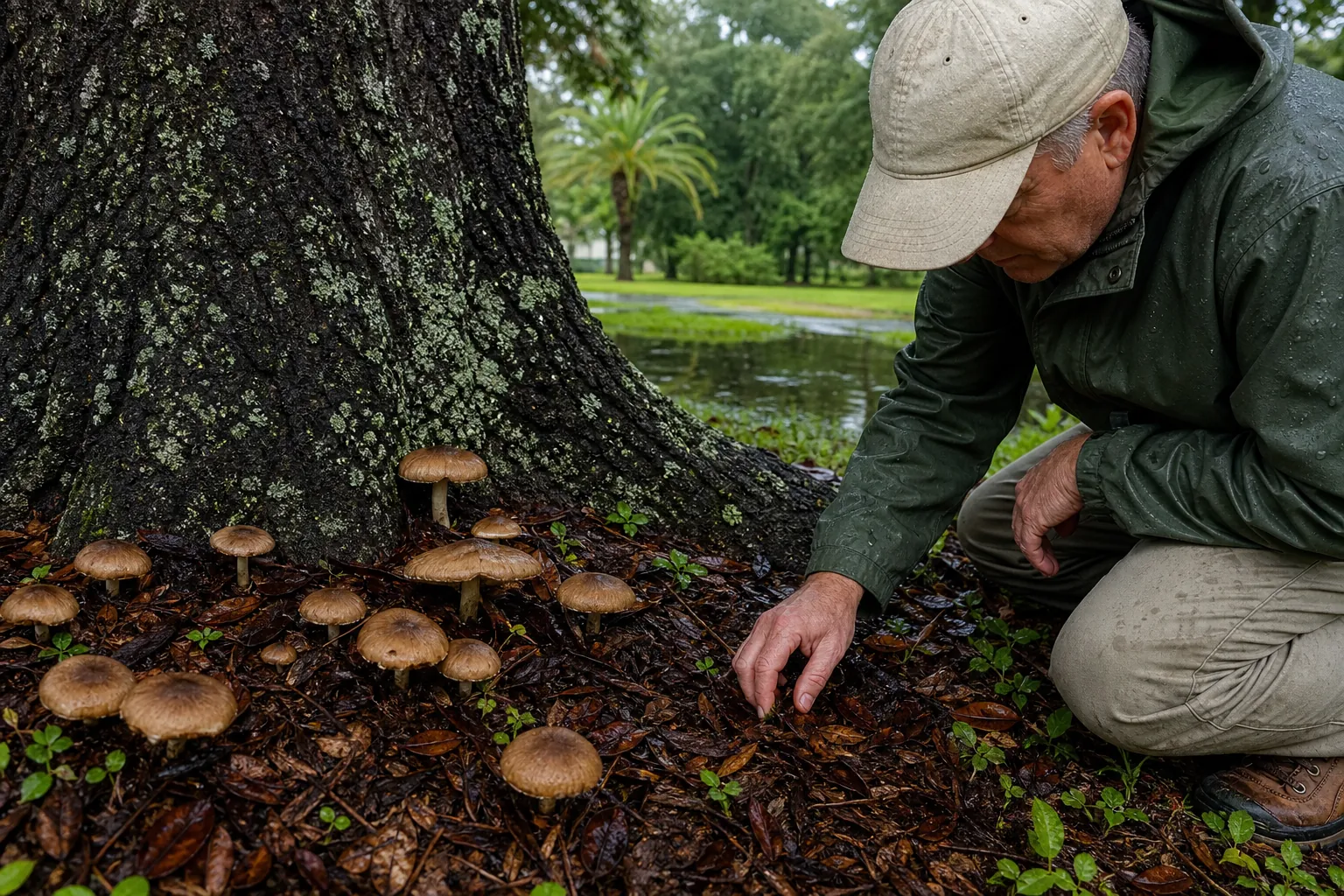
Mushrooms appearing around a tree after a soaking rain can be unsettling, especially when more wet weather and gusty onshore winds are in the forecast. Some grow from damp mulch or buried wood. Others can be associated with decay in a tree’s roots, lower trunk, or old stump. Their location matters more than their sudden appearance.
For Florida homeowners during the October 7-10, 2026 storm window, the practical question is not simply whether mushrooms are present. It is whether the tree also shows signs of weakened support, damaged limbs, or changing ground conditions. Saturated soil and wind make those observations especially important.
This guide explains what to look for safely, when an inspection makes sense, and how to prepare without creating additional risk.
Weather Context For October 7-10, 2026
As of the National Hurricane Center’s Intermediate Advisory 4A, issued at 1 PM CDT on October 7, 2026, Tropical Storm Isaias had formed in the southern Gulf of Mexico. The NHC hurricane, tropical storm, and storm surge watches covered only the northern Gulf Coast, including areas such as Bay St. Louis to Indian Pass, not Florida’s east coast.
The morning October 7 forecast discussion from NWS Melbourne called for high coverage of showers and lightning storms through late week. It identified a marginal risk of excessive rainfall across east central Florida, with minor flooding possible where heavy rain repeats.
The morning October 7 discussion from NWS Jacksonville reported saturated ground along the Northeast Florida I-95 corridor, strengthening onshore winds, and more periods of heavy rain Friday and Saturday. Those later periods extend beyond October 10, so cleanup decisions should account for continuing conditions rather than the calendar alone.
These are dated forecast details, not a claim of an east-coast hurricane threat or local watch. Check the National Hurricane Center, NWS Melbourne, and NWS Jacksonville for updated information. For tree care, the immediate concerns are wet ground, falling limbs, and safe access.
Why Mushrooms Appear After Heavy Rain
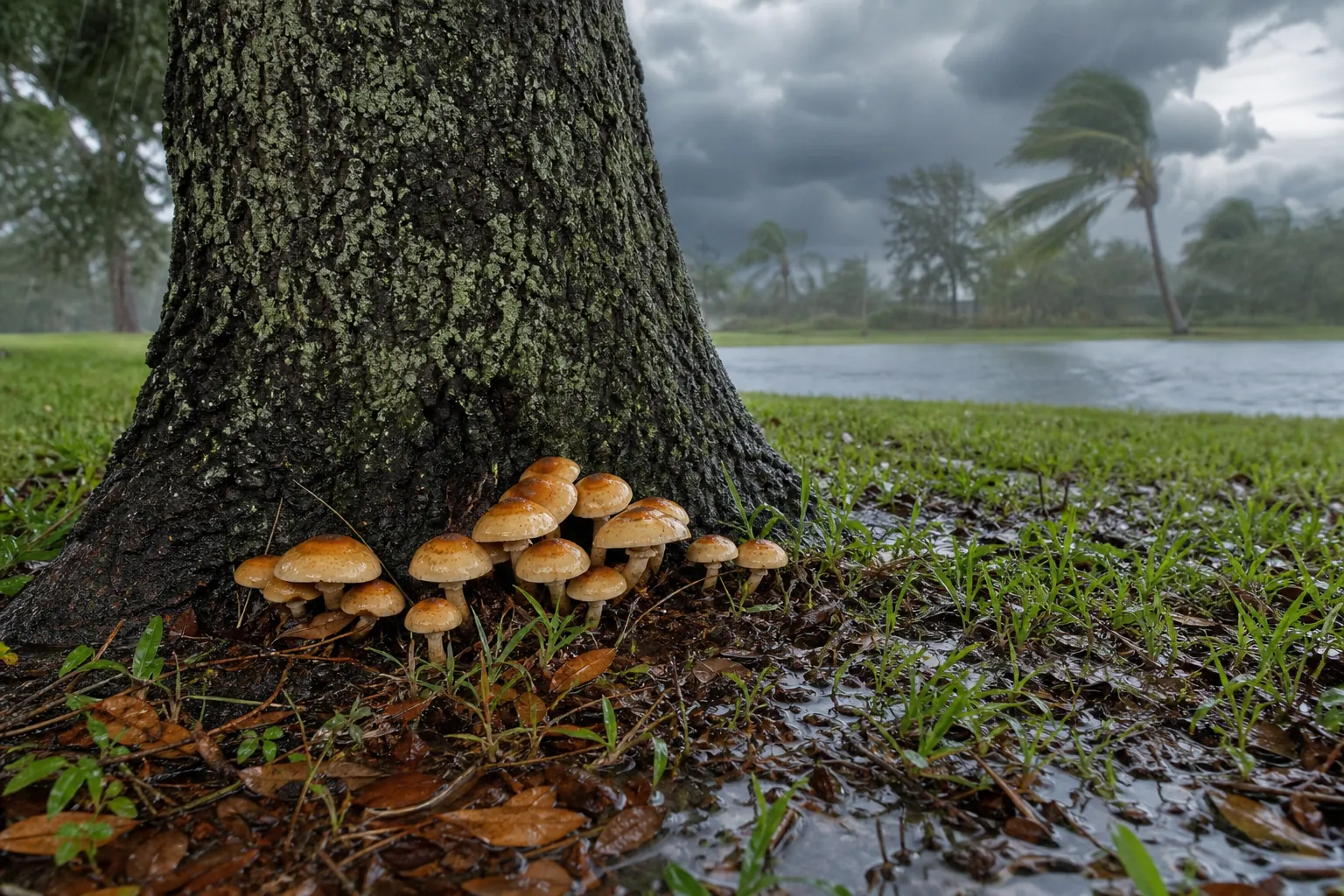
A mushroom is the visible fruiting structure of a fungus. Much of the organism may already be present in soil, mulch, dead roots, or wood before anything appears above ground. Rain supplies moisture that can trigger fruiting, making an existing fungus suddenly noticeable.
This means a cluster that appeared overnight does not necessarily indicate that a tree developed a new problem overnight. The fungus may have been growing unseen for much longer. Conversely, a tree can have internal decay without producing visible mushrooms.
Many landscape fungi help break down organic material. Mulch, buried construction wood, and roots from a previously removed tree can support mushrooms near an otherwise healthy living tree. Proximity alone does not prove that the living tree is infected.
Fungi growing directly from the trunk base, exposed roots, or root flare deserve closer attention. Some wood-decay fungi can reduce the strength of structural roots or lower-trunk wood. A professional assessment considers that possibility alongside the tree’s condition and what could be struck if it fails.
Do not eat unidentified mushrooms. Keep children and pets from handling or consuming them. Removing the visible mushrooms does not eliminate the underlying fungus or establish that the tree is safe.
Read The Location Before Drawing Conclusions
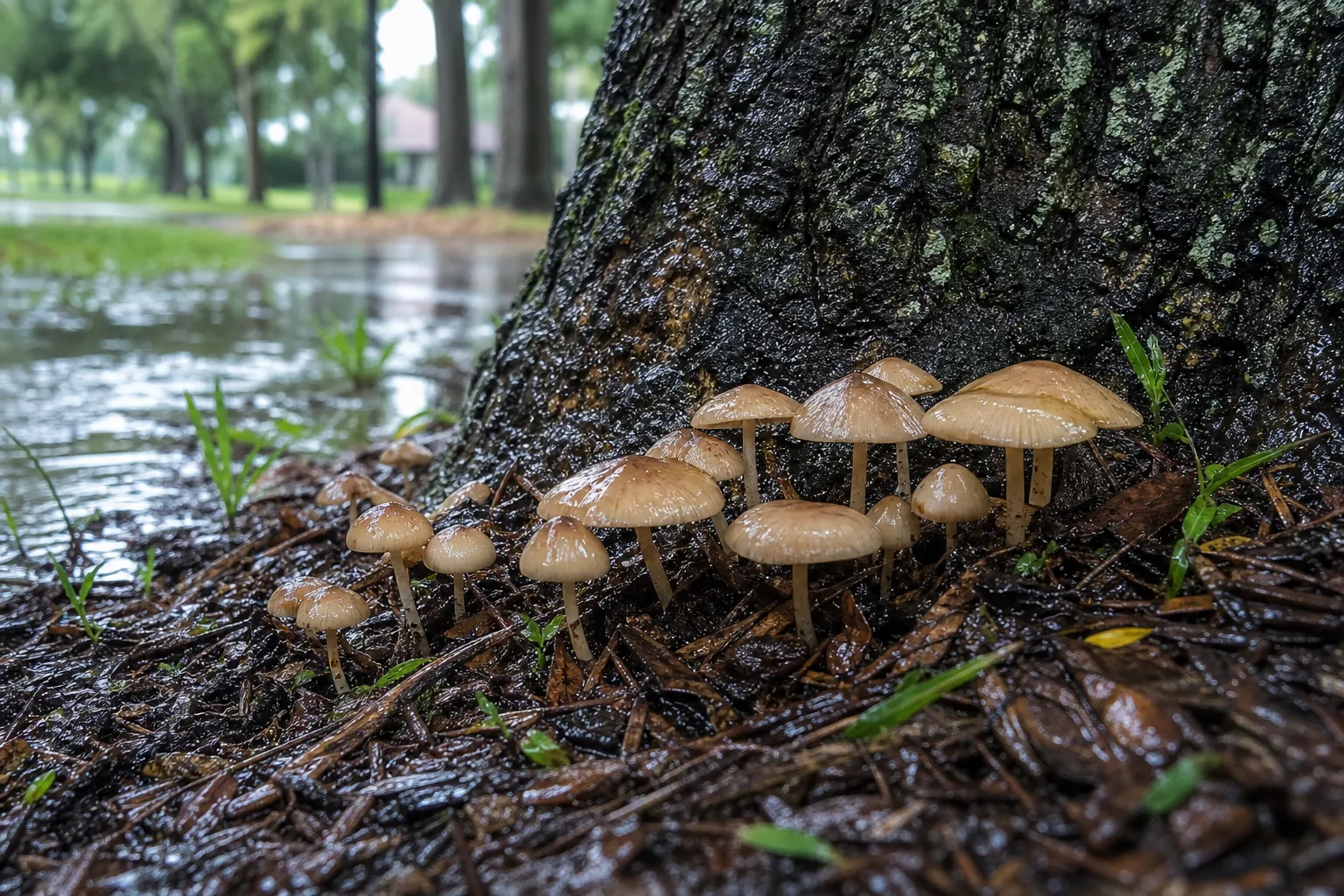
Start with a ground-level look from a safe distance during calm conditions. Avoid approaching a tree that is leaning unexpectedly, shedding limbs, or standing near damaged electrical equipment. You do not need to touch a mushroom to document its location.
The root flare is the widening area where the trunk transitions into major roots. When mulch or soil hides this area, it can be harder to tell whether mushrooms are growing from loose organic material or from the tree itself.
- Mushrooms scattered through mulch may be feeding on the mulch rather than the living tree.
- Mushrooms arranged around an old stump may be associated with that stump or its remaining roots.
- Mushrooms attached to exposed roots or the trunk base warrant an inspection, especially when other defects are visible.
- Hard, shelf-like fungal growths on the trunk should be photographed and discussed with the person assessing the tree.
- Repeated growth in the same spot is useful information even if the mushrooms disappear between rainy periods.
Take photographs showing both the whole tree and the growth’s position relative to the trunk. Include the surrounding ground and nearby structures. If safe, add a closer photograph without disturbing the area. A picture alone cannot establish root strength, but it can help guide an inspection.
Avoid digging around major roots, cutting roots to investigate, or striking the trunk to test it. Those actions can cause injury or damage and do not provide a reliable homeowner diagnosis.
Signs That Make A Tree Inspection More Urgent
Mushrooms become more concerning when they appear with structural changes. During a rainy period, compare the tree with its usual appearance rather than relying on the mushrooms alone. A new lean or movement at the base matters more than a familiar, unchanged tilt.
- A new or increasing lean calls for keeping people away from the tree’s potential fall area.
- Fresh cracks in soil near the trunk or lifting ground around roots can indicate movement of the root plate.
- A split trunk, opening crack, or partially separated branch needs professional evaluation.
- Large dead limbs or broken branches caught in the canopy can fall without much additional warning.
- Decay cavities, damaged roots, and fungal growth together justify closer assessment of the tree’s structure.
- Recent excavation, trenching, or construction near roots should be reported to the person inspecting the tree.
Declining foliage can add context, but it is not a stand-alone diagnosis. Sparse leaves, dead branch tips, or unusual leaf drop can have several causes. Likewise, a green canopy does not prove that the root system or lower trunk is structurally sound.
Consider nearby targets. A questionable tree beside a bedroom, driveway, sidewalk, or shared community entrance requires different risk consideration than a similar tree in an unused area. Keep people and vehicles away from suspect trees when that can be done safely.
If any tree or limb contacts a power line, stay away and call the electric utility. Do not touch the tree, debris, fence, or equipment involved. Never assume a downed line is de-energized.
How Saturated Soil And Wind Change The Situation
Roots support trees through their connection with surrounding soil. When soil becomes saturated, its ability to resist movement can change. The effect depends on soil type, drainage, root distribution, and the tree’s condition. Wet ground does not mean every tree will fall, but it can increase concern around compromised roots.
Wind applies force to the canopy and transfers that force through the trunk to the root system. A tree with significant root decay or damaged structural roots may have less capacity to resist that loading. Mushrooms can be one clue to investigate, not a measurement of how much strength remains.
Repeated rain also affects access. Ground that looks firm may be soft beneath grass or mulch. Heavy equipment can rut wet soil and damage roots, while ladders may settle or shift. A workable route during dry weather may be unsuitable during this storm window.
Do not stand beneath a suspect tree to watch whether it moves. If you notice unusual movement from a safe location, retreat and keep others away. During lightning or gusty conditions, postpone routine yard checks and stay sheltered.
Professional planning should consider both the tree and the site. Access, nearby buildings, utilities, ground conditions, and room for handling debris all affect how work can be performed safely.
Prepare Before Rain And Gusts Increase
Preparation should focus on exposure and obvious hazards, not a rushed attempt to reshape every tree. Start while conditions are calm. Walk only through areas that are safe, and note trees over parking spaces, entrances, outdoor seating, and frequently used paths.
- Move vehicles and portable outdoor items away from trees with visible defects when you can do so safely.
- Keep children, pets, and visitors out of areas beneath hanging limbs or newly leaning trees.
- Photograph suspect trees before conditions worsen so later changes are easier to recognize.
- Record where mushrooms appear, whether they have appeared before, and whether nearby ground remains wet.
- Keep access routes clear without dragging large limbs or debris across exposed roots.
- Arrange an inspection rather than attempting overhead cutting or ladder work yourself.
Tree trimming can address selected dead, damaged, or poorly attached branches when conditions allow. Canopy thinning and crown reduction are different techniques, and neither should be prescribed automatically because mushrooms are present. The appropriate approach depends on the species, structure, condition, and objective.
Avoid topping or aggressive last-minute cutting. Removing large portions of a canopy can create wounds and future structural problems. Pruning also cannot restore wood already lost to root or trunk decay.
If significant defects suggest removal may be appropriate, confirm applicable requirements with your city or county. Do not assume that rules are identical across Florida or that every situation receives the same treatment.
What A Professional Assessment Can Clarify
A tree inspection can help separate a mulch-related mushroom flush from signs that warrant further investigation. The assessment should connect fungal growth with the tree’s visible structure, history, site conditions, and potential consequences of failure.
Useful background includes previous storm damage, root cutting, grade changes, chronic standing water, and the approximate timing of new symptoms. Mention an old stump nearby, even if it is no longer visible. Its roots may explain some fungal activity in the landscape.
The person assessing the tree may examine the root flare, trunk, branch attachments, canopy condition, and surrounding soil. Depending on the findings, further investigation may be appropriate. No visual inspection can reveal every hidden condition, and a mushroom photograph alone cannot settle whether removal is necessary.
Florida Foliage offers tree inspections and arborist reports. Depending on the assessment, relevant services may include tree trimming, tree removal, or emergency and hurricane tree removal. Crane tree removal may be considered where the tree’s position, condition, or surrounding obstacles require that approach.
Not every mushroom-bearing tree needs removal. Some situations call for monitoring, changes to surrounding landscape practices, or targeted pruning. Others involve defects that pruning cannot resolve. The purpose of an assessment is to choose an appropriate response, not to treat every fungal growth the same way.
Clean Up Debris Without Adding Risk
After a break in the weather, look over the area from a safe position before beginning cleanup. Rain may have stopped while overhead hazards remain. A broken limb lodged in another branch can fall later, and a partially uprooted tree can continue moving.
Stay away from downed power lines and anything touching them. Call your electric utility for any line contact. Do not attempt to separate branches from wires or clear a path through electrically involved debris.
- Check above the cleanup area for hanging or broken branches before approaching small debris.
- Leave suspended limbs, leaning trees, and partially uprooted trees to professionals.
- Do not cut a branch that is bent, trapped, or supporting other material because stored tension can cause sudden movement.
- Keep debris away from the trunk and root flare instead of piling it against the tree.
- Delay nonessential equipment movement when ground conditions would cause rutting or root damage.
Small, loose debris may be manageable once the area is safe, but chainsaw work involving storm-damaged trees presents additional hazards. The weight and tension of damaged wood are not always obvious. Do not climb onto debris piles or work beneath suspended material.
Stump grinding can address a remaining stump after removal, but mushrooms may still appear as buried roots and wood decompose. Grinding does not sterilize the soil or establish the condition of nearby living trees. Keep documenting growth associated with those trees.
Plan Follow-Up For Homes And Shared Properties
For homeowners, a simple follow-up record can be valuable. Save photographs, inspection findings, and notes about changes after subsequent rain. Watch from a safe location for renewed fungal growth, changing lean, ground cracking, or additional branch loss.
For commercial properties, HOAs, and condo communities, prioritize trees near occupied areas and regular travel routes. Share clear instructions about restricted areas so residents, visitors, and maintenance crews do not unknowingly enter beneath damaged trees. Florida Foliage provides commercial tree services and HOA and condo tree services.
Avoid treating a cleared debris pile as proof that the remaining trees are sound. Cleanup and tree assessment serve different purposes. Persistent wet ground, recurring fungal growth on the tree itself, or newly visible defects deserve follow-up even after the property looks orderly.
Mushrooms at a tree’s base after heavy Florida rain are a reason to observe carefully, not a reason to panic. Their location, the tree’s structural condition, and nearby people or property determine what deserves attention. During the October 7-10 storm window, keep wet soil and gusty conditions central to your decisions.
If you would like help evaluating mushrooms near a tree or planning safe tree work, call Florida Foliage at (386) 481-7913. Describe the growth’s location, any visible changes, and nearby structures so the conversation starts with useful information.
Call (386) 481-7913 to talk through next steps.