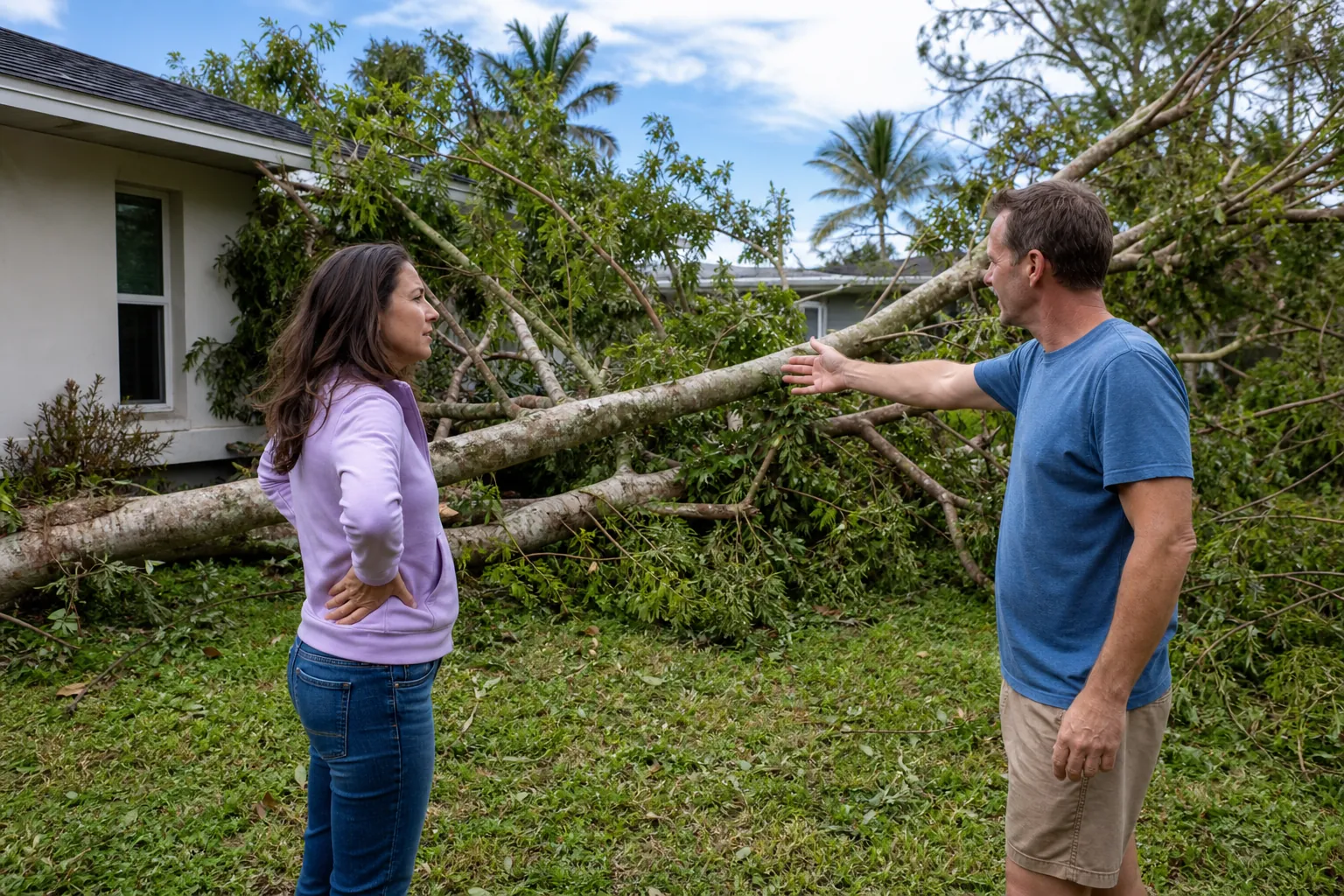
A tree falling across a property line creates immediate questions: Is everyone safe? Who should arrange removal? Does the neighbor have to pay? During Florida’s October 7–10, 2026 storm window, the first priority is avoiding unstable trees, electrical hazards and unsafe cleanup conditions.
If you are searching for “neighbor tree fell in yard after storm Florida,” start with safety and documentation rather than assumptions about fault. Where a tree grew does not, by itself, settle responsibility for damage or cleanup. Insurance coverage, the tree’s condition before it fell and the circumstances of the loss can all matter.
This guide explains how to protect your household, communicate with your neighbor, preserve useful records and plan tree removal without making a difficult situation more dangerous.
What the October 7–10 storm outlook means for trees
As of the NHC Intermediate Advisory 4A issued at 1 PM CDT on October 7, 2026, Tropical Storm Isaias had formed in the southern Gulf of Mexico. The hurricane, tropical storm and storm surge watches described in that advisory covered only the northern Gulf Coast, including areas such as Bay St. Louis to Indian Pass, not Florida’s east coast. Check the National Hurricane Center for subsequent updates.
The morning October 7 forecast discussion from NWS Melbourne described high coverage of showers and lightning storms through late week, with a marginal risk of excessive rainfall across east central Florida. Minor flooding was possible where heavy rain repeated.
The morning October 7 discussion from NWS Jacksonville reported saturated ground along the Northeast Florida I-95 corridor, strengthening onshore winds and additional periods of heavy rain Friday and Saturday.
Those conditions make tree awareness important even without an east coast tropical watch. Wet soil can reduce root anchorage, while gusty onshore wind adds force to trunks and branches. Existing root problems, decay and structural defects may make some trees more vulnerable.
A tree that remains standing after one rain band is not necessarily stable for the next. Treat a new lean, lifted root plate or hanging limb as a reason to keep people away and request an inspection when conditions allow safe access.
Make the scene safe before checking property damage
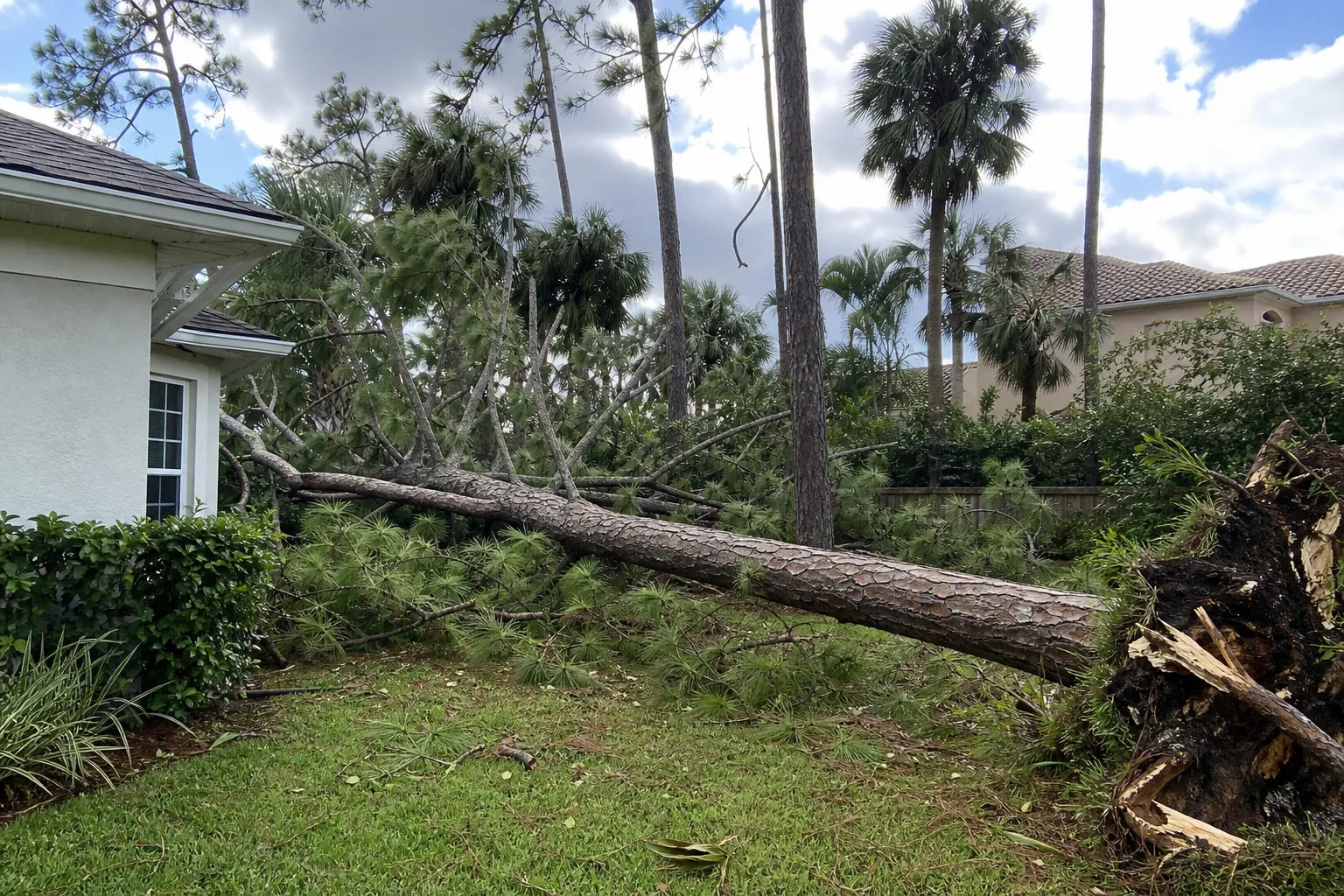
Do not rush outside to inspect a fallen tree while lightning, strong gusts or heavy rain continue. View the scene from a protected location first. Keep children, pets and bystanders away from the tree, nearby standing trees and damaged structures.
A fallen tree can remain under enormous mechanical tension. Bent branches may spring back, a trunk can roll and a partially uprooted tree can shift without obvious warning. Do not climb over it or try to pull it free with a vehicle.
- Stay away from downed power lines and anything touching them, including branches, fences and standing water.
- Call your electric utility for any tree or limb contact with a power line. Do not assume a line is safe because it is quiet or appears insulated.
- Call 911 if someone is injured, trapped or facing an immediate life-threatening hazard.
- Keep clear of a damaged roof, leaning wall or tree resting against a building until the hazard has been assessed.
- Avoid walking through floodwater to reach the tree because water can hide electrical hazards, holes and sharp debris.
Do not let a cleanup crew begin work around line contact until the electric utility has addressed the electrical hazard. Tree removal and electrical isolation are different tasks, and one does not substitute for the other.
Document the tree and damage before cleanup
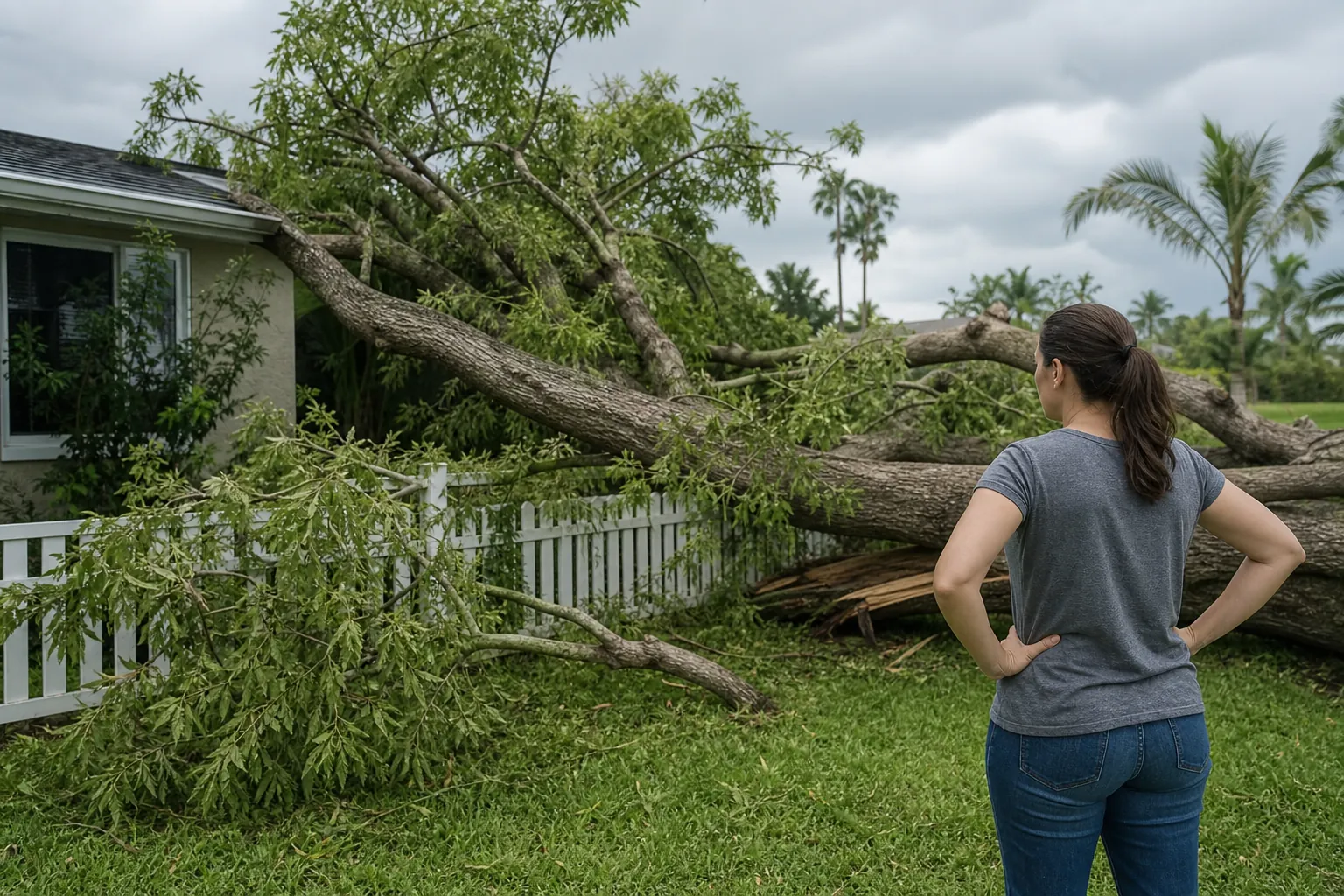
Once you can observe the area safely, create a clear record. Photographs taken before branches are cut can help explain how the tree fell, what it struck and why removal was necessary. Never enter a hazardous area just to get a better picture.
Start with wide views showing both properties, the fallen trunk and affected structures. Then photograph visible damage from a safe position. Include a fence, shed, vehicle or roof only where you can do so without standing beneath unstable limbs.
- Record when you discovered the fallen tree and whether rain, wind or lightning was still occurring.
- Photograph the apparent original tree location, exposed roots and the direction of the fall.
- Save images of damaged structures and belongings before moving them, if moving them is safe.
- Keep any earlier photographs, inspection findings or written messages about the tree’s condition.
- Retain estimates, invoices and communications related to inspections and removal.
Describe what you can actually see. “The roots lifted beside the fence” is more useful than claiming that the neighbor ignored a dangerous tree when you do not know that. An arborist inspection may help identify visible defects, but it does not automatically establish legal responsibility.
Necessary safety work should not be delayed just to preserve a perfect photograph. When urgent work is needed, ask whether the crew can document the condition before and during removal without compromising safety.
Who is responsible when a neighbor’s tree falls?
There is no reliable one-sentence answer for every Florida property. A storm-related fall involving an apparently healthy tree presents different questions from a fall involving a known, unaddressed hazard. Ownership of the tree is only part of the picture.
Potential negligence, prior notice, the cause of failure and the damage involved may affect responsibility. Insurance policy terms can also affect which expenses are covered. Do not assume your neighbor must pay simply because the tree originated on their property, or that stormy weather eliminates every possible claim.
Contact your insurer and explain the facts without assigning blame. Ask what documentation is needed, whether an inspection is required and what steps you should take before arranging removal. If there is a dispute about liability or property access, consult a Florida attorney for advice specific to your situation.
The distinction between damage and debris matters. A tree lying in an open lawn may be treated differently under a policy from a tree that damaged an insured structure or blocked access. Your insurer can explain the applicable terms, limits and exclusions.
This is general educational guidance, not legal or insurance advice. A tree service can assess removal conditions and tree defects, but it cannot decide a coverage dispute or provide a binding determination of fault.
Speak with your neighbor before work crosses the property line
A calm conversation can prevent avoidable conflict. Let your neighbor know what happened, whether anyone was hurt and which areas need to remain off-limits. Share photographs rather than leading with a demand for payment.
You might say: “Your tree has fallen across our fence and into our yard. We are keeping everyone away while we check for hazards. Can we coordinate documentation and access before removal?” This keeps the focus on practical next steps.
Identify whether the trunk, root plate or remaining limbs still extend onto the neighbor’s land. A crew may need access from both properties, and that access should be arranged rather than assumed. Put agreed access and scope details in writing.
- Agree on who will contact insurers and who will request a tree removal assessment.
- Clarify which portions of the tree are included in the proposed work.
- Confirm permission before equipment or workers enter the other property.
- Discuss fences, gates, irrigation and landscaping that could be affected by access.
- Keep payment discussions separate from immediate steps to secure a hazardous area.
If the neighbor is unavailable, document your attempts to reach them. Ask your insurer or attorney how to handle urgent work involving their property rather than treating silence as permission.
Choose a removal approach that matches the hazard
Not every fallen tree requires the same equipment or sequence. A trunk resting entirely on open ground is different from one suspended over a roof, tangled in another tree or still connected to an unstable root plate.
Florida Foliage offers tree removal, emergency and hurricane tree removal, and crane tree removal. The appropriate approach depends on access, tree position, nearby structures and ground conditions. Requesting an assessment helps establish what can be done safely.
Crane tree removal may be considered when large sections cannot safely be lowered through the available space. It is not automatically needed for every storm-damaged tree. Equipment placement and ground support require careful evaluation, particularly after repeated heavy rain.
Ask about insurance, the planned scope and how the crew will protect surrounding property. Verify relevant coverage rather than relying only on a general statement that a company is insured. Also ask who will coordinate any required utility involvement.
A written scope should identify the tree sections to be removed, debris handling, access needs and whether stump work is included. It should also distinguish urgent hazard reduction from optional follow-up work. Avoid instructions that leave everyone guessing about where removal stops.
For work near buildings, fences or remaining trees, ask how those obstacles affect the plan. A careful contractor should explain constraints without promising that difficult removal carries no risk.
Plan debris cleanup around saturated ground
During this storm window, cleanup planning should account for wet ground as well as overhead hazards. Heavy equipment can rut a saturated lawn, damage buried irrigation or lose stable footing. A route that works in dry weather may be unsuitable after repeated rain.
Tell the crew about septic components, underground utilities you know about, drainage features and soft areas. Do not assume every underground feature is visible or accurately mapped. Ask what locating steps are appropriate before stump grinding or other ground-disturbing work.
Keep tree debris out of drainage paths. Branch piles can obstruct swales and culverts, contributing to localized water problems when rain returns. Do not push wood into neighboring land, roadside drainage or waterways.
- Separate small, safely accessible debris from large pieces that require professional handling.
- Confirm local collection instructions with your city or county before placing debris near the street.
- Keep access to mailboxes, sidewalks, hydrants and driveways clear when arranging debris piles.
- Ask whether wood and branches will be removed from the property or left in an agreed location.
- Keep people away from any debris pile containing tensioned limbs or unstable trunk sections.
Stump grinding is a separate decision from removing a fallen trunk. The root area may need evaluation first, especially if the stump sits near a property boundary or buried infrastructure. Agree with your neighbor about access and scope before scheduling that work.
Inspect the trees that did not fall
After the immediate hazard is addressed, look for changes in nearby trees from a safe distance. A tree can sustain damage without falling. Split branch unions, hanging limbs, newly exposed roots and fresh soil cracks around a trunk deserve attention.
Florida Foliage provides arborist reports and tree inspections, along with tree trimming, canopy thinning and crown reduction. An inspection can help determine which work is appropriate for a specific tree rather than treating every canopy the same way.
More pruning is not always better. Excessive foliage removal or poorly placed cuts can create new problems. Do not ask for topping as a quick storm solution. Suitable pruning should account for the species, structure, condition and surrounding targets.
Tell the inspector whether you noticed a new lean, heard cracking or saw the ground move. Share earlier photographs if available. Those observations can help distinguish a longstanding feature from a recent change, although some defects remain hidden.
For shared landscapes, HOA and condo tree services or commercial tree services can help organize inspections and work across common areas. Confirm who has authority to approve work before removing or pruning a tree on association-controlled property.
Prepare for the next round of rain and wind
If the tree has not fallen and you are preparing during October 7–10, focus on actions that do not put you beneath a stressed canopy. Move vehicles away from visibly compromised trees when you can do so safely. Bring loose outdoor objects inside and identify an alternative exit if a driveway could become blocked.
Request tree inspections for concerning conditions rather than attempting major pruning as weather deteriorates. Ladder work, climbing and chainsaw use are especially risky around wet branches, gusty wind and lightning. Postpone nonessential outdoor work when conditions are unsafe.
Check with your city or county about applicable tree protection requirements before planned removal or substantial pruning. Requirements can vary by location and tree type. Do not assume that calling work “storm preparation” removes the need to confirm local rules.
Keep insurer details, your electric utility’s contact information and property photographs accessible. Continue monitoring the NHC, NWS Melbourne and NWS Jacksonville for updated information relevant to your location. The dated October 7 outlook is a starting point, not a substitute for later forecasts.
Get help with a fallen tree without rushing the decision
When a neighbor’s tree falls into your yard, the safest sequence is straightforward: stay clear of hazards, contact the utility for any line contact, document what you can safely observe, notify your insurer and coordinate access with your neighbor.
Then arrange an assessment that considers the tree’s position, surrounding structures and saturated ground. Keep legal responsibility, insurance coverage and removal logistics as separate questions so each can be addressed by the appropriate professional.
For tree removal or an inspection of storm-damaged trees, call Florida Foliage at (386) 481-7913. Describe the tree’s location, any structural contact and access concerns. If power lines are involved, keep your distance and contact your electric utility first.
Call (386) 481-7913 to talk through next steps.