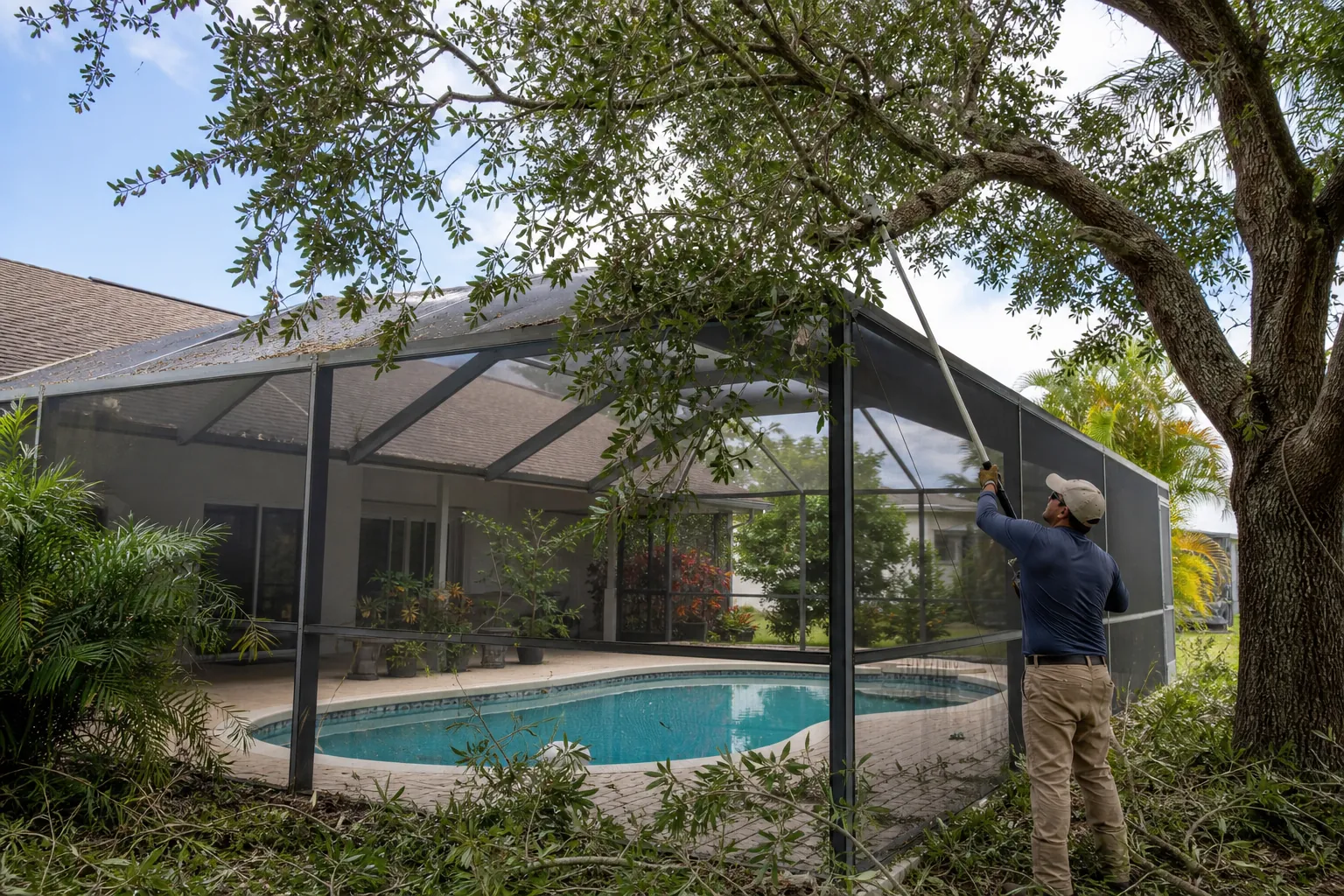
A shaded pool can be welcome during a Florida afternoon, but branches above a screened enclosure deserve attention. Leaves collect on the roof, twigs catch in the mesh, and a limb that appears comfortably clear may move closer during windy weather. The right response depends on the tree, its condition, and how it grows around the structure.
For homeowners researching overhanging branches around a pool enclosure in Deltona, the goal should be more than creating an empty space overhead. Good tree care protects the enclosure while preserving a healthy, stable canopy where practical. Some situations call for selective tree trimming. Others need a tree inspection, crown reduction, or consideration of tree removal.
This guide explains what to watch for, why clearance changes, and how to plan work around a screened pool without creating avoidable problems for the tree or property.
Why branches above a pool enclosure need attention
Pool screens are exposed to falling material from above. Even when a branch never touches the enclosure, it can drop leaves, small twigs, flowers, seeds, or fruit. Accumulated debris can hold moisture against surfaces and make routine maintenance harder. Larger falling limbs present a more serious concern for screen panels and framing.
Contact is another issue. A branch that rubs against mesh during breezy conditions can wear the material over time. Contact with framing may also damage finishes or place repeated pressure on a connection. The significance depends on the branch size, movement, and condition of the enclosure.
Not every overhanging limb is equally concerning. A healthy branch high above the roof may need monitoring rather than immediate removal. A cracked or dead limb, however, can warrant attention even if it appears to have generous clearance.
- Watch for branches touching the mesh or frame when the wind moves them.
- Look for dead limbs, hanging broken branches, and fresh debris beneath the canopy.
- Notice whether recurring leaf buildup comes from one nearby branch or the entire crown.
- Check whether new growth has narrowed a previously open gap above the enclosure.
Observe from the ground or another safe location. Do not climb onto the enclosure or use its frame to support a ladder.
Evaluate tree condition before choosing a pruning plan
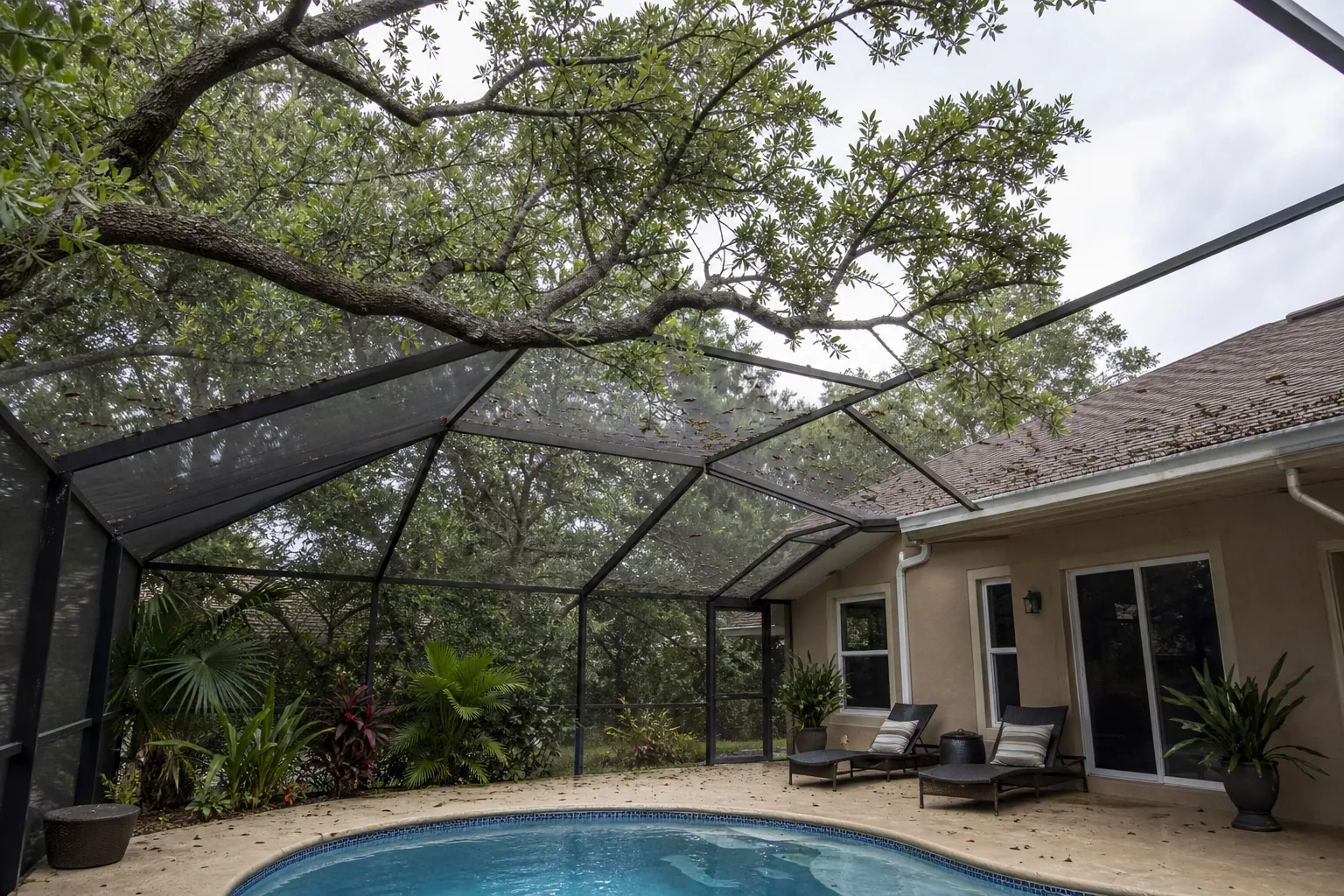
Clearance is only one part of the assessment. A tree with sound structure and vigorous growth may respond well to selective pruning. A tree with significant decay, damaged branch attachments, or root problems needs a broader evaluation before anyone decides which limbs to cut.
Visible warning signs include cracks near major branch unions, cavities, loose or missing bark, and large sections of dead canopy. Fungal growth near the base can also justify closer inspection, though identifying its meaning requires more than a photograph. A tree that has recently changed its lean deserves attention, particularly when nearby soil appears lifted or disturbed.
Past pruning matters too. Trees that were topped or repeatedly cut back to large stubs may develop clusters of shoots with attachments that require assessment. Removing those shoots without a plan can repeat the same cycle rather than improve long-term structure.
Florida Foliage offers arborist reports and tree inspections for situations where homeowners need a clearer understanding of tree condition. An inspection can help distinguish a maintenance issue from a structural concern and inform whether tree trimming or tree removal deserves consideration.
Do not treat a healthy-looking canopy as proof that every branch is sound. Conversely, a tree that drops leaves seasonally is not automatically declining. The useful question is what the observed signs mean together.
How much clearance should a pool enclosure have?
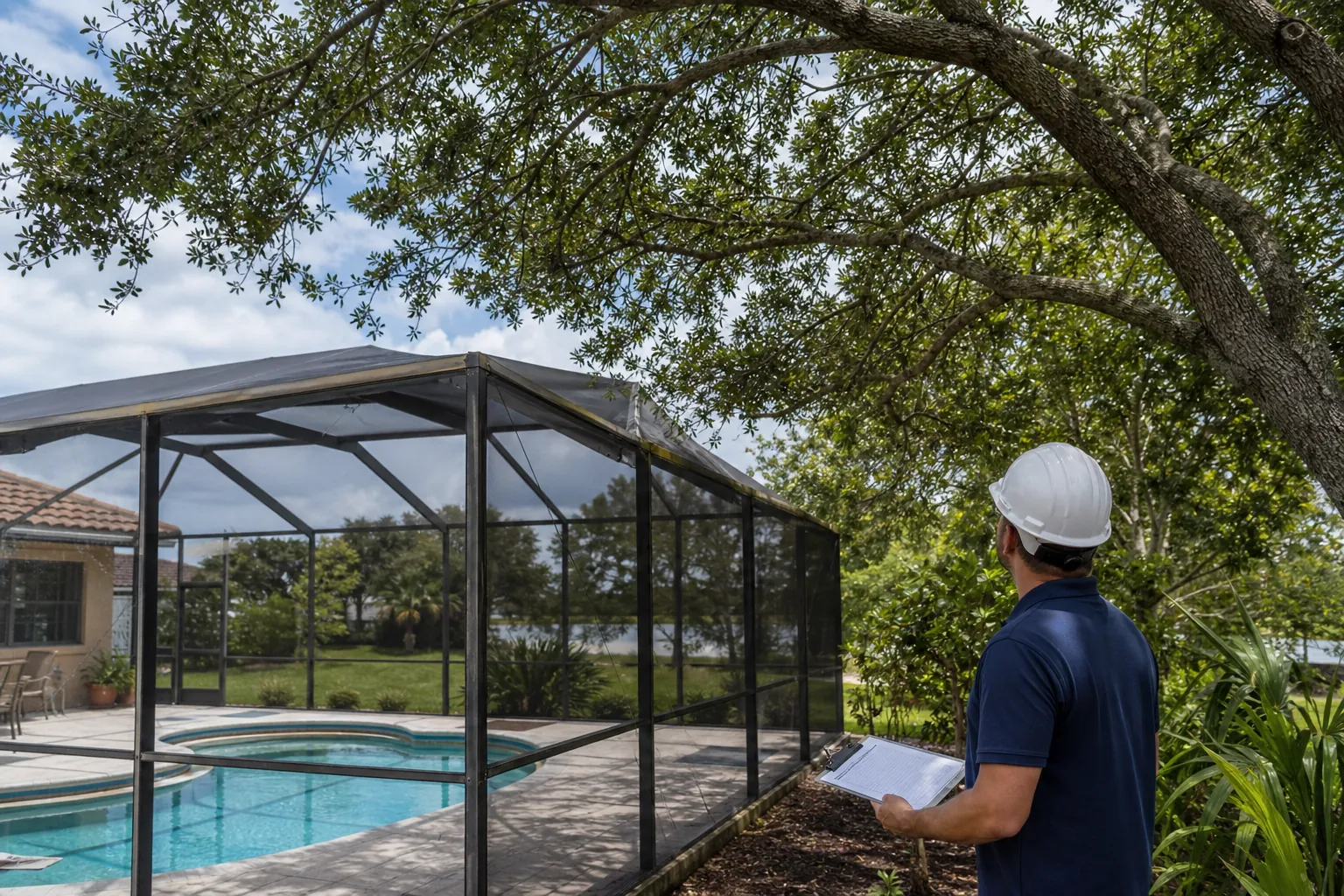
There is no single clearance distance that suits every tree and enclosure. Branch flexibility, expected growth, limb diameter, canopy height, and exposure to wind all affect the decision. A gap that looks sufficient on a still day may be inadequate when a long limb bends or sways.
The enclosure also matters. Its roof shape, height, screen condition, and location beneath the crown influence where contact or debris accumulation is most likely. Corners and sloped roof sections can create different access and clearance challenges than a lower vertical wall.
A practical pruning plan considers both current clearance and likely regrowth. Cutting only the tips immediately touching the screen may produce a short-lived result. Reducing a branch back to a suitable lateral branch can create more useful separation while maintaining a natural growth pattern.
Ask the person assessing the tree to explain which branches would be removed or reduced and why. The plan should account for how much foliage remains, the size of proposed cuts, and the effect on the rest of the crown.
It is also important to separate branch clearance from whole-tree risk. Opening space above the enclosure does not resolve decay in the trunk, unstable roots, or a damaged major branch attachment.
Choose the right approach: trimming, thinning, or reduction
Tree trimming can address specific branches that interfere with a pool enclosure. Depending on the tree, that may include removing dead limbs, reducing selected live branches, or improving clearance along the roof edge. The work should have a clear purpose rather than simply removing as much foliage as possible.
Selective branch pruning
Selective pruning focuses on particular limbs. It can be appropriate when only a few branches create contact or hang in problematic positions. Cuts should preserve the branch collar when a branch is removed and avoid unnecessary injury to the trunk or remaining limb.
Removing one large limb is not always better than reducing several smaller branches. A large cut may create a substantial wound, alter canopy balance, or remove a significant share of the tree's foliage. The choice depends on structure and species.
Canopy thinning
Canopy thinning selectively removes branches within the crown. It may help address crowded growth, but it is not a substitute for resolving a particular limb over the screen. Thinning should not strip the interior while leaving foliage only at branch ends, a practice commonly called lion-tailing.
Excessive thinning can create new problems and should not be presented as a way to make a tree stormproof. The amount and location of foliage removed matter more than an appearance of openness.
Crown reduction
Crown reduction decreases the length or spread of selected branches using suitable lateral branches. When appropriate for the species and structure, it can help move growth away from an enclosure without removing the entire tree.
Crown reduction is different from topping. Topping cuts branches indiscriminately to stubs and can encourage vigorous regrowth while leaving large wounds. Ask for a pruning approach that respects the tree's structure rather than a flat cut across the canopy.
Why work above a screen enclosure requires careful planning
A screened enclosure limits where branches can fall and where equipment can operate. A limb that would be straightforward to remove over open lawn may require controlled handling when it extends over framing, mesh, a pool, and a narrow deck.
The work plan may involve lowering branch sections rather than allowing them to drop. The crew must consider branch weight, attachment points, access, and the condition of the tree supporting the work. Even small pieces can damage a screen if they fall directly onto it.
Access constraints should be discussed before work begins. Gates, fences, overhead utilities, landscaping, and neighboring structures can influence the approach. The pool enclosure itself should not be treated as a working platform or an anchor for tree work.
- Explain whether the crew can reach the backyard through a gate or side yard.
- Identify pool equipment, irrigation components, and other features near the work area.
- Ask how branches above the roof will be handled and moved away from the enclosure.
- Keep people and pets out of the work zone until the crew says it is safe to return.
- Discuss movable furniture and other items that may need to be relocated beforehand.
Some large or difficult removals may warrant evaluation for crane tree removal. A crane is not automatically necessary, and its use depends on access, setup conditions, the tree, and nearby obstacles. The method should follow the site's needs.
When tree removal may be worth considering
Keeping a tree is often possible, but repeated pruning is not always the best long-term answer. Tree removal may deserve consideration when a tree has serious structural defects, extensive decline, or a position that prevents reasonable clearance without excessive cutting.
A tree growing very close to an enclosure may repeatedly extend into the same space. If maintaining separation would require removing too much of the crown or making repeated large cuts, an inspection can help clarify the tradeoffs.
Removal should not be based solely on leaf litter or the assumption that every overhanging tree is unsafe. Discuss whether selective pruning could reasonably address the issue, what ongoing maintenance would involve, and what concerns would remain afterward.
Confirm any applicable requirements with the City of Deltona, the relevant county office, and your HOA before authorizing work. Rules can depend on location, tree characteristics, and property conditions. Do not assume that a tree near a pool is automatically exempt from local requirements.
If removal is selected, ask whether stump grinding is appropriate for the site and future use of the area. Underground utilities, irrigation, nearby paving, and enclosure footings should be considered before stump work is planned.
What to do after storms or sudden branch damage
Florida storms can change tree conditions quickly. After strong wind, look from a safe distance for hanging limbs, fresh splits, displaced branches, and new contact with the enclosure. A branch caught in another limb may remain suspended before falling later.
Do not enter the pool area beneath a hanging or visibly damaged branch. Avoid trying to pull it down with a rope or push it off the screen. That can trigger unexpected movement or place additional stress on the enclosure.
If a branch has landed on the structure, keep clear of the affected area. The limb may be under tension, and framing may be damaged in ways that are difficult to see. Tree work and enclosure repairs are separate tasks, and removing the branch does not establish that the structure is safe.
For urgent tree damage, Florida Foliage offers emergency and hurricane tree removal. Describe what you can see from a safe location, including whether a limb is suspended, resting on the roof, or blocking access.
If power lines are involved, stay away and contact the utility or emergency authorities as appropriate. Do not approach the tree, equipment, or nearby conductive surfaces. Treat downed or contacted lines as dangerous.
Plan seasonal checks instead of waiting for contact
A simple observation routine can help catch changing conditions before branches begin rubbing against the screen. Check the canopy periodically, after strong weather, and whenever you notice a new pattern of debris. Photos taken from the same safe ground-level position can help you compare growth over time.
There is no universal pruning calendar for every Florida tree. Species, condition, growth pattern, and the objective of the work influence timing. Ask whether there are reasons to schedule nonurgent pruning during a particular part of the year.
Do not assume that severe cutting before hurricane season improves safety. Excessive foliage removal and poorly placed cuts can harm a tree. A more useful approach is to identify defective branches and structural concerns while maintaining an appropriate canopy.
- Record where branches are closest to the roof and side panels.
- Note changes in leaf production, dead twigs, or unusual branch movement.
- Schedule reassessment when regrowth approaches the enclosure again.
- Keep notes about past pruning so future decisions account for how the tree responded.
Routine enclosure maintenance remains important, but avoid reaching into branches with long tools while standing beneath them. Tree clearance problems should be addressed through tree care rather than improvised cutting from the pool deck.
Neighboring trees, HOA areas, and shared pool spaces
A branch above your enclosure may come from a tree on another property. Before arranging work, identify where the trunk stands and discuss the situation with the owner. Do not assume that overhang alone gives unrestricted permission to cut branches.
Property boundaries, access permission, and responsibility can complicate the project. Confirm applicable guidance with your city or county, and seek legal advice when ownership or cutting rights are disputed. A cooperative plan is generally more practical than arranging work without notifying the neighbor.
For shared amenities, identify who can authorize work before scheduling it. An individual resident may not have authority to approve pruning of an association-owned tree. HOA and condo tree services can help address tree care across shared landscapes, while commercial tree services may be relevant to other managed pool properties.
Managers should also plan temporary access restrictions around the pool and communicate the work area clearly. Tree inspections can provide a useful basis for discussing the condition of particular trees rather than relying only on complaints about debris.
Prepare for a useful conversation about your trees
Before contacting Florida Foliage, gather a few details: whether branches touch the enclosure, whether any limbs look dead or broken, and how equipment might reach the backyard. Ground-level photos can help explain the layout, although they do not replace an on-site assessment.
Ask which approach fits the concern, how proposed cuts will affect the tree, and whether ongoing inspections or pruning are likely to be needed. If removal is recommended, ask what tree condition or site constraint supports that recommendation.
A practical plan balances enclosure clearance with sound tree care. To discuss tree trimming, arborist reports and tree inspections, or tree removal around your Deltona pool enclosure, call Florida Foliage at (386) 481-7913.
Call (386) 481-7913 to talk through next steps.