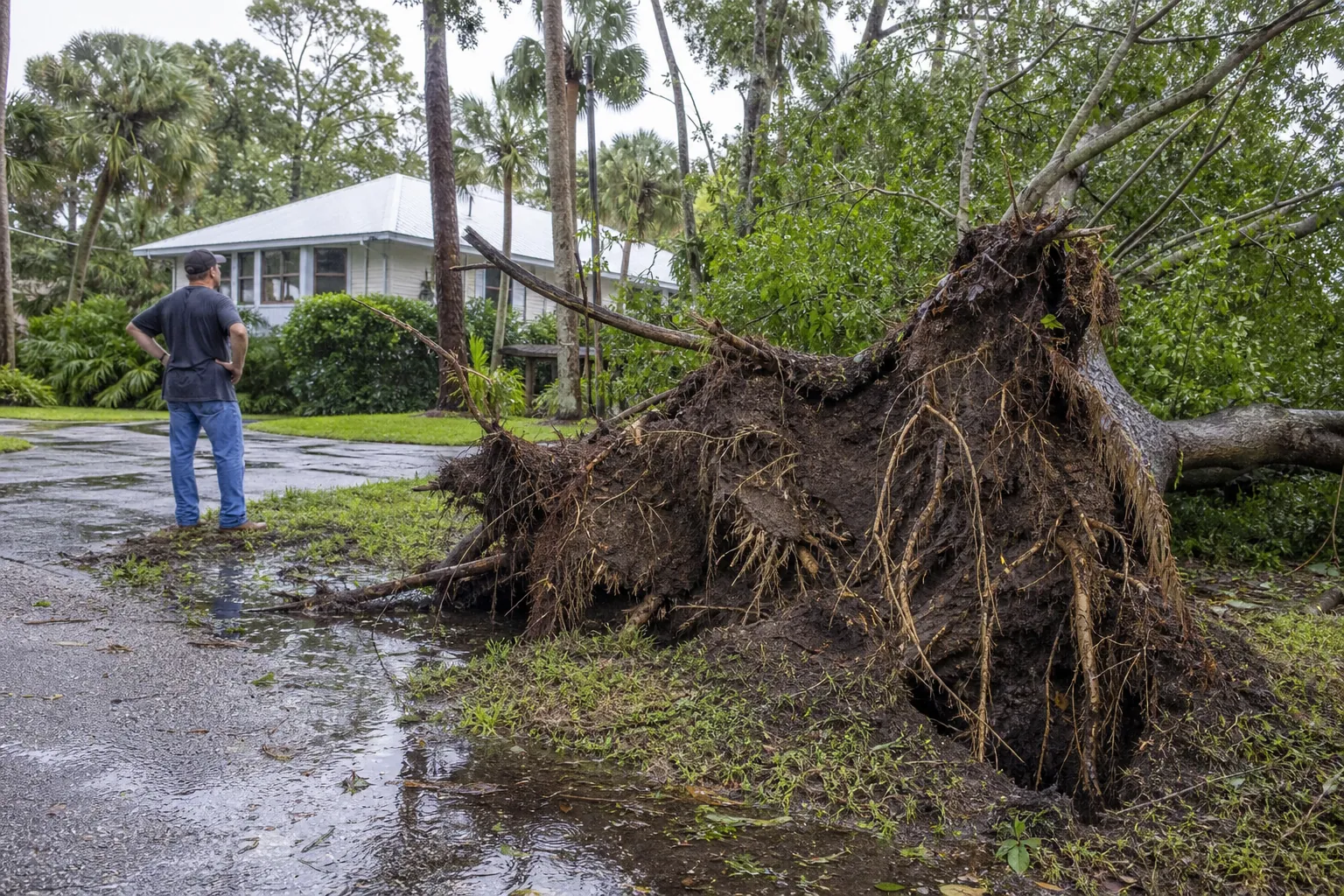
A tree does not need to experience hurricane-force wind to become unstable. When repeated rain saturates the ground, roots may have less resistance to the forces pushing against a tree’s canopy. Add gusty onshore wind, and an existing root problem or structural weakness can become more consequential.
For Florida homeowners, property managers and community associations, the Oct. 7-10, 2026 storm window calls for attention to wet ground, falling limbs and trees close to occupied spaces. The practical response is not to assume every tree will fall. It is to recognize changing conditions, reduce exposure and arrange appropriate tree care without putting anyone in danger.
This guide from Florida Foliage explains saturated soil tree uprooting risk in Florida, what to observe from a safe location and how to approach preparation and debris cleanup.
What The Oct. 7 Forecasts Mean For Tree Safety
As of the National Hurricane Center’s Intermediate Advisory 4A, issued at 1 p.m. CDT on Oct. 7, 2026, Tropical Storm Isaias had formed in the southern Gulf of Mexico. The hurricane, tropical storm and storm surge watches described in that advisory covered only the northern Gulf Coast, including areas such as Bay St. Louis to Indian Pass. They did not cover Florida’s east coast.
The local concern discussed here is heavy rain interacting with saturated soil and gusty onshore wind, not an east coast hurricane watch or a prediction of a direct hit. Keep that distinction in mind when evaluating trees in Daytona Beach, Volusia County, Flagler County and other east coast communities.
In its morning Oct. 7 forecast discussion, NWS Melbourne forecast high coverage of showers and lightning storms through late week, with a marginal risk of excessive rainfall across east central Florida. Minor flooding was possible where heavy rain repeated. NWS Jacksonville’s morning discussion reported saturated ground along the Northeast Florida I-95 corridor, strengthening onshore winds and additional periods of heavy rain Friday and Saturday.
The Jacksonville outlook makes follow-up checks important beyond Oct. 10 as well. A tree that appears unchanged early in the window may warrant another look after additional rain, provided that observation can be made safely.
For storm updates, use the National Hurricane Center, NWS Melbourne and NWS Jacksonville. Forecasts can change, so this dated snapshot should not replace current information.
Why Saturated Soil Can Increase Uprooting Risk
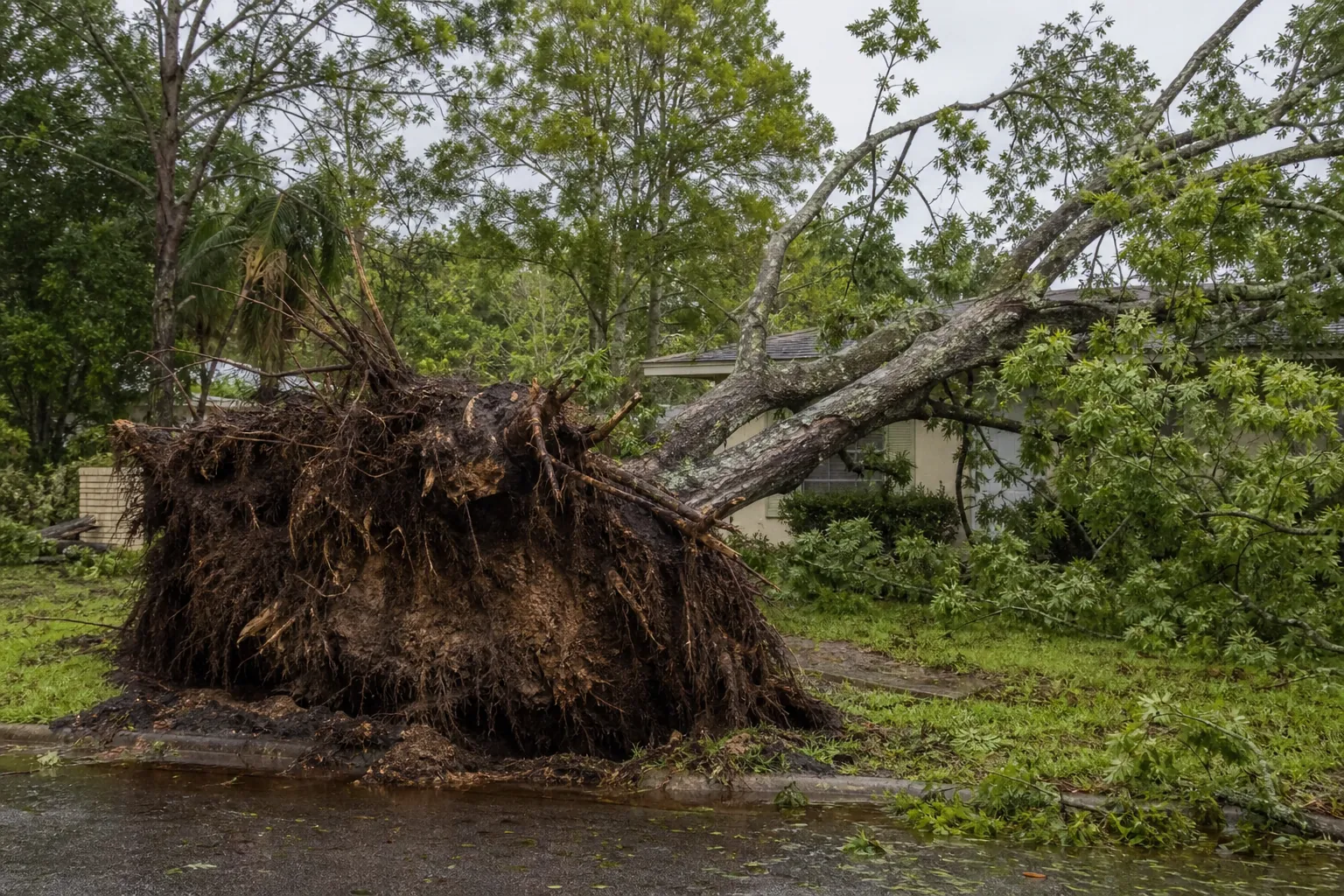
Roots anchor a tree through their connection with surrounding soil. That anchorage depends on more than root depth. Root spread, soil type, drainage, root health and the tree’s size and shape all matter. When the root zone becomes saturated, some soils lose strength and provide less resistance to movement.
Wind applies force to branches and foliage, creating leverage through the trunk toward the root system. If that force exceeds the resistance available from the roots and soil, the root plate can rotate or lift. A tree can therefore uproot even when its trunk appears sound.
Many Florida properties have constraints that complicate anchorage. A high water table, compacted soil, limited planting space or poorly drained low spots can restrict the usable root zone. Past trenching, driveway work or construction may also have cut roots without leaving obvious damage above ground.
Not every tree in wet soil is unstable. Likewise, an upright tree is not necessarily free of risk. A useful assessment considers the whole tree, the surrounding ground and what could be struck if a limb or the entire tree failed.
Recent heavy rain can expose an existing problem rather than create it from scratch. Decayed roots, previous storm injuries and inadequate rooting space may become more important when the ground is wet and wind repeatedly loads the canopy.
Warning Signs To Observe Without Approaching The Tree
Start with observations from a window or another protected position outside the tree’s potential fall area. Do not stand beneath a suspect canopy or walk up to a leaning trunk to inspect the roots. A phone photo taken from a safe location can help explain a concern to a tree care professional.
- A new lean, or a noticeable increase in an existing lean, deserves prompt attention and separation from the area.
- Fresh cracks in the soil near the base may indicate movement, especially if they accompany lifting ground or a changing lean.
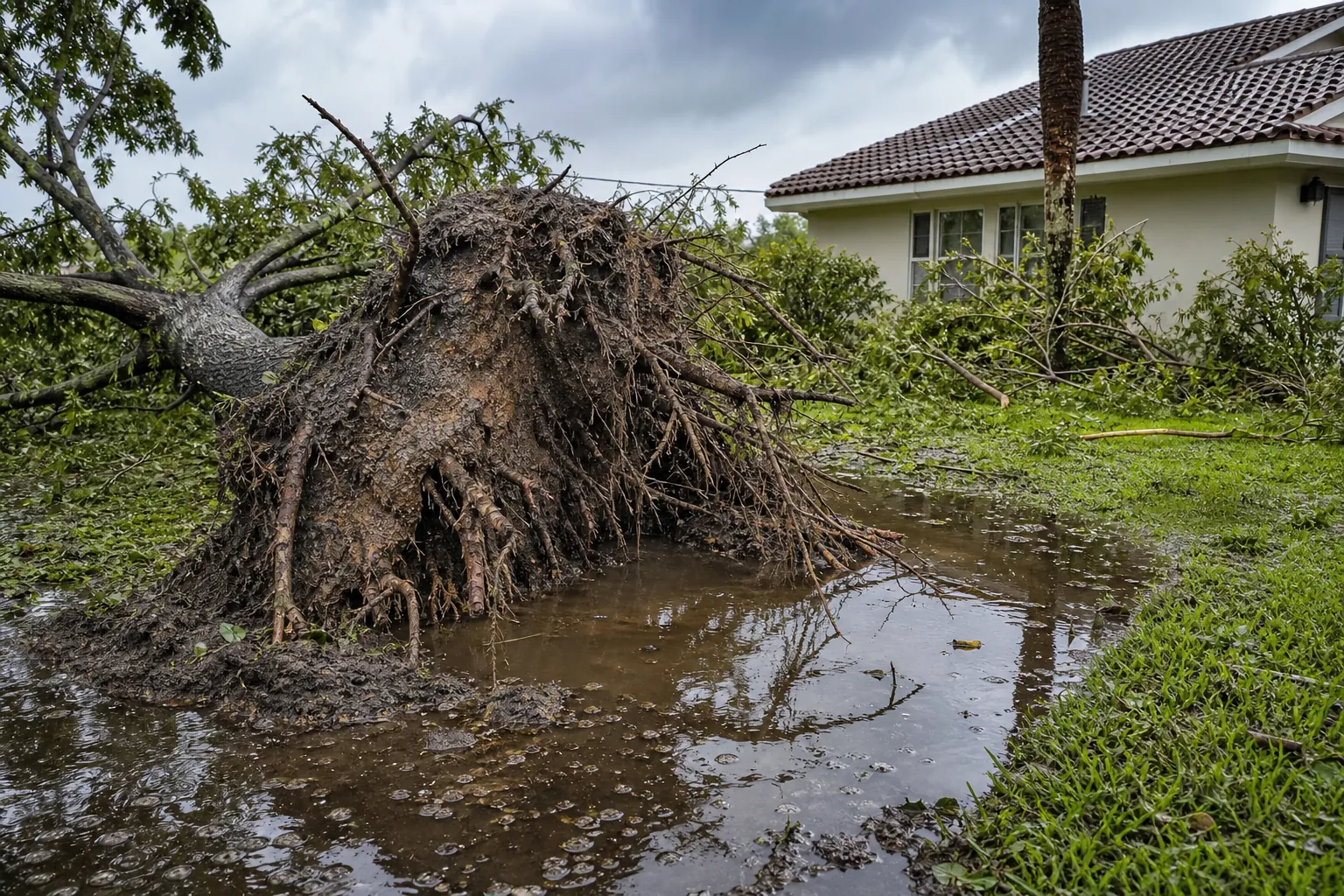
- A raised mound of soil on one side of the trunk can suggest that part of the root plate is lifting.
- New gaps around the trunk or visible root movement during gusts are reasons to keep people away.
- Hanging, broken or partially detached limbs can fall independently of the tree’s root stability.
- A split trunk, separating branch union or newly exposed cavity calls for professional evaluation.
A longstanding lean does not automatically mean failure is imminent. The important questions include whether the lean has changed, whether the roots or soil are moving and whether the tree has other defects. Do not attempt to answer those questions by pushing the trunk, pulling on branches or digging around its base.
If a tree threatens a house, occupied building, driveway or shared walkway, avoid the exposed area while seeking guidance. Where possible, relocate people to a part of the property outside the potential fall zone. Do not go outdoors during lightning or dangerous gusts simply to get a better view.
Which Property Conditions Deserve Extra Attention?
Prioritize trees where a failure could reach people or frequently used spaces. A tree beside a bedroom, parking area or community entrance has different consequences from one in an unused open area. Location helps determine urgency, but it does not establish whether a tree is structurally safe.
Look for changes around the root zone as well as changes in the tree. Persistent standing water, recent excavation and vehicle traffic over wet ground can be relevant. Share that history during a tree inspection, even when the canopy still looks healthy.
- Trees beside recently installed utilities, paving or drainage work may have experienced root disturbance.
- Trees in low spots that repeatedly collect water deserve attention to drainage and root condition.
- Trees with known decay, old storm damage or previously broken major limbs should be reassessed when conditions change.
- Trees close to buildings, play areas or regularly occupied outdoor spaces should receive priority in a property review.
- Trees with newly exposed roots after erosion need evaluation rather than an improvised covering of soil.
Species and growth form can influence how a tree responds, but a species name alone is not enough to make a removal decision. Two neighboring trees may have different root conditions, maintenance histories and exposure to wind.
For larger properties, a simple map of concerning trees can help organize an inspection. Mark each location and describe the observable issue without entering an unsafe area. Existing photos can also help show whether a lean or soil condition is new.
Practical Preparation Before Conditions Deteriorate
Preparation should focus first on people and access. Move vehicles away from suspect trees if you can do so safely before conditions worsen. Keep outdoor seating, play activities and pet areas away from trees showing fresh movement or hanging limbs.
Check ordinary surface drainage from a safe location. Clear accessible leaves from established drainage paths when weather permits, but do not excavate around roots, cut a trench beside a trunk or redirect water toward another tree. Drainage changes may require a separate evaluation and confirmation of local requirements.
- Record existing concerns with dated photographs taken from outside potential fall areas.
- Keep children, pets and visitors out of spaces beneath damaged branches.
- Identify an alternate walking route if a tree threatens the usual entrance or sidewalk.
- Have your electric utility’s contact information available before an outage or tree-related line problem occurs.
- Arrange tree inspections while conditions allow safe access rather than attempting last-minute do-it-yourself cutting.
Do not climb a ladder to remove limbs as showers, lightning or gusts approach. Wet surfaces and moving branches increase the difficulty of an already hazardous task. Ground-level cutting is not automatically safe either, particularly when a limb is heavy, split or under tension.
A rushed attempt to thin a canopy can create new wounds or leave an unbalanced structure. Tree trimming should follow an assessment of the tree’s condition and the purpose of each cut, not a general instruction to remove as much foliage as possible.
How An Inspection Guides Tree Care Decisions
Tree inspections and arborist reports can help distinguish a maintenance issue from a more significant structural concern. An assessment may consider visible root-zone movement, trunk condition, branch attachments, canopy loading, site history and nearby targets. Some defects are hidden, and inspection findings should be understood within those limitations.
The appropriate next step may be selective tree trimming, continued observation, a more detailed assessment or tree removal. Wet soil alone is not a reason to remove every tree. Conversely, a green canopy should not be used to dismiss new root movement.
Canopy thinning and crown reduction serve different purposes. Carefully selected thinning cuts can address branch density without indiscriminately stripping the interior. Crown reduction reduces selected branch lengths using suitable pruning points. Neither treatment repairs severed roots or guarantees that a tree will withstand future weather.
If a tree has a serious anchorage problem or cannot reasonably be retained near an occupied area, removal may be considered. Crane tree removal may be appropriate in some constrained settings, but equipment selection depends on access, ground conditions, tree structure and surrounding obstacles.
Florida Foliage offers tree inspections and arborist reports, tree trimming, canopy thinning, crown reduction and tree removal. Its emergency and hurricane tree removal service is also relevant when storm-related tree damage requires professional attention. The service name does not imply a hurricane warning or hurricane conditions on Florida’s east coast.
Before work begins, confirm applicable tree protection rules and permit requirements with your city or county. Requirements vary, and a storm-related concern should not be treated as an automatic exemption.
Safe Debris Cleanup After Heavy Rain And Wind
Wait until weather conditions allow a safe assessment. A fallen limb may be resting beneath another damaged branch, and a partly uprooted tree may still move. The end of a rain shower does not mean the surrounding trees or debris are stable.
Stay away from downed power lines and anything touching them, including trees, branches, fences and standing water. Treat a line as energized even if it appears inactive. Call your electric utility for any tree or limb contact with a power line, and do not attempt to cut or move the material yourself.
Fallen trees can hold substantial stored tension. Cutting a trunk or root connection may allow a raised root plate to shift or settle suddenly. Branches pinned beneath a trunk may also spring free. These are not suitable situations for casual chainsaw cleanup.
- Keep people away from partially fallen trees, hanging limbs and unstable debris piles.
- Do not pull a fallen tree with a vehicle or attempt to push a leaning tree upright.
- Leave suspended branches and limbs lodged in another tree for professional assessment.
- Move small, loose twigs only when the area has no overhead hazards, electrical concerns or unstable nearby trees.
- Avoid driving equipment across a saturated root zone, where rutting and compaction can cause additional damage.
Photograph damage from a safe location before cleanup if documentation is needed. Do not delay an urgent safety response merely to collect pictures. Follow utility directions whenever electrical infrastructure is involved.
After tree removal, stump grinding may be considered as a separate step. Access, underground utilities, soil conditions and the intended use of the area all affect that decision. A stump should not be treated as the immediate priority while unstable branches or electrical hazards remain.
Planning For Commercial, HOA And Condo Properties
Shared properties need a coordinated approach because residents, visitors and contractors may encounter the same hazard from different directions. A concern near a mail area, pool path or parking row should be communicated clearly, with access redirected where practical and safe.
Property managers can collect reports in one place, noting the tree’s location, the observed change and whether a building or access route is exposed. Avoid asking staff to inspect beneath a suspect tree or to remove hanging branches.
Commercial tree services and HOA and condo tree services can support a property-wide review and planned maintenance. Prioritize immediate hazards before routine aesthetic work, and keep records of inspections and completed work for future comparisons.
If a larger site also needs land and lot clearing or brush hogging, keep that planning separate from emergency tree decisions. Clearing vegetation is not a substitute for assessing mature trees, and heavy equipment should not be routed across wet root zones without considering potential damage.
Keep Checking Trees After The Rain Eases
Ground conditions do not necessarily recover as soon as the sky clears. Continue observing previously concerning trees from safe locations after repeated rain, watching for new leaning, soil lifting or broken branches. Arrange follow-up inspection if changes appear or access becomes safe enough for a closer professional review.
For the Oct. 7-10 window, the practical priorities are straightforward: follow current official forecasts, avoid exposed areas, take new tree movement seriously and keep cleanup away from electrical hazards. Heavy rain and onshore wind warrant preparation without assumptions about an east coast hurricane impact.
If you need help evaluating a tree or planning safe tree care, call Florida Foliage at (386) 481-7913. Describe the location, visible changes and any nearby structures or utility lines. A clear description can help guide the next step without requiring you to approach a potentially unstable tree.
Call (386) 481-7913 to talk through next steps.