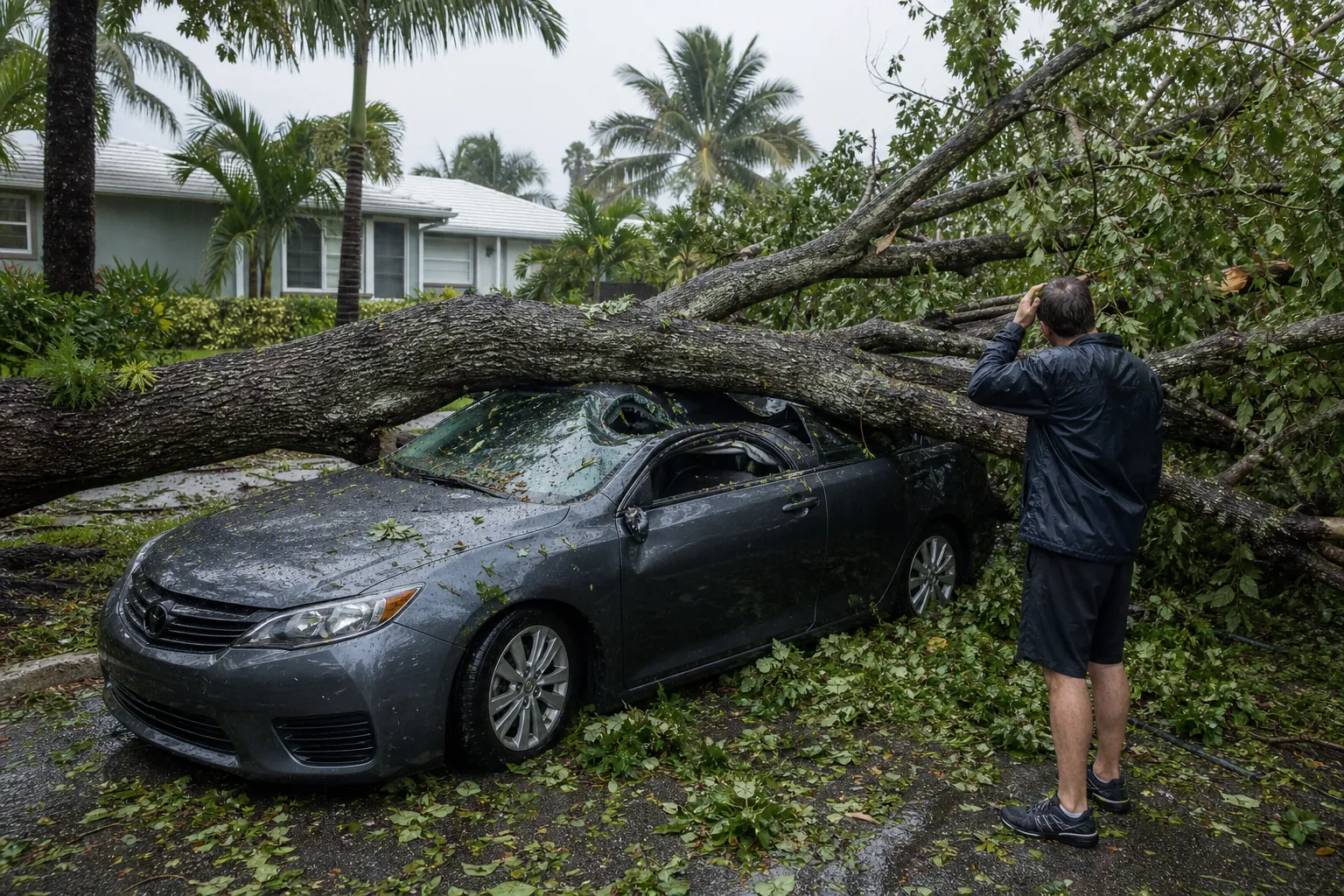
A tree on your car is not just a vehicle problem. It can also involve unstable wood, a damaged tree nearby, concealed electrical hazards, and ground too wet to support safe cleanup. The first decision should be where to stand safely, not how to pull the branch away.
For Florida residents preparing for the October 7-10, 2026 storm window, heavy rain and gusty onshore winds deserve attention even without an east coast tropical cyclone watch. Saturated soil can reduce root support, while damaged limbs may fall during additional showers or wind.
If a tree fell on your car after a storm in Florida, this guide explains how to protect people, document the incident, coordinate removal, and consider the surrounding trees. Florida Foliage can help you discuss tree removal and tree inspections, but emergency hazards must be addressed first.
What the October 7-10 forecast means for trees
As of the National Hurricane Center's Intermediate Advisory 4A at 1 PM CDT on October 7, 2026, Tropical Storm Isaias had formed in the southern Gulf of Mexico. The hurricane, tropical storm, and storm surge watches described in that advisory covered only the northern Gulf Coast, including areas such as Bay St. Louis to Indian Pass. They did not cover Florida's east coast.
The local rain outlook matters separately. In its morning October 7 forecast discussion, NWS Melbourne forecast high coverage of showers and lightning storms through late week, with a marginal risk of excessive rainfall across east central Florida. Minor flooding was possible where heavy rain repeatedly affected the same locations.
NWS Jacksonville's morning October 7 discussion reported saturated ground along the Northeast Florida I-95 corridor, strengthening onshore winds, and more periods of heavy rain Friday and Saturday. Those conditions make checking parking locations and watching for tree instability sensible precautions.
These are dated forecast details, not a prediction of damage at any particular property. Check updates directly from the National Hurricane Center, NWS Melbourne, and NWS Jacksonville. Do not assume that conditions or advisories remain unchanged throughout the storm window.
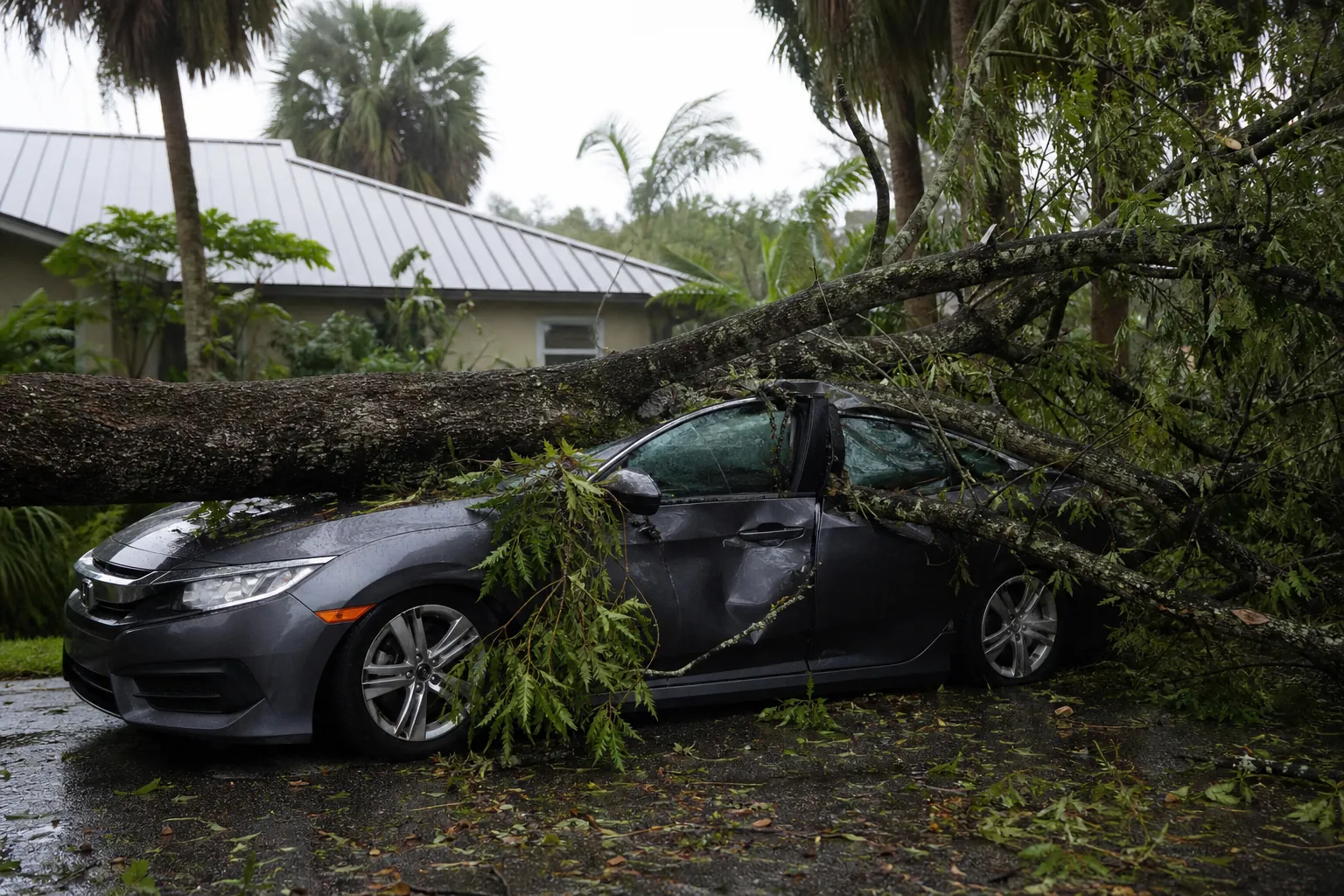
Start with people, power lines, and a safe distance
Stay away from the fallen tree and inspect the situation only from a protected location. A trunk resting on a car can roll or shift. Bent branches can release stored tension, and a partly uprooted tree can move again without much warning.
Look for overhead wires, service lines to buildings, and cables hidden among branches. Stay away from downed power lines and anything touching them, including the vehicle, tree, fence, or nearby water. Call your electric utility for any line contact. Do not assume a line is safe because it is quiet or appears insulated.
- Call 911 if someone is injured, trapped, or facing an immediate threat.
- Keep children, pets, neighbors, and bystanders away from the tree and its surrounding debris.
- Do not touch or enter the vehicle if a wire may be contacting it or nearby debris.
- Do not climb under the tree to retrieve belongings or check the windshield.
- Wait in a safe building or another protected location when lightning or additional falling limbs make outdoor assessment unsafe.
If you are inside a vehicle that is contacting a power line, remain inside and call 911 unless an immediate life-threatening hazard, such as fire, requires escape. Follow emergency responders' instructions. Anyone outside should stay back rather than approach to help.
A blocked driveway can feel urgent, but moving the tree before hazards are evaluated can make the situation worse. Keep access clear for responders where you can do so without entering the danger area.
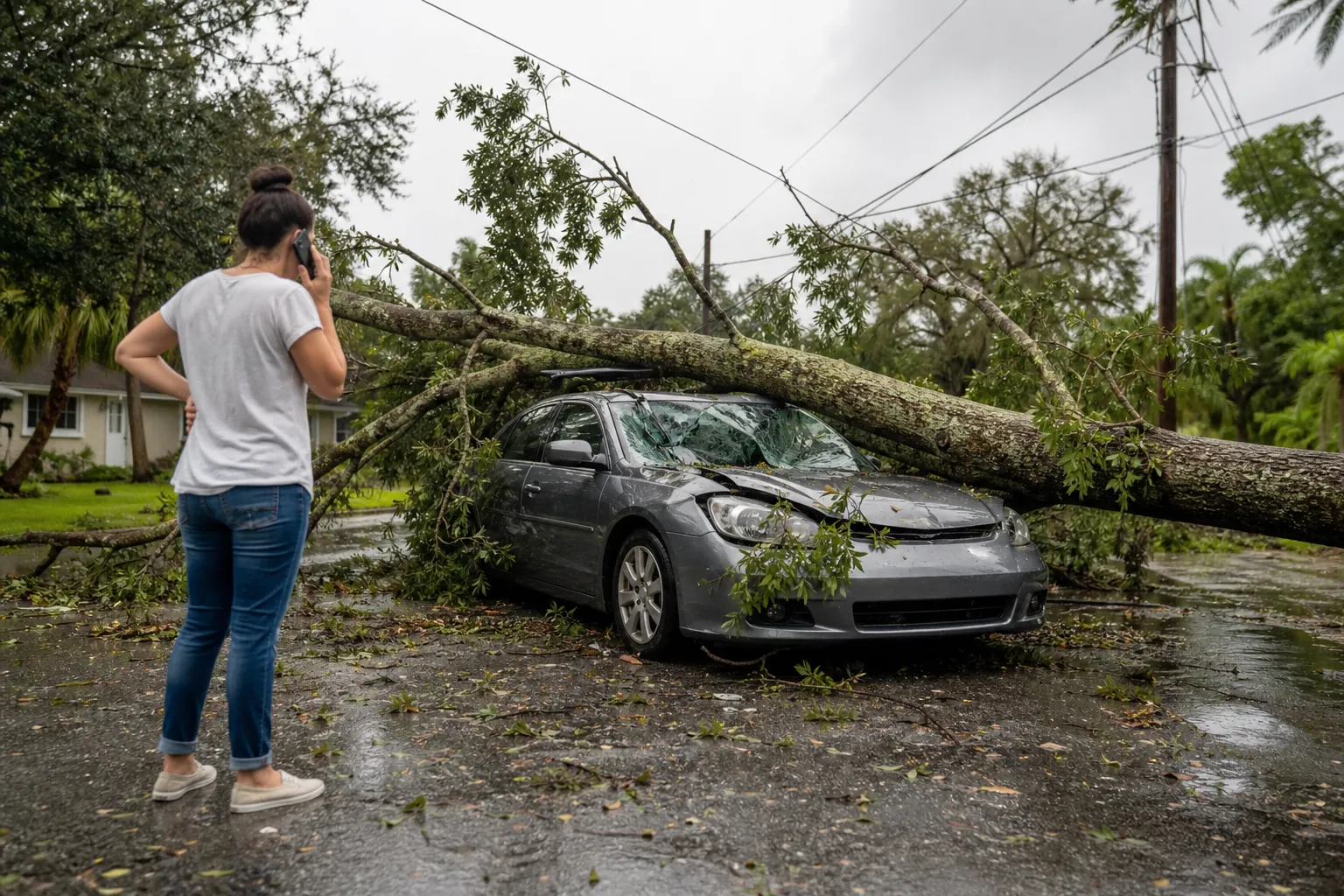
Document the damage without entering the work area
Once you have a safe viewpoint, record the scene before removal changes it. Photographs can help your insurer understand the vehicle damage and help a tree service assess access, tree position, and nearby obstacles. Never trade personal safety for a better camera angle.
Start with wide photographs showing the vehicle, fallen tree, and surrounding property. Then take closer images using your phone's zoom if needed. Capture the roof, windshield, hood, and any visible damage without standing beneath suspended wood.
- Record the date and approximate time you discovered the damage, distinguishing that from the time the tree actually fell if you do not know it.
- Photograph the root plate, broken trunk, or remaining stump only if they are visible from a safe location.
- Include nearby fences, buildings, overhead lines, and driveway conditions in your documentation.
- Save communications with your insurer, tree service, towing provider, and property manager.
- Keep invoices and written descriptions of the work performed for your records.
Describe only what you observed. For example, you can report that the soil was wet or that a branch was resting on the roof. Avoid declaring that the tree was diseased or that a neighbor was negligent unless that conclusion has been supported by an appropriate assessment.
If a tree inspection or arborist report is needed, ask what can still be evaluated before the material is removed. Emergency safety work may need to happen first, and photographs are useful when the original condition cannot be preserved.
Contact your insurer and clarify the next steps
Call your auto insurer promptly and explain that a tree or limb fell on your parked vehicle. Comprehensive coverage commonly addresses falling-object damage, but the outcome depends on your policy, deductible, exclusions, and circumstances. Do not assume that a homeowner's policy will handle the vehicle claim.
Ask what documentation the insurer needs, whether an inspection is required before removal, and how it wants removal and towing expenses recorded. If the car is exposed to rain through broken glass, ask about reasonable steps to prevent additional damage. Do not cover it yourself if doing so requires approaching unstable wood or electrical hazards.
A tree originating on a neighboring property does not automatically establish your neighbor's financial responsibility. Ownership, prior knowledge of a hazardous condition, policy terms, and other circumstances may matter. Share facts and photographs with the insurer rather than arguing about liability at the scene.
- Ask whether your policy includes comprehensive coverage for this incident.
- Confirm which claim number and contact details should appear on submitted records.
- Ask whether tree removal from the vehicle and disposal of debris are treated separately.
- Clarify whether towing should wait until the tree is removed and the vehicle is assessed.
- Request guidance before authorizing work that is not necessary to address an immediate safety hazard.
If the vehicle belongs to a tenant, employee, customer, or visitor, the property owner should preserve documentation too. Clear communication helps prevent confusion, but each involved party should confirm its own coverage.
Why removing a tree from a car requires a plan
A tree resting on a vehicle creates an unusual support system. The car may be holding part of the trunk's weight, while limbs are wedged against pavement or another tree. Cutting one section can transfer weight onto a different part of the vehicle or cause the remaining wood to slide.
Do not try to drag the tree away with a pickup truck, tow strap, or rope. Do not jack up the trunk or cut branches while standing on the vehicle. These actions can change the load unexpectedly and place people in the path of moving wood.
A professional assessment should consider the tree's contact points, suspended sections, surrounding trees, overhead utilities, and available access. Saturated ground also affects where equipment can be positioned. A route that worked in dry weather may be unsuitable after repeated rain.
Tree removal may involve separating the load into controlled sections. Crane tree removal may be considered when lifting sections offers a suitable approach, but crane access and ground conditions must be evaluated. Not every fallen tree requires a crane, and no method can promise that existing vehicle damage will remain unchanged.
Florida Foliage's emergency and hurricane tree removal services can be discussed for storm-related tree problems. The service name does not mean that a hurricane occurred at your location. Describe the actual situation, including any utility involvement, before arranging an assessment.
Leave the vehicle in place until the removal plan allows it to move safely. After the wood is removed, a towing provider or qualified automotive professional can evaluate whether the car should be driven. Damage to the roof, windshield, steering, or other systems may not be obvious from outside.
Plan debris cleanup around wet ground and remaining hazards
Removing the tree from the vehicle is only one stage of cleanup. Broken limbs, an exposed root plate, and a damaged standing trunk may still pose hazards. Ask which material will be removed and which areas will need follow-up attention.
Keep people away from partially uprooted trees. A raised root plate can move as the trunk is cut or its weight changes. Do not stand in the hole or attempt to push the roots back into place.
Wet lawns and driveways need careful access planning. Tell the tree service about septic systems, irrigation lines, underground utilities, narrow gates, and pavement concerns. Avoid guessing about equipment access where the soil is soft or standing water hides the surface.
- Separate the immediate vehicle-access problem from less urgent yard cleanup.
- Ask how branches and trunk sections will be handled and where material will be staged.
- Keep debris away from drains and access routes without entering hazardous areas.
- Confirm local debris collection instructions with your city or county before placing material at the curb.
- Discuss stump grinding separately if a stump remains after tree removal.
Confirm tree removal requirements with your city or county, especially for protected trees or work outside immediate hazard reduction. Requirements can vary. For HOA and condo properties, also check the association's authorization process and communicate with the property manager.
Inspect nearby trees before moving cars back
One fallen tree does not prove that every nearby tree is unsafe. It does, however, provide a reason to look at the surrounding parking area before returning vehicles to it. Use ground-level observation and leave closer evaluation to qualified professionals.
Warning signs include a new lean, fresh soil cracks around the base, lifted roots, split branch attachments, and hanging broken limbs. A tree that looks mostly intact may still have storm damage hidden in its canopy.
Tree inspections and arborist reports can help document visible conditions and guide decisions. They cannot eliminate all risk or reliably predict every future failure. Tell the assessor about changes you noticed, previous branch failures, and where people and vehicles spend time.
Tree trimming may address broken or problematic branches. Canopy thinning or crown reduction may be considered for suitable trees after assessment, but neither should be treated as a universal storm solution. Excessive or poorly placed cuts can harm tree structure.
If a tree has extensive structural damage or unstable roots, tree removal may be the appropriate discussion instead. Avoid asking for aggressive cutting simply because rain is forecast. The recommendation should reflect the tree's condition, species, site, and nearby targets.
Prepare parking areas during the October storm window
Before additional rain arrives, choose parking locations away from visibly damaged trees and overhanging broken limbs. When practical, move vehicles before weather deteriorates rather than going outside during lightning or strong gusts. Do not relocate a car into a flood-prone spot just to avoid branches.
For commercial properties and shared residential communities, review areas where vehicles and pedestrians gather. Commercial tree services and HOA and condo tree services can support tree inspections and planned maintenance around parking lots, entrances, and shared access routes.
- Identify an alternate parking area that does not sit beneath visibly compromised trees.
- Keep emergency access and pedestrian routes unobstructed.
- Report hanging limbs or new leaning trees to the responsible property manager.
- Schedule nonurgent tree work around safe weather and suitable site conditions.
- Recheck outdoor areas after additional rain or wind before reopening them.
Preparation should remain proportional to the actual forecast and conditions. The October 7 east central and Northeast Florida discussions emphasize rain, saturated ground, and onshore wind concerns, not an east coast hurricane watch.
Talk with Florida Foliage about safe tree removal
When you call, explain whether the tree is on the roof, hood, or windshield; whether anyone is injured; and whether any wires are involved. Mention standing water, blocked access, and limbs that are still hanging. Share photographs only from a safe location.
For tree removal, crane tree removal, storm-related cleanup planning, or tree inspections, call Florida Foliage at (386) 481-7913. Stay clear of the tree while you arrange help. If there is any line contact, call your electric utility first, and use 911 for immediate threats to life.
Call (386) 481-7913 to talk through next steps.