Reviewed by Clinton Funk
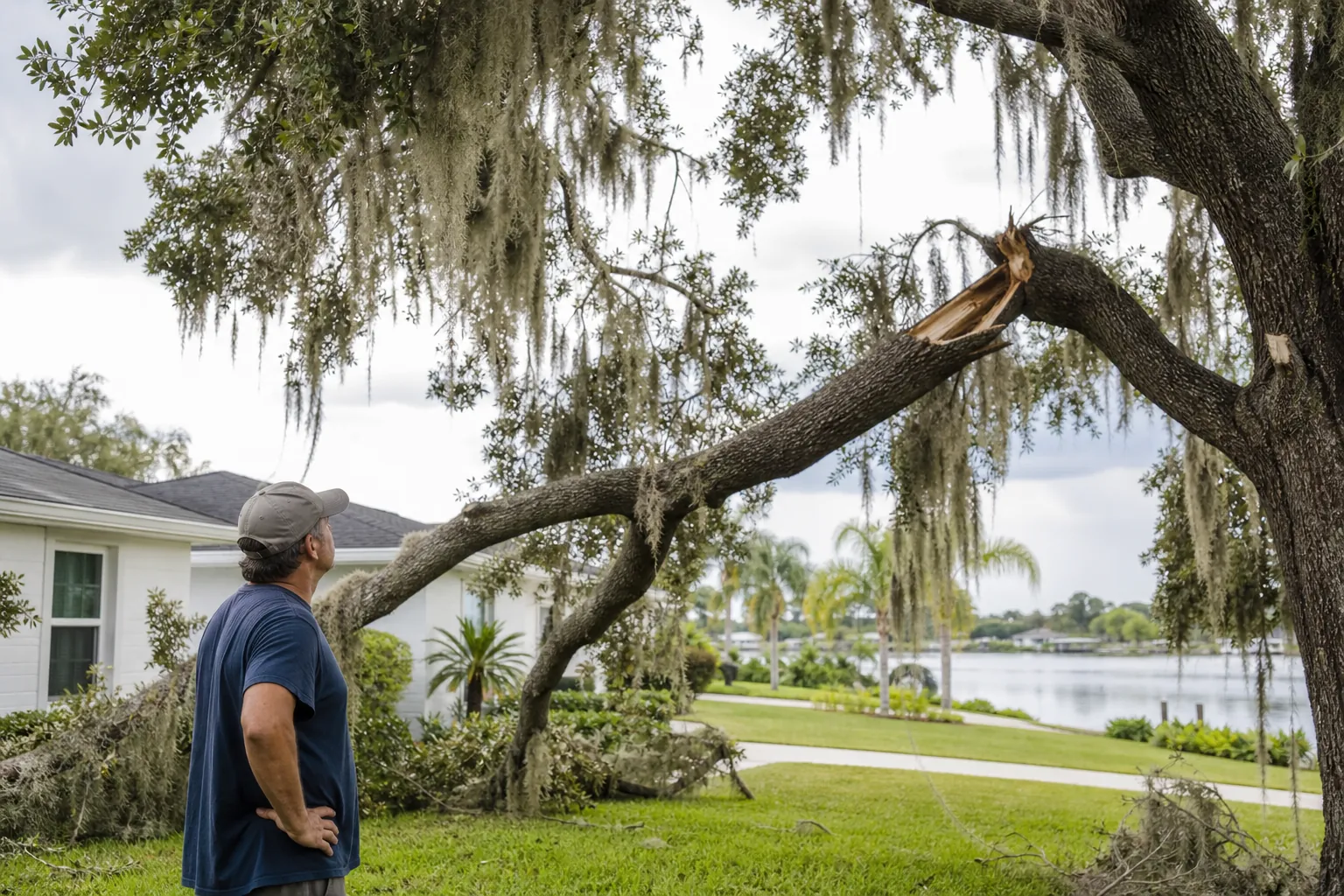
A branch caught in a tree canopy can look surprisingly secure. It may rest across two limbs, hang by a strip of bark, or blend into surrounding foliage. None of those positions tells you whether it will stay there. Wind, rain, or movement elsewhere in the crown can change its support without warning.
For Edgewater property owners, the practical question is not simply whether a branch looks dead. It is whether damaged wood could fall onto a person, vehicle, building, or regularly used outdoor space. A tree inspection helps distinguish a broken limb from normal growth and identifies conditions that cannot be judged reliably from the ground.
This guide explains what to notice from a safe location, when to keep people away, and how Florida Foliage can help with tree inspections and appropriate tree work. Do not stand beneath a questionable branch to get a better view.
Why a hanging branch deserves attention
A hanging branch is a limb that has broken or partially separated but remains suspended in the tree. Sometimes another branch supports it. In other cases, damaged wood fibers still connect it to the trunk or a larger limb. Both situations can be unstable.
A partially attached limb may still carry green leaves. That does not mean its attachment is sound. Leaves can remain green after a break, and a remaining connection may still move water while providing limited structural support.
Location matters as much as appearance. A small branch over an unused planting bed presents a different situation from a heavy limb above a front entrance. An inspection considers the damaged part, its supporting structure, and what lies beneath it.
Edgewater's Florida setting also makes changing weather relevant. Thunderstorms, gusty conditions, and tropical weather can move branches that have been resting in place. Wet foliage and shifting neighboring limbs can alter the way broken wood is supported. Waiting for the next storm to reveal whether a branch is stable is not a useful test.
What you can observe safely from the ground
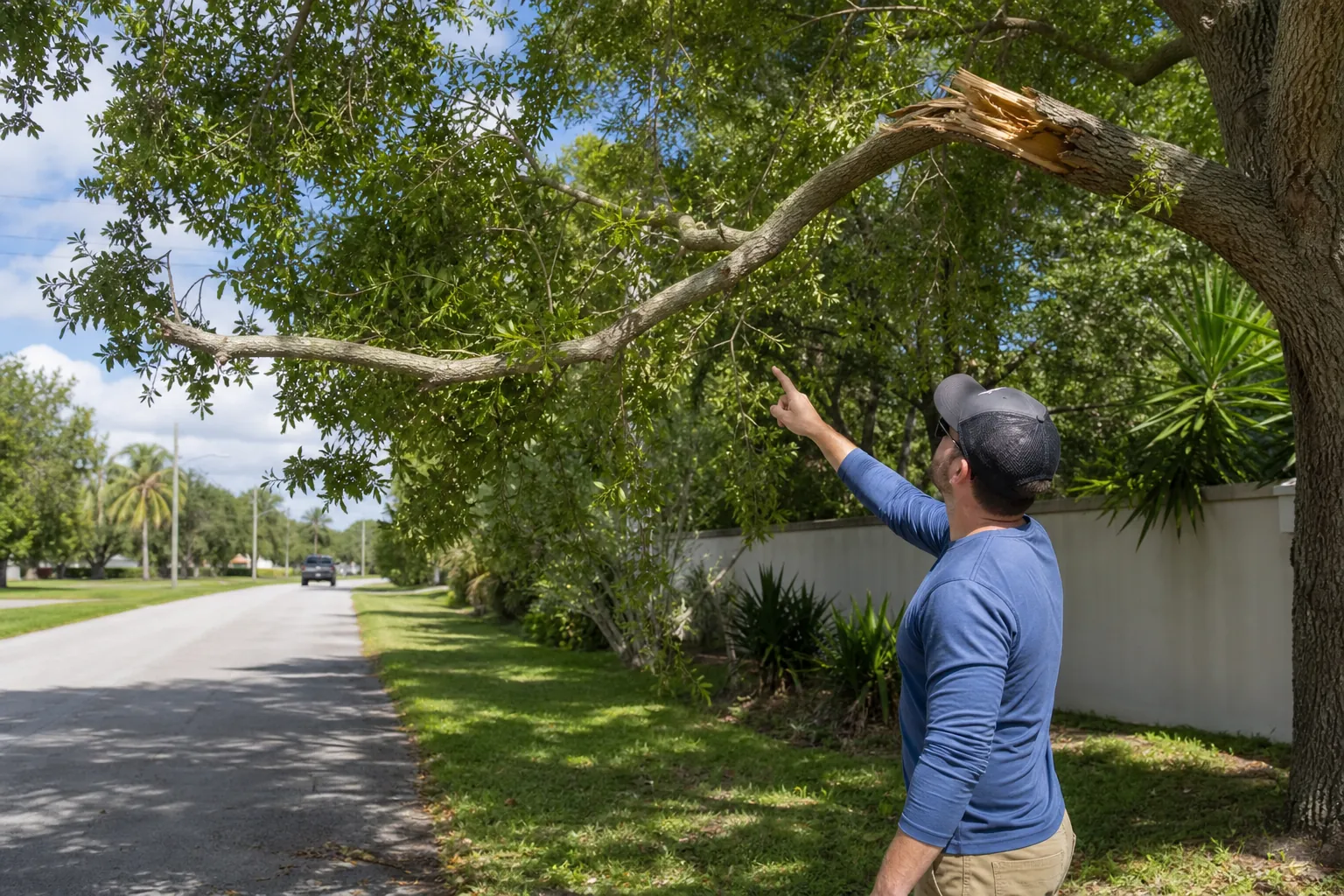
You do not need to approach the trunk to collect useful information. Start from a location outside the apparent fall area, and use binoculars or your phone's zoom if available. If the view is poor, leave the uncertainty for the inspection rather than walking underneath.
Look for changes in shape, attachment, and position. A hanging limb often points in a direction that differs from nearby branches, although unusual growth alone does not prove damage.
- Look for a branch hanging vertically or resting across neighboring limbs instead of extending naturally from its attachment.
- Notice fresh, light-colored wood, split bark, or a jagged end that may indicate a recent break.
- Check whether a limb has dropped lower than you remember or is now touching a roof, fence, or another tree.
- Observe whether one section has wilted or brown foliage while nearby branches remain green.
- Note visible cracks near the branch attachment, especially where several large limbs meet.
- Identify the spaces beneath the branch that people or vehicles normally use.
These observations help describe the situation, but they do not establish safety. Decay, concealed cracks, and weak attachments may be difficult to see from below. A photograph can support an initial conversation, but it cannot replace an on-site inspection when important details are hidden.
When to keep people away and seek prompt help
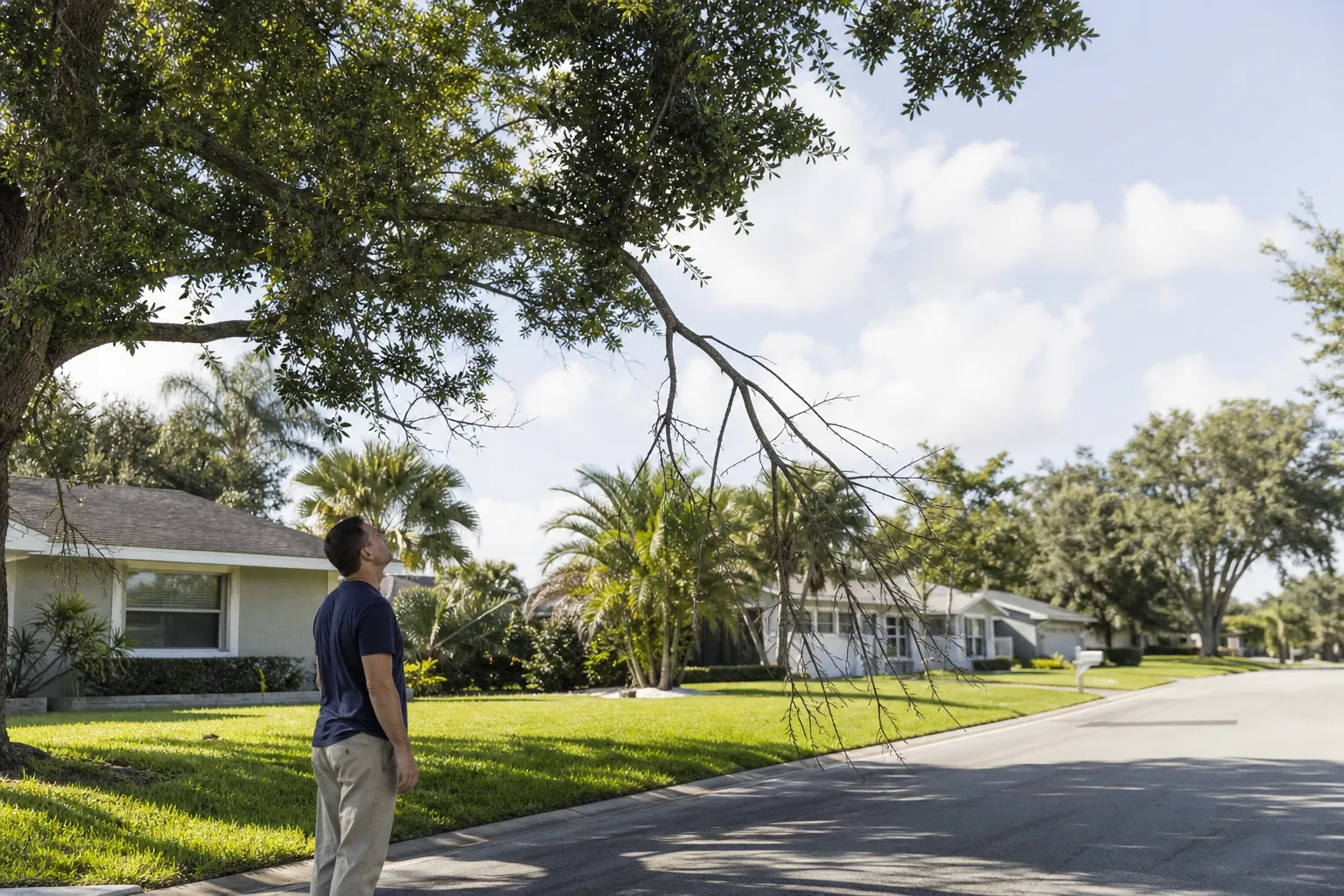
Treat the area as a concern when a broken limb hangs over a doorway, driveway, sidewalk, seating area, or play space. Move activities elsewhere and prevent others from entering the space beneath it. Choose an alternate entrance if you can do so without passing through the suspected fall area.
Do not assume the area immediately below the branch is the only place it could land. A limb may swing, strike another branch, or break into pieces. Keep a generous distance rather than trying to calculate a precise landing point yourself.
Some conditions call for prompt professional attention:
- A large limb is visibly split, partly detached, or suspended above an occupied area.
- The branch has shifted recently, or you hear cracking from the tree while remaining at a safe distance.
- A hanging limb is entangled with other damaged branches after a storm.
- The tree also shows a newly developed lean, raised soil, or visible root movement.
- The branch is touching a utility line or could fall onto one.
If utility lines are involved, stay clear of the tree, branch, and anything they touch. Contact the utility provider, and call emergency services if there is an immediate threat to people. Do not approach to determine whether a line is energized.
Florida Foliage offers emergency and hurricane tree removal. The appropriate response depends on the actual damage, access, and surrounding hazards, not simply on whether a storm recently passed.
What a tree inspection should evaluate
A useful inspection looks beyond the obvious broken limb. The goal is to understand what failed, what continues to support the damaged section, and whether other parts of the tree show related concerns.
The branch and its attachment
The inspector should assess whether the branch is fully detached, partly attached, or lodged in the canopy. The size, weight, position, and remaining connection influence how the situation can be addressed. A split extending into a larger limb may require a different approach from a clean break near the end of a branch.
The surrounding canopy
Nearby branches can conceal additional damage or support the hanging piece. Removing one part may change the position of another. The inspection should consider intersecting limbs, rubbing branches, deadwood, and visible defects in the surrounding crown.
The trunk and root area
A hanging branch does not automatically mean the entire tree is unstable. However, trunk cracks, cavities, decay indicators, root damage, or recent changes at the base may affect the overall assessment. These observations help determine whether the concern is localized or part of a broader structural problem.
The site and potential targets
Buildings, parked vehicles, fences, outdoor equipment, and pedestrian routes affect planning. So do limited access, nearby trees, and utility lines. An inspection should connect the tree's condition with how the property is actually used rather than considering the canopy in isolation.
Ask what the inspector could see, what remained obscured, and whether further evaluation is needed. A careful explanation should acknowledge those limits instead of presenting a ground-level view as complete certainty.
Why pulling or cutting the limb yourself is risky
A hanging branch can behave differently from an intact limb. Its weight may be held by twisted fibers or by another branch under tension. Cutting or pulling one point can release that stored force and send wood in an unexpected direction.
Using a ladder adds another problem: the damaged branch or falling debris can strike the ladder or destabilize the person standing on it. A pole saw does not eliminate the hazard if the operator remains beneath the limb or cannot control where it moves.
Do not throw a rope over the branch and pull it down with a vehicle. You may damage supporting limbs, pull the broken section toward yourself, or cause a larger failure. Likewise, avoid shaking the tree or trying to knock the branch loose with another object.
The safest homeowner contribution is usually to keep the area unused, gather information from a safe distance, and arrange an inspection. Leave decisions about cutting sequence and equipment to the people assessing the site.
How inspection findings guide the next step
The presence of a hanging limb does not always justify removing the whole tree. The appropriate work depends on the damage, the tree's remaining structure, and the consequences of another failure.
Tree trimming for localized damage
If the problem is limited to a broken branch and the remaining tree is suitable to retain, tree trimming may address it. The work should account for the branch's current support and the condition of the wood around the break. A clear explanation should distinguish removing damaged material from making unrelated changes to the canopy.
Canopy thinning or crown reduction when justified
Canopy thinning and crown reduction serve different purposes. Thinning selectively removes branches within the crown, while reduction decreases selected branch lengths through appropriate cuts. Neither should be treated as an automatic solution for every hanging limb.
Ask why either approach is recommended for your particular tree. Excessive pruning can create new problems, and a tree should not be stripped simply because one branch failed. The inspection findings should support the scope of work.
Tree removal for broader structural concerns
Tree removal may be considered when the damage extends beyond a manageable branch problem or when the remaining tree presents concerns that cannot reasonably be addressed through trimming. The recommendation should explain the relevant defects and how they affect the decision.
Crane tree removal may be considered when tree size, location, or access calls for that approach. It is not automatically necessary for a high branch. Equipment selection depends on the full site assessment and a suitable work plan.
Edgewater weather and property conditions to discuss
Florida weather can expose existing weaknesses rather than create every defect from scratch. A branch that breaks during a thunderstorm may have had decay, a weak attachment, or previous injury. Understanding those contributing conditions helps guide decisions about the rest of the tree.
Tell the inspector about recent storms and any changes you noticed afterward. Also mention past construction, driveway work, trenching, or changes to the soil around the tree. Root disturbance and altered site conditions can be relevant even when the most visible problem is overhead.
Coastal exposure varies across Edgewater properties. Wind exposure, salt exposure, drainage, and nearby structures can influence tree condition, but none should be assumed solely from an address. Describe the actual conditions on your lot and let the inspection establish their relevance.
Before substantial tree work, confirm any applicable requirements with your city or county. If the property is governed by an HOA or condominium association, check its approval process as well. Do not assume that every storm-damaged tree is exempt from local or association requirements.
Preparing for an inspection without entering the hazard area
A little preparation can make the visit more useful. Focus on information and access arrangements that do not require approaching the damaged tree.
- Take photographs from safe locations showing both the damaged branch and the surrounding property.
- Write down when you first noticed the problem and whether its position has changed.
- Describe what is beneath the branch, including entrances, parking spaces, walkways, and outdoor gathering areas.
- Mention known utility lines, restricted access, locked gates, or nearby structures before the visit.
- Share any previous arborist reports or relevant history of tree damage and property work.
- Keep children, pets, visitors, and routine outdoor activities away from the affected area.
Do not move a vehicle or other object if reaching it would place you beneath the limb. Explain that limitation when arranging the visit. Access can be planned around the hazard rather than asking you to take a risk beforehand.
If you need written findings for property records or a management decision, ask about arborist reports and tree inspections. Clarify what the report will cover and whether any inaccessible areas will be noted as limitations.
Questions to ask before approving tree work
A recommendation should make sense in plain language. You should understand which branch or tree is involved, what the inspection found, and why the proposed work fits those findings.
- Ask whether the concern is confined to the hanging branch or involves the trunk, roots, or other major limbs.
- Ask what conditions support trimming rather than removal, or removal rather than trimming.
- Ask how nearby buildings, utility lines, and pedestrian access affect the work plan.
- Ask whether the inspection identified additional damaged branches that need attention.
- Ask which parts of the assessment were limited by visibility or access.
- Ask whether you need to confirm local requirements or association approval before work begins.
Keep the immediate hazard separate from optional work elsewhere on the property. If additional trimming is suggested, ask for its purpose. This helps you make a focused decision without assuming that all surrounding trees need the same treatment.
Managing hanging branches on shared properties
On commercial sites, HOA grounds, and condominium properties, a hanging branch can affect people who have not seen the damage or received a warning. Property managers should communicate the affected location clearly and keep routine foot traffic away from it.
Identify an alternate route when a walkway or entrance is affected, provided that route stays outside the hazard area. Coordinate with staff and residents so landscaping activity, deliveries, and parking do not bring people beneath the branch.
Florida Foliage offers commercial tree services and HOA and condo tree services, along with arborist reports and tree inspections. For shared properties, a documented assessment can help managers communicate the findings and proposed next steps. It should still explain any inspection limitations and distinguish urgent concerns from longer-term recommendations.
Arrange a tree inspection in Edgewater
If you are searching for a tree inspection for a hanging branch in Edgewater, start by keeping the area clear. You do not need to prove the branch is about to fall before asking for help, and you should not test its stability yourself.
Call Florida Foliage at (386) 481-7913 to discuss the branch's location, visible damage, and nearby structures or utility lines. Mention whether the area is currently in use and whether the branch has moved.
An inspection can help clarify whether tree trimming, tree removal, or another appropriate approach is warranted. The aim is a practical decision based on the tree and the site, with clear explanations of what is known and what still needs evaluation.
Call (386) 481-7913 to talk through next steps.