Reviewed by Clinton Funk
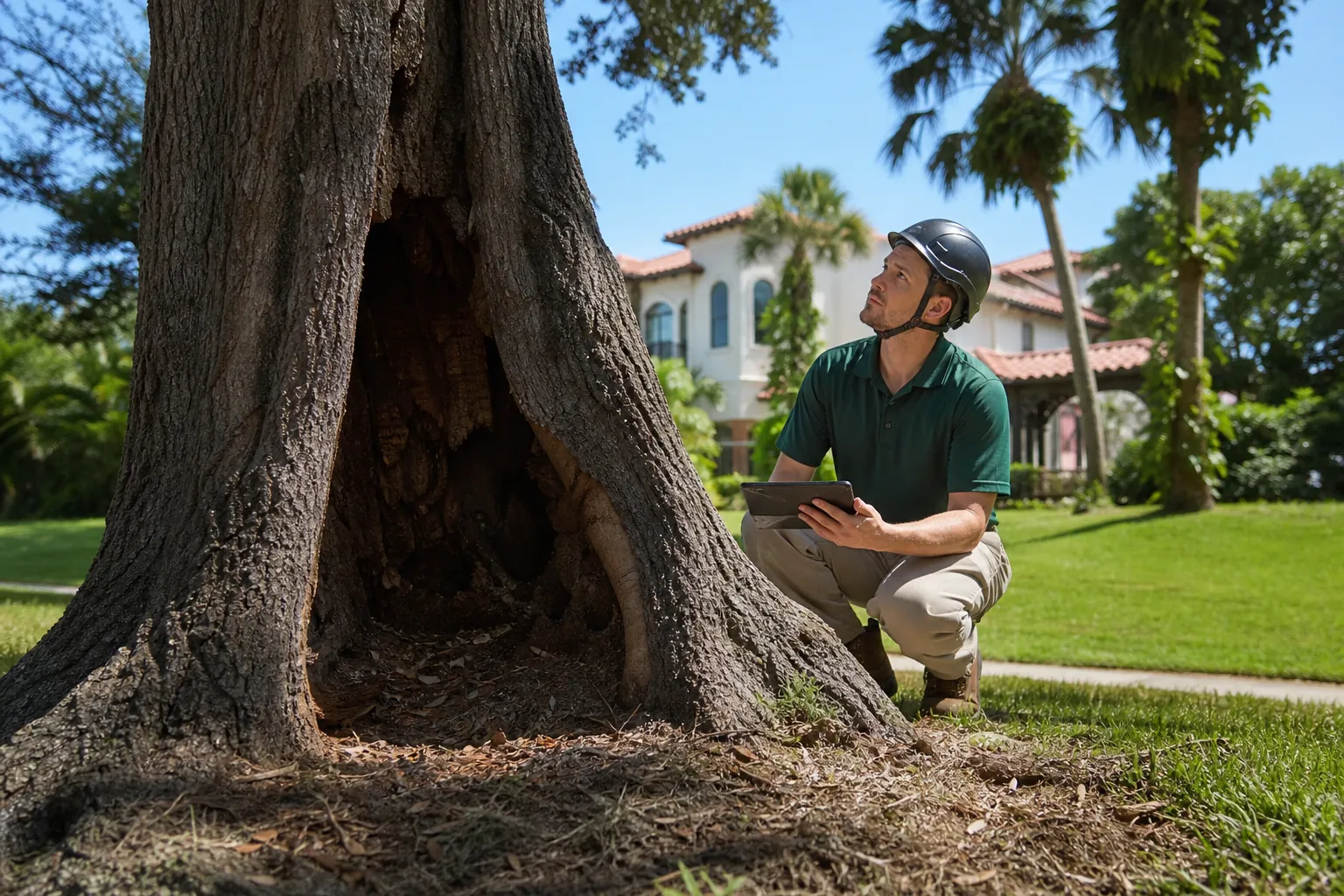
Finding a hollow opening in a tree can be unsettling, especially when that tree stands near your home, driveway, or a frequently used outdoor space. A cavity does not automatically mean a tree must be removed. It does mean the tree deserves a closer look, because an opening alone cannot tell you how much sound wood remains or how the trunk is carrying its load.
For homeowners seeking a tree inspection for a hollow trunk in Ormond Beach, the most useful starting point is a careful assessment of the whole tree and its surroundings. Florida Foliage provides arborist reports and tree inspections to help property owners understand visible defects, potential consequences, and practical next steps.
This guide explains what a hollow trunk may indicate, what to observe safely, and how inspection findings can inform decisions about tree trimming, crown reduction, or tree removal.
Why a tree trunk becomes hollow
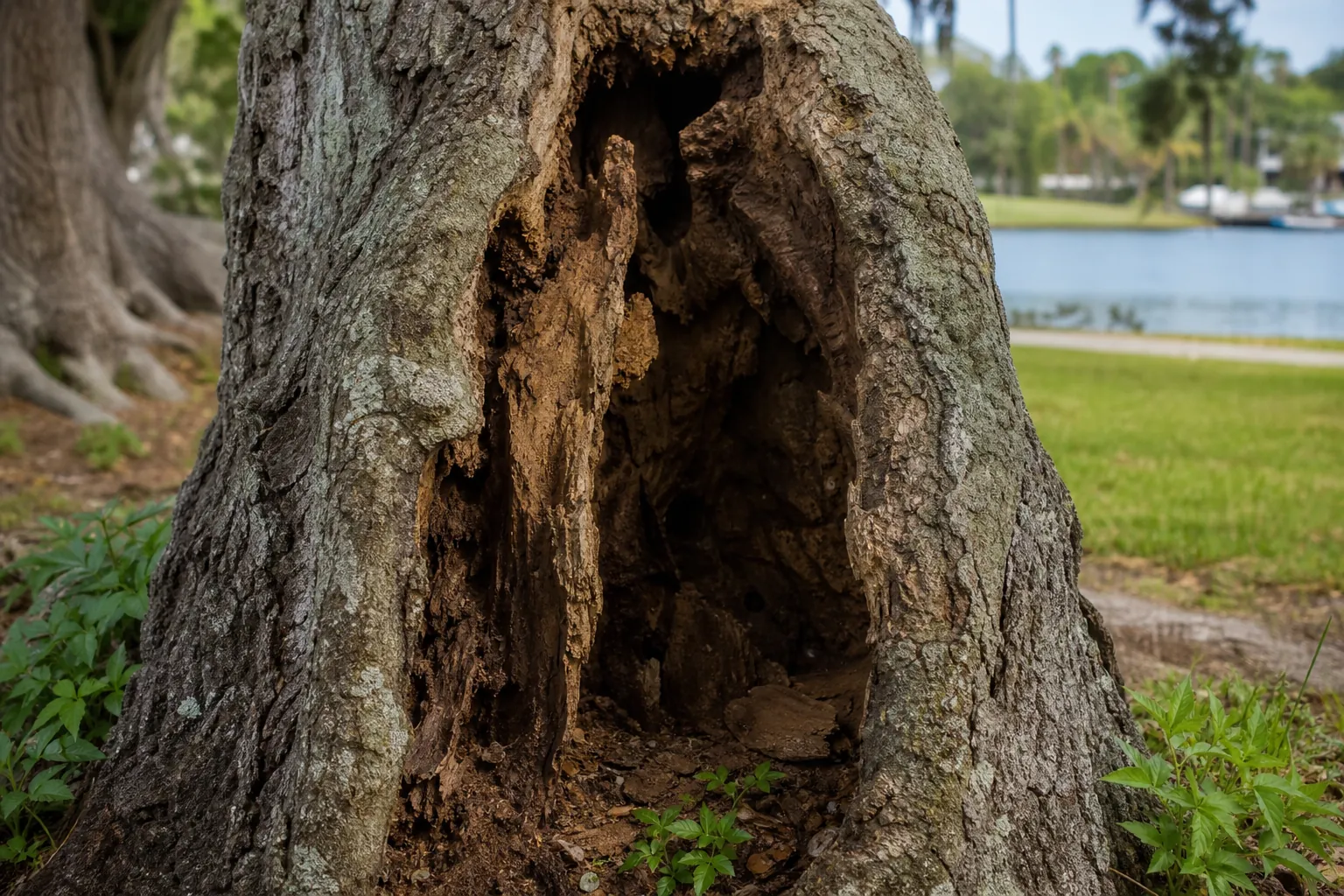
A hollow trunk often develops after an injury allows decay organisms to enter exposed wood. The original injury might involve a broken branch, a damaged trunk, an old pruning wound, or damage near the base. Over time, portions of the interior wood can decay while the outer living tissues continue supporting leaves and new growth.
This is why a tree can look green and vigorous while containing a substantial cavity. Foliage provides information about the tree's condition, but it does not prove the trunk is structurally sound. Conversely, a hollow opening does not reveal the full extent or location of internal decay.
Trees may form boundaries that slow the spread of decay. How effectively this happens varies with the species, the injury, and the tree's condition. The important question is not simply whether a hollow exists, but how the remaining wood, roots, branches, and trunk work together.
A cavity low on the trunk raises different concerns from an opening at a branch attachment. Decay extending toward the roots may affect stability, while decay at a large limb junction may affect that limb's connection. An inspection considers these distinctions rather than treating every hollow as the same problem.
Why the location matters in Ormond Beach
In Ormond Beach, a tree's exposure to wind and heavy rain belongs in the assessment. Coastal conditions, tropical weather, and saturated soil can place additional demands on trees. These factors do not establish that a particular hollow tree will fail, but they help explain why its setting matters.
A tree surrounded by other trees may experience wind differently from one standing alone beside an open parking area. Nearby construction or removal of neighboring trees can also change exposure. A tree that has stood for years without a visible problem may now face different loading conditions.
The area beneath and around the tree is equally important. A hollow tree over an unused corner of a large lot presents a different situation from a similar tree beside a bedroom, sidewalk, or shared condominium entrance. Risk assessment considers both the tree's condition and what could be affected if a part fails.
Property owners should also mention recent changes, including flooding, excavation, driveway work, or new structures. Root damage is not always obvious at the surface, and a trunk inspection should not overlook changes around the root zone.
Warning signs you can observe without approaching the tree
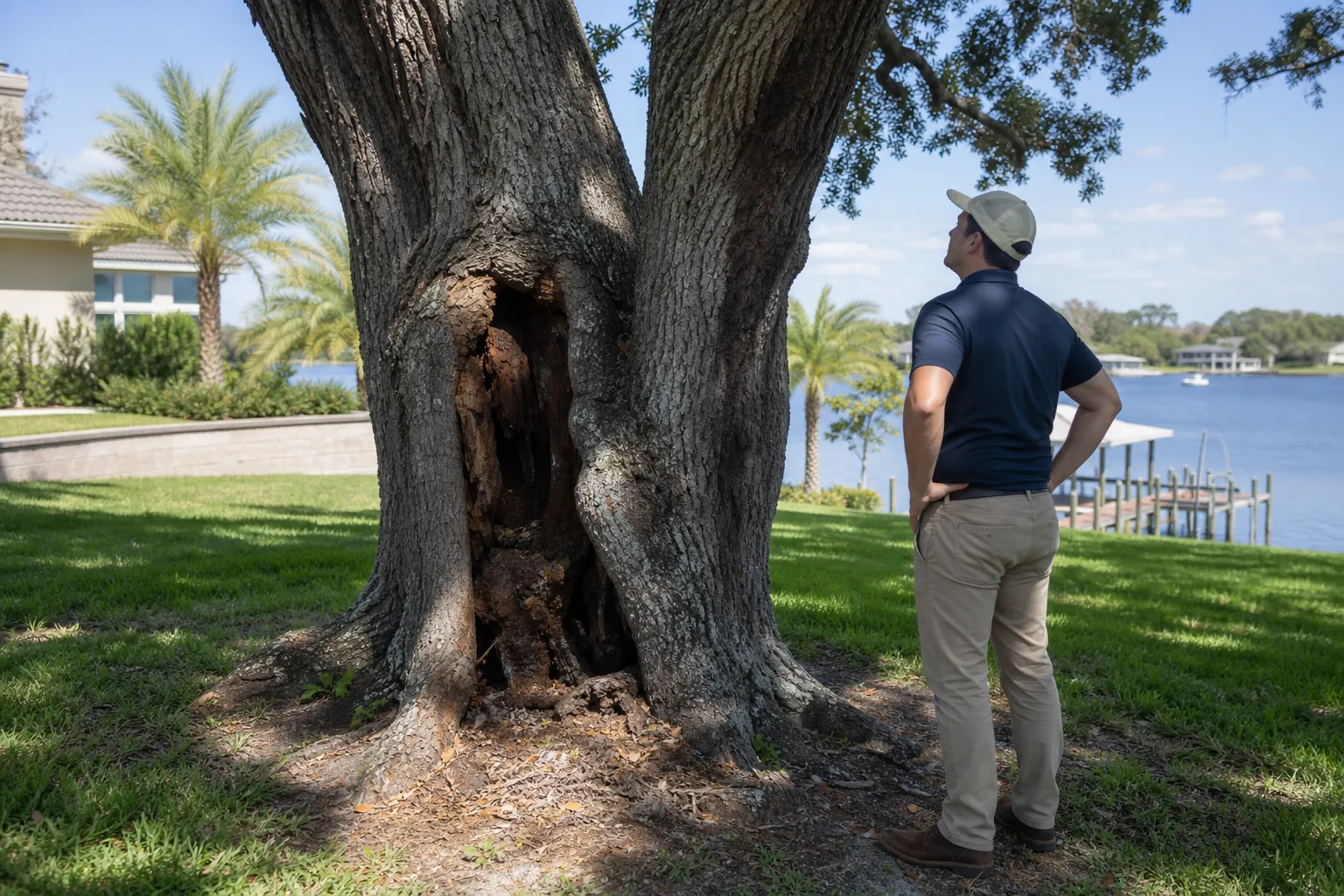
You do not need to test the hollow yourself. Begin by observing from a location outside the area where the tree or a large limb could fall. Photographs can help document a concern, but avoid moving closer just to obtain a better image.
- Look for a fresh crack in the trunk or at a major branch junction, especially if it appears to be opening or extending.
- Notice whether the tree has developed a new lean or whether soil is lifting, cracking, or separating around its base.
- Check for hanging branches, recently broken limbs, or large dead branches above occupied areas.
- Observe whether the cavity sits beside a split, an old wound, or a large branch attachment.
- Note mushrooms or other fungal growth on the trunk or near the base, without assuming that their appearance identifies the amount of decay.
- Watch for a sudden change in canopy condition, such as extensive dieback or an unusual loss of leaves.
None of these observations should become a do-it-yourself diagnosis. Some defects are more significant than they first appear, while others need context before a recommendation makes sense. A fresh structural change generally deserves more immediate attention than a long-standing opening with no other visible changes.
If the tree is actively shifting, shedding large pieces, or threatening an occupied area, keep people and pets away. Contact Florida Foliage about emergency and hurricane tree removal needs. If there is an immediate threat to life, contact emergency responders rather than entering the hazard area.
What a hollow-trunk tree inspection should consider
A useful inspection examines the tree as a connected structure. The opening matters, but so do the trunk above and below it, the major branches, the root flare, and the surrounding ground. Looking only inside the cavity can miss the features that determine the practical level of concern.
The inspector should consider the size and position of the opening, visible decay, cracks, and the distribution of remaining wood. A narrow opening can conceal a larger internal cavity. A broad opening may expose more of the interior, but its appearance still does not provide a complete measurement of strength.
Branch arrangement also matters. Long, heavy limbs and uneven canopy distribution can affect loading on a weakened trunk. Multiple stems with compromised attachments may introduce concerns separate from the hollow itself. An inspection should identify whether the trunk defect is the main issue or one of several interacting defects.
At ground level, visible roots, soil movement, buried trunk tissue, and signs of disturbance can provide context. Access limitations should be noted as well. Dense vegetation, structures, or inaccessible portions of the trunk may prevent a complete view.
Some trees warrant additional evaluation beyond a basic visual inspection. Ask what the initial assessment can establish, what remains uncertain, and whether further examination would meaningfully change the recommendation. Do not assume that any inspection can predict the exact time or conditions under which a tree might fail.
Information to gather before the inspection
A short history can make the visit more productive. You do not need a technical description. Explain when you first noticed the opening, whether it has changed, and which nearby areas are regularly occupied.
- Share older photographs if they show the trunk, canopy, or ground before the current concern appeared.
- Mention previous storm damage, large branch failures, or noticeable changes in the tree's lean.
- Describe recent digging, paving, construction, or removal of nearby trees.
- Identify nearby buildings, fences, vehicles, walkways, and outdoor seating areas.
- Explain access constraints, such as narrow gates, shared drives, or limited equipment space.
- Tell the inspector if the tree may stand on a property boundary or serve a shared community area.
Clear information is more useful than an estimate of how hollow the tree feels. Avoid inserting tools, climbing into the opening, or breaking away wood to investigate. Those actions can injure you and may damage remaining tissues.
If ownership is uncertain, clarify it before authorizing work. For shared properties, identify who can approve inspection recommendations and any later tree work. HOA and condo tree services often involve coordinating these decisions across managers, boards, and residents.
When keeping the tree may be reasonable
Some hollow trees can remain in place with an appropriate management plan. That decision depends on the defect, the remaining structure, the tree's surroundings, and the owner's ability to follow the recommendations. Keeping a tree should be an informed choice, not a conclusion based only on its green canopy.
Tree trimming may be appropriate when specific dead, damaged, or poorly positioned branches contribute to the concern. Crown reduction may sometimes reduce loading by shortening selected branches while preserving a suitable structure. Neither approach repairs decayed wood or automatically makes a hollow trunk acceptable.
Canopy thinning has a different purpose from crown reduction and should not be treated as a universal response to trunk decay. Removing interior branches indiscriminately can change load distribution and leave poorly supported branch ends. Ask why a particular pruning approach fits this tree.
Management may also involve limiting use of an area beneath the tree, moving portable seating, or changing where vehicles park. These steps can reduce exposure, but they do not strengthen the trunk. Their usefulness depends on whether the affected area can realistically remain unoccupied.
If retention is recommended, ask when the tree should be reassessed and which changes should prompt an earlier visit. A monitoring plan should describe observable concerns rather than relying on a vague instruction to keep an eye on it.
When tree removal may be the more practical option
Tree removal may be recommended when structural defects and the surrounding exposure cannot be managed acceptably. Examples include substantial decay combined with cracking, compromised support near the base, or a weakened tree over an area that cannot reasonably be kept clear.
The recommendation should explain why removal is favored over pruning or continued observation. A hollow opening by itself is not a complete explanation. Understanding the interacting defects and nearby targets helps owners make decisions without unnecessary alarm.
Removal planning must account for access, nearby structures, overhead obstacles, and the condition of the tree. A decayed trunk may limit how workers can safely approach or dismantle it. Property owners should not attempt to cut a hollow tree simply because the cavity appears easy to reach.
Crane tree removal may be considered when the site and tree condition make it appropriate. It is not required for every hollow tree, and feasibility depends on equipment access, setup space, and the work plan. Ask how the proposed approach addresses both the weakened structure and the surrounding property.
If removal is selected, discuss stump grinding separately. Removing the trunk and grinding the stump are different tasks, and the intended future use of the area helps determine what should be included.
What not to do with a hollow trunk
A cavity can invite improvised repairs, but filling or covering it does not restore the original wood structure. Concrete, foam, or other fillers can obscure the opening and complicate future evaluation. Do not pack the hollow with material as a substitute for an inspection.
Likewise, scraping out decayed wood is not a reliable way to improve stability. Removing material can damage the tree's protective boundaries or expose additional tissue. The cavity should be evaluated before anyone alters it.
- Do not drill holes into the trunk to investigate the hollow yourself.
- Do not attach ropes or pull on the tree to test its strength.
- Do not remove large limbs in an attempt to balance the tree without a specific assessment.
- Do not assume that a tree is sound because it survived the last hurricane.
- Do not allow children or pets to explore the cavity or play beneath suspect branches.
Avoid topping the tree as a shortcut. Severe cutting can create large wounds and poorly attached new growth without resolving the trunk defect. Any pruning recommendation should have a clear purpose and account for the tree's existing condition.
Using an arborist report for property decisions
An arborist report can help organize findings when several people need to understand the situation. It may be useful for a homeowner planning work, a commercial property manager documenting a concern, or an HOA reviewing options for a tree near shared facilities.
Ask the report to distinguish observations from conclusions. It should make clear which defects were visible, what areas could not be evaluated, and how the tree's location influenced the recommendation. Photographs and a clear description of the tree's position can help prevent confusion when a property contains multiple trees.
Useful recommendations identify the proposed action and its purpose. If the recommendation is tree trimming, ask which concerns the work addresses. If it is removal, ask why retention is not favored. If monitoring is appropriate, request a reassessment interval and reasons to schedule an earlier review.
Before authorizing tree work, confirm any applicable requirements with your city or county. Requirements can vary by property, tree, and location. Also check relevant community approval processes when the tree is on HOA or condominium property.
Arrange a practical next step with Florida Foliage
You do not have to decide whether a hollow tree should stay or go from a photograph or a glance into the trunk. Start with an inspection that considers the defect, the whole tree, and the people or property around it.
Florida Foliage offers arborist reports and tree inspections, along with tree trimming, crown reduction, canopy thinning, and tree removal. Commercial tree services and HOA and condo tree services can help address trees in shared or frequently used spaces.
To discuss a hollow trunk in Ormond Beach, call Florida Foliage at (386) 481-7913. Describe what you have noticed and whether anything changed recently. Until the tree is evaluated, avoid disturbing the cavity and keep clear of any area affected by fresh cracks, hanging limbs, or visible movement.
Call (386) 481-7913 to talk through next steps.