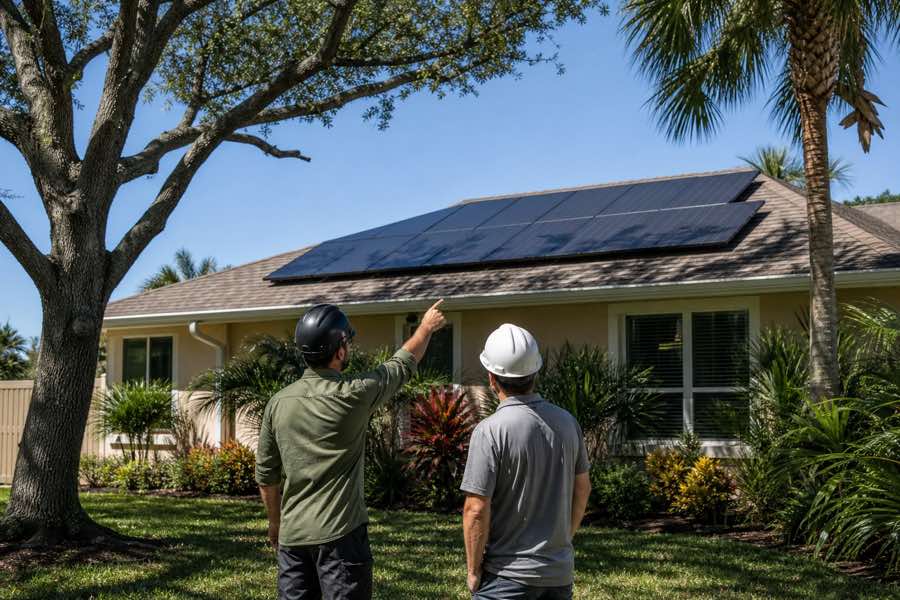
When you compare tree pruning contractors for solar-panel clearance, the real question is more than where branches touch the roof. It is how shade, roof edges, regrowth, and pruning limits all fit together. For Florida Foliage customers in Palm Coast and across Flagler and Volusia counties, that means separating solar-production concerns from arboricultural decisions before any cut is made.
Florida Foliage serves Volusia and Flagler counties, with Daytona Beach as the primary market. The company has ISA Certified Arborists on staff, is licensed and insured, and offers free estimates. If you are sorting out a roofline conflict near panels, call (386) 481-7913 or review the tree pruning service and Palm Coast tree service pages for scope details.
Scope Snapshot
- Solar providers map shade and panel output concerns.
- Tree pruning contractors decide what can be removed.
- Clearance work should respect branch structure and regrowth.
- Topping is not a substitute for selective pruning.
- Final scope depends on roof access, species, and conflicts.
How Does Shade Affect Solar Panels?
Shade affects solar panels by reducing output, but tree pruning contractors should treat that as a site-specific question, not a blanket removal order. A solar provider can identify the shaded hours, roof sections, and panel rows involved, while arborists decide how much pruning is appropriate without overcutting the tree.
That split matters in coastal Florida, where long sun angles, storm growth, and salt-stressed trees can change how shade appears across the day. A cut that helps in winter may not solve summer shading, and one hard pruning can create a bigger regrowth problem later.
For selective pruning principles, UF/IFAS explains that cuts should be placed with structure and branch size in mind, not as random shortening. See UF/IFAS pruning guidance for the basic idea behind proper pruning cuts.
For solar projects, ask for shade observations, panel locations, and the exact branches causing conflict. Then let Florida Foliage or another qualified crew turn that into a pruning scope. If you need help sorting the work, start with Daytona Beach service coverage or call (386) 481-7913.
How Close Is Too Close for a Tree Near a House?
Tree pruning contractors consider a tree too close to a house when branches contact roofing, gutters, siding, or utility attachments, or when growth leaves no room for routine maintenance. Distance alone does not decide the issue. Species, canopy spread, lean, and wind exposure matter as much as the foot gap.
In Palm Coast, sandy soil and coastal wind can push shallow-rooted trees to grow unevenly, which changes how branches reach a roof over time. A tree can be several feet away from a wall and still create conflict over the eaves, fascia, and solar edge lines. That is why roof boundaries matter in the estimate.
A careful inspector should note which branches are actually in conflict and which are only near the structure. That distinction helps avoid overpruning. If you are comparing tree trimming to removal or structural pruning, Florida Foliage can outline the options during a free estimate.
Do not assume that touching a house means the tree must come down. It may need selective clearance, crown reduction, or a different maintenance cycle. A qualified ISA Certified Arborist can explain the difference and help keep the scope tied to real contact points rather than guesswork.
What Affects the Cost of Pruning Near a Roof?
Tree pruning contractors base the cost of pruning near a roof on access, canopy size, hazard level, debris handling, and how precise the cuts must be. A low roof with easy ground access is different from a steep, tile, or multi-story setup that requires more labor and protection.
Exact branch conflicts also shape the scope. If only a few limbs interfere with panels, the work may stay narrow. If the canopy is dense, tangled, or reaching utility space, more time and coordination are needed. The type of tree matters too, because some species respond better to selective cuts than others.
Here is a simple comparison that can help you read quotes:
| Scope factor | What it changes | What to ask |
|---|---|---|
| Roof access | Setup, protection, and cleanup effort | How will crews reach the conflict area? |
| Branch count | How many cuts are needed | Which limbs are in direct conflict? |
| Debris removal | Haul-away and site cleanup scope | Is debris removal included? |
| Regrowth risk | How soon follow-up work may be needed | What regrowth should I expect? |
Ask tree pruning contractors to separate pruning labor from questions about solar output. A solar provider can tell you which panel rows are shaded. The tree crew decides what can be removed without forcing a poor cut. That keeps the estimate honest and easier to compare.
Florida Foliage can review roof boundaries, panel conflicts, and cleanup expectations during a free estimate. For Palm Coast properties, use (386) 481-7913 to start that conversation.
Which Month Is Best for Tree Pruning?
Tree pruning contractors usually choose the month based on tree species, flowering cycle, storm risk, and the reason for the work. For solar clearance, the best time is often when the conflict is easiest to see and the tree can be pruned with the least stress, not simply when the calendar says so.
In coastal Florida, timing also has to account for hurricane season, active growth, and heat. A tree pruned too heavily before peak growth may rebound fast. A tree pruned at the wrong time for its species can lose flowers or react with dense shoots that block panels again.
That is why a solar problem should be separated from the pruning decision. The solar provider can document shade patterns, while the arborist decides when and how much to remove. If the property has recurring storm cleanup needs, Florida Foliage can discuss a seasonal plan during a free estimate.
For biology-based pruning timing and cut placement, UF/IFAS also notes that pruning should support tree health rather than create avoidable stress. See the UF/IFAS do-not-top guidance for why shape matters when canopy reduction is being discussed.
Who Should Perform Professional Tree Pruning?
Tree pruning contractors with arboricultural training should perform professional pruning when the tree is near a roof, solar array, or utility path. A homeowner can identify the shade problem, but the person making cuts must understand branch collar placement, species response, and the risks of overthinning or topping.
For solar projects, the right crew is often a two-contractor scope. The solar provider identifies the shade concern and notes which panels matter. The tree crew then reviews the roof boundaries and exact branch conflicts, and writes a pruning plan that stays within tree-safe limits. That is the cleaner way to compare bids.
Florida Foliage has ISA Certified Arborists on staff, which helps when a property owner needs a pruning scope that is tied to the tree, more than the panels. If you need a ISA Certified Arborist to review the site, call (386) 481-7913 and ask for a free estimate.
Professional crews should also handle debris removal unless the quote says otherwise. That keeps roof cleanup, haul-away, and site access in one plan. For many Palm Coast homes, that matters as much as the cut itself because sandy ground, mulch beds, and pool cages can complicate cleanup.
How Does the One-Two-Three Rule Guide Pruning?
Tree pruning contractors use the one-two-three rule as a simple way to think about how much canopy to remove without overdoing it. The idea is to identify one main issue, two or three branches causing the problem, and the least amount of pruning needed to fix the conflict safely.
That rule helps with solar clearance because it keeps the scope focused. If only a few limbs shade the array, the answer may be selective pruning, not broad canopy reduction. It also leaves room for regrowth, which is important in Florida where many species push new shoots quickly after cuts.
It is also a reminder that topping is the wrong shortcut. The University of Florida warns against topping because it creates weak, poorly attached sprouts and can make future management harder. See UF/IFAS on why not to top for that limited point. A better plan is selective pruning that keeps structure intact.
If a contractor cannot explain which branches are being removed and why, that is a warning sign. Ask for a written scope that lists branch conflicts, pruning limits, and expected regrowth. Florida Foliage can provide that level of clarity during a Palm Coast estimate or by phone at (386) 481-7913.
How Do You Choose Tree Pruning Contractors?
Tree pruning contractors should be chosen for scope clarity, more than for availability. The best quote explains who inspected the shade, which roof boundaries were considered, what exact branches conflict with the panels, how much pruning is acceptable, and whether debris removal is included.
Use this checklist when comparing proposals:
- Confirm solar shade observations are documented.
- Ask which branches conflict with roof boundaries.
- Request pruning limits and regrowth expectations.
- Verify debris removal and cleanup details.
- Check licensing, insurance, and arborist oversight.
That checklist keeps solar questions and arboricultural decisions separate. The solar provider should identify production concerns. The tree crew should decide the cuts. If a quote blurs those roles, it is harder to know what you are buying, and harder to avoid overpruning.
Florida Foliage serves Volusia and Flagler counties, with Daytona Beach as the primary market, and that local range matters for access, storm patterns, and coastal growth. Whether the property is in Palm Coast or closer to the beach corridor, a free estimate can help define the real scope before work begins. For a direct conversation, call (386) 481-7913.
Also ask what the contractor does not promise. No one should promise permanent sunlight from a one-time pruning visit. Trees grow, seasons shift, and panels can be shaded again. A realistic scope explains the likely maintenance cycle instead of selling a permanent fix.
Florida Foliage can review the site, confirm pruning limits, and explain whether the project fits a tree pruning service or a broader tree trimming plan. That is especially useful when the issue sits near a roofline, pool cage, or tight side yard where debris removal and access need planning.
Who should identify the solar shade concern?
The solar provider should identify the shade concern by showing which panels lose output, at what times, and from which roof areas. Tree pruning contractors then use that information to decide what branch conflicts can be addressed without overcutting. This keeps production questions separate from pruning decisions and helps avoid unclear or oversized work scopes.
Can pruning guarantee permanent solar clearance?
No pruning can guarantee permanent solar clearance because trees keep growing and light angles change through the seasons. Tree pruning contractors can reduce current conflicts and improve exposure, but they should not promise a lasting fix from one visit. A realistic plan includes expected regrowth and possible follow-up maintenance.
Should the tree or solar contractor work first?
Usually the solar contractor should document the shade issue first, then tree pruning contractors should evaluate the exact branch conflicts. That sequence helps the pruning crew work from real panel data rather than guesses. It also keeps the arboricultural scope tied to roof boundaries, clearance limits, debris removal, and future growth.
Can branches be topped for panel sunlight?
Topping should not be used as a shortcut for panel sunlight. The UF/IFAS guidance on topping explains that it creates weak regrowth and poor structure, which can make future shade and maintenance worse. Tree pruning contractors should use selective pruning instead, with cuts that respect the tree’s form and long-term health.
How early should I request a pruning estimate?
Request a pruning estimate as soon as you notice recurring shade, roof contact, or panel loss during key sun hours. Early review gives tree pruning contractors time to inspect access, canopy structure, and cleanup needs before the work becomes urgent. It also helps compare options before storm season or heavy growth changes the scope.
If you are comparing tree pruning contractors for solar-panel clearance in Palm Coast, Florida Foliage can help you sort the shade report, roof boundaries, pruning limits, and debris removal into one clear scope. Use the free estimate page or call (386) 481-7913 to get started.