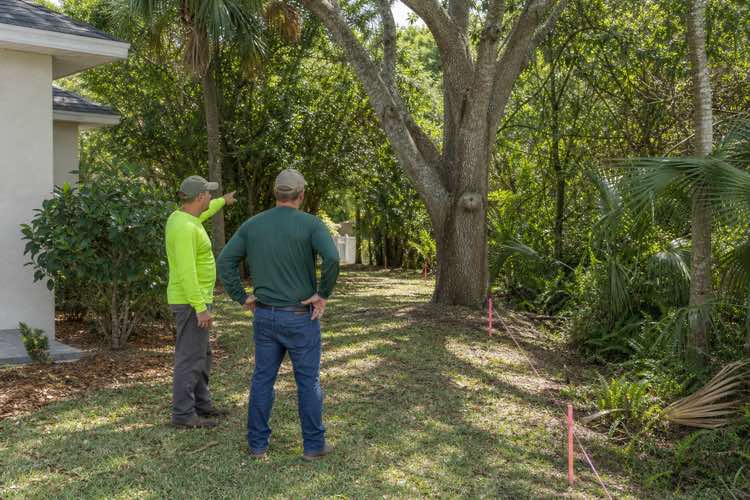
When fence plans and tree work overlap, tree removal contractors should be brought in early so the site is cleared without guessing at boundaries, post holes, or access. In Port Orange, sandy soil, tight side yards, storm cleanup, and utility locations can change the job plan. Florida Foliage helps property owners sort the removal side before the fence installer starts.
- Set the fence line before cutting starts.
- Keep tree removal separate from boundary decisions.
- Confirm stump depth near future posts.
- Plan access and debris hauling in advance.
- Hand off a clean, graded site.
The best sequence usually starts with a survey or clear owner-marked limits, then moves to tree removal, stump work, and final handoff. That order keeps tree removal contractors focused on trees, roots, and cleanup, while the fence crew handles layout, posts, and fencing. It also reduces friction when retained trees sit near the future line.
How Far Should a Tree Be From a Fence?
Tree removal contractors should measure the gap from tree to fence by the actual project plan, not by guesswork. A tree can be close enough to affect posts, roots, and grading even if the trunk itself seems clear. The fence line, not the trunk alone, determines whether removal or pruning is needed.
That distance matters more in Volusia County yards where property edges, gates, and service access may be tight. Roots can spread well beyond the canopy, and a future fence can cross that zone. Florida Foliage can review the layout before work starts, and a Port Orange tree service visit can help identify where the removal scope ends and the fence scope begins.
When a tree stands near the proposed line, ask both contractors to work from the same reference point. A survey, owner-marked limits, or a fence installer’s layout string can help. The goal is simple: tree removal contractors clear only what belongs in their scope, while the fence crew keeps control of post placement and final alignment.
How Should You Prepare for Tree Removal?
You should prepare for tree removal by confirming the boundary, marking retained trees, and clearing access for equipment and debris. Tree removal contractors need to know what stays, what goes, where trucks can enter, and whether the fence installer needs the same route later. Good prep avoids repeated labor and damaged turf.
Before work day, share any survey, plat, or owner-marked fence line with both contractors. If the site is narrow, note gates, sheds, irrigation heads, and low utility lines. Florida Foliage often recommends a written scope so the tree side and fence side stay separate. For larger specimens, use the large tree removal page to discuss access and staging needs before the bid is finalized.
- Mark the fence line before removal starts.
- Identify trees that must remain untouched.
- Clear gate widths for crews and hauling.
- Note utilities, irrigation, and underground concerns.
- Share stump and grading needs in writing.
If the trees are close to structures, homeowners should avoid assuming every contractor can cover every task. Tree removal contractors may handle cutting and cleanup, but the fence installer may still need separate layout decisions. Florida Foliage provides free estimates, and you can request a free estimate when you want the tree scope reviewed first. For direct contact, call (386) 481-7913.
How Is a Tree Removed After Growing Into a Fence?
Tree removal contractors remove a tree grown into a fence by planning the fence release, the cut sequence, and the cleanup order before any wood comes down. The fence may need to be detached in sections, but that decision belongs to the fence scope, not to the tree crew alone. Safety and access come first.
In coastal Florida, the situation can be complicated by lean, salt exposure, soft soil, and storm wear. If branches or stems have pressed into panels or posts, the tree may hold the fence in place until the fence installer removes certain pieces. Florida Foliage works from the tree side of the job, while the fence contractor handles the layout and reconstruction side. OSHA’s tree care guidance notes that tree removal work is a specialized operation with serious hazards, which is why trained crews should manage it: OSHA tree-care guidance.
Tree removal contractors should also protect retained trees that share the same line. If a living tree will stay, crews may need a narrower rigging plan or a different drop zone so the fence crew can later rebuild without extra damage. That is one reason Florida Foliage asks for the planned fence route before estimating the removal side.
| Project Point | Tree Removal Scope | Fence Installer Scope |
|---|---|---|
| Boundary line | Uses provided line | Confirms final layout |
| Fence sections | Avoids unnecessary removal | Detaches or rebuilds panels |
| Posts | Clears root and stump space | Sets post locations |
| Access | Plans equipment entry | Uses agreed route |
| Final grade | Leaves removal area ready | Finishes fence-side adjustments |
How Do Tree Removal Contractors Clear a Fence Line?
Tree removal contractors clear a fence line by removing the tree, cutting back conflicting limbs, hauling debris, and leaving enough room for the fence installer to work. The job should follow the fence layout, not replace it. Tree removal contractors should not assume they are choosing post locations or boundary limits.
That separation matters when several trees line a yard edge in Daytona Beach or Port Orange. A property owner may want to keep one tree and remove another. The scope should name each tree and each retained trunk so there is no confusion at handoff. Florida Foliage can help define what belongs in the removal bid and what belongs in the fence build. For general service details, see the tree removal service page. Florida Foliage also serves the broader coastal market, including Daytona Beach tree service work.
In some cases, the fence installer may want a cleaner edge than the tree job alone provides. That can mean removing low stubs, hauling brush, or opening a working corridor near the line. Tree removal contractors can prepare that corridor, but they should not pour fence footings, set posts, or assume the fence crew wants the same grade at every point.
Florida Foliage is licensed and insured, and ISA Certified Arborists are on staff. That matters when the line is crowded and the plan needs clear tree knowledge before the fence contract is signed. If you need the tree side reviewed first, call (386) 481-7913 and ask for a site estimate from Florida Foliage.
Can a Property-Line Tree Be Removed Without Agreement?
A property-line tree may not be removable without agreement, because boundary and ownership questions can control who has authority. Tree removal contractors should not decide that issue on their own. If the trunk sits on or near the line, the owner, survey, governing rules, insurer, or legal professional may need to confirm who can authorize removal.
Tree removal contractors can still provide a scope review, but they should not be asked to settle boundary rights. In Florida, the owner of the land, the fence layout, and the survey line may each point to different work boundaries. University of Florida IFAS notes that tree care decisions are often helped by proper arborist involvement and planning, especially when ownership or tree health affects the work: UF IFAS guidance on hiring an arborist.
Florida Foliage recommends that owners bring the survey, plat, or written line marking to the estimate. That keeps the tree side clear and helps the fence installer avoid post placement disputes later. It also protects retained trees that may share roots or overhead space with the tree being removed.
How Is a Stump Removed Next to a Fence?
Tree removal contractors remove a stump next to a fence by planning the grind depth, access path, and nearby protection before equipment arrives. The stump needs to come out far enough for the fence crew to build without root interference, but the work should stay inside the agreed removal scope. The fence installer decides post depth, not the stump crew.
In sandy Port Orange soil, stump grinding can go deeper or shallower depending on the next trade’s needs, irrigation lines, and nearby structures. Tree removal contractors should ask where the posts will go, because stump depth and post locations can conflict. If a fence post must sit near the former trunk, the stump work should be coordinated before the fence contractor drills or digs.
Final grading is another point to settle early. A fence can look uneven if stump chips are left too high or if the area is not shaped for the fence crew’s work. Florida Foliage can leave the site ready for the next contractor, but the exact grade target should be agreed in advance with the owner and fence installer.
What Should You Look for in a Tree Removal Service?
You should look for a tree removal service that understands fence coordination, boundary limits, and cleanup handoff. Tree removal contractors should be able to explain what they will remove, what they will leave, how they will protect access, and what the site will look like when they finish. A clear scope matters more than a rushed promise.
Ask whether the company uses ISA Certified Arborists, carries proper licensing and insurance, and provides free estimates. Florida Foliage serves Volusia and Flagler counties, with Daytona Beach as the primary market, and the team can review tree work before the fence contractor starts. The company can also help when access is tight or the yard needs more than a basic cut.
When comparing bids, check for language about debris removal, stump depth, retained trees, and the handoff to the fence installer. Those details keep tree removal contractors from guessing at work outside their role. If the quote does not mention boundary limits, ask for clarification before the job begins.
For a fence project, the best tree bid is the one that defines the tree side well and leaves the fence side untouched. That is the cleanest way to keep schedules aligned and avoid scope gaps. Florida Foliage can review the tree portion, answer questions about access or stump work, and provide a written estimate. Call (386) 481-7913 to discuss the plan, or start with a request a free estimate through Florida Foliage.
Who should mark the planned fence line?
The fence line should be marked by the surveyor, owner, or fence installer, depending on the project documents and local requirements. Tree removal contractors should work from that marked line, not choose it themselves. If the line is uncertain, pause the removal scope until the boundary is confirmed so the tree work does not create a fence dispute.
Should stump depth match future post locations?
Stump depth should be planned with future post locations in mind, but the fence installer sets the post needs. Tree removal contractors can grind deeper where a post or footing will go, as long as the layout is known first. Share the planned fence line early so the stump work does not interfere with digging or drilling later.
Can the fence crew use the tree-service access route?
Yes, if both contractors agree on the route and the ground condition still supports fence work. Tree removal contractors may use a driveway, side yard, or gate that the fence crew also needs later. That shared access should be protected, cleaned, and documented so trucks, tools, and materials do not conflict on the next visit.
Who handles final grading after removal?
Final grading should be assigned in writing before work starts. Tree removal contractors can leave the area smooth and ready for the next trade, but the fence installer may need a different grade near posts or gates. If the property has irrigation, drainage, or sandy low spots, the owner should confirm the target finish with both contractors.
How can a Port Orange owner request an estimate?
A Port Orange owner can call Florida Foliage at (386) 481-7913 or use the estimate request page to share photos, the fence plan, and any survey or marked line. This helps tree removal contractors price the tree side accurately and keeps the fence side separate from the start.
For fence-ready clearing in Port Orange, Florida Foliage can coordinate the tree side first so the fence crew has a clean handoff. If you need tree removal contractors for a project that includes a future fence line, start with a request a free estimate or call (386) 481-7913.