Reviewed by Clinton Funk
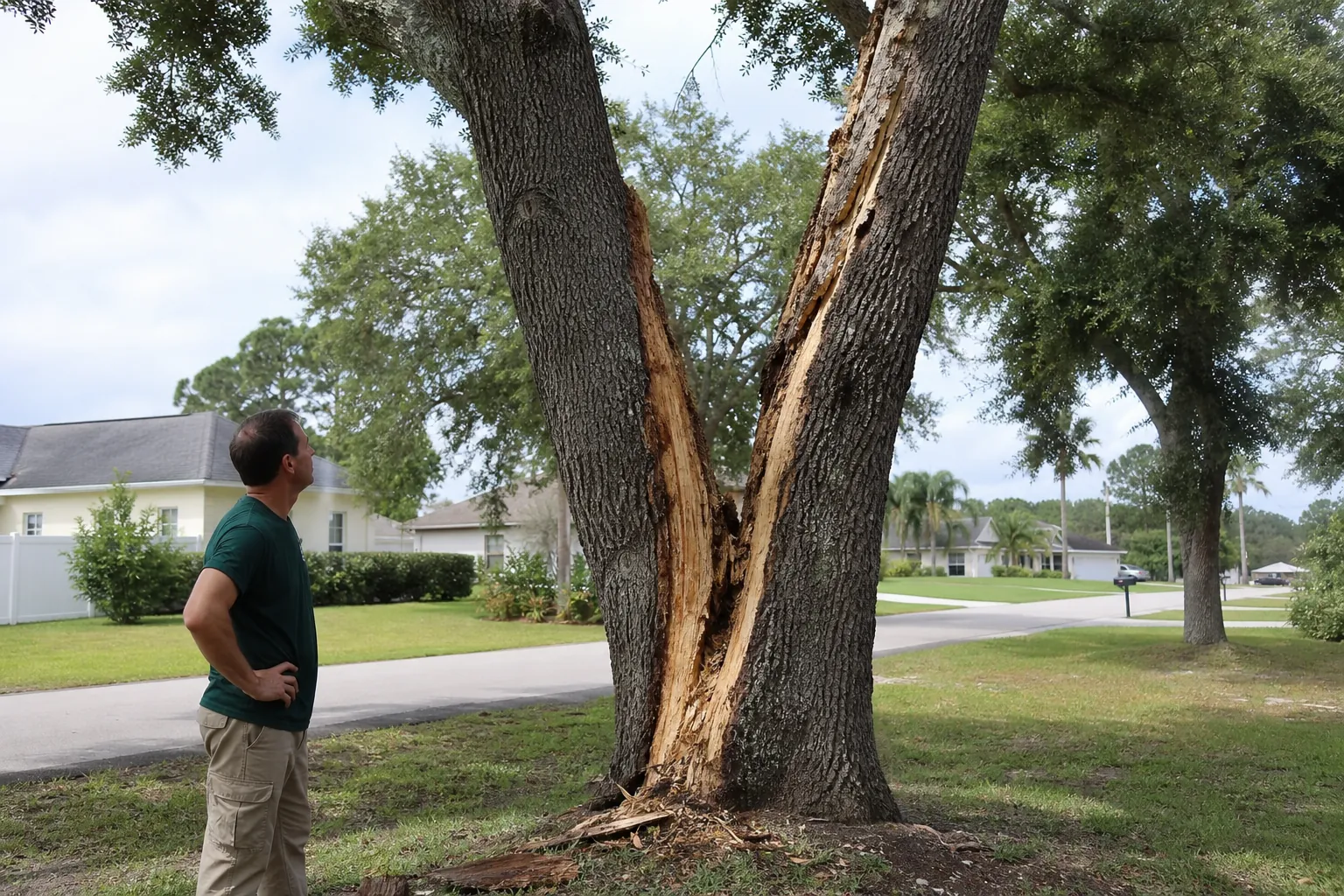
A crack running down a tree trunk can be unsettling, especially when the tree stands beside your house, driveway, or a neighbor's fence. Some cracks affect only outer bark. Others separate major sections of wood and can change how the tree supports its canopy. Knowing the difference requires more than a quick look from the sidewalk.
If you are searching for tree removal split trunk Palm Coast guidance, start with safety rather than a decision to save or remove the tree. Keep people away from the area beneath it, observe from a safe distance, and arrange a professional inspection. Florida Foliage can discuss tree inspections and tree removal needs at (386) 481-7913.
This guide explains what a split trunk can mean, which warning signs deserve prompt attention, and how a removal plan can protect nearby property. It also covers situations where trimming may be considered and why stump grinding is a separate decision.
What a split trunk can tell you about a tree
A split trunk is a separation in the bark, underlying wood, or both. Its significance depends on its depth, location, cause, and relationship to the tree's structure. A narrow surface crack is not automatically evidence of imminent failure, but a shallow-looking opening does not prove the tree is sound.
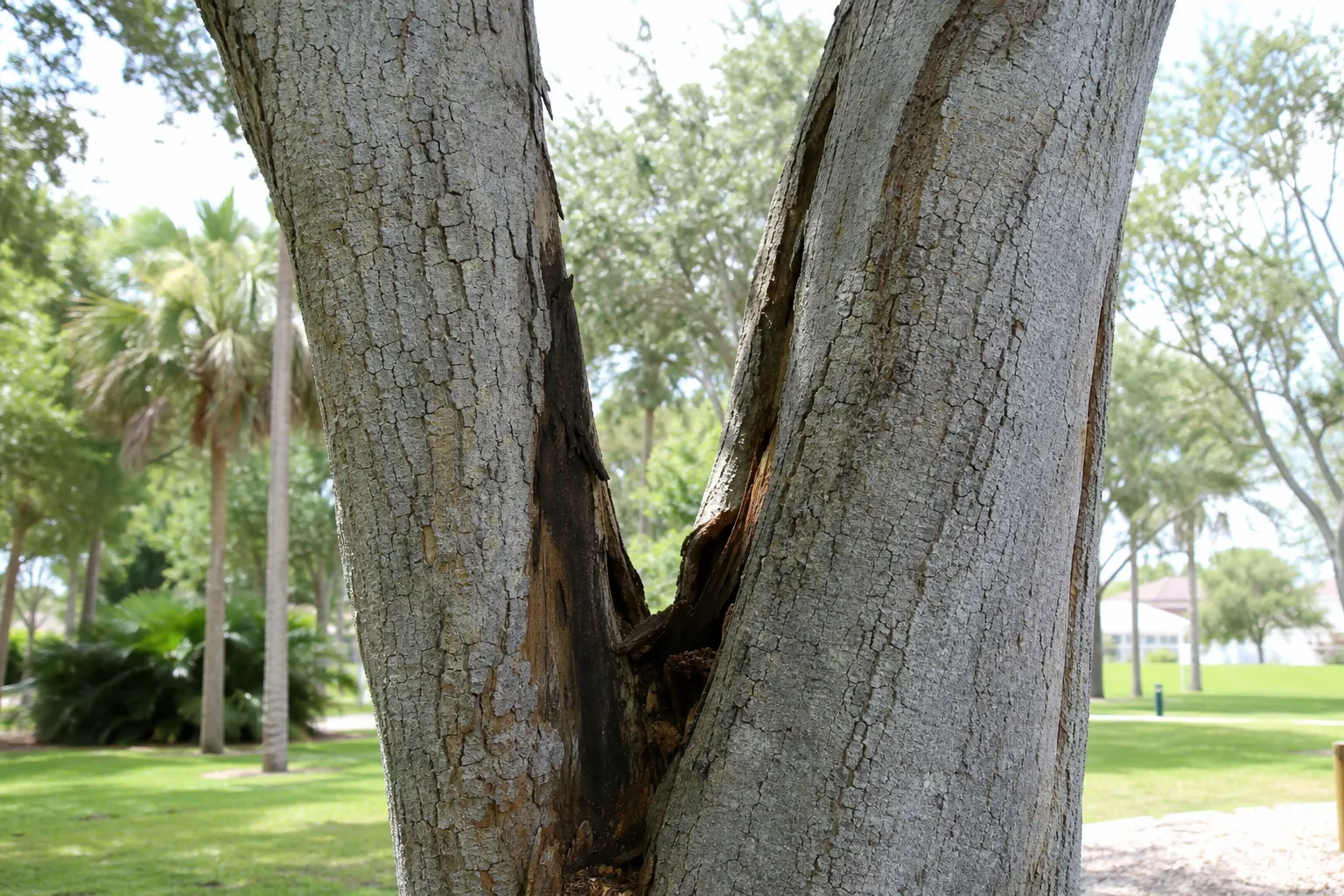
One common problem develops where two large stems grow closely together. Bark can become trapped between them instead of a strong wood connection forming across the union. This is called included bark. As the stems grow and carry more weight, the connection may separate, particularly during strong wind.
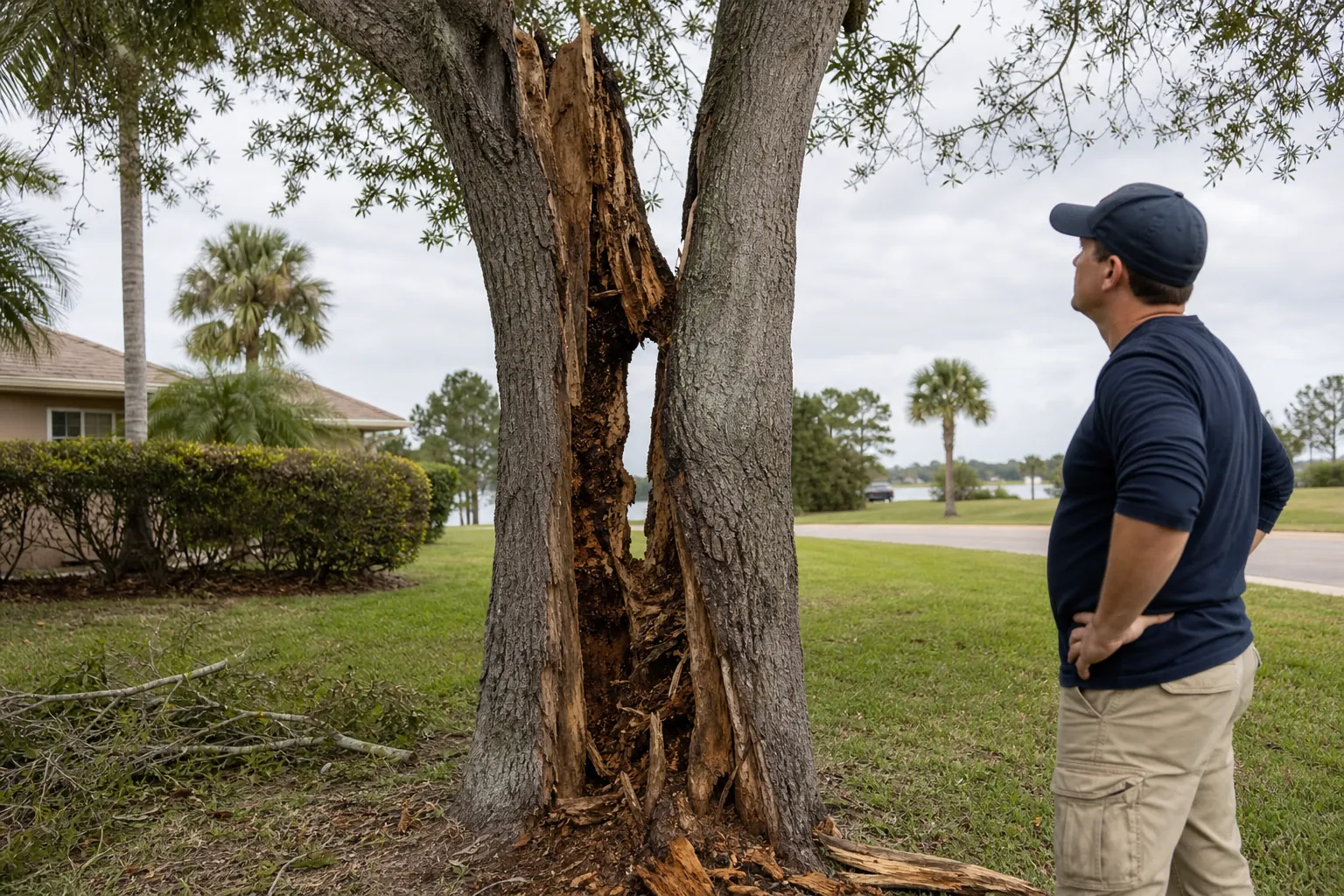
Other cracks may follow storm damage, an impact, or deterioration around an old wound. Decay can reduce the amount of sound wood available to support the trunk. A split may also extend farther internally than its visible opening suggests.
Leaves are not a reliable stability test. A tree can have a green canopy while its main support structure is compromised. Likewise, a tree that has stood through previous storms may have developed a new defect since then.
An inspection considers the whole tree: the trunk, branch unions, canopy, root area, and nearby targets. The question is not simply whether a crack exists. It is whether the tree's remaining structure can reasonably support its load in its particular setting.
Warning signs that call for prompt attention
Some observations make a split trunk more concerning. Look only from a position outside the potential fall area, and do not approach to measure the crack or test whether the stems move. Photographs can help explain the situation, but obtaining them should never require standing beneath damaged wood.
- A newly opened split that exposes fresh wood should receive prompt professional attention, especially after a storm.
- Two main stems separating at their shared union may indicate a compromised connection supporting a substantial canopy.
- A new lean, lifted soil, or visible movement around the root plate can signal a problem beyond the trunk crack itself.
- A broken or hanging branch above the split creates an additional hazard even if the trunk remains standing.
- Repeated cracking sounds or visible movement between trunk sections are reasons to leave the area immediately.
- A split beside a house, occupied patio, sidewalk, or regularly used parking space deserves attention because people or property could be struck.
Do not wait outside to see whether movement stops. Bring children and pets indoors, move activities elsewhere, and avoid parking near the tree if you can do so without entering the hazard area.
If a tree or branch is touching a power line, stay away and contact the utility. Do not touch the tree, nearby equipment, or anything in contact with the line. For an immediate threat to people, contact emergency responders. Tree service planning comes after the immediate danger is addressed.
What to do before a tree professional arrives
Your first job is to reduce exposure, not repair the split. Establish a practical boundary that keeps people out of the possible fall area. A damaged tree may fail in an unexpected direction, so a small circle around the trunk may not provide enough separation.
Avoid tying the stems together, driving screws into the trunk, or wrapping the crack with household materials. Improvised repairs can expose you to falling wood and may create a misleading sense of security without addressing the underlying defect.
Do not cut branches to lighten the tree yourself. Removing a limb changes the load on the trunk and can trigger movement in an already unstable structure. Ladder work, climbing, and chainsaw use are particularly dangerous around split stems.
- Write down when you first noticed the split and whether it appeared or widened after recent weather.
- Describe nearby buildings, fences, vehicles, overhead wires, and spaces that people regularly use.
- Take photographs from a safe location if the trunk and overall canopy are visible without approaching.
- Explain access limitations, including narrow gates, enclosed yards, drainage features, and shared driveways.
- Keep pets secured and let household members know which outdoor areas should remain unused.
If safe access is not possible, a verbal description is enough to begin the conversation. Do not enter a hazardous area simply to provide a better photograph. Tell the tree service if conditions are changing so the urgency can be assessed appropriately.
When removal may be the more appropriate choice
Tree removal may be recommended when a split affects a major load-bearing part of the trunk and the consequences of failure are significant. A deep separation at a large stem union, extensive decay near the split, or associated root movement can limit reasonable options.
The location matters. A tree leaning over a bedroom or busy walkway presents a different situation from a similar tree in an area people rarely enter. An inspection should consider both the likelihood of failure and what could be affected if failure occurs.
Canopy size also matters. Long, heavy limbs can place leverage on a damaged union. Strong gusts can increase those forces. Reducing foliage does not restore separated trunk wood, and an apparently balanced crown may still sit above a weak connection.
A removal recommendation should explain the observed defect and why it changes the tree's management options. Ask which parts of the structure are compromised, whether the split appears active, and whether nearby trees influence access or the work sequence.
There is no universal crack width that determines whether every tree must be removed. Species, wood condition, crack position, trunk shape, and surrounding use all affect the assessment. A photograph alone may not show enough detail for a final recommendation.
If removal is not immediately necessary, ask what conditions should trigger another inspection. New movement, a wider opening, fresh damage, or a change in how the surrounding area is used may warrant reassessment.
Can trimming help a tree with a split trunk?
Tree trimming sometimes forms part of a management plan, but it is not a repair for a structural split. The appropriate approach depends on the defect and the amount of sound structure remaining. Trimming should follow an assessment rather than serve as an experiment.
Crown reduction can shorten selected branches and reduce leverage where the tree's condition supports that approach. Canopy thinning removes selected branches within the crown. These are different objectives, and neither should be treated as an automatic solution for a damaged trunk.
Removing too much live foliage can stress a tree and alter its growth. Indiscriminate cutting or topping may create additional problems without resolving the original weakness. The goal is a considered recommendation, not simply making the tree smaller.
Ask whether the proposed trimming addresses a specific loading concern or only changes appearance. Also ask what residual risk remains afterward. A tree can require removal even when some branches could technically be cut back.
For a tree beside a frequently occupied area, uncertainty about a major split may carry more weight than the desire to retain shade. A practical decision balances the tree's condition, site use, and realistic management choices.
How split-trunk removal is planned around your property
Removing a structurally damaged tree requires planning around the defect itself. A normal climbing or cutting approach may not be suitable when the trunk cannot be relied upon to hold expected loads. The crew must evaluate access, stability, and where tree sections can be controlled.
Depending on the site, removal may involve taking the tree apart in sections rather than lowering it as a whole. Crane tree removal may be considered when a large or compromised tree stands near structures or when access limits other approaches. A crane is not appropriate for every property.
Equipment placement requires attention to ground conditions, access width, nearby structures, and utilities. Palm Coast properties can have tight side yards, landscaping beds, screened enclosures, and neighboring homes close to the work area. These details affect the removal plan.
- Tell the crew about irrigation lines, septic components, drainage systems, and other known underground features.
- Identify gates, fences, outdoor furniture, and parked vehicles that may restrict access or need to be moved safely.
- Discuss where equipment may travel and how lawn or landscape impacts will be managed.
- Ask whether the scope includes removing branches, trunk sections, and other debris produced by the work.
- Confirm whether stump grinding is included or will be handled as a separate service.
Never move objects from beneath the damaged tree unless the area has been determined safe. If access preparation would expose someone to the hazard, tell the crew and let that issue become part of the work plan.
Confirm applicable tree rules with the City of Palm Coast or the appropriate county office before removal. Requirements can vary by location and circumstances. If the property belongs to an HOA or condo community, also check its approval process without assuming that community approval replaces public requirements.
Storm damage and emergency tree removal in Palm Coast
Florida storms can reveal weaknesses that were previously difficult to see. A split may become visible after strong winds pull opposing stems in different directions. Rain can also soften soil, making root movement an important part of the inspection.
After a storm, assess conditions from indoors or another protected location before entering the yard. Look for hanging limbs, leaning trees, damaged neighboring trees, and downed wires. A tree that remains upright may still have unstable sections overhead.
Emergency and hurricane tree removal focuses on urgent hazards, but damaged trees still require a controlled approach. Poor visibility, ongoing wind, saturated ground, and blocked access can affect when and how work proceeds. Do not assume that immediate cutting is the safest response in every situation.
When contacting Florida Foliage, explain whether the tree is standing, partially fallen, or resting on a structure. Mention any visible wires and whether people can safely avoid the area. These details help clarify the situation without asking you to investigate at close range.
Photographs and written notes may be useful for your own records, but safety comes first. Stay clear of the damaged area and follow instructions from emergency responders or utility personnel when they are involved.
Stump grinding and decisions after removal
Once the tree is removed, the remaining stump deserves a separate discussion. Stump grinding reduces the stump below the surface, but it does not remove every root throughout the yard. The depth and extent of grinding should match the intended use of the space.
If you want grass, a planting bed, or a replacement tree, tell the crew before work begins. Grinding produces a mixture of wood material and soil, and the finished area may need additional preparation. Ask what will remain and who will handle any follow-up landscape work.
A new tree should not be selected only to replace the shade you lost. Consider mature height, canopy width, distance from buildings, available rooting space, and overhead clearance. A suitable planting location helps avoid future conflicts between trees and property use.
Removal also creates an opportunity to inspect nearby trees. Trees exposed to the same storm may have broken branches, new leans, or damaged unions that are less obvious than the original split. Tree inspections can help identify which issues need attention and which can be monitored.
Questions to ask before approving the work
A useful conversation should leave you understanding both the tree's condition and the proposed scope. You do not need technical expertise to ask for a clear explanation of the defect, work method, and cleanup expectations.
- Ask what observations support removal rather than trimming or continued monitoring.
- Ask how the split affects the planned cutting sequence and equipment choices.
- Ask which areas must remain clear before, during, and after the work.
- Ask whether nearby structures, landscape features, or access restrictions change the plan.
- Ask what debris removal and stump grinding are included in the agreed scope.
- Ask whether an arborist report would be useful for documenting the assessment.
For commercial properties, HOA communities, and condos, also clarify who authorizes the work and communicates access restrictions. Commercial tree services and HOA and condo tree services may involve shared parking, pedestrian routes, and multiple residents or tenants.
A split trunk does not always mean a tree must come down, but it should not be dismissed because the canopy still looks healthy. Keep a safe distance, seek an inspection, and base the decision on the tree's structure and surroundings.
For tree inspections, tree removal, or emergency and hurricane tree removal in Palm Coast, call Florida Foliage at (386) 481-7913. Describe what you can observe safely, and discuss the next appropriate step without approaching the damaged tree.
Call (386) 481-7913 to talk through next steps.