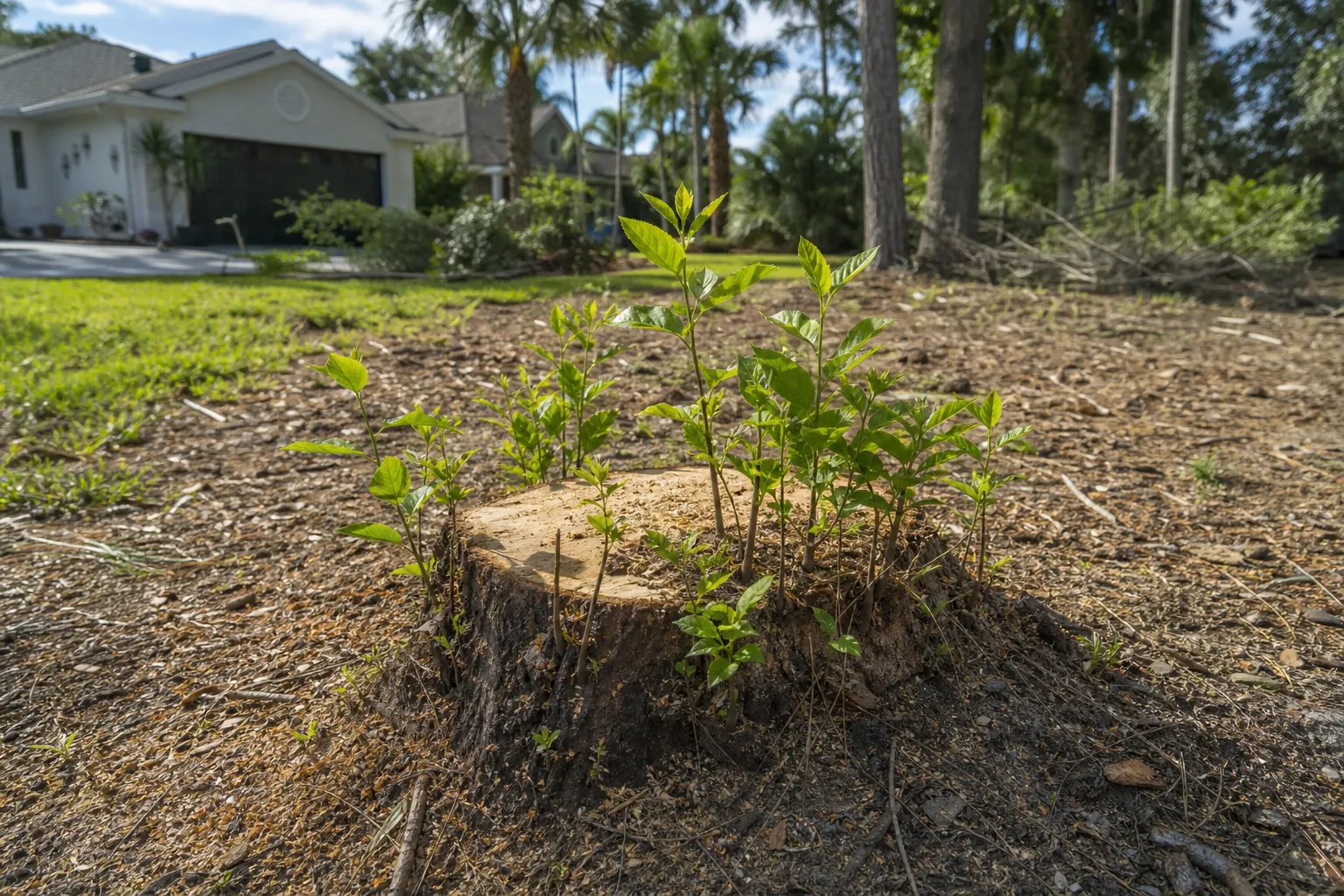
A few weeks after a tree stump is ground down, fresh green shoots can appear where you expected an empty patch of soil. Some grow directly from the old stump area. Others emerge several feet away, following roots that remain underground. This can be surprising, but it does not automatically mean the stump grinding was done incorrectly.
If you are researching tree sprouts after stump grinding in Port Orange, the important distinction is between removing the visible stump and eliminating every living root. Grinding addresses the stump and nearby woody material within the agreed work area. It does not necessarily remove the entire root system. Understanding that difference helps you choose a sensible response without digging up your yard unnecessarily.
Florida Foliage helps property owners evaluate tree concerns through tree inspections and arborist reports, along with tree removal and stump grinding. This guide explains why sprouts develop, how to identify them, and what to consider before taking further action.
Why a ground stump can still produce new growth
Tree roots do more than anchor a trunk. They also store resources that supported the tree before removal. When the trunk and canopy disappear, portions of the root system may remain alive temporarily. In species capable of resprouting, dormant buds on roots or remaining stump tissue can respond by producing new shoots.
A stump grinder reduces wood into chips within the area the machine reaches. Roots extending beyond that area usually stay in place. Some thicker roots may run beneath turf, planting beds, pavement, or neighboring vegetation. Removing all of them would be a different and potentially disruptive undertaking.
Species matters. Some trees readily produce root suckers, while others are less likely to regenerate this way. The tree's condition before removal, remaining root reserves, and the amount of living tissue left behind also influence what happens afterward.
Port Orange's warm growing conditions can make fresh shoots noticeable during active growth. Rainfall and irrigation can support that growth, although neither tells you whether a root system will survive long term. A small cluster of shoots is a reason to monitor the site, not proof that a replacement tree will inevitably develop.
Identify what is growing before choosing a response
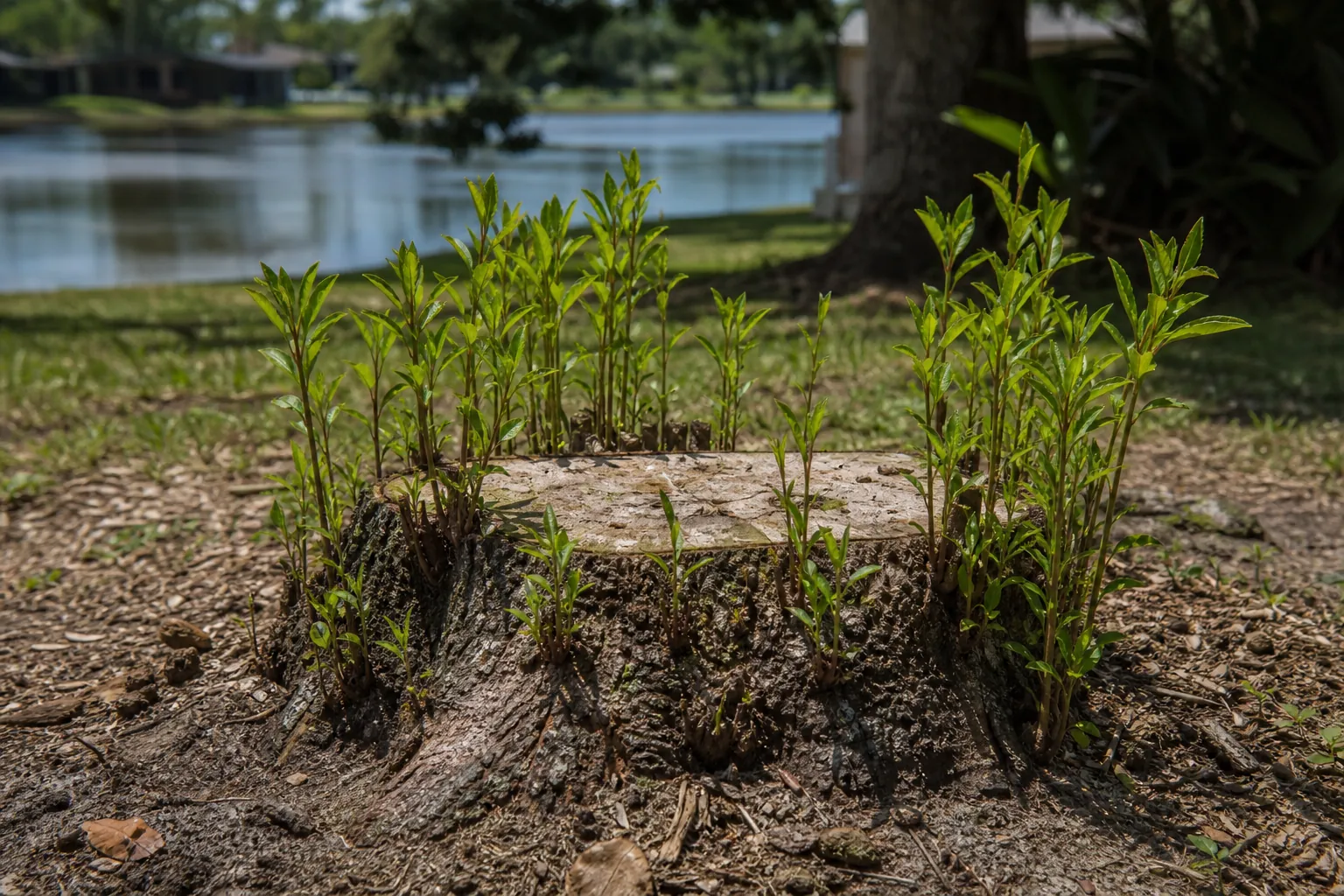
Not every plant appearing in a former stump area is connected to the removed tree. Disturbed soil, additional sunlight, and open space also create opportunities for weeds and volunteer seedlings. Identifying the growth first can prevent unnecessary work.
Compare the new leaves with photos of the original tree, if you have them. Look at leaf shape, arrangement along the stem, and whether shoots appear in a line that could follow an old root. Identification can be difficult when juvenile leaves differ from mature foliage, so treat these clues as preliminary rather than conclusive.
- Stump sprouts often emerge as a tight cluster from remaining woody tissue near the original trunk location.
- Root suckers may appear farther from the stump and can occur in several patches across the yard.
- Seedlings usually establish as separate plants, although you may need a closer inspection to distinguish them from root-connected shoots.
- Unrelated weeds can colonize the disturbed area without having any connection to the removed tree.
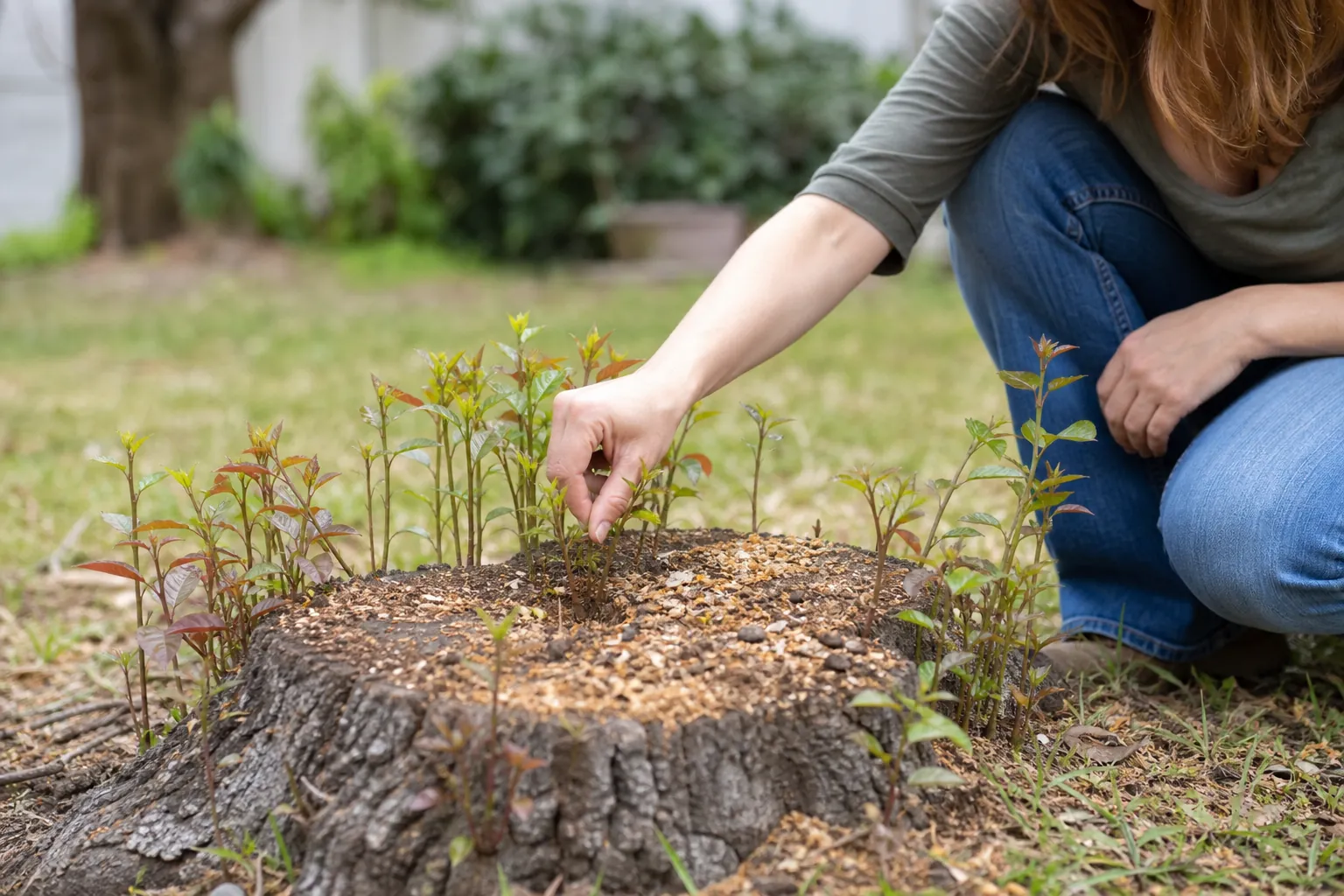
Take clear photos before mowing or cutting everything back. Include close-ups of leaves and a wider view showing the shoots in relation to the stump location. Those photos can help an arborist assess whether you are dealing with residual tree growth or a separate plant problem.
What stump grinding does and does not accomplish
Stump grinding removes the above-ground stump and reduces material below the surface to a specified depth and footprint. That can make the area easier to maintain and prepare for its next use. However, the finished surface may conceal intact roots and small amounts of living wood outside the grinding area.
The appropriate grinding depth depends on site conditions and the intended use. Restoring a lawn, installing a planting bed, and preparing for construction involve different requirements. Underground utilities, irrigation components, access limitations, and adjacent trees can also affect what is practical.
Additional grinding may help when sprouts originate from accessible stump tissue that remains. It may not solve growth arising from roots farther away. Before requesting more work, determine where the shoots originate and whether the additional disturbance fits your plans for the space.
Keep the original scope in mind when evaluating results. A service intended to remove a visible stump is not the same as full root excavation. If expectations were unclear, ask for an explanation of the completed work and discuss what the remaining growth means for the property.
A practical approach to managing small sprouts
For a manageable number of small shoots, repeated removal can be a reasonable starting point. The goal is to prevent the sprouts from developing a sustained leafy canopy that supports the remaining roots. This approach takes observation and persistence, and results vary by species and site.
Cut shoots close to their point of emergence with an appropriate hand tool. Avoid tearing them out if doing so could damage turf, irrigation, or nearby plant roots. Where shoots are in a regularly maintained lawn, mowing may keep some growth short, but woody stems can become unsuitable for ordinary mowing equipment.
- Inspect the stump area and nearby lawn regularly during active growth so you can address shoots while they are small.
- Use clean, sharp tools and wear suitable protection when cutting woody growth.
- Remove shoots before they develop into larger stems that are harder to manage.
- Record whether new shoots are becoming fewer, staying consistent, or spreading into additional areas.
- Keep children and pets away from sharp cut stems and exposed woody debris.
Do not assume one cutting will finish the process. Living roots may send up another flush after the first shoots are removed. Conversely, an absence of shoots for a short period does not prove the roots are fully inactive. Monitor over time rather than judging the result after a single weekend.
If growth becomes extensive or repeatedly returns despite consistent removal, a tree inspection can help clarify the next step. The most useful recommendation will account for tree identity, shoot distribution, and nearby plants rather than applying the same solution to every yard.
Why digging, covering, and home remedies need caution
Digging out every sprout may sound straightforward, but root systems are rarely confined to the visible patch. Excavation can disturb soil around desirable trees, damage irrigation, and create uneven ground. Before any digging, arrange appropriate utility location and identify private lines that may require separate attention.
Covering the stump area with soil or mulch does not reliably stop root suckers. Shoots may emerge beyond the covered spot, and heavy covering can create drainage or planting problems. Mulch is useful for many landscape purposes, but it should not be treated as a dependable way to eliminate a living root system.
Avoid pouring salt, fuel, bleach, or other household substances into the area. These materials can harm soil, nearby plants, and water resources. Burning a stump area or root debris introduces additional hazards and may be restricted. Confirm any applicable requirements with your city or county before considering activities governed by local rules.
Fast-looking shortcuts often create a second problem without resolving the first. A small amount of recurring growth is usually better handled through identification and a measured plan than through indiscriminate digging or chemical experimentation.
Considerations before using an herbicide
Some situations may warrant discussion of a labeled herbicide treatment, but product selection and application are not interchangeable across sites. The plant species, treatment method, surrounding vegetation, and proximity to water all matter. Never assume a general weed-control product is appropriate for woody sprouts.
Any product used must be labeled for the intended application, and its directions must be followed. Relevant details can include application timing, protective equipment, weather limits, and restrictions around desirable plants. More product is not necessarily more effective and can increase the chance of unintended damage.
Tree roots can extend beyond property boundaries. In some circumstances, roots may also connect with other trees. If you are uncertain whether the sprouts belong to the removed tree or a nearby living tree, do not apply a treatment based on appearance alone.
For waterfront areas, drainage features, shared landscapes, or sites near valued trees, seek qualified guidance before proceeding. Chemical treatment is not automatically necessary, and Florida Foliage's tree inspections can help assess the tree-related conditions without assuming that every sprouting stump needs the same response.
Restore the area without creating new maintenance problems
Stump grinding leaves a mixture of wood chips and soil. Depending on how much material remains and how the site is restored, the area may settle as wood decomposes. A surface that looks level immediately after work can later develop a depression.
For lawn restoration, assess the amount of woody material and the condition of the soil before placing sod or seed. A thick layer of chips is not equivalent to a prepared soil base. Ask about appropriate material removal and backfilling for your intended use rather than simply covering the debris with a thin layer of soil.
Keep irrigation suited to the new planting, not directed at the old stump area indefinitely. Excess water will not eliminate living roots and may complicate establishment of turf or other plants. Watch for pooling, soft spots, and settlement after rainfall.
Maintain visibility while the site is being monitored. Dense new planting can make recurring suckers harder to find and remove. If shoots are still appearing, allowing room to inspect the area may be more practical than immediately filling it with tightly spaced shrubs.
Can you plant another tree near the old stump?
Often, a replacement tree can be planted nearby, but the exact location deserves thought. Remaining roots, grinding debris, soil condition, sunlight, and mature tree size all affect the choice. Planting directly into a pocket dominated by chips can create an unsuitable root environment.
A new tree also needs adequate space from buildings, pavement, utilities, and other trees. Choosing a species solely because it grows quickly can lead to future conflicts. Consider its mature canopy, expected root behavior, and suitability for the exposure and drainage on your property.
- Choose a planting position with enough usable soil for the new tree's root system.
- Account for the tree's mature dimensions rather than only its size at planting.
- Check whether old roots or debris interfere with proper planting depth.
- Keep the root flare visible and avoid piling soil or mulch against the trunk.
- Separate replacement-tree care from sprout management so new growth is not accidentally cut or treated.
An inspection can help evaluate the site before you commit to a replacement. Moving the planting location a modest distance may be more practical than attempting to remove every old root, but the decision should reflect the actual conditions.
When recurring sprouts deserve professional assessment
Professional assessment is especially useful when you cannot identify the shoots, when growth appears close to a valuable living tree, or when the affected area is too extensive to maintain comfortably. It is also worth seeking guidance before excavating around structures or changing a shared landscape.
Sprouts alone are generally different from an immediate tree emergency. However, if nearby trees show structural damage, hanging limbs, or storm-related instability, those concerns should be evaluated separately. Do not let attention to the old stump distract from a hazard in the remaining canopy.
Florida Foliage provides arborist reports and tree inspections, tree removal, tree trimming, and stump grinding. Where property conditions call for them, services also include canopy thinning, crown reduction, crane tree removal, and emergency and hurricane tree removal. The appropriate work depends on what is present, not merely on the appearance of new shoots.
For shared properties, commercial tree services and HOA and condo tree services can help address tree concerns within a coordinated maintenance plan. Confirm responsibility for the affected area with the property manager or association before authorizing work, and check applicable city or county requirements when needed.
What to share when you call about stump sprouts
A little preparation makes the conversation more useful. Note when the tree was removed, when the stump was ground, and when sprouts first appeared. If you know the species, mention it. If you do not, photos of the former tree or its leaves may help.
Describe whether the shoots form one cluster or spread across several locations. Explain your goal for the area, such as restoring lawn, keeping a bed open, or planting another tree. Mention nearby irrigation, pavement, structures, and trees that you want protected.
Tree sprouts after stump grinding are best approached as a site-specific maintenance question. Identify the growth, remove manageable shoots consistently, and avoid remedies that could harm the surrounding landscape. If you would like help understanding what is happening on your Port Orange property, call Florida Foliage at (386) 481-7913 to discuss a tree inspection or your stump grinding concerns.
Call (386) 481-7913 to talk through next steps.