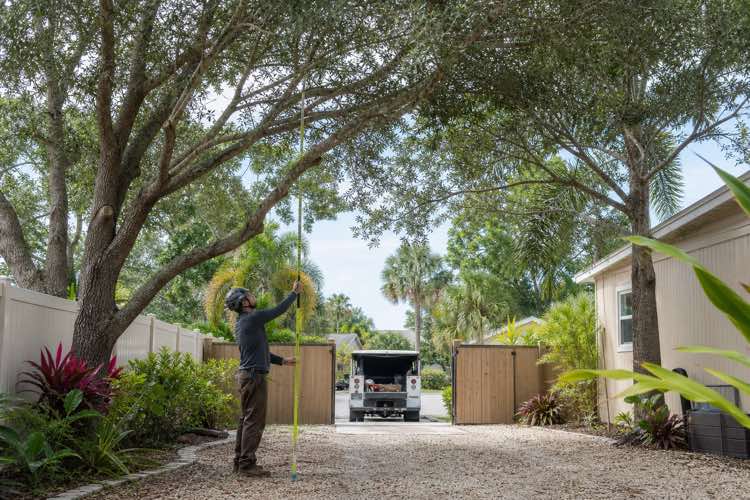
If you need a tree trimming service for fence and gate clearance in Palm Coast, the real question is not how much can be cut. It is how much usable space you need for daily use, vehicle movement, and fence protection without weakening the tree. Florida Foliage approaches that scope with measured clearances, ISA Certified Arborists on staff, and service across Volusia and Flagler counties, including the Daytona Beach market and Palm Coast tree service calls.
- Measure the gate swing, latch side, and vehicle path first.
- Protect fence panels, posts, and hardware before cutting begins.
- Confirm who has authority at a property line before work starts.
- Expect regrowth and plan for maintenance intervals.
- Ask for a written scope from an insured crew with arborist oversight.
A good tree trimming service starts with clearance targets, not guesses. Around gates, that means measuring the swing path, latch clearance, overhead height, and the width a truck, mower, or trailer actually needs. Around fences, it means keeping branches off the structure, reducing rubbing, and preserving healthy attachment points. For a quote or site review, you can request a free estimate from Florida Foliage.
In coastal Florida, clearance work also has to account for sandy soil, wind exposure, and fast regrowth. A cut that solves this month’s obstruction may create a weak shape if too much live wood is removed. Florida Foliage serves Daytona Beach and nearby communities, and a measured plan helps the crew trim for function while protecting tree structure.
How Does Line-Clearance Tree Trimming Differ?
Line-clearance tree trimming differs because the goal is a usable opening, not a full reshape. A tree trimming service for fences and gates focuses on exact clearance around movement points, while keeping enough live growth for health. That scope is more about measured access, branch attachment, and future regrowth than appearance.
For a fence line, the work usually starts with the problem area. Is the issue gate swing, side clearance, or branches pressing into panels? A crew can trim to that target without opening the whole tree canopy. That measured approach helps avoid overcutting and reduces repeat damage from branches that keep scraping the same spot.
Florida Foliage uses ISA Certified Arborists on staff to help separate useful trimming from unnecessary removal. That matters when a tree leans toward a fence or sends limbs over a driveway gate. The right cut should preserve structure and avoid creating a thin edge of growth that becomes weaker in the next storm season.
Property context matters too. In Palm Coast and Daytona Beach, many yards have tight access, shared fence runs, and utility lines nearby. A tree trimming service should account for those constraints before any cut is made. If the scope is unclear, start with a site walk and a written plan. You can always request a free estimate before work begins.
| Scope point | What to measure | Why it matters |
|---|---|---|
| Gate swing | Full open arc and latch side | Prevents rubbing and binding |
| Vehicle passage | Actual width and mirror clearance | Confirms usable access |
| Fence line | Branch contact points | Reduces wear and breakage |
| Overhead clearance | Height above gate or drive | Keeps entry usable |
| Regrowth room | Expected seasonal extension | Helps set maintenance timing |
How Do You Clear Trees From a Fence Line?
You clear trees from a fence line by measuring the obstruction, protecting the fence, and trimming only the branches that interfere with use. A tree trimming service should identify contact points, leave healthy attachment where possible, and keep cuts consistent with the tree’s shape and future growth.
Start with the fence itself. Posts, rails, wire, vinyl panels, and hardware all react differently to pressure. A branch that merely brushes wire may be handled differently from one that has grown into a panel or is bending a post. The crew should also check the soil line near the fence, since root flare and mounded mulch can affect how close a truck or chipper can get.
A practical method is to define the clearance target in plain terms. For example, a gate may need enough room to open without scraping, while a straight fence run may only need a few inches of separation for air movement and maintenance access. A tree trimming service can then remove only what is required to reach that target.
The right scope also includes cleanup. Cut limbs, twig drop, and sawdust can collect against fence bottoms and attract moisture. In coastal Florida, that trapped moisture can speed wear on wood and hardware. Florida Foliage can build cleanup into the work plan so the fence line is usable after the trim, more than open on paper.
If the branch pattern is dense or the opening is tight, a tree pruning approach may be more suitable than heavy removal. Pruning keeps the work selective and supports a cleaner long-term edge. For a fence line estimate in the Daytona Beach area, call (386) 481-7913 or request a free estimate.
Can You Trim Tree Limbs Overhanging Your Property in Florida?
Can you trim tree limbs overhanging your property in Florida? Often, a property owner may address limbs that cross onto their side, but the exact scope depends on ownership, property lines, and local rules. A tree trimming service should not assume neighbor consent or authority without checking the site and applicable jurisdiction.
That is why the first step is not cutting. It is confirming where the trunk stands, where the boundary is, and whether the tree is shared, offset, or entirely on one parcel. Overhanging limbs can still belong to the neighbor’s tree, even if they extend over a fence. A crew should avoid making assumptions about what belongs to whom.
Florida law questions are often property-specific. If there is any dispute, the owner may need an insurer, survey, or legal professional to weigh in. Florida Foliage can help with the trimming scope, but not with legal ownership decisions. That distinction matters when a fence line sits close to mature shade trees and the branch pattern crosses several parcels.
For the cut itself, the goal should remain functional clearance. That means enough room for the gate, vehicle, and maintenance access, while avoiding the common mistake of taking a hard line through the canopy. A measured tree trimming service is more likely to preserve the tree and avoid repeat conflict with the fence.
Because branch direction and attachment matter, Florida Foliage typically prefers an on-site review. If you need a practical clearance plan in the Daytona Beach area, call (386) 481-7913 or connect through the Daytona Beach market page to request a free estimate.
Who Owns a Tree on a Florida Property Line?
Who owns a tree on a Florida property line depends on where the trunk and root system sit relative to the legal boundary. If the trunk is on one parcel, the tree usually belongs to that owner; if the trunk is shared by both sides, the tree may be considered shared. A tree trimming service should not guess at ownership.
That issue matters because ownership affects who may authorize work and how far trimming can go. A fence can make the line look obvious when it is not. If the trunk is near the boundary, a survey or other property record may be needed before work begins. Florida Foliage can assess the trim scope, but property-line authority belongs to the owner, governing rules, and any relevant professional input.
When a tree sits at or near a line, the best question is often: what clearance is needed for safe use and ongoing fence protection? That practical focus keeps the conversation on function instead of assumptions. A tree trimming service with an arborist on staff can also help avoid cuts that remove too much live crown from one side.
In close quarters, the structure of the tree matters as much as the boundary. Branches with poor attachment, repeated rubbing, or heavy lean toward a gate may call for selective pruning rather than broad removal. Florida Foliage serves Volusia and Flagler counties, and that kind of measured work is often more useful than a simple visual guess.
For standards on pruning cuts and branch selection, UF/IFAS notes that proper pruning choices should support tree health and structure, while topping is harmful and should be avoided. See the guidance at UF/IFAS pruning guidance and UF/IFAS do-not-top guidance for the limited point that pruning should be selective and topping should not be used as a substitute for proper branch removal.
What Should You Ask a Tree Trimming Service?
You should ask a tree trimming service how it measures clearance, protects the fence, and handles regrowth after the cut. The best contractor will explain the scope in plain words, identify branch attachment concerns, and tell you what remains after the work is finished. That is more useful than a vague promise to “open it up.”
Ask whether the crew will inspect the gate swing, vehicle width, and any nearby utility conflicts before cutting. Ask how they will keep branches from scraping fence panels or driving hardware into posts. Ask whether the plan is a trim or a pruning approach, since those can lead to different results along a tight fence line.
Also ask about cleanup. A good tree trimming service should state whether debris will be removed from the fence line, gate path, and access lane. In sandy coastal yards, loose twigs and sawdust can blow back into hardware and landscaping quickly, so cleanup is part of the usable result, not an extra thought.
Florida Foliage is licensed and insured, and free estimates are available for property-specific scopes. If you are comparing contractors, ask for the exact measurements they used, what they plan to leave in place, and how they expect the tree to grow back. For a site review, call (386) 481-7913.
Before you sign, use this short checklist:
- Measure gate swing and vehicle clearance first.
- Identify fence materials and vulnerable hardware.
- Confirm trunk location and property-line questions.
- Ask what regrowth remains after trimming.
- Request cleanup details in the written scope.
What Tree Trimming Mistakes Should You Avoid?
You should avoid overcutting, guesswork on ownership, and ignoring how the tree will regrow. A tree trimming service should not turn a fence-line problem into a structural problem by taking too much live wood. Mistakes often start when clearance is treated as a visual fix instead of a measured, functional scope.
One common mistake is chasing a perfectly straight line. Trees do not grow like fences. If every branch that reaches toward the boundary is removed, the remaining canopy can become thin and weak. Another mistake is cutting too close to the trunk or making flush cuts that harm the tree’s natural defense. Proper pruning matters more than speed.
A second mistake is ignoring fence damage before the work starts. If a gate already drags or a panel is loose, trimming alone may not solve the issue. A tree trimming service should note where the fence needs repair versus where the tree needs clearance. That protects both the property and the final result.
A third mistake is assuming the job is done once the branches are off the fence. In Palm Coast and Daytona Beach, regrowth can be quick enough to bring the same problem back within a season or two. A measured clearance target helps set realistic maintenance timing. Florida Foliage can build that into a practical plan during the estimate.
For a closer look at the difference between sound pruning choices and poor cuts, the University of Florida guidance on pruning explains why selective cuts matter and why topping should be avoided. That is the kind of limited, practical point a property owner can use before choosing a tree trimming service.
Who Is Responsible for Trimming Around Power Lines?
Who is responsible for trimming around power lines depends on the line location, utility rules, and the type of wire involved. A tree trimming service should treat power line work as a special category and avoid any DIY approach. Qualified crews and the utility may need to coordinate the work, especially near service drops or primary lines.
Power line proximity changes the whole scope. A branch that is fine around a fence may become a hazard if it touches energized lines or blocks utility access. That is why line-clearance work near power sources should be handled by trained professionals who understand required clearances and utility procedures. Florida Foliage will assess the situation and, when needed, help identify when the utility or another qualified party must be involved.
Do not assume all overhead wire work is the same. Communication lines, service drops, and power conductors can differ in ownership and risk. If the fence line shares space with overhead utilities, the crew should plan access, drop zones, and cleanup carefully. A tree trimming service that ignores that layout may create a larger problem than the original branch contact.
If you have a fence or gate issue near wires, ask for an on-site review before work is scheduled. Florida Foliage serves Volusia and Flagler counties from the Daytona Beach area, and a measured review helps separate normal trimming from utility-sensitive work. For help with the scope, call (386) 481-7913 or request a free estimate.
How should gate clearance be measured?
Measure the full swing of the gate, the latch side, and the width needed for the largest vehicle or cart that will pass through. A tree trimming service should use those dimensions before cutting branches. Include overhead height too, since a clear opening can still be unusable if limbs hang into the swing path.
Can a contractor trim branches from a neighboring tree?
Sometimes only the overhanging portion on your side may be trimmed, but the exact authority depends on ownership, boundary location, and local rules. A tree trimming service should not assume permission or right of entry. If the trunk is near the line, a survey or legal guidance may be needed before work is approved.
Should fence protection be listed in the estimate?
Yes. Fence protection should be stated in the estimate so you know how the crew plans to avoid damage to posts, panels, gates, and hardware. A tree trimming service should describe access, drop zones, and cleanup. That helps compare bids based on the real scope, more than the cut itself.
How much clearance will remain after new growth?
The remaining clearance depends on the species, season, and how much live wood is left after trimming. In coastal Florida, regrowth can be noticeable, so a tree trimming service should explain the expected buffer, more than the finished look. Ask how much space will still be available after one growth cycle.
Can Florida Foliage quote a fence-line trimming scope?
Yes. Florida Foliage can review the site, measure the fence or gate clearance, and provide a scope for the needed tree trimming service. The company serves Volusia and Flagler counties, uses ISA Certified Arborists on staff, and offers free estimates. Call (386) 481-7913 to get started.
If you need a measured tree trimming service for a fence or gate in Palm Coast, Florida Foliage can help define the scope and review the site conditions before work begins. Use request a free estimate and call (386) 481-7913 to talk through the clearance target, cleanup, and regrowth plan.