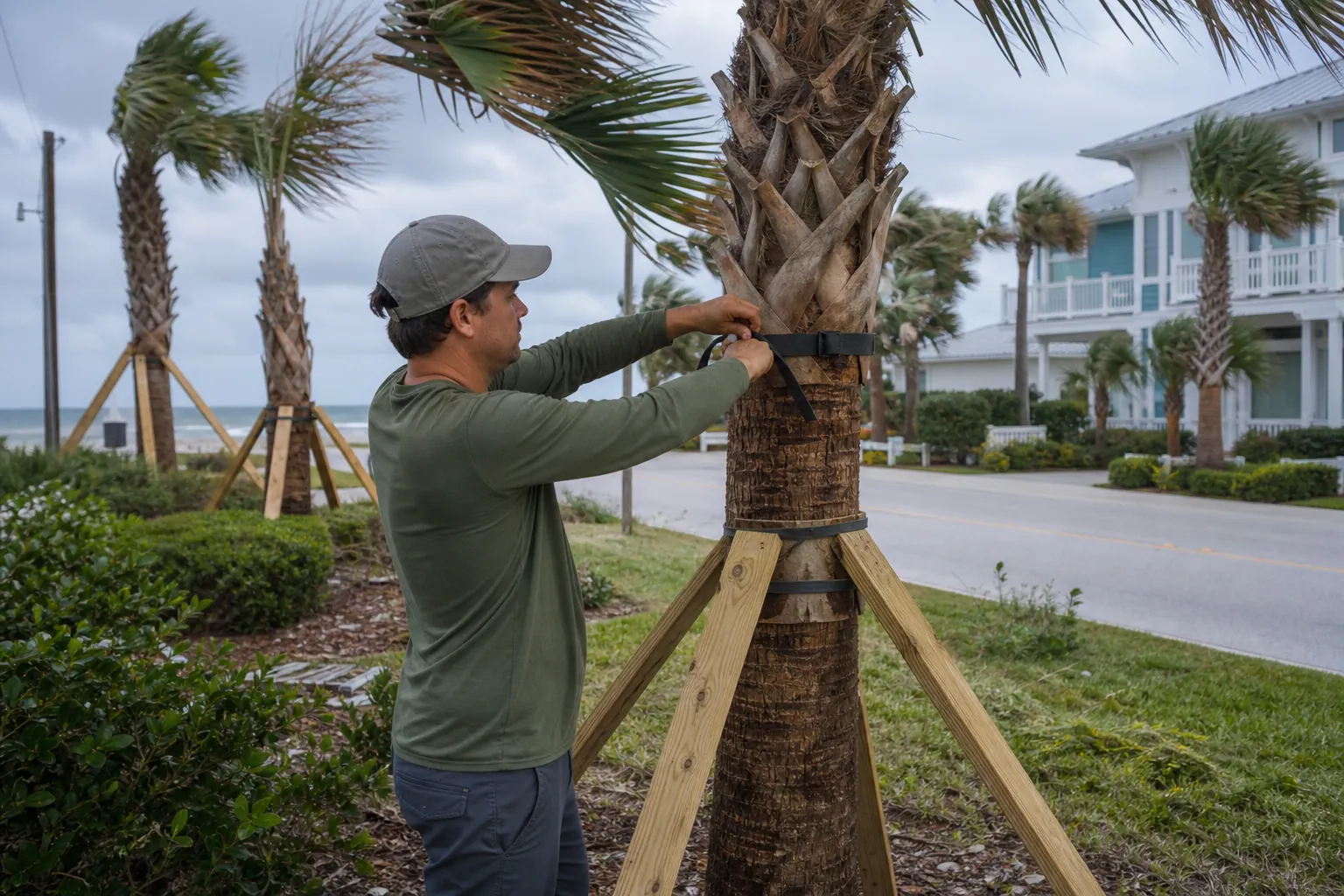
For Jacksonville Beach homeowners, tropical storm tree preparation starts with the conditions around the roots, not just the branches overhead. During the October 7–10, 2026 storm window, heavy rain, saturated soil and strengthening onshore winds make it important to check trees near homes, driveways, sidewalks and shared outdoor spaces.
The goal is not to strip every tree or rush into major cutting. It is to identify obvious hazards, arrange appropriate professional care while conditions allow and keep people away from trees that show signs of instability. A thoughtful inspection can help distinguish work that deserves attention from pruning that can wait.
Florida Foliage offers tree inspections and arborist reports, tree trimming, tree removal and other tree services for residential and shared properties. This guide explains what to check, what not to attempt and how to approach debris cleanup without turning a manageable problem into an injury.
Understand the October 7–10 weather context
As of the National Hurricane Center Intermediate Advisory 4A, issued at 1 p.m. CDT on October 7, 2026, Tropical Storm Isaias had formed in the southern Gulf of Mexico. The hurricane, tropical storm and storm surge watches described in that advisory covered the northern Gulf Coast, including areas such as Bay St. Louis to Indian Pass, not Florida’s east coast.
For Jacksonville Beach, the relevant preparation issue is the local combination of wet ground, additional rain and onshore wind. The National Weather Service Jacksonville forecast discussion issued the morning of October 7 reported saturated ground along the Northeast Florida I-95 corridor, strengthening onshore winds and more periods of heavy rain Friday and Saturday.
The National Weather Service Melbourne discussion from that morning forecast high coverage of showers and lightning storms through late week across east central Florida. It also described a marginal risk of excessive rainfall, with minor flooding possible where heavy rain repeats. That discussion provides regional context, but the Jacksonville forecast is the more relevant source for Jacksonville Beach decisions.
These are dated forecast details, not a statement that Jacksonville Beach is under a tropical cyclone watch or warning. Check the National Hurricane Center, NWS Jacksonville and, for east central Florida context, NWS Melbourne for updated information before scheduling outdoor work.
Why saturated soil changes tree risk
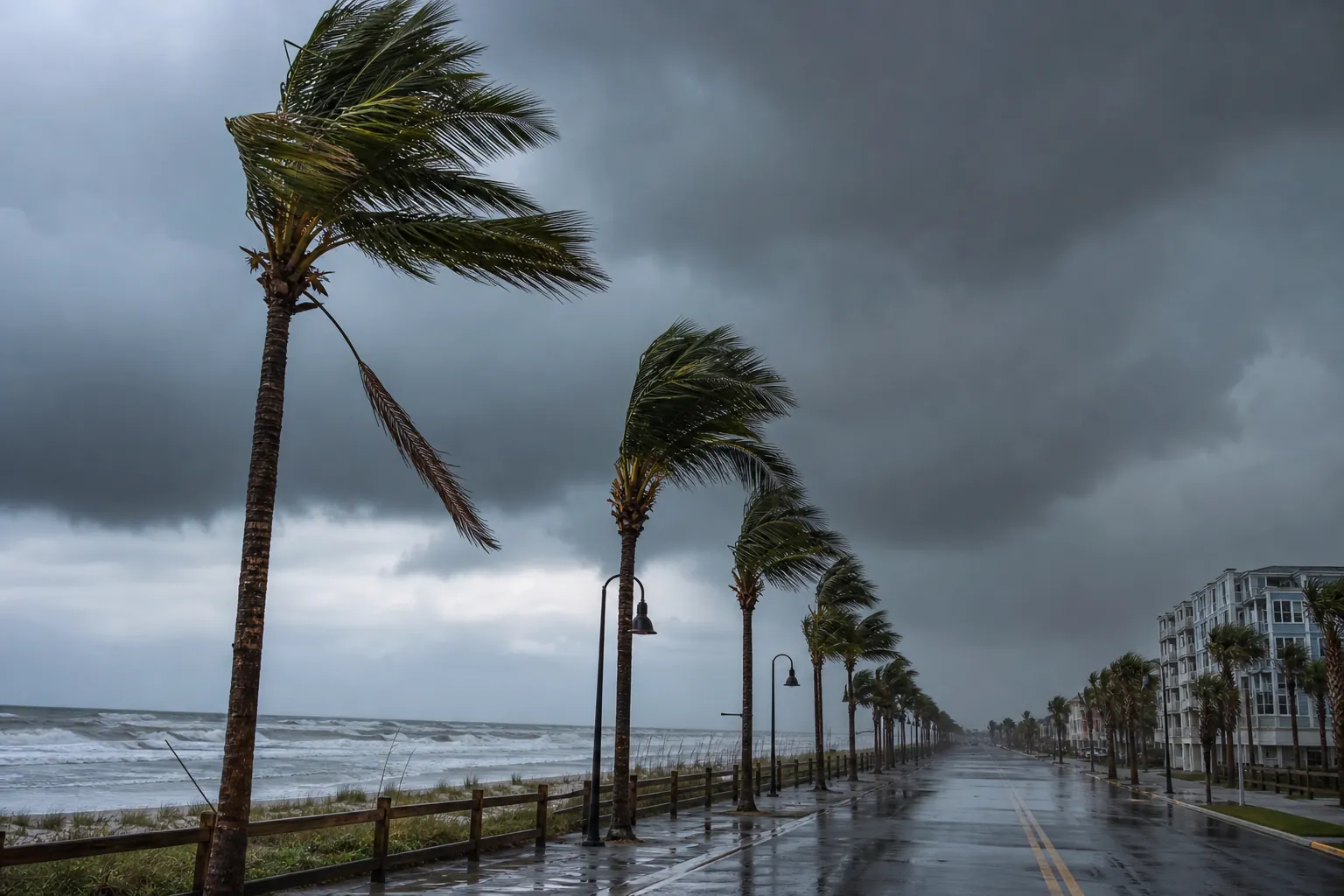
A tree’s stability depends on its root system and the surrounding soil. When the ground is saturated, some trees can become less securely anchored, especially if roots are already damaged, decayed, confined or exposed by erosion. Wet ground alone does not mean a tree will fall, but it changes how existing defects should be evaluated.
Wind puts force on the canopy. Leaves and branches catch gusts, transferring that force through the trunk to the roots. A tree with a large canopy and compromised anchorage may need a different response from a sound tree with one broken branch.
Look at the whole setting. Recent excavation, construction traffic, changes in drainage or a newly exposed tree after neighboring trees were removed can affect its condition. Tell the person inspecting the tree about those changes, even if they happened months earlier.
Do not drive equipment across a wet root zone simply to get closer for a look. Soft soil can be rutted and compacted, and equipment may become stuck. Observe from a safe location and leave close examination of a potentially unstable tree to a qualified professional.
Make a ground-level inspection before conditions worsen
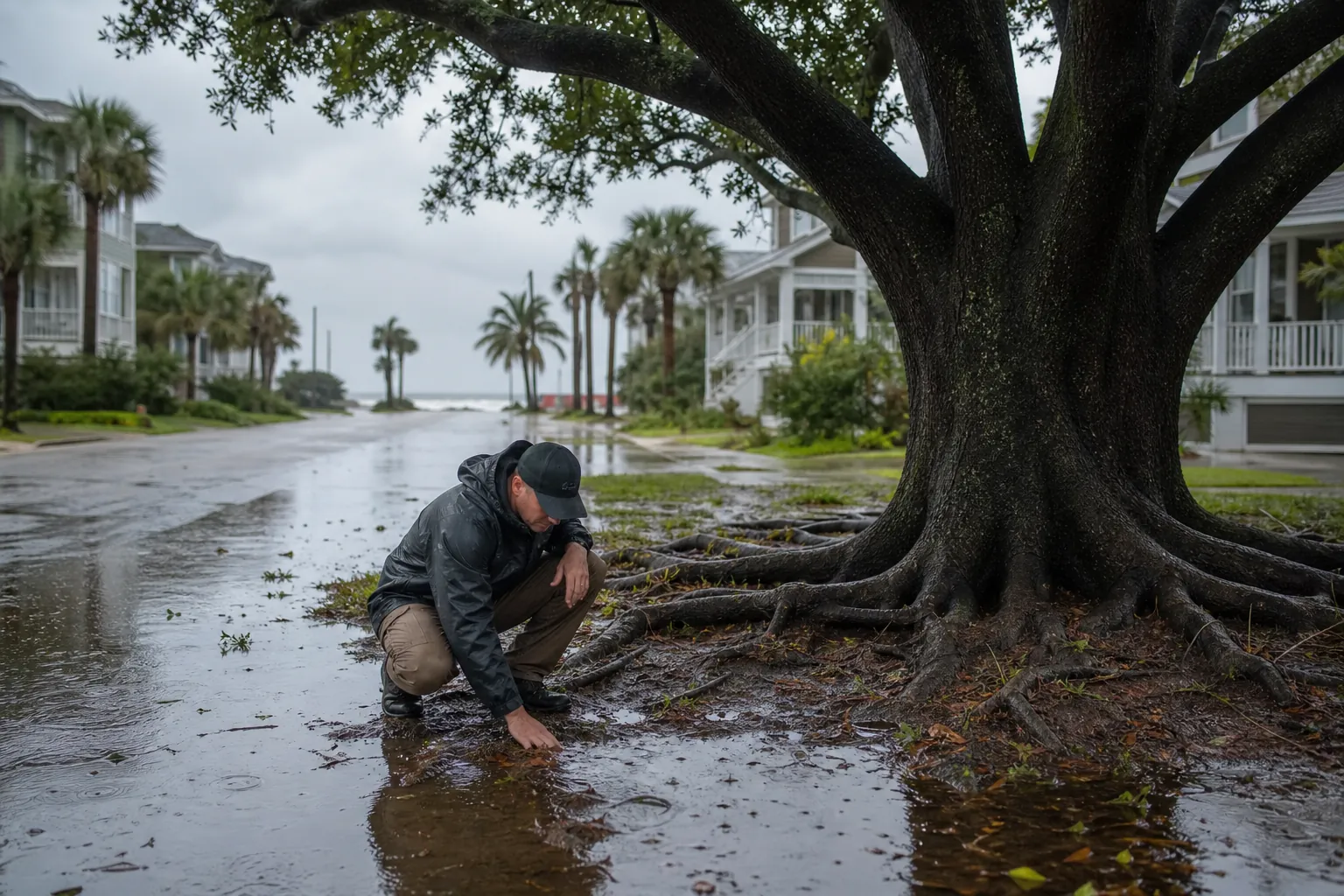
Walk the property only when there is no nearby lightning and conditions are safe. Stay on firm ground, avoid standing under questionable limbs and use binoculars or a phone camera to view the canopy. Do not climb a tree or use a ladder to investigate damage.
Start with trees that could reach occupied areas. A defect over a bedroom, entrance or frequently used parking space deserves more attention than the same defect over an unused corner of a yard. Check neighboring trees from your own property as well, without entering another owner’s land.
- Look for dead branches, broken limbs and hanging branches that could fall into areas people use.
- Check for newly visible cracks, split branch unions or changes in a tree’s lean.
- Look for fresh soil cracks, lifted ground or movement around the base of the trunk.
- Note cavities, decay, fungal growth or loose bark, and ask a professional what those observations mean.
- Identify limbs close to roofs, exterior equipment, gates and access routes without attempting to cut them yourself.
- Photograph concerns from a safe distance so you can explain their location when requesting an inspection.
Some trees naturally lean, and not every cavity requires removal. What matters is the combination of condition, recent changes and what the tree could strike. A tree inspection can help evaluate those factors rather than relying on appearance alone.
If a tree appears to be moving at the roots, developing a fresh lean or splitting, keep people out of its possible fall area. Do not stand beside it to obtain a better photograph. Seek professional guidance from a safe location.
Choose targeted pruning instead of aggressive cutting
Appropriate tree trimming can address dead, damaged or poorly attached branches. It should be based on the tree’s species, structure and condition, not a blanket instruction to remove as much foliage as possible before rain arrives.
Overpruning creates wounds, removes useful foliage and can leave a tree with an unbalanced canopy. Topping, which cuts major limbs back to stubs, is not a sound storm preparation shortcut. It can create future structural problems rather than provide dependable protection.
Canopy thinning and crown reduction are different practices. Carefully selected thinning removes particular branches within the canopy, while crown reduction reduces selected branch lengths using appropriate pruning cuts. Neither should be prescribed automatically for every tree on a property.
- Ask which specific branches need attention and why their removal is appropriate.
- Discuss whether tree trimming, selective canopy thinning or crown reduction fits the tree’s condition.
- Keep the focus on sound structure and necessary clearance rather than making the canopy look bare.
- Allow the crew to postpone work when lightning, gusts or unstable ground make the operation unsafe.
When the forecast window is short, prioritize clear hazards instead of requesting extensive cosmetic pruning. Removing an accessible dead limb may be appropriate, while a complicated canopy operation may need to wait for safer weather and better site conditions.
No pruning approach makes a tree storm-proof. Trees remain living structures exposed to changing weather, soil conditions and hidden defects. The purpose of professional care is to address identifiable problems, not promise a particular outcome.
Know when removal needs professional evaluation
Tree removal may be appropriate when a tree has serious structural defects, significant root problems or damage that cannot reasonably be addressed through pruning. That decision should account for the tree’s condition and the people or structures within reach.
A tree near a home, fence, pool or neighboring building can require controlled dismantling rather than a simple ground-level cut. Limited access and wet soil can make the work more complicated. Crane tree removal may be considered for certain sites, but equipment selection depends on access, ground support and the removal plan.
Do not attach a rope to a vehicle and try to pull a leaning tree upright or bring it down. Do not cut roots to release a partially uprooted tree. Both actions can trigger movement that is difficult to predict or control.
Before nonemergency removal, confirm applicable tree protection, permitting or approval requirements with your city or county. If the property belongs to an HOA or condominium association, confirm its authorization process as well. Requirements can vary, and an approaching weather event does not automatically eliminate them.
For a tree that has already fallen, split or become unstable, emergency and hurricane tree removal may be the relevant service category. The need for that service depends on the actual tree hazard, not on whether a hurricane watch applies to the property.
Prepare the property without disturbing tree roots
Useful preparation includes more than cutting branches. Before conditions deteriorate, relocate vehicles away from visibly questionable trees, bring loose outdoor items inside and choose an entrance that does not pass beneath a damaged canopy. Avoid moving hazards into a neighbor’s access route.
Remove loose leaves and small debris from accessible ground-level drainage paths when it is safe. Do not excavate around tree roots or redirect runoff toward the trunk as a last-minute fix. Persistent drainage problems deserve a separate assessment after the weather window.
- Keep gates and access paths clear so a tree crew can assess the property without unnecessary obstacles.
- Move furniture and lightweight outdoor objects away from trees and secure them in an appropriate sheltered location.
- Keep children and pets away from areas beneath broken branches or trees showing root movement.
- Record existing tree concerns with dated photographs taken from safe positions.
- Share access restrictions, buried infrastructure concerns and known root damage when arranging tree work.
Avoid placing heavy supplies, vehicles or equipment on saturated soil beneath trees. In addition to compaction, this can interfere with inspection and create access problems. Preserve a clear route without turning the root zone into a staging area.
Do not begin broad land and lot clearing or brush hogging simply because storm weather is approaching. Those services serve different property-management needs and require appropriate planning. Immediate preparation should focus on existing tree hazards and safe access.
Set clear priorities for commercial and shared properties
Commercial properties, HOAs and condominium communities often have trees over parking spaces, walkways, gathering areas and entrances. A consistent inspection process helps managers prioritize these locations without treating every tree as equally urgent.
Start with occupied buildings and commonly used routes. Identify who can authorize work, who can restrict access and how residents or tenants will receive updates. A damaged tree should not remain above an open seating area while an approval email circulates.
Commercial tree services and HOA and condo tree services can include inspections and targeted work suited to these shared settings. Arborist reports may help document findings and explain recommended action, particularly where several owners or managers need a common understanding.
- Assign one contact to collect tree concerns and communicate with the tree service.
- Mark affected areas without placing staff beneath unstable limbs or near a damaged trunk.
- Notify residents when parking spaces or walkways need to remain unused.
- Provide site maps, gate instructions and information about overhead lines before work begins.
- Keep dated inspection notes and photographs for maintenance records.
Do not ask maintenance staff to perform unfamiliar chainsaw work because a contractor cannot immediately begin. Restricting access is often the safer temporary measure while a professional evaluates the problem.
Stay away from electrical hazards and unstable trees
If a branch or tree contacts a power line, stay away and call your electric utility. Treat downed lines as energized. Do not touch the tree, nearby fencing, standing water or equipment that may be in contact with the line.
Do not assume a wire is safe because it is not sparking or because nearby buildings have lost power. Keep other people away and follow the utility’s instructions. Tree work involving electrical contact must wait for the appropriate utility coordination.
During heavy rain, lightning or gusty conditions, postpone outdoor tree checks. Observe from a safe indoor location if possible. Do not walk outside to investigate cracking sounds beneath the canopy.
A tree can remain hazardous after the rain or wind eases. Broken limbs may be lodged overhead, and a partly uprooted tree may shift later. Improving weather is not proof that the area beneath it is safe.
If a tree damages an occupied structure, move away from the affected area and seek appropriate emergency assistance when people are in danger. Do not enter a damaged building just to retrieve belongings or inspect where the trunk landed.
Approach debris cleanup in a safe sequence
After conditions improve, first check for power lines, hanging limbs and unstable trunks from a safe distance. Keep the cleanup area closed if any of these hazards are present. Clearing small branches beneath a suspended limb is not a safe first step.
Photograph damage before moving debris when it is safe to do so. Separate observations about the tree from assumptions about why it failed. A professional inspection may be needed to understand remaining defects or decide whether a standing section can be retained.
- Handle only small, fully detached debris that you can move comfortably without entering a hazardous area.
- Wear sturdy footwear, gloves and eye protection when collecting manageable branches.
- Leave large limbs, suspended branches and trunks under tension to trained tree workers.
- Keep debris out of streets, drainage paths and required access routes.
- Confirm current collection and disposal instructions with your city or county before placing material for pickup.
Storm-damaged wood can be under substantial tension. Cutting one section may cause another to spring, roll or drop. A trunk attached to a lifted root plate can move unexpectedly when cut, making chainsaw cleanup especially hazardous for inexperienced users.
If tree removal leaves a stump, discuss stump grinding after the immediate hazards are addressed. Equipment access, soil firmness and nearby utilities affect planning. The stump is usually a separate cleanup decision, not the first priority while broken limbs remain overhead.
Plan a follow-up inspection after the wet period
Once immediate debris is managed, revisit trees that experienced root movement, branch loss or new leaning. Check whether erosion has exposed roots or whether fresh cracks have appeared. Observe from firm ground and avoid testing a tree by pushing on it.
A follow-up tree inspection can assess damage that was difficult to see during the initial walk-through. It can also help distinguish urgent work from longer-term care, allowing pruning and removal decisions to be made with better information.
For tropical storm tree prep in Jacksonville Beach, FL, the October 7–10 priority is practical: recognize saturated-ground concerns, address identifiable defects when work can be done safely and keep people clear of unstable trees and electrical hazards.
Call Florida Foliage at (386) 481-7913 to discuss a tree inspection, targeted tree trimming or tree removal. Describe what you can see from a safe location, mention any line contact and explain access conditions. A clear description helps establish the next appropriate step without asking you to approach the hazard.
Call (386) 481-7913 to talk through next steps.