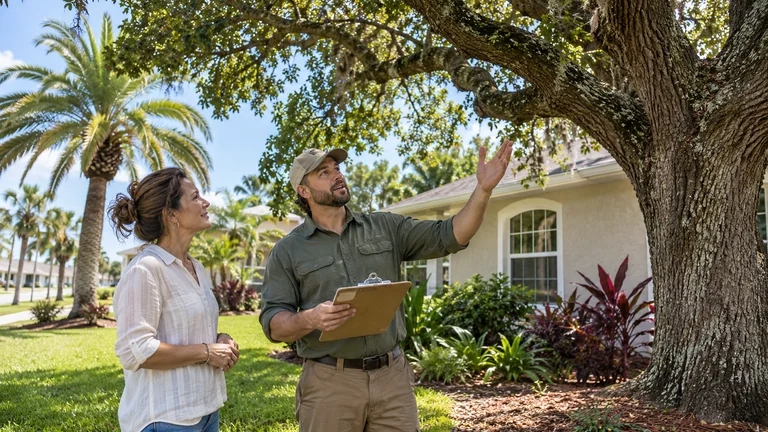
An arborist consultation helps answer a tree-care question before you commit to physical work. You may need to understand why a tree is declining, whether a branch problem calls for pruning, or what documentation an approval office requires. The useful starting point is the decision you need to make, not a preset instruction to trim or remove the tree.
Florida Foliage works with an ISA Certified Arborist consultant. For property owners in Daytona Beach, FL, that relationship provides a way to request professional assessment before choosing a service. Explain whether you need advice about condition, a pruning recommendation, or a written report, because those requests do not necessarily involve the same scope.
A clear consultation connects findings with options and identifies questions that remain unresolved. It should help you understand what work is justified, what needs further evaluation, and what the next decision involves. It should not start with a promise that every tree can stay or that every concern requires removal.
When Does an Arborist Consultation Help Before Tree Work?
A consultation helps when the reason for work is uncertain or when you need a professional opinion rather than only a work estimate. Florida Foliage's arborist consultation information addresses health, structure, and reports, while its tree trimming information describes physical pruning services.
ISA stands for the International Society of Arboriculture. Florida Foliage's credential explanation describes an ISA Certified Arborist as someone with documented field experience who has passed an examination and must maintain continuing education. The credential belongs to the individual. When arranging a visit, ask who will assess the tree and confirm that person's role in the proposed service.
UF/IFAS recommends seeking an ISA-certified arborist when you are unsure about proper pruning. It also advises professional pruning for trees taller than about 15 feet. For an owner, the practical lesson is to seek qualified help rather than turn uncertainty about a large tree into an experiment.
Common reasons to request an assessment include:
- Unexplained decline: The tree looks different, but you do not know whether the concern involves branches, growing conditions, or another health issue.
- A structural question: You need advice about competing stems, damaged branches, or the relationship between the tree and nearby property.
- Uncertain pruning goals: You have been advised to reduce the canopy without a clear explanation of which problem that would address.
- A documentation request: A permit office, association, insurer, or transaction contact needs a written professional opinion.
- A retention decision: You want an assessment of management options before authorizing removal of a tree you would prefer to keep.
An estimate answers what a defined job would involve and cost. A consultation addresses what the tree needs and why. These discussions can relate to one another, but do not assume that a quote includes a written condition report. State the question first, then ask which service will answer it and what you will receive afterward.
Certification also should not replace checking the proposed scope. Ask whether the visit concerns one tree, several trees, a specific branch conflict, or the whole property's tree-care priorities. A narrow request and a property-wide review are different assignments, even when the same consultant is involved.
What Should the Assessment Consider About the Tree and Site?
The assessment should connect the tree's visible condition with its structure, growing area, and relationship to the property. Florida Foliage's assessment service description identifies canopy, root-zone, bark, and structural observations; its young-tree structural pruning guide explains why branch relationships need separate attention.
Health and structure are related questions, but they are not interchangeable. Dead or injured growth concerns branch condition. Two stems competing with the main leader concern the developing framework. A branch obstructing a path concerns clearance. Ask the consultant to identify the actual finding rather than group every issue under a broad label such as an overgrown tree.
The site deserves attention too. UF/IFAS says tree care should account for soil preferences, sunlight, and any special fertilizer requirements. An assessment can therefore raise growing-condition questions without concluding that more pruning is the answer. Share what you know about changes near the tree, including landscaping work, irrigation changes, or recent excavation, so the consultant can decide which information matters.
| Area of concern | Useful assessment question | Decision to clarify |
|---|---|---|
| Canopy condition | Which growth is dead, injured, or otherwise concerning? | Whether targeted branch work or further health evaluation is appropriate. |
| Branch framework | Are stems competing with the main leader or branches touching? | Which structural relationship needs attention and why. |
| Root zone and trunk base | Do site conditions or accumulated mulch need closer evaluation? | Whether the care recommendation should extend beyond pruning. |
| Property use | What specific access or clearance conflict exists? | Whether selective work can address the stated need. |
Mulch offers a useful example of why the trunk base belongs in the discussion. UF/IFAS explains that mulch moderates soil temperature and helps retain moisture, but piling it against the trunk can encourage rot and problematic root growth. If the base is buried, ask for evaluation rather than assuming a canopy trim will address the underlying concern.
Before relying on the recommendation, ask what was examined and what remains uncertain. A photograph can help identify the tree, but it should not be treated as a complete evaluation of canopy, bark, root zone, and structure. If the consultant recommends another step, ask which unresolved question it is intended to answer.
How Can the Consultation Define Appropriate Pruning?
The consultation should turn a general trimming request into a tree-specific objective with clear limits. Florida Foliage's pruning service descriptions distinguish several purposes for work, and its structural pruning guide shows why developing branch relationships matter more than a uniform outline.
UF/IFAS describes pruning as selective branch removal for clearance, reduced breakage risk, or size management. Its guidance identifies dead, diseased, or injured branches, stems competing with the main leader, and crossing or touching branches as considerations. Those categories give an owner concrete questions to ask about a proposed scope.
For example, a competing stem is not the same issue as an ordinary side branch. UF/IFAS identifies removal or reduced length as possible responses to stems competing with the main leader. The consultant's explanation should identify the competition and connect the selected response to that relationship. A request to shorten every branch does not provide the same information.
Clearance needs should be equally specific. Describe the walkway, driveway, roof area, or maintenance access that concerns you. Ask which branches create the conflict and how the proposal addresses it. This helps distinguish a practical access requirement from an optional appearance preference, rather than treating the entire lower canopy as a single removal target.
For young shade trees, the recommendation can also identify what deserves later review. Florida Foliage's structural pruning guide describes staged decisions about the main leader, developing branches, and clearance. A later review should reconsider the tree's development, not simply repeat the previous trim or assume that every retained branch has already been approved for future removal.
Keep the pruning recommendation separate from any broader care plan. A branch conflict does not establish a fertilizer need, and a soil or moisture concern does not by itself explain which branches should be removed. Ask for the reasoning behind each proposed service so that unrelated tasks do not become one unexplained package.
The written scope should make the objective understandable without requiring you to choose cuts yourself. Look for an explanation of the problem, the intended change, and any deferred questions. UF/IFAS also advises avoiding providers who advertise tree topping. A smaller-looking canopy is not, by itself, a sound reason to accept a proposal.
Why Do Palms Need a Different Consultation Conversation?
Palms need recommendations suited to their species and condition rather than a shade-tree branch-management plan. When discussing tree trimming services, identify palms separately and request advice through Florida Foliage's ISA Certified Arborist consultant information if frond condition or the reason for pruning is unclear.
UF/IFAS explains that lower palm fronds naturally die as new fronds develop. Some species, including royal, foxtail, and Christmas palms, shed older fronds themselves. Other palms retain dead foliage. This distinction matters because the presence of old fronds does not automatically establish a health problem or mean every palm needs the same maintenance visit.
The same guidance says live, green, healthy fronds should not be removed. These leaves make food for the palm, and unnecessary removal can create crown wounds. A sparse, upright-only canopy is not the desired result. Ask the consultant to distinguish genuinely dead fronds from healthy foliage before accepting a proposal based mainly on making the palm look cleaner.
Yellow or partly damaged leaves deserve a separate question. UF/IFAS notes that they may reflect nutrient deficiencies, although some palms naturally develop yellowing older fronds. Removing affected leaves too soon can erase symptoms useful for identifying the problem. These leaves may also still supply nutrients, so appearance alone should not determine the work.
Fruit and flower stalks involve different considerations from green leaves. UF/IFAS identifies falling fruit clusters and retained dead fronds as possible concerns for people or property. Describe where people walk, park, or gather beneath the palm. The consultation can then separate a falling-material concern from an assumption that the whole canopy needs reduction.
UF/IFAS does not identify one universally better season for palm pruning when its guidelines are followed. It also notes that waiting until blooms have dropped and fruit growth has begun can support local pollinators before fruit-stalk removal. Ask how the proposed timing relates to the actual maintenance purpose, rather than treating a recurring schedule as proof that every palm requires pruning.
How Should Assessment Inform Removal and Stump Planning?
An assessment should explain whether management remains appropriate before removal is selected, then keep removal and site-restoration decisions distinct. Florida Foliage's tree removal information recognizes alternatives for some trees, while its stump grinding information addresses a separate part of the finished scope.
Florida Foliage's removal guidance identifies dead or dying trees, structural concerns that cannot be adequately addressed by other means, and construction needs as reasons removal may be considered. It also recognizes that some trees can be managed. Ask which finding supports the recommendation and why another approach is or is not suitable for the tree being assessed.
The reason for removal and the method of removal are different decisions. A consultant's condition findings help explain the first. The qualified removal team must also evaluate access, nearby structures, overhead obstacles, and the space needed for work. Do not assume that identifying a tree for removal settles equipment selection or authorizes use of neighboring land.
Florida Foliage's crane setup-space guide explains why there is no universal driveway measurement that approves a crane location. Ground support, reach, entry, lifting clearance, and material-handling space all matter. Share known underground features and access restrictions, but leave equipment positioning and operating decisions to qualified personnel. An apparently open yard does not settle those questions.
If removal is recommended, discuss the stump before approving the job. Grinding addresses stump wood and selected surrounding portions; it is not the same as extracting the entire root system. Explain whether your goal is mowing access, lawn restoration, a planting area, or future construction. Ask what is included, what wood remains, and what separate preparation the intended use may require.
The fresh-versus-old stump guide also explains that some species can produce shoots from surviving roots after cutting. Grinding should not be described as a guarantee against all future shoots. Where tree decline prompted removal, ask whether understanding the original problem should influence replacement planting or the choice of a new location.
If the concern appears urgent, explain that when contacting the company rather than treating it as a routine appearance consultation. Florida Foliage's emergency tree removal information discusses assessment of tree condition and surrounding property. Confirm the appropriate next step without assuming a response time or a predetermined removal method.
When Is a Written Arborist Report Worth Requesting?
Request a written report when another party needs documented findings or when you need a durable record of the professional opinion. Florida Foliage's arborist services information describes reporting for permits, associations, insurance, and real estate; its removal information provides context for decisions that may require local confirmation.
Start with the intended recipient. An association considering tree work may ask a different question from a permit office reviewing removal. Before commissioning the document, obtain the recipient's current requirements and share them when requesting the consultation. Ask whether the proposed report will address the identified tree, observed concern, recommendation, and purpose for which you need it.
For property in Daytona Beach, FL, confirm property-specific permit requirements with the responsible city or county office. Do not infer permission from a general service description or from the fact that an arborist recommends removal. Ask who will obtain any required approval and how that responsibility will be recorded before physical work is authorized.
Florida Foliage lists risk assessment reports among the services connected with its consultant relationship. If a recipient requests a particular assessment format, clarify that requirement before the visit. Ask who will prepare the report and whether its scope matches the requested purpose. Do not assume that a brief verbal opinion and a formal written assessment are interchangeable deliverables.
For managed properties, keep the professional recommendation distinct from the board or manager's authorization. Identify which trees are included, who can approve work, and whether access involves shared areas. One property-wide proposal can still contain different recommendations for individual trees. A vote to proceed with maintenance should not obscure which tree-specific work was actually proposed.
In a property transaction or insurance matter, state the question and any document deadline when requesting service. Confirm the deliverable and timing rather than assuming them. Keep the report with the associated proposal and approvals so that the recommendation can be understood in context. A report informs a decision; it should not be presented as a promise of approval, coverage, or a particular outcome.
How Can You Prepare and Compare Consultation Proposals?
Prepare a clear tree-care question, share safe-to-gather background information, and compare written scopes rather than broad promises. Florida Foliage's consultation information helps identify the type of advice needed, while its site-planning guide explains why access details belong in the initial conversation.
You do not need to diagnose the tree before making contact. Describe what prompted the request and what decision is pending. Photos taken from safe ground-level locations can help identify the tree and its surroundings. Do not climb, test damaged branches, disturb roots, or enter an unsafe area to improve the information you provide.
Organize the request in a practical order:
- Identify the tree: Explain its location on the property and distinguish it from nearby trees that are not part of the request.
- Describe the concern: Note visible changes, a branch conflict, an access problem, or the question another party has asked you to resolve.
- State your goal: Explain whether you prefer retention, need clearance, are considering removal, or require a professional written opinion.
- Share relevant records: Provide prior reports, proposals, known site changes, and any written requirements supplied by the intended report recipient.
- Explain access limits: Mention locked gates, shared driveways, known buried features, and areas controlled by another owner or an association.
- Confirm the deliverable: Ask whether the service includes verbal advice, a written recommendation, a formal report, or a separate work estimate.
UF/IFAS recommends obtaining more than one arborist opinion and a written proposal. It also advises checking references, requesting proof of workers' compensation insurance, and checking applicable permits and licenses. These are questions to verify with the provider, not credentials or coverage to assume from a website label.
When comparing proposals, look first at whether they answer the same question. One may concern a single clearance conflict while another includes broader condition evaluation. One may include a report and another may not. Ask for clarification before treating different scopes as competing versions of the same service or deciding that the larger scope must be better.
Keep the assessment recommendation and the physical-work proposal connected but distinct. The first should explain the finding and reasoning. The second should identify authorized work, access arrangements, debris handling, and any stump work. If the proposal includes an item you do not understand, ask how it relates to the assessment rather than accepting an unexplained addition.
Confirm fees for the actual consultation and any requested report before arranging service. Also ask whether later work, additional trees, or another evaluation would require a separate agreement. There is no need to assume one standard package when the underlying questions and deliverables differ.
For an ISA Certified Arborist consultant assessment in Daytona Beach, FL, call Florida Foliage to request an estimate and describe the decision you need help making. A precise request gives the consultation a useful purpose: understanding the tree before committing to pruning, removal, or a documentation-dependent next step.