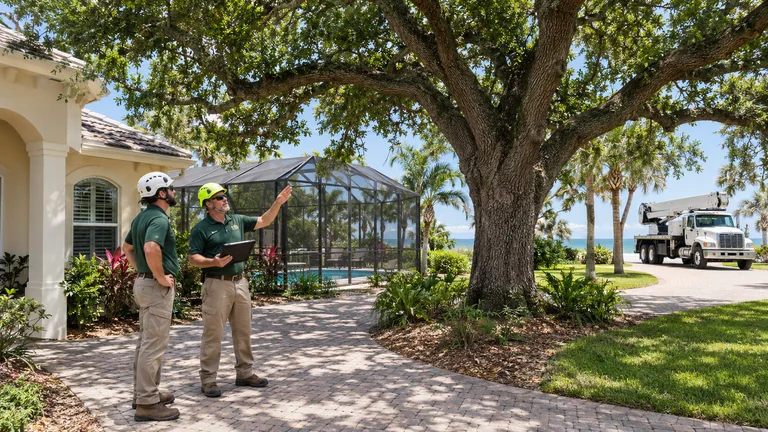
Large tree removal in Ormond Beach, FL, starts with two questions: whether removal is the right choice and how the property can support the work. Height matters, but so do trunk size, tree condition, nearby buildings, equipment access, and space for handling wood. A tree behind a screened pool enclosure presents a different planning problem from one beside an open driveway.
Request an on-site assessment before choosing equipment or comparing estimates. The useful outcome is a proposal that connects the tree's condition with a workable removal method, identifies access requirements, and explains what will remain after cleanup. Homeowners and property managers should understand those decisions without having to design the operation themselves.
Does the Large Tree Need Removal or a Different Type of Care?
Size alone does not establish that a tree needs removal. Begin with a tree condition assessment, then review the reasons for removal and possible alternatives described in Florida Foliage's tree removal services. The recommendation should address the actual concern, not simply the tree's height.
Florida Foliage works with an ISA Certified Arborist consultant. An assessment can consider canopy condition, bark, the root zone, and structural concerns. Explain whether your request involves declining growth, a damaged tree, interference with property use, or a construction project. These are different reasons for seeking advice, and they should not receive an unexplained, identical recommendation.
Pruning may be appropriate when the concern involves particular branches rather than the whole tree. UF/IFAS explains that selective pruning can provide clearance, reduce breakage risk, or reduce size. Its guidance also identifies dead, diseased, injured, crossing, and touching branches as considerations. Those purposes support asking whether targeted care could address the problem, but they do not establish that any particular tree can remain.
A large palm needs a different evaluation from a branching shade tree. UF/IFAS notes that dead palm fronds do not themselves threaten the palm's health, although falling fronds or heavy fruit clusters can present hazards. It also advises against removing healthy green fronds. Dead foliage alone should not be treated as proof that the entire palm requires removal.
Ask the evaluator to distinguish a branch problem from a concern about the whole tree. If removal is recommended, request a plain explanation of why other management options would not adequately address the finding. If retention is recommended, ask what care or further evaluation is proposed. Neither outcome should be promised before the tree is assessed.
Keep your own observations at a safe distance. You can describe a change in appearance or identify the tree from ground-level photographs without climbing, testing branches, or entering an area beneath damaged growth. Photos help communicate the request; they do not replace the site assessment needed for a large removal.
How Are Crane, Lift, and Rigging Options Chosen?
The removal method depends on tree condition, reach, access, and surrounding obstacles, not a height cutoff alone. Florida Foliage's removal service information describes cranes, aerial lifts, and professional rigging as possible options. Its guide to crane tree removal setup space explains why the approach route, ground support, lifting clearance, and landing area must be considered together.
A crane can be considered for a large tree near structures, but an open driveway does not automatically provide a suitable setup. The working footprint includes stabilizing equipment as well as the vehicle. The crew also needs a controlled area for handling lowered sections and moving debris. Those spaces may occupy different parts of the property.
Professional rigging allows crews to control and lower tree sections rather than rely on an open area for the whole tree. An aerial lift provides another possible access method. These are descriptions of service options, not interchangeable choices an owner should select from a photograph. Tree condition and site limitations can rule out an otherwise appealing approach.
| Planning area | What needs evaluation | Question to ask |
|---|---|---|
| Equipment approach | Gate openings, turns, slopes, and overhead obstructions | Which route will the equipment use? |
| Ground support | Pavement, wet soil, fill, and buried features | What must be verified before setup? |
| Lifting and landing space | Reach, nearby structures, and room for handling sections | Which areas must remain clear? |
Crane reach deserves special attention. Moving the crane farther from the tree can change its lifting capability and the proposed operation. Moving closer may introduce weak ground or restricted setup space. The operator and qualified crew must evaluate the equipment's requirements. A property owner does not need to calculate loads to ask why a location is being proposed.
If the first setup does not work, ask what alternatives merit assessment. Another approved position, different equipment, or revised access arrangements may be possible. A constrained yard does not automatically prevent removal, but it also does not justify forcing a machine into an unsuitable location.
Which Property Constraints Should Be Discussed at the Site Visit?
Discuss the full route from the street to the work area, including hidden underground features and shared access. The crane setup planning guide covers these site constraints, while a tree assessment addresses condition findings that can affect the removal plan.
Start with fixed obstacles: gateposts, walls, tight corners, roof overhangs, and pool enclosures. Then identify ground conditions that may not be obvious during a brief visit. Recurring puddles, settled driveway sections, previous excavation, or recently placed fill all deserve discussion. Neither pavement nor a dry-looking lawn proves that the location can support the proposed equipment.
- Buried systems: Share known locations of septic components, drainage structures, irrigation, private wiring, and utility trenches. Ask who will arrange any necessary locating and verification.
- Shared property: Identify common driveways, association-controlled parking, and any proposed use of a neighboring parcel. Resolve permission before the plan depends on that space.
- Everyday access: Explain delivery windows, locked gates, resident parking, and building entrances that affect how the property operates.
- Features to protect: Point out pool equipment, outdoor kitchens, landscape lighting, fences, and nearby plants that could be overlooked in a tree-only discussion.
Overhead obstacles matter throughout the planned lifting path, not just above the equipment. Tell the estimator about visible utility lines, roofs, balconies, and neighboring tree canopies. Do not approach lines, trim nearby branches, or attempt to guide equipment around them. The crew must assess the situation and coordinate with the utility when necessary.
For an HOA, condominium, or business property, ask how the work area will be separated from residents, visitors, customers, and other contractors. The landing area and debris-handling space need control as well as the equipment position. A usable plan should explain which routes and parking spaces will be unavailable.
Conditions can change after the estimate. Report new standing water, construction activity, blocked access, or changes in the tree before work begins. An earlier assessment should not be treated as permanent approval when the ground or access route has changed.
What Should a Large Tree Removal Estimate Explain?
A useful estimate identifies the tree, proposed work, access arrangements, and cleanup scope. Review Florida Foliage's tree removal information alongside its arborist assessment services so the physical removal and any requested evaluation or written report are clearly distinguished.
Height, trunk diameter, restricted access, nearby structures, debris volume, and stump inclusion can affect the scope and estimate. Compare proposals against those details rather than assuming that every quote includes the same work. A lower total does not reveal whether wood haul-off, grinding, or other requested tasks have been omitted.
- Tree identification: Confirm exactly which tree is included, especially on properties with several similar trees or a shared boundary.
- Equipment and access: Ask which areas the plan relies on and what permissions or site checks remain unresolved.
- Debris handling: Specify whether branches and trunk wood will be removed or whether an agreed amount will remain.
- Stump and finish: Confirm whether grinding, chip removal, filling, or landscape restoration is included or excluded.
- Responsibility: Identify who will confirm permits, coordinate locating, and communicate with the property manager or other responsible parties.
Confirm property-specific requirements with the city or county before authorizing work. Do not assume that a tree removal approval also allows equipment to occupy a street or public shoulder. Association approval and permission to use neighboring property are separate matters that should be resolved when the proposed work depends on them.
UF/IFAS recommends requesting proof of workers' compensation insurance, checking required permits and licenses, obtaining written proposals, and checking references when hiring tree-care professionals. These are practical verification steps. They are not a reason to assume credentials or coverage without reviewing the relevant information.
Ask about expected duration and what circumstances could change the plan, without treating an estimate as a guaranteed completion time. Keep the agreed proposal available for the person managing access. On a shared property, designate a contact who can resolve questions without expanding the authorized work informally.
How Should Cleanup, Stump Grinding, and the Next Use Be Planned?
Plan the finished condition before removal begins, because taking down the tree and preparing its former location are different tasks. Florida Foliage's stump grinding services address the remaining base, while its fresh versus old stump guide explains why roots, chips, and intended use still matter afterward.
Branch cleanup and trunk haul-off do not by themselves establish that stump grinding is included. Ask what will remain above and below ground, which visible root flares are within the proposed grinding area, and how the resulting material will be handled. Make any preference for retaining wood clear before work starts.
Grinding reduces stump wood into chips mixed with soil; it does not extract the entire root system. Remaining underground wood can affect planting and can contribute to settling as it decomposes. A surface that looks clear after grinding should not automatically be treated as ready for a new tree, pavement, or construction.
Explain the planned use during the estimate. A mowing-focused finish presents different questions from a new planting location or a future hardscape project. If you want another tree in the same spot, discuss that before agreeing to the grinding scope. The disappearance of the visible stump is not a complete planting-site evaluation.
Also distinguish debris removal from landscape restoration. Ask whether the proposal includes chip haul-off, suitable soil, grading, sod, or only the tree work and stated cleanup. Defining these boundaries helps you arrange any later landscape work without assuming that one contractor's scope includes every part of the project.
Before the crew arrives, confirm which vehicles and movable belongings should be relocated, using only areas safe to enter. Keep residents, visitors, children, and pets outside the established work zone. If access or ground conditions have changed, tell the company rather than trying to preserve an outdated plan.
For large tree removal in Ormond Beach, FL, call Florida Foliage to request an estimate and site assessment. Describe the tree, nearby structures, access restrictions, and your plans for the space. That gives the discussion a practical starting point for choosing an appropriate scope.