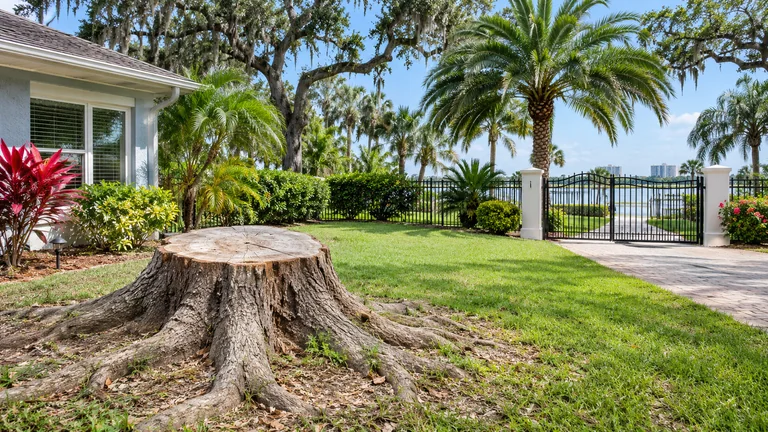
Stump grinding in Daytona Beach, FL, should start with a clear plan for the space after the stump is gone. Restoring a lawn, planting another tree, and preparing for a patio are different goals. They can require different grinding limits, cleanup arrangements, and follow-on work.
Grinding reduces stump wood below the surrounding ground, but it does not extract the entire root system or automatically produce finished planting soil. A useful estimate explains both what will be removed and what will remain. Before choosing a service, decide how you want to use the area and ask for a site assessment that connects the proposed work to that use.
How Does Stump Grinding Compare With Full Stump Removal?
Stump grinding reduces the stump and selected root flares, while full stump removal involves excavating the root ball. Florida Foliage’s stump grinding service information describes these options, and its guide to fresh and old stumps explains why underground wood still matters after grinding.
For a homeowner who wants to remove a mowing obstacle, grinding may address the immediate problem without excavating the root ball. The process turns solid stump wood into smaller pieces mixed with soil. Roots outside the agreed grinding area generally remain underground. That distinction should be clear before the work is approved, especially when the visible stump occupies only a small part of the former tree’s base.
Full removal presents a different scope. Excavating the root ball leaves a larger opening that also needs a restoration plan. It may deserve consideration when a replacement tree must occupy the same location. However, the decision should follow an assessment of the intended planting area, remaining wood, access, and surrounding features. Neither option should be selected solely because it sounds more complete.
The condition of nearby surfaces also matters. A root extending toward a walkway creates a different question from an isolated stump in open lawn. Grinding the visible wood does not, by itself, repair displaced pavement or resolve a structural concern. If your project includes those problems, identify them separately so the proposal does not confuse stump work with repairs by another contractor.
Leaving a stump temporarily may be reasonable when it is out of the way and landscape plans remain undecided. Waiting for decay, however, does not provide a dependable completion date. A weathered stump can retain firm wood below ground even when its surface appears soft. Discuss whether its present location interferes with walking, mowing, or the next planned use of the yard.
Remaining roots also mean that grinding should not be sold as a universal guarantee against future shoots. Some species can produce growth from surviving roots. If shoots appear afterward, have them identified before deciding how to respond. The practical comparison is therefore between defined removal scopes, not between promises that every trace of the former tree will disappear.
What Grinding Depth And Footprint Fit Your Plans?
The appropriate grinding depth and area depend on what will replace the stump, not just how much wood is visible. Florida Foliage’s grinding service page describes below-grade work, while its tree removal information identifies stump grinding as a separate item to clarify in the overall scope.
The service description discusses grinding roughly six to twelve inches below the soil surface, depending on intended use. Treat that range as a starting point for the site discussion, not a specification that suits every project. Ask where depth will be measured and whether the proposed work includes the broad root flare around the cut trunk. Depth alone does not describe the whole excavation area.
| Planned Use | Grinding Discussion | Follow-On Work To Confirm |
|---|---|---|
| Lawn or sod | Depth and footprint needed to remove the stump obstruction | Excess chip removal, suitable soil, and final surface preparation |
| Ornamental planting bed | Remaining wood within the proposed planting area | Soil condition, drainage, and planting layout |
| Replacement tree | Root-ball space and whether excavation or relocation is preferable | Planting-site assessment and suitable soil volume |
| Patio, driveway, or construction | Wood remaining beneath the proposed project footprint | Requirements from the contractor responsible for the finished project |
A lawn-focused scope may differ from the preparation needed for a new tree root ball. Likewise, removing the stump below the surface does not establish that the area is ready for concrete or another load-bearing use. Share the future project with the grinding contractor before accepting an estimate. If another contractor will prepare the base or build the finished surface, have that contractor identify the required condition.
The footprint deserves equal attention. A narrow cut face can sit above a wider base with substantial flared roots. Ask which visible roots are included and where the work stops near fences, paving, or other plants. A proposal that names only the stump without describing those limits can leave different expectations about the finished result.
If your plans change after the estimate, revisit the scope before work begins. Moving from grass to a replacement tree or paved surface changes the question the contractor must answer. Agree on the intended use first, then ask for the depth, area, and restoration responsibilities that fit it.
Does A Fresh Or Old Stump Need A Different Plan?
Stump age provides useful background, but wood condition and site access are more informative than age alone. Florida Foliage’s fresh-versus-old stump guide explains these differences, and its stump grinding service information connects the work to the intended use of the ground.
A recently cut stump often has an exposed surface and clearly visible root flares. That can make the location easier to discuss during the assessment. Fresh wood is not necessarily sound throughout, though. If the original tree contained decay, the remaining stump may also have soft or hollow sections. The contractor should assess its actual condition rather than assume all recently cut wood behaves alike.
An older stump can present the opposite appearance problem. Its upper surface may have softened while lower wood remains firm. Grass, leaves, or later landscaping can conceal its edges and nearby roots. An old stump that looks small from above may therefore involve more wood than expected. Tell the estimator about any changes made around the site since the tree was removed.
Decay can also leave cavities and contribute to settling near the former trunk. If the ground has developed a depression, point it out rather than covering it before the visit. The source guide describes how repeated filling can conceal remaining wood without resolving the underlying condition. A site assessment should distinguish the visible stump from the broader area that may need attention.
There is no universal waiting period that makes grinding the better choice. Earlier work may fit a plan to restore mowing access or complete a landscape project. Waiting may fit a location that is not currently in use. Neither choice removes the need to consider roots, chips, and the finished ground level. Natural decay should not be treated as a predictable substitute for those decisions.
Share any history of fencing, nails, wire, edging, or other objects attached to the former tree. Embedded material may not be obvious from the exposed surface. Also report changes in access, such as a new gate or planting bed. These details help the contractor assess an old stump without relying on its appearance or the conditions that existed when the tree came down.
What Access And Underground Features Need Assessment?
The contractor needs to assess the route to the stump as well as the working area around it. Florida Foliage’s stump assessment guidance covers access and buried features, while its equipment setup planning guide explains why a tree removal access plan must also account for requested stump work.
A wide-looking yard does not establish that equipment can reach the stump. Gates, tight turns, slopes, steps, and fixed landscape features may limit the route. Provide photographs that show the approach from the driveway or street, not just the stump’s cut surface. Preliminary measurements can help communicate a restriction, but the contractor still needs to determine whether the proposed access is workable.
Ground condition matters along that route. Sandy soil is not automatically suitable when it is saturated or unstable. Tell the estimator about recurring standing water, recent excavation, soft areas, or places where equipment has previously become stuck. If conditions change after the assessment, report the change rather than assuming the original access plan remains suitable.
- Access restrictions: Identify locked gates, narrow passages, shared driveways, and areas controlled by another owner.
- Buried systems: Share known locations of irrigation, private wiring, drains, septic components, and other underground features.
- Nearby property: Point out fences, patios, pools, walls, and planting beds close to the stump or equipment route.
- Site history: Mention embedded metal, previous excavation, unusual depressions, and changes made since tree removal.
- Future use: Explain whether the area will become lawn, a planting bed, a replacement-tree site, or part of a construction project.
Ask who will coordinate any necessary utility locating and how private underground systems will be identified. Existing drawings can help, but they may not show every later change. Do not dig around a suspected line or dismantle the stump to improve the photograph. Unresolved underground conditions belong in the planning discussion before equipment enters the area.
For an HOA, condominium, or commercial property, identify the person responsible for access and resident or tenant coordination. Discuss pedestrian routes, parking restrictions, and other work occurring nearby. Confirm property-specific requirements with the city or county, including any approvals related to the wider tree removal or construction project. Do not assume one approval covers every activity.
Once the contractor establishes the work boundary, keep children, pets, residents, and uninvolved workers outside it. Grinding involves moving equipment and flying debris. Owners can help by communicating access arrangements and known site conditions, not by approaching the machine or attempting to prepare unknown underground areas themselves.
What Happens To Chips, Soil, And The Finished Surface?
Grinding produces loose wood chips mixed with soil, so cleanup and restoration need explicit agreement. Florida Foliage’s stump grinding information describes chip retention and haul-off options, while its stump condition guide explains why the resulting material is not automatically finished planting soil.
The chip pile can appear substantial because solid wood has been reduced to loose pieces. Before scheduling, decide whether you want material retained for an appropriate landscape use or removed. Confirm whether the proposal covers all excess grindings, only material above the surrounding surface, or another defined amount. Avoid relying on the word cleanup without a description of the intended result.
For lawn restoration, ask how excess woody material will be managed and whether suitable soil will be supplied before sod or seed is installed. A deep concentration of chips can complicate establishment and contribute to settling as the wood breaks down. Grinding, hauling, soil placement, and lawn installation are distinct tasks even when they form part of one landscape project.
Chips retained as surface mulch have a different purpose from material left deep in a planting area. UF/IFAS tree-care guidance explains that mulch helps conserve soil moisture, moderate soil temperature, and limit weeds. It recommends a two- to three-inch layer for ordinary mulch materials, with a different allowance for coarse materials. It also warns against accumulating mulch against tree trunks.
Those mulch benefits do not mean every batch of stump grindings should be spread anywhere without assessment. Discuss the proposed location and use, particularly when the removed tree had an unresolved health problem. Fresh grindings should not be described as finished compost. If material is retained, identify where it will go so it does not simply become an unplanned mound around a surviving tree.
Remaining roots and buried wood can continue to break down after the surface initially looks level. Monitor the area for developing low spots rather than expecting the first finish to remain unchanged. If settling occurs, have the surface restored appropriately for its use. For a paved or built-over area, follow the requirements of the contractor responsible for that project rather than treating additional loose fill as a universal solution.
How Should New Planting And Retained Trees Be Planned?
Replacement planting needs an assessment beyond the disappearance of the visible stump. Florida Foliage’s arborist assessment information addresses tree condition and root-zone concerns, while its young-tree care guide distinguishes growing-site needs from later branch-development work.
If a new tree must occupy the old stump’s exact location, say so before grinding. Remaining roots, wood, loose material, and changing ground levels can interfere with preparation for a new root ball. A mowing-focused scope may not create the required planting space. Discuss whether a different location or root-ball excavation would better fit the proposed replacement rather than deciding after the equipment has left.
A nearby planting position may offer a more suitable area, but it still needs evaluation. Consider the new tree’s mature size, available soil volume, and clearance from structures and utilities. The UF/IFAS guidance on selecting and maintaining trees emphasizes understanding soil preferences, sunlight needs, and any special fertilizer requirements. Removing the old stump does not establish that the site meets those needs.
The reason for the original tree’s removal also belongs in the discussion. If it declined because of an unresolved disease concern or persistent site problem, replacing it without understanding that issue can repeat the difficulty. Florida Foliage works with an ISA Certified Arborist consultant. Ask whether a condition assessment or written report would help guide the replacement decision before selecting a new tree.
Retained plants need their own consideration. Identify nearby trees and planting beds when defining equipment access and the grinding footprint. Do not expand root work simply to make the area appear uniformly clear. If the route seems to require branch or frond removal, have that evaluated separately through an appropriate pruning recommendation rather than treating it as an automatic part of stump cleanup.
Palms are a useful example of why that distinction matters. UF/IFAS palm-pruning guidance advises against removing healthy green fronds and explains that prematurely removing yellowing leaves can erase evidence useful for identifying a problem. A nearby palm should not receive a more severe trim merely to accompany stump work. Keep its health needs separate from the decision about the former tree’s base.
What Should A Stump Grinding Estimate Include?
A useful estimate identifies the stump, grinding limits, access arrangements, chip handling, and the condition in which the site will be left. Florida Foliage’s stump grinding service can be discussed as a standalone project, or alongside tree removal when both tasks are being considered. Neither should be assumed to include the other.
Compare written scopes before comparing totals. Two proposals may describe different depths, root-flare areas, haul-off arrangements, or restoration work. A lower figure does not establish that the same result is being offered. Ask each contractor to connect the proposed work to your intended use and explain any site restrictions that prevent that result from being included.
- Identify the work: Record which stump or stumps are included and which nearby roots or flares are within scope.
- Describe the limits: Confirm the proposed depth, reference ground level, working footprint, and restrictions near property features.
- Assign access responsibilities: Clarify permissions, gate access, locating arrangements, and any unresolved underground questions.
- Define material handling: State whether chips stay, where retained material goes, and what haul-off includes.
- Separate restoration: Identify responsibility for soil, grading, sod, planting, paving preparation, and later surface maintenance.
- Clarify additional work: Establish how newly discovered conditions or requested scope changes will be discussed before proceeding.
For several stumps, identify each location rather than relying on a single property-wide instruction. One may be in open lawn while another sits beside irrigation or a shared walkway. Record any different intended uses. This gives an HOA board or property manager a clearer basis for authorization and helps avoid treating every stump as though it presents the same access and restoration needs.
When choosing a provider, UF/IFAS hiring guidance recommends obtaining written proposals, checking references, requesting proof of workers’ compensation insurance, and checking applicable permits and licenses. Its guidance concerns professional tree care; it does not establish the permit status of an individual stump project. Confirm the requirements for your property and the complete proposed work with the appropriate city or county office.
For stump grinding in Daytona Beach, FL, call Florida Foliage to request an estimate and site assessment. Explain where the stump sits, how equipment may reach it, and what you want the space to become. Ask for a proposal that makes the grinding, material handling, and follow-on responsibilities clear before work is authorized.