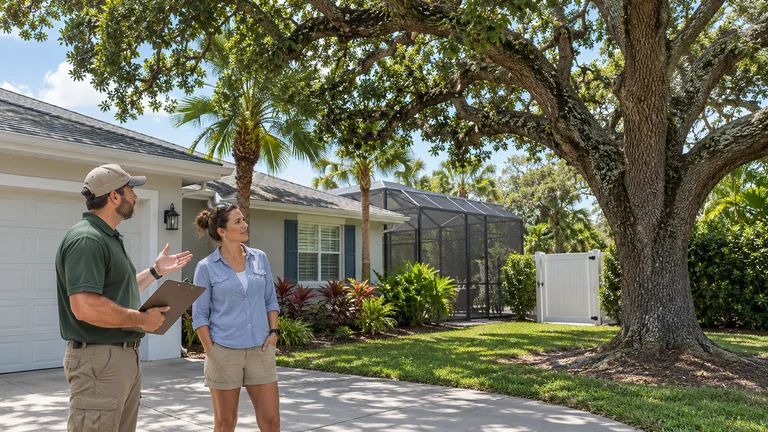
Tree removal cost in Port Orange, FL depends on the tree, the space around it, and the services included in the proposal. Height matters, but it does not tell the whole story. A broad canopy, a thick trunk, a narrow access route, or branches extending over a screened enclosure can change the work plan. Stump grinding and debris handling also need clear agreement before you compare totals.
The useful starting point is an on-site estimate tied to a defined result. Ask which tree the proposal includes, how the property affects the proposed work, and what will remain afterward. A lower total is not necessarily a lower price for the same service if one proposal leaves the stump or wood behind.
For the broader removal decision, see the guide to tree removal in Daytona Beach, FL. Then use the cost factors below to discuss your own property, distinguish removal from optional stump work, and compare proposals for the same finished result.
How Size and Tree Condition Shape the Estimate
Tree height, trunk diameter, canopy volume, and condition help determine the work involved. Florida Foliage's tree removal service information identifies size and debris volume as cost factors, while its tree assessment services address health and structural questions that may affect the recommendation.
Height and trunk width describe different parts of the job. A tall tree may require a different equipment plan from a shorter tree, while a thick trunk adds substantial wood to handle. Canopy spread matters separately because branches add material for processing and hauling. An estimate based only on how tall the tree looks can miss these differences.
| Estimate Factor | What the Site Visit Checks | What to Clarify |
|---|---|---|
| Height | The tree's height and its relationship to the available work area. | Which equipment needs are included in the proposal. |
| Trunk diameter | The amount and size of trunk wood requiring handling. | Whether all trunk wood will leave the property. |
| Canopy volume | Branch spread, debris volume, and nearby structures. | Whether branch processing and haul-off are included. |
| Tree condition | Visible damage and structural concerns relevant to planning. | Whether further assessment or documentation is proposed. |
Condition deserves its own explanation rather than a vague surcharge for a difficult tree. The estimator should connect an observed concern to the proposed work. If structural uncertainty needs further evaluation, ask what that evaluation will establish and whether a written report is part of the requested service. Do not assume every removal estimate includes a formal assessment report.
A photograph can identify the tree and communicate your concern, but it cannot show every site constraint. Florida Foliage's information about assessing hazardous removals describes reviewing tree condition, size, location, and nearby structures before choosing an approach. Share visible changes from a safe location rather than approaching damaged branches for a closer picture.
Why Access and Equipment Change the Work Plan
Access affects how equipment reaches the tree, where it can operate, and how wood leaves the site. Compare the proposed tree removal scope with the requirements explained in planning setup space for crane tree removal, because a driveway alone does not establish a workable site.
A tree behind a house presents different planning questions from one beside an open approach. Gateposts, tight turns, overhead obstacles, pools, and nearby structures can limit the usable space. A crane plan also needs suitable ground support, reach, a lifting route, and a separate area for handling tree sections. These requirements explain why equipment decisions should follow a site assessment.
For an owner, useful preparation means sharing property information, not choosing equipment or approving ground conditions. Tell the estimator about features that may not be apparent during a brief visit:
- Restricted entry: Identify locked gates, narrow passages, tight driveway turns, and shared entrances.
- Buried features: Share known locations of septic components, irrigation, drainage, and private underground lines.
- Surface concerns: Mention recent excavation, recurring standing water, cracked pavement, or unexplained depressions.
- Shared use: Explain parking rules, building access needs, and areas controlled by an association or neighbor.
No universal driveway width or equipment footprint can confirm that a crane will work on a particular property. Ground support and reach matter alongside open space. Ask why the proposed position is suitable and which parts of the property the plan relies on. Leave equipment capacities, utility clearances, and support arrangements to qualified professionals.
When comparing quotes, ask whether both estimators have assumed the same access arrangements. One proposal may depend on a shared driveway or neighboring property that has not been approved for use. Confirm those permissions before scheduling. Also report changes such as wet ground or new construction, since the assessed route may no longer be available in the same condition.
Separate Stump Work, Haul-Off, and the Finished Yard
Tree removal, stump grinding, and finished landscape preparation are different scope decisions. Florida Foliage's stump grinding service information explains below-grade stump work, while its fresh versus old stump guidance describes why roots, chips, and the intended use of the area need separate discussion.
Start by asking whether the removal price includes the stump at all. If grinding is requested, the proposal should define the area and depth of work rather than simply say that the stump disappears. Grinding addresses stump wood and specified surrounding portions; it is not the same as excavating the entire root system. Many roots can remain underground.
Your next use of the space helps frame the request. Easier mowing, new lawn, a planting bed, and future construction are not identical goals. Explain the goal before accepting a stump scope. Removing the visible obstacle does not automatically create a planting-ready bed or a construction-ready surface, and future work may need a separate assessment.
Debris handling also has two parts. Removal creates branches and trunk wood, while stump grinding creates loose wood chips mixed with soil. Ask what happens to each material. If you want wood retained, define that preference before work starts. If you want chips removed, confirm that arrangement rather than assuming it follows from a general promise of cleanup.
Stump age alone is not a sound basis for assuming a lower quote. Older wood may be partly softened, but substantial firm wood can remain below the surface. Landscaping can also conceal roots or restrict access. Discuss the actual stump and work area rather than waiting for decay on the assumption that it will make the task predictable.
Remaining roots and woody material can decompose and contribute to settling. Clarify the initial finished condition and any later landscape work you expect. That distinction helps prevent a clean removal site from being mistaken for a permanently level, fully restored lawn.
Check Whether Removal Is the Right Scope First
A removal estimate should follow a decision about what the tree needs, not replace that decision. Florida Foliage's tree trimming services address targeted branch work, and its young-tree structural pruning guidance explains how specific branch-development concerns differ from removing an entire tree.
UF/IFAS explains that selective pruning can provide clearance, reduce the risk of branch breakage, or reduce size in its guidance on pruning and maintaining trees. It also identifies dead, diseased, injured, crossing, and touching branches as pruning considerations. Those purposes support asking whether your concern is a branch problem or a broader tree condition problem.
This does not mean pruning is a substitute for every proposed removal. An assessment needs to establish whether retention is appropriate for the actual tree. Ask the professional to explain the reason for removal, the alternatives considered, and any limitations of those alternatives. Compare recommendations against your concern rather than assuming that either the smallest job or complete removal must be correct.
Palms need a different discussion from branching shade trees. According to UF/IFAS guidance on pruning palms, lower fronds naturally die as newer fronds develop, and dead fronds do not themselves harm the palm's health. The guidance also says healthy green fronds should not be removed. Brown lower fronds alone therefore do not establish a need to remove the entire palm.
If health or structural concerns remain unclear, ask about an assessment before authorizing removal. Florida Foliage works with an ISA Certified Arborist consultant. Confirm whether the request is for an estimate, a condition assessment, a written report, or a combination, since those deliverables should not be treated as interchangeable.
Compare Written Proposals and Confirm Local Requirements
The clearest comparison uses written proposals for the same tree and the same finished result. Review Florida Foliage's removal service scope alongside its assessment and documentation services so physical work, professional evaluation, and any required report are clearly distinguished before you approve a total.
UF/IFAS recommends obtaining a written proposal, having more than one arborist look at the job, requesting proof of workers' compensation insurance, and checking applicable permits and licenses in its tree-care hiring guidance. These are useful checks when choosing professional help. A clear price matters, but so does knowing what the provider has agreed to do.
- Identify the tree: Make sure each proposal includes the same tree or trees and distinguishes removal from any nearby pruning.
- Confirm access assumptions: Record any need for shared entrances, neighboring property, parking changes, or additional permissions.
- Define equipment scope: Ask whether the proposed equipment and related site arrangements are included in the total.
- Specify material handling: State whether branches, trunk wood, and grinding chips will be removed or retained.
- Describe stump work: Confirm whether grinding is included and how its area, depth, and cleanup are defined.
- Name the endpoint: Distinguish removal cleanup from soil work, lawn restoration, planting, or other follow-on improvements.
For property in Port Orange, FL, confirm applicable tree-removal requirements with the city or county responsible for the property. Do not assume another property's approval or a neighboring city's rule applies. Ask who will confirm the requirement, prepare any documentation, and obtain any needed approval. If a written report is requested, clarify its scope and whether its cost is included.
Access permissions deserve a separate check. Approval to remove a tree does not necessarily authorize using a roadway, shared driveway, or neighboring parcel for equipment. Association requirements may also need coordination. Identify who controls each space the work depends on and resolve those arrangements before relying on the quoted plan.
If totals differ, ask each provider to explain the difference in scope rather than requesting an unexplained price match. A missing stump item or different haul-off arrangement may account for part of the gap. Call Florida Foliage to request an on-site estimate for tree removal in Port Orange, FL, and describe your access concerns and preferred finished condition.