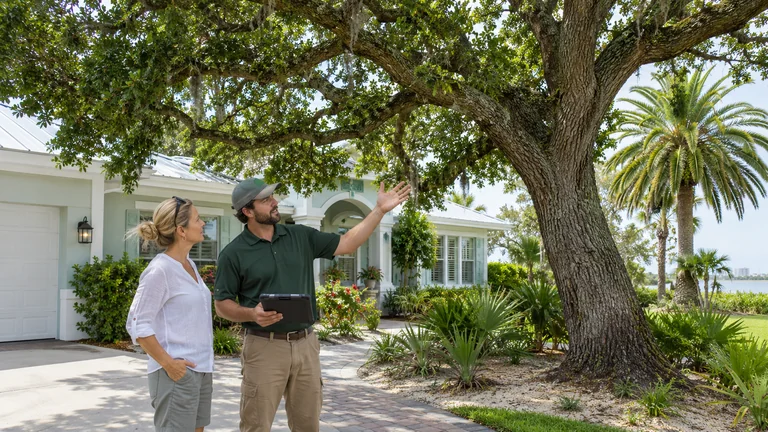
Tree trimming in Daytona Beach, FL should begin with a clear reason for the work. Branches may crowd a roof, block a walking route, or contain dead growth. A canopy may need selective attention without losing the shade and character that make the tree valuable. Those are different needs, and they should not all lead to the same general trim.
UF/IFAS explains that selective pruning can provide clearance, reduce the risk of branch breakage, or reduce tree size. That guidance supports a focused approach: identify the concern, assess the tree, and agree on work tied to that concern. It does not support removing branches simply to fill a truck.
Florida Foliage provides tree trimming and works with an ISA Certified Arborist consultant. Homeowners can request an assessment and written estimate that separates access needs, canopy care, palm work, and any condition concerns requiring further evaluation.
What Should Tree Trimming Accomplish on Your Property?
Tree trimming should address specific clearance or canopy concerns while keeping the tree's landscape role in view. Florida Foliage's tree trimming services include several types of targeted work, while young-tree structural pruning addresses the separate task of developing a young shade tree's branch framework. Mature-canopy maintenance should not be confused with that early training.
Start with what you want to use or protect. A driveway needs usable passage. A walkway needs room for people. A roof concern calls for an evaluation of the branches near the building. An appearance request should explain which view matters and what you hope to retain, rather than asking for every branch to be shortened.
The service name alone is not enough to define the job. Crown cleaning concerns dead, dying, and diseased branches. Crown raising concerns lower branches and clearance. Crown reduction concerns size. These categories can help organize a conversation, but the proposal still needs to connect the chosen work to the actual tree.
- Roof and gutter clearance: Identify the building face and branches causing concern. Ask what separation the proposed work can provide without extending the scope to unrelated parts of the canopy.
- Walking and driving access: Explain the route and its normal use. A pedestrian path, passenger-car driveway, and delivery route are not interchangeable requests.
- Dead or damaged growth: Describe the location from a safe place. Ask whether the concern is limited to a branch or calls for a broader condition assessment.
- Canopy appearance: State whether you want to retain shade, improve a particular view, or address branch interference. Avoid using a stripped or uniformly shortened outline as the measure of success.
Separate necessary access work from optional appearance changes. If a branch blocks a path, that can be discussed as a defined clearance issue. If another branch merely looks uneven from the street, it presents a different choice. Keeping those requests separate makes it easier to compare the scope, understand the estimate, and decide which items to authorize.
For several trees, describe each one by location and purpose. The oak beside the driveway may need clearance work, while another shade tree may need only deadwood evaluation. A property-wide appointment can coordinate the visit without assuming that every tree needs the same treatment or any pruning at all.
How Should Roof, Driveway, and Walkway Clearance Be Planned?
Clearance should be planned around the particular obstruction, the space being used, and the tree's condition. Discuss branch work through clearance trimming services, and use the site-planning principles in Florida Foliage's equipment access guidance when explaining gates, surfaces, and nearby obstacles. That guidance does not mean a trimming job requires a crane.
A useful request describes both the object and its surroundings. For a roof concern, identify the roof section, nearby screened enclosure, gutter, or other feature involved. For a driveway, explain how vehicles normally enter and turn. For a path, identify the route people actually use rather than asking for the entire lower canopy to be removed.
| Owner Goal | Scope to Discuss | Boundary to Confirm |
|---|---|---|
| Separate branches from a roof | Evaluate the branches near the affected roof section and explain the proposed clearance work. | Which branches are included and which nearby branches will remain. |
| Keep a walkway usable | Assess lower branches affecting the actual walking route. | Whether work is limited to the path rather than the whole lower canopy. |
| Improve driveway access | Consider normal vehicle use, turning space, gates, and overhead obstacles. | The intended access outcome and any unresolved site restrictions. |
| Improve a view | Identify the viewpoint and consider selective work while retaining tree structure. | The view being addressed and the canopy features to preserve. |
Do not select a clearance distance from an unrelated property and assume it fits yours. Ask the professional to explain the proposed outcome for the tree and structure involved. A photograph can show where a conflict appears, but it should not become a promise that a particular branch can be managed exactly as it looks from one angle.
Access for the work also deserves attention. A fenced yard may have a narrow gate, tight turn, or surface that needs evaluation before equipment enters. Share information about irrigation, drainage, septic features, and private underground systems. Do not widen access by cutting branches or removing site features before the proposed approach has been discussed.
Where work would depend on shared or neighboring space, resolve permission and access arrangements before scheduling. Confirm property-specific permit requirements with the city or county and clarify who will handle each required step. If branches are near overhead wires, keep clear and request professional coordination rather than treating them as ordinary household clearance work.
How Can Canopy Care Stay Selective Instead of Becoming Excessive?
Canopy care should target identified branch problems rather than pursue the largest possible visual change. Florida Foliage's trimming information distinguishes cleaning, reduction, and clearance work, while its tree assessment services address condition questions that may change the recommendation. A full-looking canopy alone does not explain which branches need attention.
UF/IFAS identifies dead, diseased, injured, crossing, and touching branches as pruning considerations. These are useful categories because they describe different findings. A dead branch presents a condition issue. Two touching branches present an interaction. A request for more roof clearance concerns the relationship between a tree and a structure.
Ask for those findings to be explained separately. Otherwise, a proposal to open the canopy may hide several unrelated decisions. The owner should be able to understand what was observed and why the proposed branch work responds to it. That is more useful than a general promise to make the tree look lighter or more balanced.
Crown reduction and routine clearance should also remain distinct in the estimate. A branch close to a building may create a local concern. A request to reduce overall size involves the canopy more broadly. Ask whether your objective can be met selectively, what the proposed result would look like, and what limits the professional recommends for that tree.
Preserve the features you value in the discussion. If afternoon shade matters, say so. If the tree frames a patio or screens a neighboring building, identify that role before approving changes. This does not guarantee every feature can remain unchanged, but it gives the evaluator a clearer basis for explaining tradeoffs and realistic options.
Do not judge the work only by the pile of branches afterward. A modest visible change may address the stated conflict. The better comparison is between the agreed scope and the completed result: the specified route, roof section, or branch concern, together with the canopy features the proposal intended to retain.
What Is Different About Trimming Palms?
Palms need a separate pruning decision, not the same shaping approach used for branching shade trees. Identify them separately when requesting tree trimming, and seek a professional condition assessment when frond color or decline raises questions. Palm species, relative health, dead fronds, and fruit clusters all belong in that discussion.
UF/IFAS advises retaining live, green, healthy palm fronds. Those leaves make food for the palm through photosynthesis. The guidance favors a full, rounded canopy rather than an upright tuft with no leaves extending to the sides. A sharply stripped appearance should not be treated as evidence of thorough maintenance.
Completely dead fronds and heavy fruit clusters present different issues from healthy green leaves. UF/IFAS explains that removing dead fronds or fruit clusters can reduce the risk of falling material injuring people or damaging property. Dead fronds do not themselves threaten the palm's health, so appearance and the use of the space below should be distinguished from a health diagnosis.
Yellow or partly dead leaves require care in the decision. The same UF/IFAS palm guidance notes that they may reflect nutrient deficiencies and can preserve evidence useful for identifying a problem. Some palms also have naturally yellowing older fronds. An owner should not assume that every yellow leaf is either harmless or ready for removal.
Some palms naturally shed older fronds and may not need pruning for that purpose. Ask which kind of palm is present and whether there is an actual maintenance need before placing it on a recurring trimming schedule. The distinction matters on properties where several palm species have been grouped together under one landscaping instruction.
Fruit and flower stalks can be discussed separately from leaf removal. UF/IFAS reports no evidence that removing living flower or fruit stalks harms the palm. For owners who want to support pollinators, it recommends waiting until blooms have dropped and fruit growth has begun before removing fruit stalks. Share that preference when defining the work.
There is no single preferred season for palm pruning in the supplied UF/IFAS guidance, provided its pruning recommendations are followed. Convenience alone should not determine what gets removed. Ask for the palm scope to identify the material involved, the area below it, and any condition concern that should be evaluated before cosmetic work proceeds.
When Is an Assessment More Important Than a Routine Trim?
An assessment should come first when the concern involves overall decline, uncertain branch condition, or possible structural problems rather than a simple clearance request. Florida Foliage's arborist assessment information covers canopy, bark, root-zone, and structural observations, while its tree removal information recognizes that some trees can be managed instead of removed.
A branch close to a roof does not, by itself, establish that the whole tree should come down. Likewise, shortening branches does not settle every question about a tree's condition. Ask the evaluator to distinguish the local clearance need from any finding that affects the recommendation for retaining, treating, supporting, or removing the tree.
Florida Foliage works with an ISA Certified Arborist consultant. That relationship is relevant when the owner needs a professional opinion about tree health, structural concerns, or written documentation. Confirm whether the requested visit includes an assessment, a written report, a work estimate, or a combination. These serve different purposes and should not be assumed to be interchangeable.
Photographs can help identify the tree and communicate a concern before the visit. They should not be treated as a complete condition assessment. Provide wider views from safe ground-level positions and explain what has changed. Do not approach a hanging branch, climb for a closer image, or enter an area where the tree may be unstable.
A newly broken or suspended limb, a tree resting against a structure, or a reported change in lean deserves a different conversation from routine appearance work. Florida Foliage's information about urgent tree concerns describes the role of professional evaluation in hazardous situations. Keep people away from the affected area while arranging appropriate help. Contact the utility if electrical equipment is involved.
If removal is recommended, ask why pruning would not adequately address the identified concern. If retention is recommended, ask which work or further evaluation supports that choice. Neither outcome should be promised before the tree is assessed. The useful result is an explained recommendation tied to observed conditions, not reassurance based only on how green the canopy looks.
What Should a Site Visit and Written Estimate Include?
A useful site visit should connect your goals to named trees, defined work, access arrangements, and a written scope. Request the work through Florida Foliage's trimming service, and clarify whether assessment or reporting services are also needed. An estimate for branch work should not leave unresolved condition questions hidden inside a vague description.
Before the visit, identify the trees by location and collect any relevant property information. Explain locked gates, shared driveways, parking restrictions, pool enclosures, and known underground features. Share previous tree reports if available. Helpful preparation means communicating what you know, not digging around roots, testing branches, or altering access on your own.
- Identify each tree and its goal. Use clear location descriptions. State whether the request concerns roof clearance, a walkway, deadwood, size, appearance, or palm material. Keep optional changes separate from the main concern.
- Define the proposed work. Ask which parts of the tree are included, what outcome is intended, and which canopy features will remain. Resolve unclear terms such as tidy up or cut back before approval.
- Confirm access and responsibilities. Establish the proposed entry route, restrictions, required permissions, and who will confirm any applicable city, county, or association requirements.
- Separate additional services. Clarify whether assessment, written reporting, removal, or other work is included. Do not assume that mentioning a concern authorizes a separate service.
- Set cleanup expectations. Confirm debris processing, haul-off or retention, and the areas included in cleanup. Record any preference to keep material before work begins.
UF/IFAS recommends obtaining written proposals, checking references, and asking for proof of workers' compensation insurance. It also advises checking required permits and licenses and having more than one arborist look at the job. These are practical hiring checks, not substitutes for understanding the actual pruning recommendation.
Compare proposals by scope rather than price alone. One may address only the driveway side of a tree; another may include cleaning throughout the canopy. One may include a written assessment or debris removal that another does not. Ask questions until those differences are clear instead of assuming a lower or higher total represents identical work.
For an association or managed property, identify who can approve changes and who will communicate access restrictions. Residents, visitors, deliveries, and other maintenance work may affect the site plan. Written authorization should distinguish the trees approved for work from trees merely discussed during the visit, especially when several owners or common areas are involved.
How Should Cleanup and Future Care Be Handled?
Cleanup and follow-up should be defined separately from the amount of pruning. Florida Foliage's trimming information describes debris processing and cleanup, while stump grinding is a separate consideration if an assessed tree is removed instead. A routine trimming proposal should make the expected finished condition clear without bundling in unrelated work.
Tell the estimator whether you want branches or processed material taken away or retained. Confirm where retained material would be placed and whether additional handling is included. These preferences belong in the proposal. They should not influence how much living material is removed from a tree simply to produce mulch or fill a designated space.
If a removal becomes part of the project, clarify the stump scope before approving it. Florida Foliage's fresh and old stump guidance explains that grinding differs from removing the entire root system. The intended use of that space, remaining wood, chips, and possible settling need their own discussion rather than being treated as ordinary trimming cleanup.
For retained trees, useful care extends beyond the canopy. UF/IFAS describes mulch as helping moderate soil temperature, conserve moisture, and suppress weeds. It recommends a two- to three-inch layer for ordinary mulch materials and warns against piling mulch against the trunk. Do not let routine replenishment become a growing mound around the tree's base.
Ask what should trigger the next review rather than assuming another trim is automatically due on a fixed date. The next question may concern renewed walkway interference, a previously identified branch relationship, or a new condition issue. A review can decide whether work is warranted; it need not function as advance authorization for more pruning.
Keep the written scope and any assessment with a simple record of what was completed. At the next visit, describe changes in property use as well as changes in the tree. A different vehicle route, new enclosure, or revised pedestrian path can change the clearance request even when the tree has no newly reported condition problem.
For tree trimming in Daytona Beach, FL, call Florida Foliage to request an estimate. Describe the trees, the access or canopy concern, and the features you want to preserve. A site-specific recommendation provides a clearer basis for approving work than a general request to make every tree smaller.