Reviewed by Clinton Funk
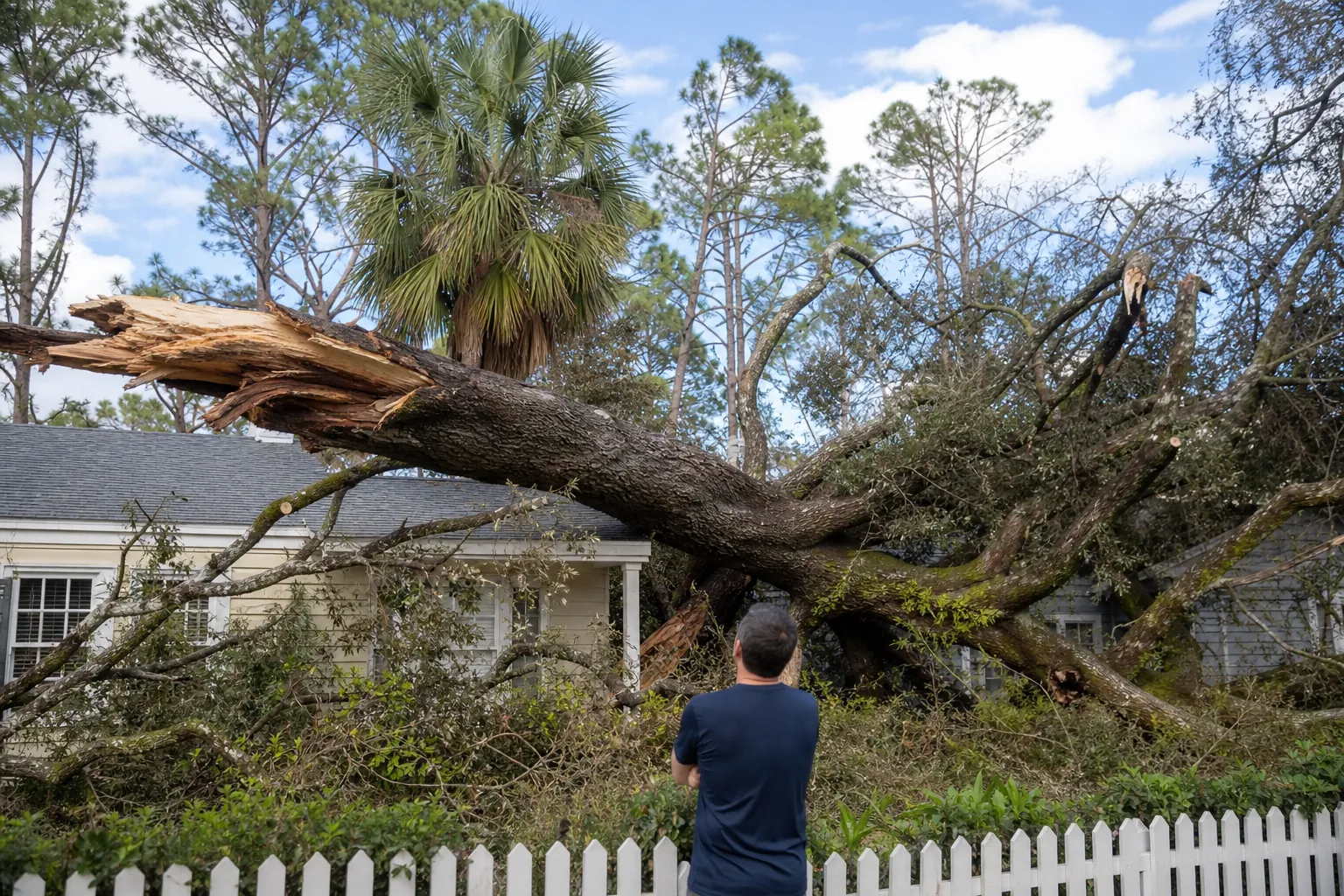
Hurricane lodged trees are whole trees caught in the branches or trunks of other trees. Record both visible trees in your description, rather than describing only the fallen trunk. Distant views can help describe the scene, but they cannot establish stability. Describe each visible trunk and where they appear to touch when you request an assessment.
What makes hurricane lodged trees different from hanging limbs?
A lodged tree has its main trunk caught against another tree. A hanging limb is a broken branch still held above ground. Our guide to hanging limbs after hurricanes explains that separate concern. The storm-damaged tree assessment guide gives broader context for evaluating damage across a whole tree.
The key detail is the path of the main trunk. One tree may lean into a nearby crown, which means its leafy branches. Another may have a broken trunk resting across a fork. In either case, the receiving tree forms part of the scene.
For clear descriptions, call them the lodged tree and the supporting tree. These names explain their roles without judging their strength. An upright trunk and green leaves are visible features, not a complete tree assessment. The UF/IFAS tree-defect guide explains why roots, trunks and branches also need attention.
The lodged tree may still have roots in the ground. It may instead have a broken base or partly lifted roots. These details help define the assessment, but no single detail settles the outcome. A trunk touching the ground may still have other contact points above.
- A whole trunk caught in another crown needs a paired-tree description, even when both crowns remain green.
- A broken branch hanging within one crown belongs to a different damage category than a lodged whole tree.
- Several tangled crowns can hide which trunk belongs to which base, leaving the tree count unclear.
The first goal is to name the problem without trying to solve it. Record uncertainty instead of guessing which tree holds the other's weight. That keeps the description useful when a professional later views the site.
This article focuses on that paired-tree problem, rather than general debris pickup. It does not explain how to cut, pull, or release either tree. Those actions require a site-specific work plan beyond what distant observations can provide.
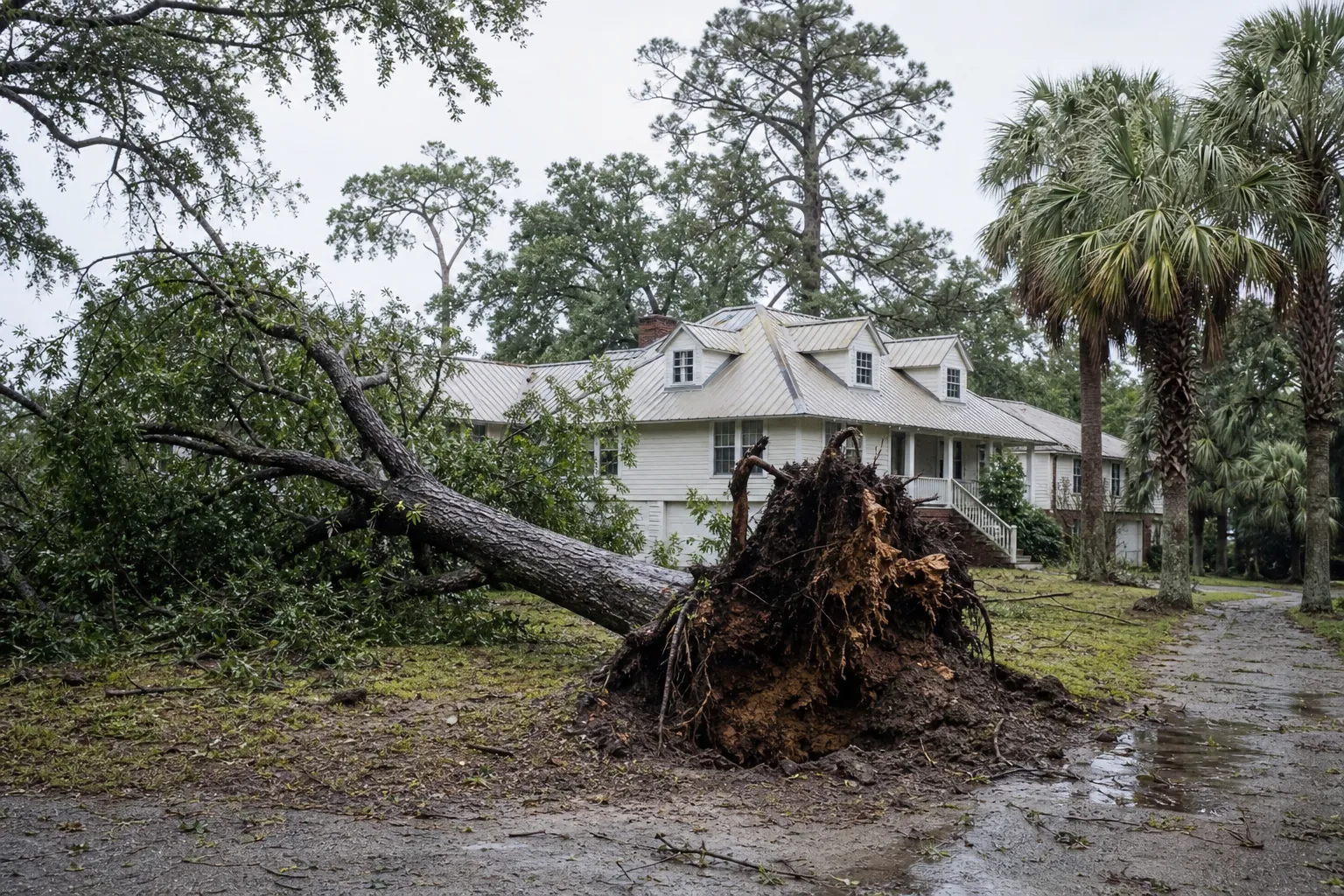
What can you observe without approaching the lodged tree?
Useful observations describe what is visible, where it is, and what remains hidden. They do not rate the trees as stable. The guide to distant yard observations covers viewing limits. Our tree damage records guide helps keep notes clear without turning them into a diagnosis.
Begin with what you can already see from a place away from the trees. A porch is not automatically a suitable viewing point. Its location may put it beside the damaged pair. No photo or article can establish a suitable viewing boundary for every yard.
Before any outdoor observation, follow local instructions and check for broader storm hazards. The National Weather Service's after-hurricane guidance warns about downed wires, fallen objects, and weakened structures. It also says to return after evacuation only when officials say it is safe.
Useful notes describe shapes and locations in plain words. For example, “the smaller trunk rests across the larger tree's fork” states an observation. “The large tree can hold it” makes an unsupported judgment. Keep those two kinds of statements separate.
- Describe which trunk appears lodged and which tree appears to support it, if both are visible.
- Note visible ground changes near either base without approaching to inspect cracks, roots, or soil.
- Record nearby buildings, paths, and wires that appear in the same view as the damaged trees.
- Mark hidden contact points as unknown rather than moving closer to fill gaps in your notes.
A photograph can preserve the view without proving what lies behind it. Branches may overlap in an image even when they do not touch. Depth, trunk size, and gaps are often hard to judge from one angle.
There is no need to collect a complete photo set. If the base or crown cannot be seen from your existing location, leave it undocumented. An honest gap is more useful than a close view gathered by entering the damaged area.
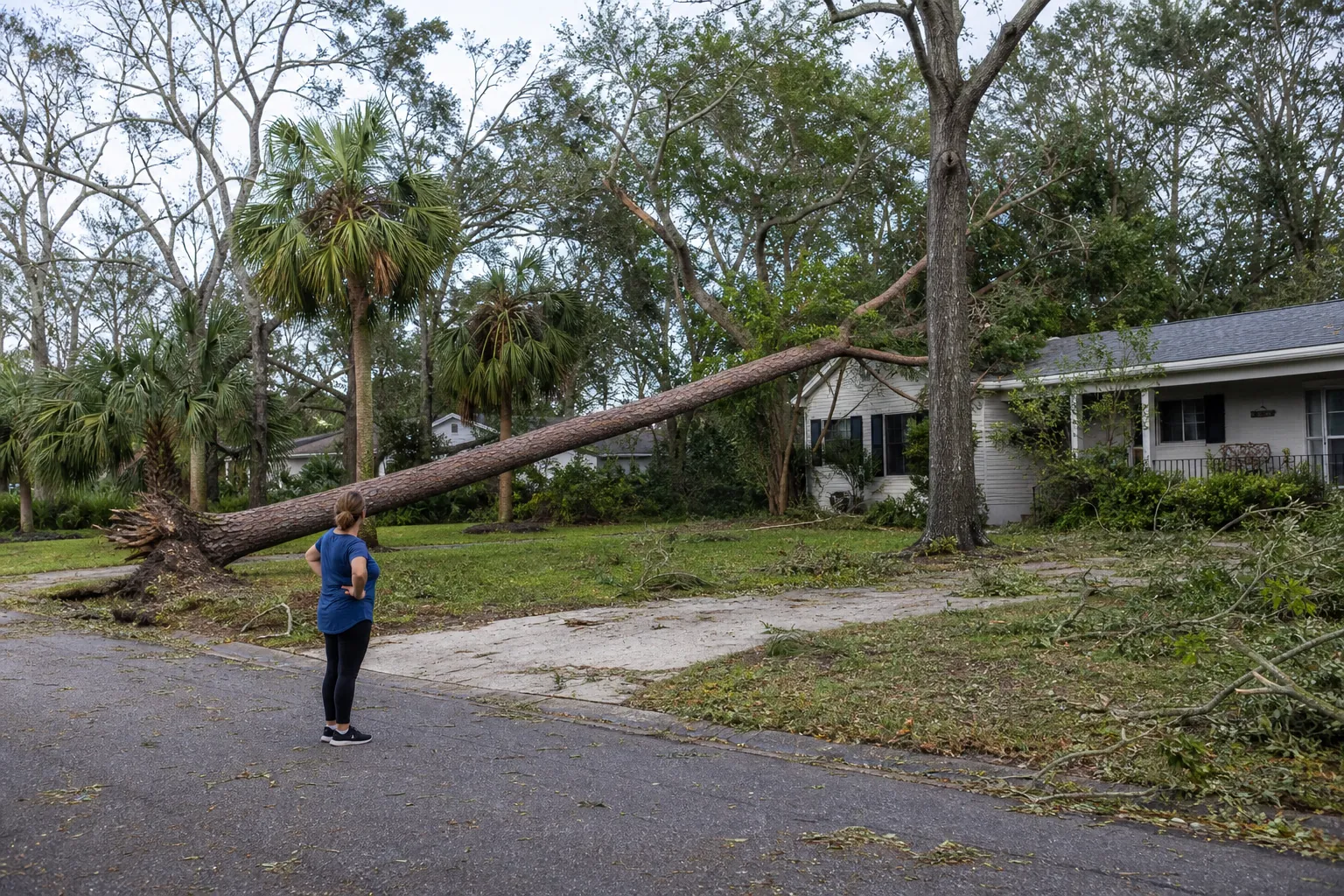
How can you describe both trees for assessment?
Describe both visible trees so your record does not omit part of the scene. Record what you can see without deciding what it means for removal. Our guide to storm damage at tree bases explains one assessment area. The leaning tree guide adds context about changed trunk positions after a storm.
A professional assessment considers each tree from its base through its crown. It also examines where the trees meet. The aim is to understand the damaged pair, including facts that a distant view cannot show. The visible lean is one part of that picture.
For the lodged tree, the assessment may include its roots, trunk breaks, and crown damage. Its remaining connection to the ground matters to the description. A trunk that looks intact from one side may have damage hidden on the other.
For the supporting tree, record visible marks or changes without assigning a cause. The UF/IFAS storm-damage assessment publication explains why qualified evaluation considers roots, trunks and branches. An upright stance alone is not a substitute for that evaluation.
Record any visible raised soil near the base without interpreting the roots beneath it. UF/IFAS notes that soil or mulch can hide root defects. Calling the base “unchanged in this view” is more precise than calling the roots sound.
The contact zone is where one tree rests against the other. There may be several such points across the crowns. The view from the house may show one contact while hiding another. That is why a single clear photo still has limits.
A paired assessment does not mean both trees need the same outcome. The lodged tree and supporting tree may have very different damage. Any decision about keeping either tree needs its own findings. The assessment should explain what is known, what remains uncertain, and what needs another look.
Species and tree size provide context, but they do not replace this review. A large supporting tree can still have damaged parts. A smaller lodged tree can still create a complex contact pattern.
How can a paired-tree worksheet make the scene clearer?
A paired-tree worksheet separates visible facts from questions that need professional assessment. It records each tree on its own, then brings their contact points together. Use the tree call information guide for concise descriptions and the cleanup scope guide for organizing the broader site needs.
The table below is a record format, not an inspection checklist. Complete it only from information you already have. Blank spaces are acceptable. “Not visible” gives a clearer record than an estimate based on leaves, shadows, or a partly blocked view.
| Part of the scene | Distant observation to record | Professional assessment focus |
|---|---|---|
| Lodged tree | Identify the main trunk and its visible position. | Assess the trunk, crown, roots, and remaining attachments. |
| Supporting tree | Describe the tree that appears to receive the lodged trunk. | Assess its own condition and the affected branches or trunk. |
| Contact zone | Record visible touch points and any blocked views. | Examine how the trees meet and where damage is present. |
| Tree bases | Note visible lifted soil or roots without approaching. | Evaluate each base and the limits of the root assessment. |
| Surrounding area | Name nearby paths, buildings, wires, and other trees. | Account for these features in the site-specific work plan. |
Add a simple location label for each tree, such as “near the back fence.” Avoid labels that assume a result, such as “the good tree.” A neutral name remains useful if the assessment finds damage that was hidden from your view.
- Label the lodged tree and supporting tree using fixed yard features visible from your location.
- Write one short statement for each visible feature, keeping guesses out of the record.
- Mark each blocked view as unknown, including any base or contact point hidden by leaves.
- Keep professional findings separate so the final record shows which details were actually assessed.
The worksheet serves as a shared description, not a task to finish outdoors. It can also prevent mix-ups when several trees stand close together. Its value comes from clear labels and honest limits, rather than the number of boxes filled.
What should stay outside routine cleanup while the pair awaits assessment?
A whole tree lodged in another belongs outside routine yard debris work. The paired trees need assessment before nearby cleanup becomes part of a work plan. The guide to stopping DIY storm cleanup explains task limits, while the waiting for tree help guide covers the pause before work begins.
Do not treat the supporting tree as a place to stand beneath or store debris. This article provides no approach distance or release method. Those choices cannot be settled from a general description. Keep the paired-tree problem separate from ordinary raking and pickup plans.
Access is part of that distinction. A clear patch of grass beneath tangled crowns does not establish a suitable work area. Likewise, reaching a shed through the trees is different from seeing the shed from the house. A visible route is not a professional assessment.
Other storm hazards may rule out outdoor activity altogether. Ready.gov's hurricane guidance says not to wade in floodwater or touch wet electrical equipment. It explains that floodwater can contain dangerous debris and can become electrically charged by power lines.
- Leave tree cutting, pulling, and release decisions out of household cleanup plans for the lodged pair.
- Keep children out of disaster cleanup work, as directed by Ready.gov's after-hurricane guidance.
- Describe any visible wires when seeking help, without approaching them to identify their type.
If wires are involved, the scene needs attention beyond tree work alone. The National Weather Service warns about downed electrical wires after hurricanes. Do not use a tree photograph to decide that a line is harmless or disconnected.
Waiting also means accepting gaps in the cleanup plan. Furniture, tools, or loose debris may remain where they are for now. Their presence does not change the need to assess the trees first. A complete yard cleanup is a later goal, not the first measure of progress.
What should the assessment explain before cleanup moves forward?
The assessment should distinguish the condition of each tree from the plan for handling debris. It should also state what remains uncertain. Our guide to preparing for a tree visit covers site information. The later yard recheck guide explains why follow-up observations deserve a separate place in recovery.
A useful summary identifies both trees and describes their visible damage. It explains how their contact affects the work scope. It should distinguish findings made on site from details still hidden. Clear limits help prevent a partial view from becoming a broad conclusion.
Include the supporting tree in your description and ask what findings or unresolved questions apply to it. Record the response without assuming that removing the lodged tree establishes the remaining tree's condition. Nor does removing the lodged tree, by itself, explain the supporting tree's long-term condition.
Cleanup scope can then be described in plain stages without giving release instructions. Handling the lodged pair, managing loose debris, and reviewing retained trees are different tasks. Combining them under “clean up the yard” can hide important gaps in the plan.
Any follow-up notes should name the tree and the feature being tracked. A general instruction to “watch the yard” is less useful. The point is to preserve clear information, not ask the homeowner to test the tree or confirm its strength.
If later views show a change, keep that observation separate from earlier findings. A fresh split, changed trunk position, or different contact point deserves a new description. Do not treat an earlier photograph as proof of the present condition.
For Pensacola homeowners, the practical goal is a clear handoff from observation to assessment. You describe what is visible without approaching to fill gaps. The professional evaluates the paired trees and defines the work. This division keeps a useful record without turning it into DIY tree work.
This is educational Pensacola guidance, not a statement of local crew availability. Florida Foliage is headquartered in Daytona Beach.
Is a lodged tree the same as a leaning tree?
No. A leaning tree tilts, but it may not touch another tree. A lodged tree is caught against another tree's trunk or branches. The two conditions can occur together. Describe the contact as well as the lean so the assessment includes both trees.
Can a green supporting tree still need assessment?
Yes. Record green leaves as one visible feature without treating them as an assessment of strength. The UF/IFAS tree-defect guide also considers roots, trunks and structural branches. Include the supporting tree in your description and leave conclusions about its condition to qualified assessment.
Can photos show that the lodged pair is stable?
No. Photos can help identify the trees and show visible contact points. They cannot establish stability or reveal every hidden defect. A clear image still leaves gaps around roots, trunk surfaces, and overlapping branches. Professional assessment must account for those limits.
What if the lodged tree still has roots in the ground?
That detail belongs in the description, but it does not settle the assessment. The roots may be partly visible, partly hidden, or disturbed. The trunk and crown still need review, along with the supporting tree. Do not test the attachment by pushing or pulling.
Does assessing both trees mean both will be removed?
No. A paired assessment considers each tree's condition and their contact points. It does not assume the same outcome for both. The findings may support different plans for each tree. Any retained tree needs its own clear assessment rather than a conclusion based on appearance alone.
Call (386) 481-7913 to request an estimate.
AI helped draft this article and create its images. The text offers general guidance; it cannot establish the condition of a tree or work area.
Call (386) 481-7913 to talk through next steps.